Uncategorised3 min(s) read
uncategorised3 min(s) read
1. The bigfin squid
This is one of the most obscure squids alive in the ocean. It was videotaped for the first time in 1988, but clear footage did not become available until 2001. It was unique among the cephalopods, with two enormous fins like wide elephant ears, and a series of extremely long spindling legs like spaghetti noodles.
It truly looks alien. Not much is known about it, either. Some scientists believe it feeds by raking its insanely long tentacles along the sea floor, but nobody is certain. They can be up to 23 feet long, and live in the deep dark of the sea, below 4,000 feet.
2. The peacock mantis shrimp
This cute, kaleidoscopic shrimp is beautiful but terrifying. Their eyes are better than a human being's, seeing over ten times more color than us, along with ultraviolet light. They can also kick your butt. Or, box you out. Their punches move at insane speeds of 50 miles per hour. That's right, little 7-inch shrimp can punch harder than you. Getting punched by this shrimp is like getting shot with a .22 caliber handgun. Absolutely mad.
Crazy to think that you could get beat up by a shrimp, isn't it? This beautiful little creature lives in the warm waters around Africa and India, and it isn't even rare. You could keep one as a pet, just as long as you buy bulletproof glass to house it in.
3. Giant Isopod
Our next creature looks like a pillbug, but is in fact a gigantic crustacean that lives buried deep in the mud at the bottom of the ocean. Certain deep sea creatures grow to be enormous, such as squids and tube worms, and this giant is no exception. Some can get up to two feet long, and they eat meat as well. They'll eat fish, including dogfish sharks. They're also crazy tough - one giant isopod in captivity went 5 years without eating a single time.
4. The mimic octopus
This octopus, only discovered in 1998, doesn't just copy the color of its surroundings - it can copy the color and shape of any fish that swims near it. Its body is insanely flexible, so it can twist itself into crazy shapes and appear invisible amongst schools of fish, or mimic the appearance of a poisonous lionfish to ward off predators. They are extremely intelligent, and this video speaks for itself:
5. The frilled shark
Another deep-sea monster, this shark lives in depths of well over 4,000 feet, and has a mouth filled with 26 rows of teeth, perfect for eating octopus and small fish. It looks like an eel mixed with a prehistoric monster, and has been found in Australia and Japan. They can be about 6 feet long, and they often die outside of the dark deep ocean, though some have been kept alive in shallow waters for a short time. They're very rare, and take up to three years to give birth to children. I hope they won't die out in our lifetime.
What other insanely unique and creative creatures exist in our world's oceans? Only time will tell. But there are certainly thousands of species out there waiting to be discovered. Feels adventurous, doesn't it?stories1 min(s) read
Scientists working in the Antarctic have discovered a creature "like nothing seen before" 3,500 meters under the ice.
Expedition Antarctica set off on a 50-day exhibition of the Southern Ocean to learn more about its seabed earlier this year, and it's safe to say that their efforts have not been vain.
They shared their journey on YouTube in a documentary entitled, The Secrets of Antarctica, which reveals everything they've discovered so far:
[[youtubewidget||https://www.youtube.com/watch?time_continue=2606&v=sbYX4Lur4Yc]]
However, one discovery stood out more than most: a strange creature that has yet to be named.
The narrator explained: "Having braved ice storms, broken equipment and rough seas for almost two months, the team braces itself for the most high-pressured assignment of them all.
"They will delve 3,500 meters into the abyssal plain, a depth almost as high as the Swiss Alps.
"It will endure 300 times more pressure than we experience every day.
"Suddenly the abyssal plain reveals itself, it looks barren, like the surface of Mars, but a closer look reveals life that no one has ever witnessed in Antarctica at all."
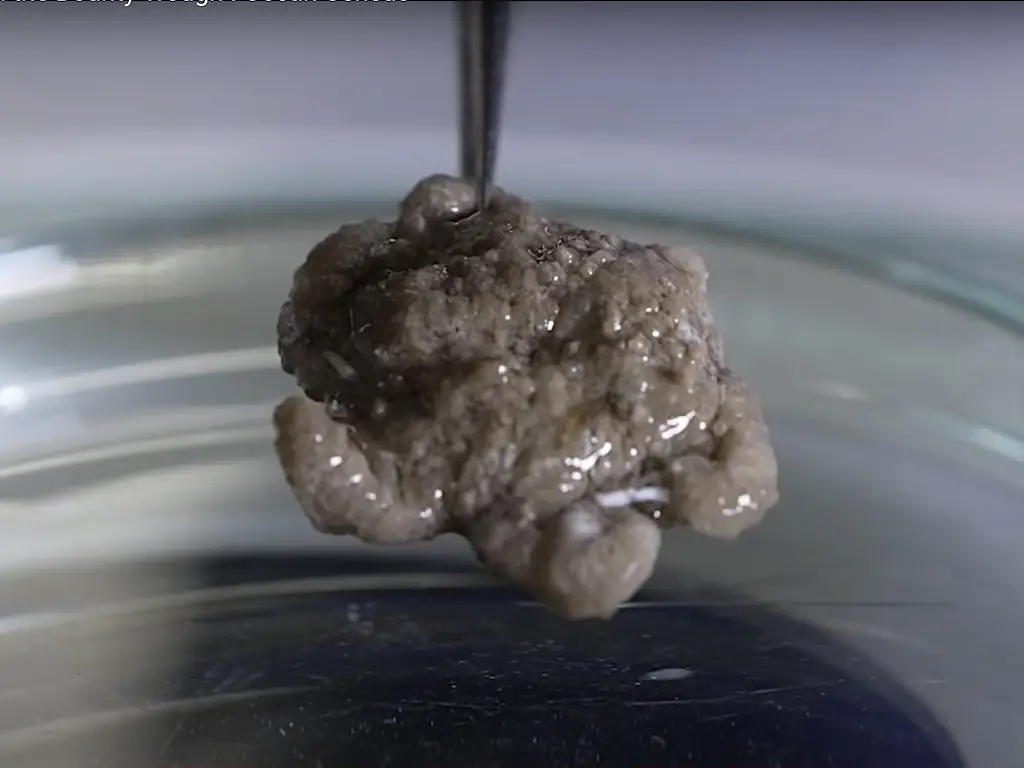
Desperate to examine this life, the scientists put down a fishing net to this extraordinary depth and this creature is what they recovered.
The narrator continued: "The team take the opportunity to trawl the bottom, having set up more than 5,000 of cable into the sea.
"The beam trawl finally comes aboard at 2:00 am and, after six hours of waiting, the team gets its reward. 12 buckets of mud and one single fish.
"But in this mud lies many delectable delights like this sea cucumber. Then Kareen [Schnabel] finds an even more curious specimen."
Recounting how exciting the discovery was, Dr. Schnalbel, a marine biologist at the National Institute of Water and Atmospheric Research in New Zealand, said: "It has something quite interesting at the front which sort of likened it to a hippopotamus.
"We don't know how many are down there, we don't know how common this is.
"But I have never seen anything like this before."
To put how far down 3,500 meters is into context, that's a depth as high as the Swiss Alps.
science & tech3 min(s) read
Scientists have made a stunning discovery after they uncovered 100 new species off of the coast of New Zealand and an entirely new life form.
The Ocean Census, launched last April, has set an ambitious goal to identify 100,000 unknown species within the next decade, aiming to shed light on the mysteries lurking in the ocean depths, as reported by CNN.
During a three-week expedition in February aboard the research vessel Tangaroa, the team collected nearly 1,800 samples from depths as far down as three miles below the surface.
The team employed various types of sleds modified for different terrains, including a beam trawl, a seamount sled, and a specialized device for sampling just above the seafloor.
Regarding the incredible new find, the researchers mistook it for a sea star or sea anemone, though those working along the expansive 500-mile-long Bounty Trough now speculate it might be an entirely new species of deep-sea coral.
Dr. Michela Mitchell, a taxonomist at the Queensland Museum Network, expressed her excitement, stating: "Even more excitingly, it could be a whole new group outside of the octocoral. If it is, that is a significant find for the deep sea and gives us a much clearer picture of the planet’s unique biodiversity."
The discovery has left scientists scratching their heads. "It is still a mystery. We can’t even describe it to family. We don’t know where it is in the tree (of life) as of yet, so that’ll be interesting," said Dr. Daniel Moore of the Ocean Census.
"It was true exploration, very exciting," Moore exclaimed.
In addition to the potentially groundbreaking discovery of the deep-sea coral, the team also encountered a new species of fish, identified as an eelpout.
"The eelpout was instantly recognized as being different from the others," Moore explained.
Commenting on the rarity of discovering new vertebrates, Moore stated: "Finding new vertebrates is rare. There are hundreds of thousands of invertebrates in the sea that we still don’t know. Vertebrates, we like to think that we know what’s out there, but the reality is, we just don’t."
Despite these remarkable discoveries, the vast majority of the ocean remains unexplored. According to the Ocean Census, of the estimated 2.2 million species believed to inhabit its watery depths, only about 240,000 have been cataloged by scientists.
This isn't the only recent remarkable discovery, as a group led by Dr. Javier Sellanes of the Universidad Católica del Norte off the coast of Chile believes they've discovered over 100 new species.
Dr. Javier Sellanes told Schmidt Ocean: "We far exceeded our hopes on this expedition. You always expect to find new species in these remote and poorly explored areas, but the amount we found, especially for some groups like sponges, is mind-blowing.
"These thriving and healthy ecosystems indicate that the Nazca-Desventuradas and Juan Fernández Marine Parks effectively protect delicate marine habitats."
Who knows what sea creatures are lurking down there... it's no wonder some people have a fear of the ocean!
uncategorised3 min(s) read
weird3 min(s) read
A man has posted an incredibly terrifying image of a bizarre sea creature, and it's reminding people of the movie Teeth.
Let's be honest, the ocean is a place full of known creatures that the vast majority of us would probably cry if we met face to face.
Considering that a large number of the world's oceans are unexplored, it stands a fair chance there are so many species out there that we have never, and probably will never encounter.
While this is arguably for the best, that doesn't stop the occasional creature popping up from time to time that leaves people startled.
With that in mind, it shouldn't come as a surprise that a horrendous worm-like critter with giant teeth has been photographed and posted on Instagram...
Craig Evans, behind the Instagram account @costal_foraging_with_craig, shared the snap much to the horror of many viewers.
He wrote: "I found this dead 'Sea Lamprey' while fishing for sea trout in a West Wales river. These wonders of nature spawn in freshwater, feed on tiny algae and microorganisms until they migrate to sea to prey on larger fish.
"It's fearsome mouth attaches itself to the side of the fish and sucks it blood etc. This one was around 2ft in length and weighed around a Kilo."
A two-foot sea monster that sucks blood out of poor unsuspecting marine life sounds like something out of a horror movie, right?
Craig concluded: "I was fortunate enough to stand over a number of these spawning in fast flowing water about a foot deep. After spawning in June they all die. I've seen many of these over the years and the only mammal that eats them are otters and then only [the] last few inches of its tail. These ancient species of jawless fish are a sign of a healthy ecosystem."
Regardless of these creatures having a part to play in the circle of life, that didn't stop people from sharing their utter horror.
One comment compared it to the movie Teeth, which centers around a woman whose vagina has teeth, and you can tell where it goes from there... the comment read: "Reminds me of the film... Teeth."
Another horrified viewer said: "That’s my nightmares sorted for tonight then," while a third person said: "What in the devilish nightmare of hell is this!?!"
The horror being shared seems pretty understandable, though other comments suggested that these creatures can be eaten. Each to their own I guess.