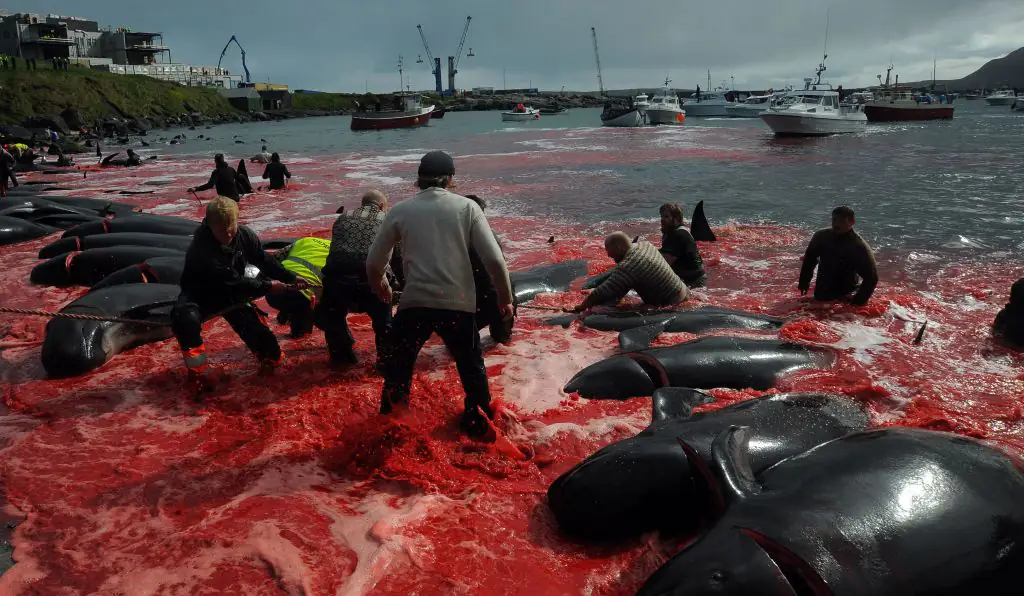
Fishermen in the Faroe Island have continued their horrifying annual tradition of slaughtering whales, turning the sea red with their blood.
On the shore of Torshavn, the capital city of the Faroe Islands, Pilot whales were driven toward waiting hunters, beginning the annual slaughter. So far, up to 150 pilot whales as well as 20 white-sided dolphins have already been killed, and since the beginning of this year, an estimated 500 of the animals had been killed "for food".
[[imagecaption|| Credit: Getty]]
This comes via the Blue Planet Society, who gave followers these statistics via Facebook post, urging readers to sign a petition to stop the whales being slaughtered, arguing they are protected under EU law (the Faroe Islands are part of the kingdom of Denmark).
"More than 100,000 dolphins and small whales are hunted and killed every year. Most hunts are unregulated, illegal and unsustainable with unknown impacts on populations," says a statement on Change.org, written by Blue Planet Society founder John Hourston.
"I founded Blue Planet Society to conserve our amazing marine wildlife - and I'm determined to help save dolphins and small whales. I'm urging Shinzo Abe, Prime Minister of Japan, and Aksel V. Johannesen, Prime Minister of the Faroe Islands, to stop the hunt of dolphins and small whales."
[[imagecaption|| Credit: Getty]]
According to Sea Shepherd UK, this particular brand of hunting is especially brutal. The whales are lured to the shore where blunt hooks are beaten into their blowholes, and they're dragged onto land and their spinal cords sliced.
But the Faroe Islands are sticking by their traditions; the official tourism page says that whaling in the Faroe islands is something they've done for "a century".
"The Faroese have eaten pilot whale meat and blubber since they first settled the islands over a century ago. Today, as in times past, the whale drive is a community activity open to all, while also well organised on a community level and regulated by national laws.
"Records of all pilot whale hunts have been kept since 1584 and the practice is deemed sustainable, as there an estimated 778,000 whale in the eastern North Atlantic region. Approximately 100,000 swim close to the Faroe Islands, and the Faroese hunt an average 800 pilot whales annually."
[[imagecaption|| Credit: Getty]]
"The meat and blubber from the hunt is distributed equally among those who have participated," added Visit Faroe Islands.
For decades, whaling has been a controversial practice that is banned in many countries on account of it putting entire species at the risk of extinction. Despite this, many places still permit the activity - partly for research purposes, but also because whale meat tends to be a huge moneymaker for tourist industries.
In Iceland, hunting whales has been banned and re-legalised a number of times with varying regulations, and it is currently legal there - contrary to the rules that the IWC (International Whaling Commission) has tried to implement.
New outrage over the practice has emerged today, however, as it transpired that whalers in Iceland have killed what appears to be a blue whale: a species that has not been deliberately slaughtered since 1978.
However, the owner of the company responsible for butchering the animal, Kristjan Loftsson, has denied the allegations that the creature is a blue whale. He is claiming that it is either a fin whale or a hybrid of the two species - neither of which are protected under current laws in Iceland.
"I am absolutely confident that it's a hybrid," he said. "To mistake a blue whale for a fin whale is impossible, this whale has all the characterisations of a fin whale in the ocean. There are a lot of blue whales off the Iceland coast, when we see the blows and sail to it, and we realise it is a blue and then we leave it and go and look for fin whales."
On the contrary, Arne Feuerhahn - who is part of the campaign group Hard to Port, which publicised this recent killing - says that nobody can be sure either way at this point.
"We cannot confirm 100 per cent," she said. "We have consulted a lot of international experts, most think that it is a juvenile male blue whale but there also has been some doubts with some believing that it could be a hybrid between a blue and a fin whale."
Even so, some other experts are already confidently stating that this is definitely a pure breed blue whale.
Paul Watson, who founded a marine conservation group called Sea Shepherd, has stated with certainty: "I know a blue whale when I see one and this whale slaughtered by Kristjan Loftsson is a blue whale." He continued: "This man must be stopped from ruthlessly violating international conservation law and bringing such disrepute to the nation of Iceland. There can be no legal justification for this."
The country's official stance is currently that the whale is of an undetermined species.
"While initial information suggests that the animal in question was not a blue whale, we take these reports seriously and the relevant authorities are investigating this matter with all urgency," said Kristján Thor Juliusson, Iceland's Minister of Agriculture and Fisheries.
"At present, Icelandic authorities are not in a position to confirm the species, although initial information from the directorate of fisheries in Iceland suggests the animal caught is not likely to be a blue whale but rather a hybrid of a fin whale and a blue whale."
A confirmation will only be possible once a DNA taste has been conducted.
A video has emerged showing a pod of dolphins swimming closely together for comfort and reassurance, before being slaughtered by Japanese whalers. The footage, which was shot in a cove near the town of Taiji, was released by US-based charity, Dolphin Project.
In an article accompanying the video, Dolphin Project revealed that a group of captured pilot whales could be seen swimming in a slow circle, as the matriarch rubbed ''up against members of her family'' in order to provide moral support. Of the group, eight were ultimately selected to be taken into captivity, while the remaining majority were slaughtered.
A member of the charity and alleged eye-witness to the event wrote:
“Exhausted and traumatized, the family surfaced and spy hopped as they caught their breath. Once the nets were dropped and their fate was sealed, they swam in a tight circle, always touching one another. Their beautiful matriarch could be also be seen swimming around them, always rubbing up against members of her family. Without food or shelter, hunters left the family alone overnight.”
Short-finned pilot whales are a predominantly oceanic species and are one of the largest known species of dolphin, growing up to seven metres in length. Capable of diving to depths of over 600 metres, they are ordinarily found in open sea, but will occasionally head in-shore to forage.
The shocking incident took place at a location known as the Cove - made infamous after the 2009 documentary feature of the same name. Every year, thousands of cetaceans are herded into the large, shallow bay, before being penned in and ultimately killed by fishermen. The hunting season lasts from September through to February, with hunting permitted providing that you have a license.
Two pink dolphins were recently spotted in a Louisiana river:
Despite signing up to the International Whaling Commission in 1987, Japan announced the controversial decision to once again resume commercial whaling in July this year. Though this has attracted significant criticism from many members of the international community, the MailOnline reports that the Japanese Fisheries Agency has authorised fishermen to kill or capture around 16,000 cetaceans annually.
If you've ever seen that horrible final episode of Blue Planet II, where albatross parents feed their baby birds plastic and a beautiful turtle gets caught up in a rogue bag, then you'll already know that humans are inadvertently doing some pretty terrible things to the world's oceans right now. Last year, we managed to dump an estimated 8 million tonnes of plastic into our waters - and while this may seem like a huge amount in itself, a recent report has predicted that the amount of litter in the sea could triple within a decade unless something drastic is done.
Now, the horrific real life side-effects of this plastic pollution have been brought to life once more in a series of heartbreaking images that have emerged from Thailand, showing a pilot whale who died after mistakenly ingesting up to 80 plastic bags.
The whale was first discovered ill in a canal near the country's border with Malaysia, according to Thailand's Department of Marine and Coastal Resources. Good samaritans used buoys to keep the animal afloat and an umbrella to shield it from the sun; after receiving treatment from veterinarians, the whale was stabilised and managed to bring up five plastic bags.
However, the whale's condition later deteriorated and it passed away. It was during the autopsy that scientists discovered the mass of plastic bags, weighing up to 8kg (17lbs), which the Department's head believes it had mistaken for food. While the whales usually feed on squid, they do eat octopus and smaller fish when necessary. In images posted on the Department of Marine and Coastal Resources' website, it is clear that the bags cover most of the room's floor.
Speaking after the event, Jatuporn Buruspat, head of the department, told Reuters that they would be using the case to raise awareness of the environmental impact of plastic pollution ahead of World Oceans Day on June 8: "We will use the whale case and invite all sectors to show their intentions on how to reduce the use of plastic in Thailand". In 2017, a report by Ocean Conservancy listed Thailand as one of five countries - alongside China, Indonesia, Philippines and Vietnam - who dump more plastic into the ocean than all other nations combined.
But the depressing truth is that there is still so much more to be done, because as horrible as this story may be, there are still thousands more animals killed by plastic waste every day whose stories you'll never even read about.
Last week, the body of a sperm whale washed up on the shores of Sardinia, Italy.
The mammal, measuring eight metres (26.2 feet) long, was transferred by local fire brigades to a research facility, where veterinarians and researchers from Sassari and the University of Padua discovered that she was pregnant and, perhaps even more tragically, had died with 22 kg (49 lbs) of litter in her stomach.
"It was dramatic to find the fetus ... we felt bad already at that point," recalled Mattia Leone, a marine biologist who was present for the post-mortem exam. "But then when we opened the stomach and saw all the plastic, we realised, yet again, we were bearing witness to this very worrisome, sad situation."
It is not clear yet whether or not the plastic in her stomach was instrumental in the whale's death, but it almost certainly contributed to the malnourishment and demise of her calf.
Luca Bittau, the president of the SEAME (Scientific Education and Activities in the Marine Environment) group, told CNN that the poor creature's stomach contained "garbage bags ... fishing nets, lines, tubes, the bag of a washing machine liquid still identifiable, with brand and barcode ... and other objects no longer identifiable".
"She was pregnant and had almost certainly aborted before (she) beached," he said. "The foetus was in an advanced state of composition."
"This spermwhale was found dead in porto cervo in Sardinia: in the belly she had a fetus and 22 kg of plastic... are there still people who say these are not important problems?" Sergio Costa, Italy's environment minister, wrote on Facebook. "For me yes, and they are priority."
"Marine Litter (the waste at sea) affects all marine life, not only Italy, of course, but every country in the world has the duty to apply policies to fight it. We have used in a carefree way the 'comfort' of disposables in recent years, and today we are paying the consequences - indeed, especially the animals."
According to a WWF study released last year, more than 95 percent of the waste in the Mediterranean Sea and on its beaches is made of plastic. Waste levels in tourist areas - such as Sardinia - are especially bad, as litter left by visitors (combined with poor local environmental management) is to blame.
The area where the whale was discovered is quite a popular tourist spot, as there is a rich marine life presence around 20 miles or so off the Sardinian coast. Known as the Caprera Canyon, the area is home to many species of whales and three different species of dolphin.
Unfortunately, if incidents like this recent one continue, we may cease to see areas like this. In fact, if we do not act soon, we may eventually wipe out all ocean life entirely.
Leone disclosed that SEAME wants to preserve this whale's skeleton in order to educate others on the impact that people are having on the ocean, and to raise awareness on the impact that plastic and other waste is having on wildlife in our seas and oceans.
"Reduce, reuse, recycle," come the cries of the eco-warriors. However, while taking a firm stance on environmental issues is still stigmatised, the effects of humankind's lax attitude towards the planet is manifesting itself in ever more concerning ways.
A sperm whale, one of the largest animals on the planet, is likely to have been defeated by the 1,000 pieces of plastic trash in its stomach. Washed ashore in an Indonesian national park, the carcass was assessed by researchers who discovered almost six kilos of plastic in its stomach.
Items discovered included 115 drinking cups, four plastic bottles, 25 plastic bags and two flip-flops. The 9.5m (31ft) creature was found near Kapota Island in the Wakatobi National Park late on Monday. The whale had to be buried without a necropsy due to its decayed condition but it's thought that the plastics in its stomach could be responsible for its death.
Zach Abraham, Director of Global Campaigns at WWF International, told VT: "This devastating discovery is a painful reminder of the impact that plastic pollution is having in our oceans and the damage it is causing to marine life. Governments and businesses must do more to prevent plastic from entering our rivers and oceans."
Last year, in addition to the news that we now cannot reverse climate change simply by planting trees, it was also reported that marine ecosystems are facing "irreparable damage". Stating that we are not in a position to fully heal our oceans might seem like a pessimistic approach. However, considering 10 million tonnes of plastic waste ends up in the world's oceans every year, it's not hard to see how the UN came to this conclusion.
In fact, in March, it was reported that a study by Foresight Future of the Sea Report had found that ocean plastic could triple in the next decade. Three months later, a pilot whale died off the southern coast of Thailand having swallowed 80 plastic bags."If nature had a distress signal to warn us that it can't take any more of our plastic rubbish," Greenpeace stated in a press release, "it would look like this - a dead whale with 1,000 pieces of plastic in its stomach. Our throwaway culture has turned whales' guts into dustbins for our plastic waste. And the global plastic contamination doesn't end there - this material is already in the food we eat, the water we drink, and inevitably in our bodies too. It's clear that we can't go on like this."
According to a German study, the majority of the plastics in the ocean come from just 10 major rivers - the Yangtze, the Indus, Yellow River, Hai River, the Nile, the Ganges, Pearl River, Amur River, the Niger, and the Mekong (in that order).There exists a clear cultural and corporate divide between east and west, with five Asian countries - China, Indonesia, the Philippines, Vietnam and Thailand - responsible for more than half of the plastic waste that ends up in our oceans. This is according to a report published in 2015 by Ocean Conservancy and the McKinsey Center for Business and Environment.
In a tweet by WWF-Indonesia, they explain just what the carcass contained: "Hard plastic (19 pieces, 140g), plastic bottles (4 pieces, 150g), plastic bags (25 pieces, 260g), flip-flops (2 pieces, 270g), pieces of string (3.26kg) & plastic cups (115 pieces, 750g)."
“This discovery is deeply upsetting," Dwi Suprapti, WWF-Indonesia Marine Species Specialist, told VT. "It is a wake-up call for Indonesians about how plastic pollution is causing irreparable damage to our oceans and marine life. We urge businesses and governments to work together to address this issue urgently to prevent further plastic leakage into our oceans."
However, there are wider implications for those who eat meat and fish. While cups and flip-flops are - of course - a huge problem, there are also 51 trillion microplastic particles in the ocean. In many cases, plastic pellets are lost before they have a chance to be manufactured into something. Often ending up in drains, streams or bags of trash destined for landfill, they regularly make their way into the ocean.
Other microplastics can be found in toothpastes, facewash and cleaning items. That said, the items in the ocean which are visibly affecting wildlife - such as carrier bags - are also eventually broken down into microplastics.
Due to the cyclical nature of the food chain, these plastics then end right back where they started - with the humans. Because of the sheer quantity of meat and fish we eat, we ingest far more microplastics than any restaurant or supermarket would have you believe.
However, as well as meat and fish products, microplastics have also been found in honey, beer and sea salt. In fact, due to the erosion of the bottle itself, bottled water may contain up to 241 microplastic particles per litre.
"If we want to stop this slow-motion environmental disaster unfolding before our eyes," Greenpeace continue, "we need to immediately start cutting the amount of throwaway plastic we produce. The change needs to take place at the source: in the supermarket aisles where so much plastic packaging is sold and in the production lines of consumer giants like Coke, Nestle and others, where our plastic problem originates."
Eating up to one tonne of food per day, sperm whales are especially at risk of ingesting plastics and are considered a vulnerable species by the IUCN (International Union for Conservation of Nature). However, living for up to 70 years and having the largest brain of any animal to have ever existed, sperm whales are in a unique position to observe the damage that the two-legged land creatures are doing to their home.
In one minute, you can take part in this Greenpeace campaign and urge major corporations to rethink their relationship with plastic.