Now that we're in the middle of a global pandemic, it's more tempting than ever to take a step back from civilization and the norm of your day-to-day life (well, what's left of it).
And it turns out that there's an opportunity that could allow you to do just that, as Barbados is inviting people to come and work remotely on the island for a year.
The Caribbean island is looking for remote workers to boost its economy as part of its new "Barbados Welcome Stamp" scheme.
These penguins also got a welcome change of scene during the pandemic:
The scheme is allowing visitors to come to the picturesque island and work remotely during a 12-month period, where they will be free to come and go as they please.
Prime Minister Mia Mottley proposed the scheme because of the devastating effect that the coronavirus pandemic has had on Barbados' economy, which is heavily reliant on tourism.
[[imagecaption|| Credit: PA Images]]
According to the Barbados Government Information Service website, Mottley said: "You don't need to work in Europe, or the US or Latin America if you can come here and work for a couple [of] months at a time; go back and come back.
"The government is committed to working with you on the promotion of new concepts like the 12-month Barbados Welcome Stamp, being able to open our borders to persons traveling and making it as hospitable as ever for all of us, and making it available for Barbadians from every walk of life to believe that for special occasions, or just for so, that they can come out and be a part of this wonderful exercise."
[[imagecaption|| Credit: PA Images]]
However, if, like me, you're working from home for the foreseeable future and like the idea of doing so with golden sand between your toes, it's worth noting that the scheme hasn't been finalized yet, and Mottley didn't say when she expected it to be operational.
Barbados will be open to international visitors from July 12, but visitors will have to wear a facemask and provide a negative Covid-19 test result, per Travel and Leisure.
Elena Manighetti and Ryan Osborne quit their jobs in 2017, bought a boat, and decided to travel the world. As a result, it was only until recently that they were totally oblivious about the ongoing coronavirus pandemic that has shaken the world.
Per BBC News, this was all because they said goodbye to their families and friends with one cardinal rule: do not contact us with any bad news.
The couple, who had previously lived in Manchester, England, were making their way across the Atlantic Ocean to the Canary Islands to the Caribbean last month, completely oblivious to the fact that the deadly coronavirus was rapidly spreading around the world.
Dr. Anthony Fauci warns the coronavirus will "get worse before it gets better":
Then, in mid-March, after 25 days at sea, the couple discovered the extent of the problem when they docked on a small island. This happened before they docked when a phone signal told them that the island's borders closed because of a global pandemic.
In an interview with the BBC, Elena said: "In February we'd heard there was a virus in China, but with the limited information we had we figured by the time we got to the Caribbean in 25 days it would all be over.
"When we arrived we realized it wasn't over, and the whole world had been infected," added Ryan.
Elena, whose family are from Lombardy, Italy's worst-hit region, said: "We told our shore contacts we didn't want to hear any bad news, which was a difficult job as it was pretty bad news."
"We first attempted to land in one of the French territories in the Caribbean but when we arrived we found all the borders were closed and the islands were closing down," Ryan said.
"Even at that point, we assumed it was a preventative measure due to the high season. We thought the islands didn't want to run the risk of a few tourists infecting the locals."
The couple decided to reroute to Grenada, and while at sea, they eventually found a spot where their 4G signal became strong enough to discover the extent of what was happening.
Elena said: "A friend of ours was already in Saint Vincent, which is where we were aiming to head. We managed to get in contact with her 10 hours before we were due to dock.
"She told us we were going to be refused entry as I'm an Italian citizen, even though I hadn't been to Italy in months."
Thankfully, the couple had been tracking their movements via GPS. It proved not only their travel history but that they had been in isolation for 25 days at sea.
As a result, they were finally able to step back onto dry land. But the couple struggled when they discovered how badly their families had been affected by the virus.
"My hometown is in the Italian region of Lombardy which has been one of the worst affected in the world," Elena said. "Ryan and I hadn't realized how it had affected our families until we docked and I managed to call my dad.
"It was a hard conversation. He told me to not panic but our town had been one of the worst affected areas globally. He sent me a New York Times profile on our hometown, which made it all feel suddenly real. I was shocked.
"It's a very macabre picture at home, there are no more coffins, no more cemetery space or room in the crematorium. My family is thankfully safe at home and have been in lockdown for over six weeks, but people we've known for years have died."
For now, the couple is safely sheltering in Bequia, Saint Vincent, but are worried about how long they can realistically stay in the area.
"We don't want to leave Saint Vincent for now as nowhere is open," says Elena. "We're sitting tight for the time being with the aim of getting out before hurricane season starts at the beginning of June."
The couple hopes to continue exploring the Caribbean by traveling north, however, for the time being, their plans look uncertain.
She added: "We're sandwiched between the hurricane season and the virus."
A boss has sparked a debate on social media after sharing his response to an employee requesting to work from another country.
Remote working became the new norm after Covid-19 as managers were forced to implement changes to allow employees to be safe during the height of the pandemic.
As it's been four years since the world temporarily shut down, some employers are happy for workers to continue completing tasks away from the office, while others are desperate for them to return to their desks.
One boss left many people divided after taking to LinkedIn to reveal that he doesn’t care where his employees work from.
Check out the now-deleted post below:
Hunt shared a now-deleted post on the social media platform. Credit: LinkedIn
Tom Hunt is the CEO of Fame, a B2B podcast company based in the United Kingdom.
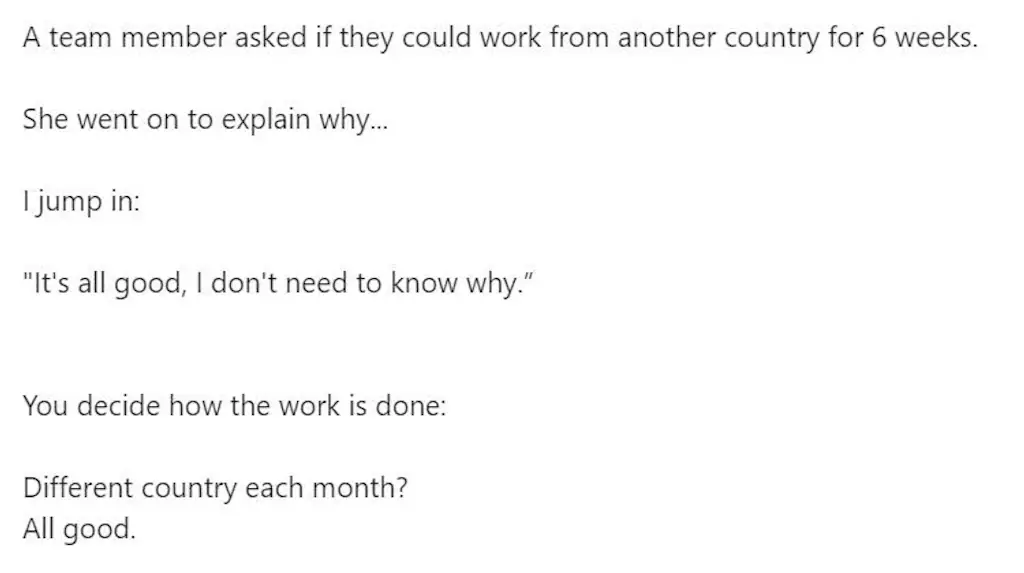
He shared on the social media platform that his staffer asked if she could work abroad for six weeks.
“She went on to explain why… I jump in: ‘It’s all good; I don’t need to know why.’ You decide how the work is done,” he penned.
“Different country each month? All good. Work from the garden? All good. Couple of hours off for a doctor’s appointment? All good. Work from Wetherspoons after dropping the kids off at school? All good,” he added.
The post, which amassed more than 300,000 reactions and 9,000 comments, has now been removed from the platform as well as Hunt's account.
A few users praised Hunt for his answer. Credit: Justin Paget / Getty
According to News.com.au, some users applauded Hunt for his answer, commending him for creating a healthy work environment.
“Yes! This is exactly the kind of work environment so many of us need,” one user praised, while another added: “Absolutely agree! Your approach highlights the importance of trust and flexibility in the modern workplace.
"By focusing on output rather than rigid schedules, you empower team members to find their most productive and balanced way of working,” they added.
A third shared: "Your life is your life. We don’t track time; we track output. And we trust you to deliver. Flexible work is the future."
Meanwhile, others disagreed with Hunt, stating that working from another country was better in "theory" rather than "practice".
A second added: “The thought process you have is correct, however. Having employees all work from home with zero interaction apart from teams or zoom is dangerous. All of my best ideas have come from experiences and sitting round a table provoking thought in real life scenarios."
“Unfortunately, I do not agree, unless you have a good measurement of output, working remotely does not work,” a third argued.
Some people said working from another country was better in "theory" rather than "practice". Credit: Alvarez / Getty
Brett McAllen, the CEO of Workspaces, shared his thoughts on the debate surrounding remote working, telling the outlet that working in the office involves a level of “immersion” you can’t achieve at home.
“When the office gets super busy due to big projects or nearing deadlines, the energy, buzz, and excitement is palpable. People share ideas, throw around thoughts, bounce ideas off the cuff,” he explained. "The workplace becomes a place of innovation and spontaneity. This is difficult to achieve when working from home.”
The CEO stated that he believes that "you are immersed in and part of the activity,” when you are in the office, adding: “You are present for key workplace moments. The perception is that if you are in the workplace, you are more in touch with and in tune with the organization.”
Do you guys agree with Hunt's response and McAllen's thoughts?
However, when the current pandemic worsened, the length of their trip significantly increased and they were forced to stay on the islands for five months after they closed their borders in a bid to stop the spread of the virus.
As a result of the lockdown, the tourist-reliant businesses in the area have suffered devastating losses.
In an interview with Business Insider, Ohliger, the cofounder of Jerry Media, said: "The island is completely dead. All the reservations canceled. The beach is basically a private beach for us and everything shut down."
It's been estimated that the Turks and Caicos Islands lost $22 million a month as a result of the pandemic-induced lockdown because their economy is entirely based on tourism, with the majority of it coming from the US.
Ohliger, who has been visiting the area for 33 years, said that he's struggled to watch the impact of the pandemic on locals.
His friend, Kamario Smith, described the situation as "very, very devastating" after being unable to do his work as a bartender at the Ocean Club Resort on the island of Providenciales.
The ongoing pandemic has changed life as we know it, and with no end in sight, people are seeking answers from unconventional sources.
PsychicWorld reported in June that since the lockdown began, there were 669,000 Google searches for "psychic advice" and searches for "psychic predictions coronavirus" increased by 95% over a 90-day period.
The website surveyed the things people are seeking psychic help for during the pandemic, and they found that 80% were asking to see their future, 74% were seeking love advice, and 67% were seeking job advice.
However, this does not give an insight into how this differs from the experience of psychics before the pandemic.
[[imagecaption|| Credit: Pexels]]
Working over video chat and phone, VT interviewed two psychics, Daniela Birch and Justine Ayling, both of whom experienced the reported surge in business, and we asked them how this compared to psychic work before COVID-19.
Justine Ayling said she received so many requests she turned down work.
Meanwhile, Daniela Birch said that those who had previously been closed off to her work became less frightened of it.
She said: "People are way more open to my advice. While in the past, I have felt people judged me and feared my gifts."
The two women noticed a difference in the type of requests they've received, with both noting a move towards mediumship - channeling communication between the dead and the living.
Birch said: "I am known as a relationship/soul mate specialist, but I would say the mediumship side has been stronger. My clients are wanting reassurance from their loved ones on the other side."
This was also the case for Ayling, who said: "I've seen a bit of an increase in people wanting to connect with spirit, partly for guidance but mainly for comfort.
"People realized that the cards were not going to tell them anything they didn't already know, lockdown/virus/social distancing wasn't going away anytime soon."
Clinical psychologist Dina Hassan said people are choosing mediumship because the pandemic has taught them that so many things are out of their hands.
She said: "Right now, it seems that every time you come to plan for the future, something bad happens, and this leaves you believing little in your ability to plan for what's to come."
The psychics said this has been a difficult time for them too, with Birch revealing that there have been days when her psychic channels have been blocked as she is "highly sensitive to energy."
She said: "Many psychics, including me, are empaths, and we feel the world's pain.
"I have had so many clients in pain, and fear of their future. Some have miscarried, lost loved ones, their business has dried up financially, and everyone is wanting reassurance from me."
One of the downsides of having so many people come to her for advice is that she has had days where she too has wanted comfort and has had to learn how to ask for it herself.
[[imagecaption|| Credit: Pexels]]
Ayling said that while she hasn't necessarily had trouble while working with clients, she has also tapped into the negative feelings of others.
She said: "I've had to put a lot of white light protection around myself during lockdown. I meditated, used healing crystals, and used mindfulness to keep the darkness of the time at bay."
An increased number of male clients have contacted Birch during the pandemic, which is an interesting shift from Pew Research Center's finding that women are typically twice as likely to visit psychics.
She said: "I am receiving a lot more men lately who want advice I do also offer intuitive mentoring and working on business coaching and not only one-off readings and guidance."
Ayling said that one of the reasons people have sought out mediumship is because they have lost loved ones of the virus and wanted confirmation that they were still around.
"They also wanted the chance to say their goodbyes," she said.
Hassan said that seeking out psychics is a way of supplementing a need with hard evidence - evidence which, unfortunately, does not exist during this time.
She said: "It will be someone who really got hit hard by COVID. Who is in learned helpless mode, and that can be anyone because the isolation and distancing is affecting everyone, even therapists."
[[imagecaption|| Credit: Pexels]]
If you want to seek out psychic advice, Birch and Ayling advise consulting psychics with good reputations and taking recommendations where possible.
Birch said: "See what they specialize in. Really be crystal clear as to what you want support with."
Ayling added: "Have a completely open mind and be clear at the start what you are looking for."
But while psychics may comfort some during the pandemic, Hassan said that a good alternative is mindfulness.
"It's not a good thing to be stuck in the future or the past," she said. "Being mindful is about being aware of the here and now and celebrating your small successes, which, ultimately, could help you feel better about the future."
Now that COVID-19 has been officially declared a global pandemic, people around the world are staying indoors in an attempt to halt the spread of infection.
However, there's no doubt that some people will have a much easier time keeping themselves amused than others. Indeed, there are many people out there who are probably dreading what feels like being under house arrest.
If you're one of those people then don't worry: there's someone out there who has real experience of living in isolation, and he's been more than willing to share his tips on how to survive in quarantine.
Watch this video if you want to know why self-isolating is so important right now:
Who am I talking about? I'm talking about NASA astronaut Scott Kelly, who spent nearly a year in isolation while on the International Space Station. In a recent interview with The New York Times, Kelly shared some of his tips for how the general public can get through the isolation period.
Kelly stated: "When I went to sleep, I was at work. When I woke up, I was still at work... When you are living and working in the same place for days on end, work can have a way of taking over everything if you let it. Living in space, I deliberately paced myself because I knew I was in it for the long haul — just like we all are today."
He continued: "When you are living and working in the same place for days on end, work can have a way of taking over everything if you let it. Living in space, I deliberately paced myself because I knew I was in it for the long haul - just like we all are today."
"The spread of the coronavirus is showing us that what we share is much more powerful than what keeps us apart, for better or for worse. All people are inescapably interconnected, and the more we can come together to solve our problems, the better off we will all be."
Kelly added: "As helpless as we may feel stuck inside our homes, there are always things we can do. I’ve seen people reading to children via video-conference, donating their time and dollars to charities online, and running errands for elderly or immuno-compromised neighbors. The benefits for the volunteer are just as great as for those helped."
We are urging all of our readers to adhere to the advice from their respective governments and medical bodies, and practice social distancing and self-isolation where required. Together, we will beat this.