ADVERT
Health2 min(s) read
Published 16:00 30 Jun 2022 GMT
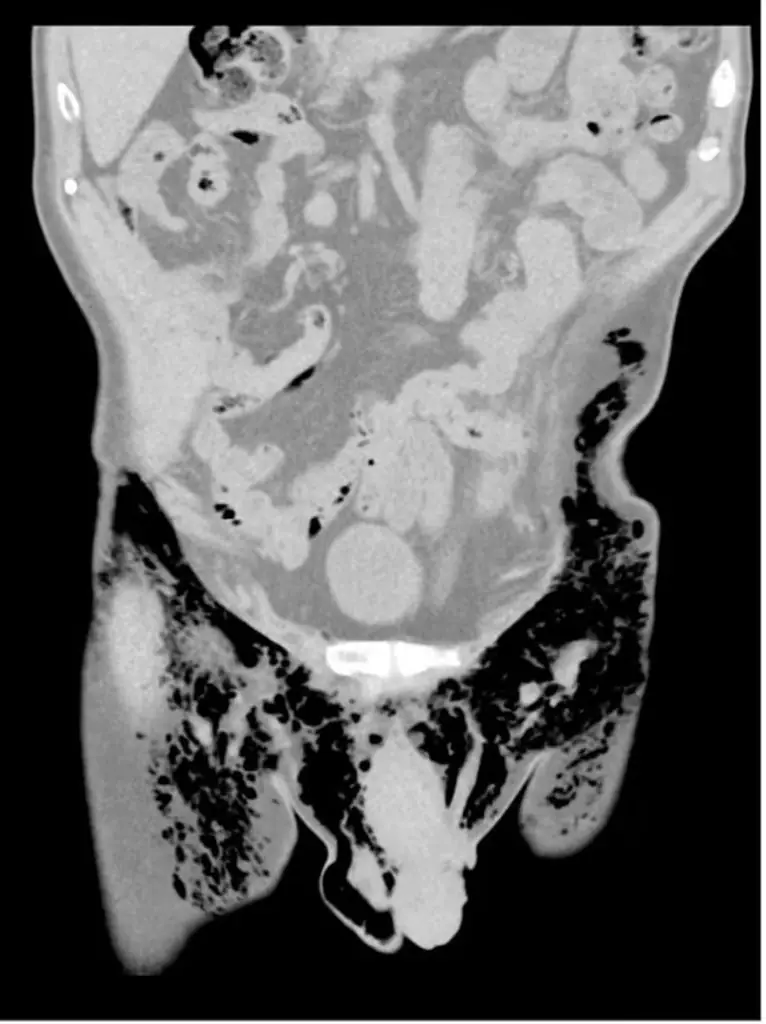
An Ohio man who heard a "hissing" sound coming from his genitals has become the first person in the world to be diagnosed with a "whistling scrotum", according to a new study published in the American Journal of Case Reports.
The 72-year-old man, who has not been named, was taken to his local emergency room after telling doctors about his bizarre symptom, the report said.
An X-ray was taken of the patient's chest which showed that he had "excessive" air floating in his body, leading to the collapse of his lungs.
Had it been left untreated, it could have resulted in permanent damaged to the functioning of his heart and lungs and could have even been fatal.
It was later discovered that the main cause of the strange sound coming from the man's scrotum was an open wound located on the left side. The injury had been left over from testicle surgery the patient had undergone to reduce swelling some months earlier. This allowed some trapped air to escape.
The man also experienced shortness of breath and swelling to his face as a result of the surgery. To resolve his malady, two plastic tubes were inserted into the man's chest in order to remove the excess air.
According to Dr. Brant Bickford, the man was transferred to a different hospital to undergo further treatment. His condition only worsened as the air trapped between his lungs and the chest wall began to increase. As a result, medics added a new chest tube.
Fortunately, his lungs recovered after a couple of days in the hospital and the man was eventually released.
The man did, though, have air trapped in his scrotum and abdomen, a condition known as pneumoscrotum, for another two years, which was referred to as an "abnormally long time."
Doctors could not explain how this phenomenon was able to occur but were ultimately left with no choice but to remove both of his testicles.
According to the study, the man's pneumoscrotum was potentially caused by penetrating injuries, which in turn resulted in trapped air.
lifestyle2 min(s) read
Published 16:44 22 Sep 2021 GMT
A man sought medical help after he started to experience a bizarre phenomenon with his bum and genitals.
The man, 33, realized that something was seriously wrong when he began to defecate from his penis and ejaculate from his anus, Indy100 reports.
However, it took two years for the man to seek out medical help.
News of the man's condition was revealed in the research article titled "A Curious Case of Rectal Ejaculation", which was published by US scientists last month.
It reads: "A 33-year-old male with a history of illicit drug use presented with five days of testicular pain. He also noted a substantial amount of urine and sperm passage from his rectum in addition to pneumaturia and fecaluria for the past two years."
Pneumaturia and fecaluria are conditions that cause gas and feces in urine.
To begin with, doctors had to rule out a number of other conditions including tuberculosis and inflammatory bowel disease.
When the man's urine was examined, it was revealed that he had a UTI, and a CT scan showed swelling in his left testicular tube and a "gas-filled structure" in his prostate, which was responsible for his rectal issues.
Scientists concluded that the gas-filled structure was "chronic appearing rectal-prostate fistula", and they were able to confirm their hypothesis with a voiding cystourethrogram (VCUG), a special type of x-ray.
The article revealed that the man had been in a three-week comatose state as a result of intoxication with cocaine and phencyclidine, a hallucinogenic drug.
The researchers explained that they had to use a catheter when he was hospitalized and this caused "significant trauma".
But despite the extreme symptoms experienced by the man, all that was required to solve the problem was a simple surgical procedure known as a "joint colorectal and urologic surgical fistula repair."
The man "recovered with only mildly reduced antegrade ejaculatory volume over several months."
The article said that rectourethral fistulas are incredibly rare, and they affect just 0.5 in every 100,000 people every year.
"The majority of adult cases are acquired, while most pediatric cases are due to congenital abnormalities," it explained.
weird3 min(s) read
Published 12:58 19 Aug 2025 GMT
A 44-year-old man in Tanzania made a startling medical discovery after seeking treatment for an unusual symptom: his right nipple had begun leaking pus. What doctors uncovered shocked both the patient and medical staff, he had been living with a knife lodged inside his chest for eight years without realizing it.
The man, whose identity has not been made public, was described as otherwise healthy, with no history of chest pain, difficulty breathing, coughing, or fever. According to a case report, his only symptom when he presented to medical professionals was a discharge of foul-smelling pus beneath his right nipple, accompanied by localized swelling and induration, The Sun reports.
His medical history revealed the likely cause. Eight years earlier, the man had been involved in a violent altercation during which he suffered multiple cuts to his chest, back, abdomen, and face. At the time, he received only basic first aid treatment. Due to limited medical resources in the area, he was never referred for further scans or imaging, such as an X-ray, that could have detected the presence of a foreign object. After his wounds healed, he continued with daily life without incident, never suspecting that something far more serious remained inside his body, the National Library of Medicine detailed.
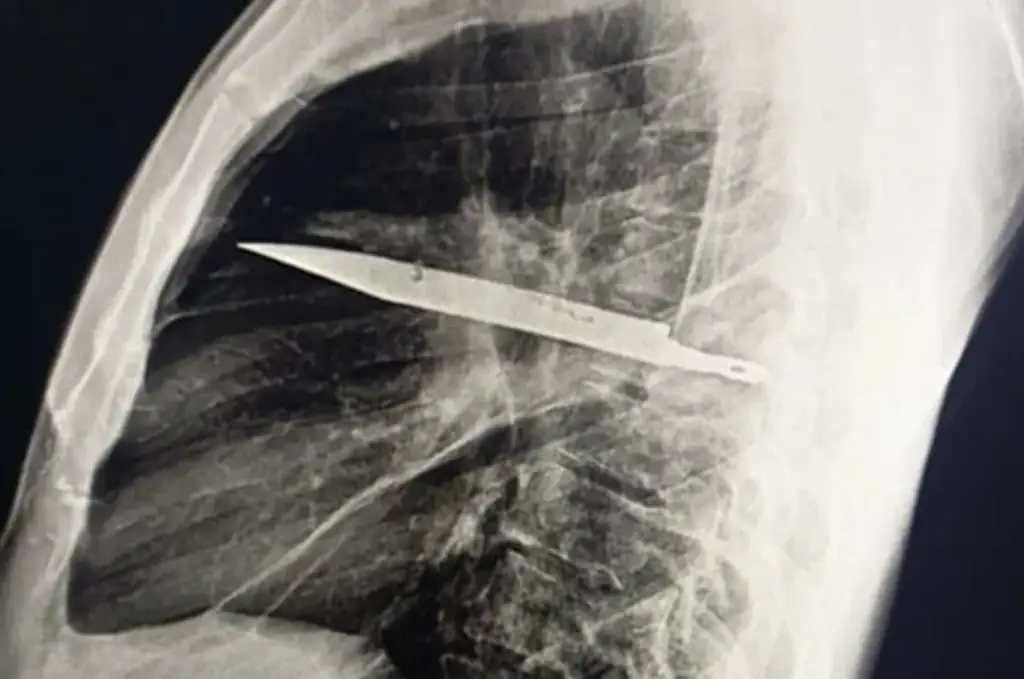
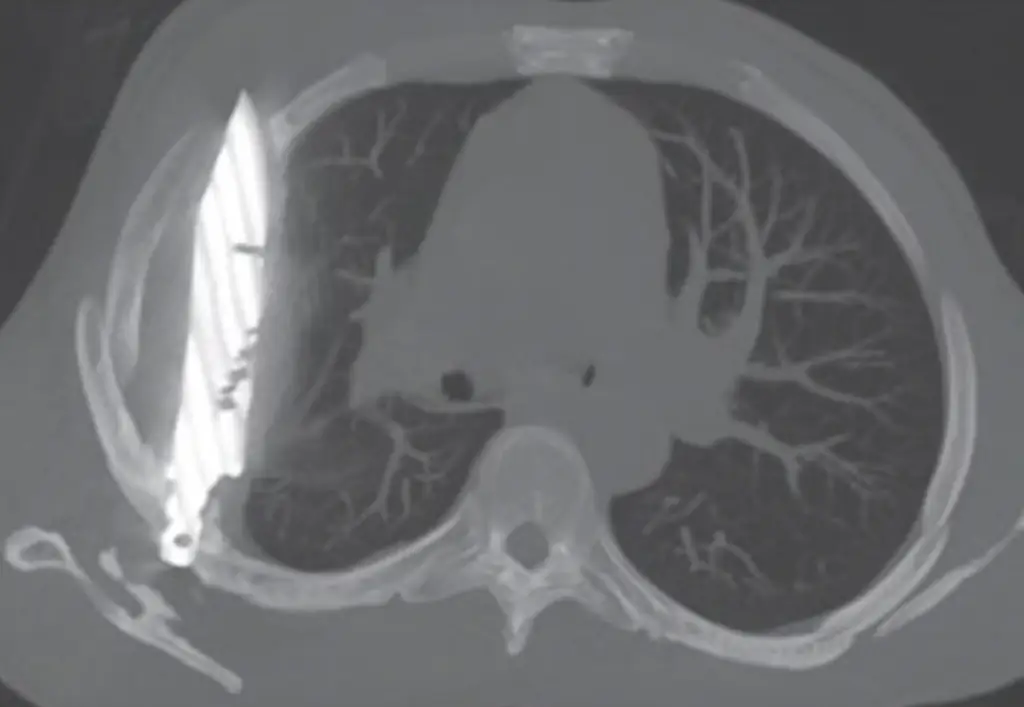
Doctors who examined him during this recent visit ordered an X-ray, which revealed a “retained metallic object” inside his chest. Further imaging confirmed the shocking finding: a knife blade had penetrated through his scapula (shoulder bone) and remained lodged deep within the chest cavity. Around the blade, a significant build-up of pus and necrotic tissue had formed, a sign that his body was beginning to respond to the foreign object after years of relative silence, according to PEOPLE.
Surgeons immediately intervened, removing the knife in a procedure that carried substantial risk. Remarkably, the man recovered well following surgery and was discharged after 10 days of hospital care. However, doctors emphasized that the outcome could easily have been far more dangerous. The retained knife could have led to life-threatening complications, including systemic infection, sepsis, or fatal organ damage.
Researchers noted that the man’s survival over eight years was due in part to his body’s ability to encapsulate the knife in fibrous tissue, essentially walling it off from surrounding organs and limiting inflammation. Still, the eventual infection demonstrated that this protection was failing, and without treatment, his condition could have deteriorated rapidly.
Medical experts involved in the case stressed that this extraordinary incident only highlights the ongoing challenges of trauma care in resource-limited regions. Without access to basic imaging equipment and trained surgical teams, injuries that might appear superficial can hide deeper, life-threatening complications.
“This case illustrates the urgent need for improved access to trauma management, safe surgery, and anesthesia in low-resource settings,” the researchers concluded, per Yahoo. They highlighted that the presence of such a large retained foreign body for so many years should serve as a reminder of the importance of comprehensive evaluation after violent injuries, no matter how minor they may initially appear.
The Tanzanian man’s story ultimately ended in recovery, but doctors warn it could just as easily have ended in tragedy.
health3 min(s) read
Published 12:32 11 Aug 2018 GMT
When it comes to any sort of medical qualm, it's always better to err on the side of caution and get regular check-ups than it is to ignore a potential problem and just hope that it goes away. Often, this might mean going to the doctor and having them look at something you might consider to be embarrassing or gross - but none of that will matter to them, so long as they get you the help you need.
Unfortunately, not everyone sees it this way. Indeed, some people would rather keep their lumps, bumps and warts all to themselves rather than have them checked out by a stranger - and, sometimes - this can lead to dire consequences.
Just this month, it was reported that one man in India lost his entire penis after ignoring the symptoms of cancer for about a year.
According to the British Medical Journal, an 82-year-old man was admitted to hospital "with complaints of the wound in right inguinal region for the last 15 days". At first, he was sent to a primary care clinic where he informed doctors that he had been experiencing pain in an ulcer that had developed on his penis a whole 12 months earlier, and that he had ignored it up until that point.
The man also gave details about "swelling" and "sloughing" (shedding) around his genital region that he'd been experiencing for a number of months. This prompted doctors to drain the pus-filled area and prescribe him with antibiotics in order to clear up any remaining infection.
Unfortunately, the treatment did not help, and the man returned two weeks later after the ulcer had caused his entire penis to fall off.
"Clinical examination revealed almost complete loss of phallus,” Dr Gaurav Garg, from King George’s Medical University in India, reported. "There was evidence of abscess in right inguinal region and hard matted nodes palpable in the left inguinal region. Metastatic workup revealed evidence of distant metastases. Biopsy from the base of residual penile stump revealed squamous cell carcinoma."
For those that don't speak doctor, this essentially translates to: he had an abscess on the right side of his groin, and hard lumps on the left. Further examination revealed that he had skin cancer.
Unfortunately, the cancer had progressed too far for the doctors to do anything by that point, and the man passed away just 15 days later.
Dr Garg was careful to note that this incident was incredibly rare, and that auto-amputation of the penis (or, indeed, any body part) due to cancer is usually as a result of neglecting to seek medical help.
"In the present case, the patient neglected his initial symptoms and eventually developed penile auto-amputation, inguinal abscess and widespread metastasis," he said. "Auto-amputation of the penis due to carcinoma penis is very rarely reported in the literature."
This story should serve as a warning to anyone who is worried about an ulcer or any other sort of growth on any part of their body. It's always better to be safe than sorry.
health2 min(s) read
Published 23:27 21 Aug 2018 GMT
How much do you take the simple act of passing wind for granted? To be honest, most people probably don't even think about it. We've all had the somewhat-embarrassing experience of letting loose a loud burp at an inappropriate moment in public, and have wished that we could get rid of belching and never have to do it again. But once you read this story, you might think twice about that particular fantasy...
Talent spotter Neil Ribbens endured a lifetime of agony and discomfort because of one bizarre reason: he was biologically incapable of burping. It might sound like a boon to never have to burp again; but Neil was left in pain every time he ate or drank, when methane gasses would quickly build up in his stomach and gut without having any way of being released.
Neil first developed the curious condition in his childhood, when he noticed that, after eating a large meal or drinking alcohol or sodas, he'd soon endure painful stomach aches and violent hiccups while his belly bloated to twice its normal size. He'd also fart far more, as the gas was forced to escape his body another way.
Neil was later saved by an unlikely cure: Botox.
Now, most people think that Botox is purely a method of erasing wrinkles and smoothing out skin, but it has a number of other useful applications. After a £3,000 private procedure, in which a doctor injected the substance into his larynx, Neil's throat muscles loosened up after decades of tension and now he can burp to his heart’s content.
Commenting on his peculiar gastric problem, Neil stated:
"One doctor I spoke to laughed, which wasn’t great. After that, subsequent GPs would just prescribe me various over-the-counter drugs. There was no one who had heard of my condition. I avoided going to the pub with friends until I was about 25, because I knew I’d be in pain and would have to leave. Not being able to burp really impacted on my social life. If I had a three-course dinner I’d feel terrible afterwards, which led to me missing things like big work Christmas meals."
He added:
"I don’t know how many people have this condition – but they should have this procedure. It was worth every penny. This condition is being gradually better understood by a handful of doctors around the world, but it hasn’t even got a name, which shows there’s still a long way to go. But words can’t really describe how much better I feel now and, luckily, unlike cosmetic Botox, it won’t have to be repeated at monthly intervals. The one operation should have cured my problem for good.”
Neil's girlfriend is apparently very happy that he has been cured, and personally I'm very glad that Neil is now capable of breaking wind comfortably, and can enjoy drinks at a bar without suffering.
health4 min(s) read
Published 14:34 12 May 2026 GMT
A man who had four inches of his penis amputated after being diagnosed with penile cancer has revealed the terrifying symptom that finally pushed him to seek medical help.
Back in 2019, when he was 26 years old, Hamill developed excruciating pain and swelling in his genitals.
However, he was initially reluctant to seek help, telling VT in an exclusive interview: "Because it was in such an intimate area, you don't want to go to the doctor and just whip your willy out. So I just put it off," adding that he "only put it off for a week."
But one symptom in particular made him realize something was seriously wrong, and he had to start seeking help.
Hamill says: “And that's when the bleeding started. So I had my first bleed, that's when I was like, okay, I need to go get this checked now.”
Despite fearing it could be cancer, he was sent home with a topical cream after being told he was “too young” to have penile cancer.
“And I just said, is there any chance it can be penile cancer? Because I've got pretty much all the symptoms,” he recalls. “And [his doctor] looked me in the eye and went, 'Yeah, you've got the symptoms, but you're just too young. So it can't be. I think it's a bad case of ballinitis. Here's some cream. Go home and keep applying it.'”
Hamill said his condition rapidly deteriorated after that appointment, and he started noticing what he described as a "death smell".
“It got worse because then the pain started and then the smell started, like everything just started accelerating,” he explains.
The now 33-year-old said he trusted the doctor’s reassurance at the time because penile cancer is so rare, particularly in younger men.
“Yeah, so it's one in 100,000 men, I think, on the American record,” he says. “But only around, I think it's 700 to 800 men get it in the UK every year. And typically they're over 50 years of age as well.”
Hamill adds: “I was 26, so I'm actually one of the youngest on the planet to survive penile cancer.”
After his symptoms worsened dramatically, including intense pain and severe bleeding, Hamill was rushed to A&E, where doctors diagnosed him with penile cancer. To save his life, surgeons were forced to perform a partial amputation, removing around four inches of his penis.
Hamill has since become incredibly open about his experience online, using social media to raise awareness of penile cancer and encourage others not to ignore symptoms.
He admits that opening up has not always been easy, particularly when it comes to dating and confidence.
“The one big thing about me is... it probably has taken a bit of power away from me,” he says. “Because I know a lot of people say a man isn't their penis, and I get that. And I get everyone's mindset.
“But being a man, and being amputated down there, it does take a piece of you away. Whether that's confidence, whether that's ego... it still has an impact on you.”
Despite the emotional impact, Hamill said women he has dated have generally been understanding about his condition.
“It's been all right,” he said. “Women aren't really that bothered in that sense. I've talked them through it and everyone I've been with... it's never been an issue in reality."
He also revealed he has since fathered a child after the surgery, adding: “I've had my child in the natural way as well.”
After struggling to find support groups with people his own age, Hamill decided to start speaking publicly about penile cancer in the hope of helping others.
He is now planning awareness campaigns and social media stunts to get more people talking about the disease, including a proposed “penis tour” where members of the public would be challenged to guess what type of cancer he had.
“It's one of the reasons why I thought, you know what, I'll just put some videos out there,” he said. “Because the problem when I was going through it... I had no support.”