A security guard at a Russian gallery was charged with vandalism after he used a ballpoint pen to draw two sets of eyes on a painting worth around $1.4 million.
The guard, who has not been named, was accused of defacing the painting on his first day at work at an exhibition at the Boris Yeltsin Center in Ekaterinburg, Russia.
The ordeal, first reported on by Russian publication Art Newspaper, involved the "Three Figures" painting, a piece completed in the 1930s by Soviet artist Anna Leporskaya.
According to the outlet, visitors to the gallery alerted staff on December 7 after they spotted what appeared to be two pairs of "crudely-rendered eyes" scribbled on the painting.
Alexander Drozdov, executive director of the Boris Yeltsin Center, told Art Newspaper that the guard was a 60-year-old contracted worker employed by a private security organization.
Drozdov added that he used one of the ballpoint pens at the museum to make the etchings.
Credit: ITAR-TASS News Agency / Alamy
"His motives are still unknown, but the administration believes it was some kind of a lapse in sanity," exhibition curator Anna Reshetkina told the publication.
Per BBC News, Museum administrators fired the guard, and police opened an investigation into the incident. If found guilty, the guard could be sentenced to up to three months in prison.
The rest of the work in the exhibition has since been placed behind protective screens, according to The Washington Post. Leporskaya's painting is undergoing restoration, which is expected to cost around $3,400.
"The ink has slightly penetrated into the paint layer since the titanium white used to paint the faces is not covered with author’s varnish, as is often the case in abstract painting of that time," Ivan Petrov wrote in Russia's Art Newspaper.
"Fortunately, the vandal drew with a pen without strong pressure, and therefore the relief of the strokes as a whole was not disturbed. The left figure also had a small crumble of the paint layer up to the underlying layer on the face."
A portrait of President Donald Trump that hung in the Colorado State Capitol has sparked controversy after the president publicly criticized the painting as “purposefully distorted,” leading to its removal and drawing sharp rebuke from the artist who painted it.
British-born artist Sarah A. Boardman - who painted Trump’s official portrait for the Denver State Capitol Gallery of Presidents in 2019 - says the fallout from Trump’s remarks is now threatening her livelihood.
“President Trump is entitled to comment freely, as we all are,” Boardman said in a statement, per Sky News. “But the additional allegations that I 'purposefully distorted' the portrait, and that I 'must have lost my talent as I got older' are now directly and negatively impacting my business of over 41 years which now is in danger of not recovering.”
The controversy began when Trump took to Truth Social in late March to denounce the painting.
“Nobody likes a bad picture or painting of themselves, but the one in Colorado, in the State Capitol, put up by the Governor, along with all other Presidents, was purposefully distorted to a level that even I, perhaps, have never seen before,” he wrote.
The 78-year-old POTUS compared it to Boardman’s portrait of President Barack Obama, which he described as “wonderful,” and added: “The one on me is truly the worst.
"She must have lost her talent as she got older.”
President Trump criticized a portrait of himself hanging in the Colorado Capitol that he claimed was “purposely distorted". Credit: Truth Social /@realDonaldTrump
Trump said he had received complaints from Colorado residents and called on Governor Jared Polis to remove the artwork.
“In any event, I would much prefer not having a picture than having this one,” Trump wrote, before adding: “Jared should be ashamed of himself!”
The portrait had been commissioned by the Colorado State Capitol Advisory Committee after funding was raised by former Senate President Kevin Grantham, a Republican.
Credit: Truth Social
Boardman said she painted the image using a reference photograph that was approved by the committee, along with her works in progress.
“I completed the portrait accurately, without 'purposeful distortion', political bias, or any attempt to caricature the subject, actual or implied. I fulfilled the task per my contract,” she said. “For the six years that the portrait hung in the Colorado State Capitol Building Rotunda, I received overwhelmingly positive reviews and feedback. Since President Trump's comments, that has changed for the worst.”
The painting was removed following Trump’s criticism, BBC News reports.
Boardman, who has also painted official portraits of former Presidents George W. Bush and Barack Obama, said the backlash marks a significant and damaging moment for her professionally. “My intentions, integrity, and abilities have been called into question,” she said.
Governor Polis’s office, meanwhile, responded with a touch of sarcasm to Trump’s public outcry. “Gov. Polis was surprised to learn the President of the United States is an aficionado of our Colorado State Capitol and its artwork,” a spokesperson said. “We appreciate the President and everyone’s interest in our capitol building and are always looking for any opportunity to improve our visitor experience.”
Trump, who has been known to tightly control his public image, made further headlines recently when his envoy Steve Witkoff confirmed receipt of a new portrait from Russia. Witkoff said he had been asked to transport the “beautiful portrait” by a “leading Russian artist” back to Washington.
Featured image credit: Truth Social /@realDonaldTrump
Since the Trump administration spent $14 million of taxpayer money on painting the Lincoln Memorial Reflecting Pool “American Flag Blue”, only for it to turn green in a matter of days, online criticism of the decision has been relentless, and White House Press Secretary Karoline Leavitt is caught in the eye of it.
The money-sucking project is rapidly becoming the centre of a growing political storm over government spending.
Humiliatingly, after spending an eye-watering sum on painting the memorial pool, the water turned green just days after it was resurfaced.
In a desperate attempt to resolve the discoloration, the administration then ordered hydrogen peroxide to be added to the water.
President Donald Trump and Karoline Leavitt defended painting the pool. Credit: Anadolu / Getty Images
What has happened the memorial pool?
However, all it appeared to do was turn the edges blue and leave a huge green strip running through the middle. Large sections of paint then began peeling from the pool’s floor, and a dead duck was spotted floating on the surface shortly after the toxic chemical was added.
In typical Trump style, the President took to Truth Social to address the damage and shift the blame onto the other political side. In numerous posts, he claimed that vandals had slashed the 250-foot strip and poured corrosive chemicals into the water. He even stated that “many” arrests had been made, although there is no evidence of them.
Unsurprisingly, Trump’s posts were met with criticism and suspicion, and the extremely expensive failure by the government attracted global media attention.
In a bid to defend the colossal mistake made by the administration, White House Press Secretary Karoline Leavitt hit out at the media, rather than addressing the embarrassing blunder.
When an X user complained about the volume of media coverage the story was attracting, Leavitt replied: "So true, and so sad. The liberal media is truly deranged."
The administration promoted the pool story first
Quickly, the comment sparked a wave of backlash from White House critics, many of whom accused Trump of starting the song and dance over the memorial pool.
In now-deleted social media posts and tip-offs to the press, Trump had persistently promoted the painting of the pool in the weeks before it suddenly went wrong, causing many people online to point out that he cannot complain about the media interest now.
One X user wrote: "Could it be that people are talking about it because Trump spent weeks and weeks talking about how big this project was? Y'all created this news cycle."
Social media users also dug up previous posts promoting the pool project from the Press Secretary herself, while others criticized the administration’s spending priorities. It was widely pointed out that cuts had been made to food assistance programmes on the grounds of funding.
An artist who was paid $84,000 for his paintings instead sent a collection of blank canvases to the buyer and titled them ''Take the Money and Run".
Artist Jens Haaning was paid $84,000 by the Kunsten Museum of Modern Art of Denmark for two paintings to be used in an upcoming exhibition, PEOPLE reports, however, he decided to send two blank canvases instead.
CNN states that the museum had commissioned the artist to recreate two of his previous works that involved framing cash to represent the respective salaries of Austrians and Danes in their respective currencies.
The work was intended to be used in an exhibition about the future of labor.
Kunsten, however, was shocked to discover that instead of using the money to commission new artwork, the artist had instead chosen to send the museum two blank canvases.
"I have chosen to make a new work for the exhibition, instead of showing the two 14- and 11-year-old works respectively," Haaning told the museum in an email, CNN reports.
"The work is based on/responds to both your exhibition concept and the works that we had originally planned to show," he wrote.
He titled his new piece "Take the Money and Run".
In an interview with CBS News, Lasse Andersson, the museum's director, said that instead of being angry, he laughed when he saw the two blank canvases.
"The staff was very surprised when they opened the crates. I was abroad when the crates were opened, but suddenly received a lot of mails," Andersson said.
"Jens is known for his conceptual and activistic art with a humoristic touch. And he gave us that - but also a bit of a wake-up call as everyone now wonders where did the money go," he added.
NPR reports that Haaning signed a contract to provide the artwork and will therefore be liable to return the $84,000, which he reportedly plans to do in mid-January when the exhibition ends.
Despite not getting what they asked for, the museum isn't entirely unhappy with the blank canvases.
"It wasn't what we had agreed on in the contract," Andersson said, "but we got new and interesting art."
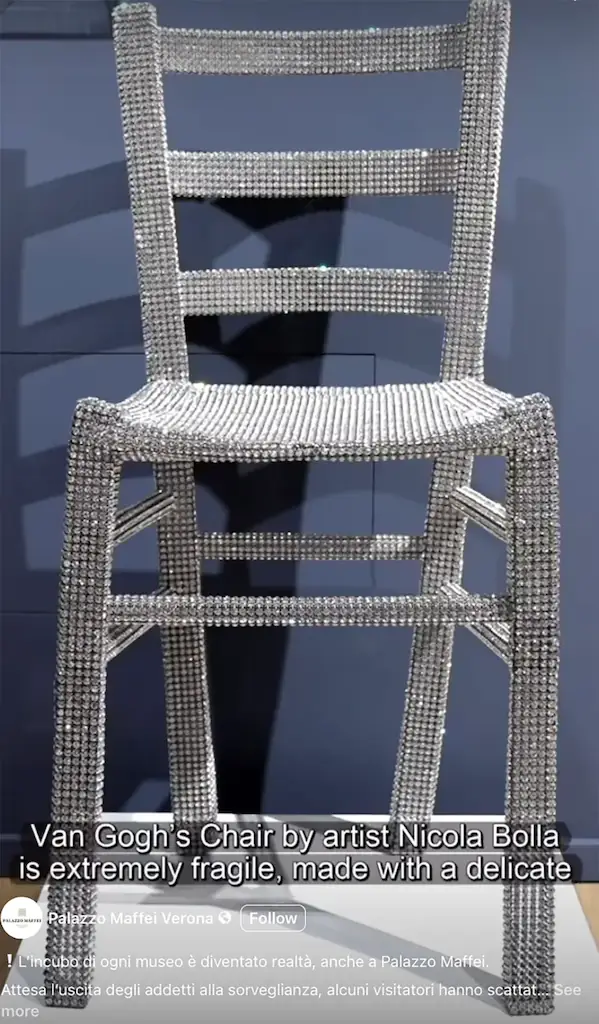
A clueless tourist sat down on the "Van Gogh" chair, which was adorned with thousands of Swarovski crystals, and shattered it.
Security footage from the Palazzo Maffei in Verona, Italy, captured the disastrous moment a man ignored both common sense and museum etiquette and decided to sit on an art installation decorated with shimmering Swarovski crystals.
Instead of faking a seat like the woman he was with, the unnamed tourist lowered his full weight onto the fragile sculpture.
In a split second, the chair, created by Italian artist Nicola Bolla and modeled after a seat featured in one of the Dutch painter’s iconic works, buckled under him.
The man grasped at the wall while his partner scrambled to help him up. The pair then bolted from the scene, leaving the damaged art piece behind.
The art piece by Nicola Bolla was named the Van Gogh chair because it resembles a chair in one of the Dutch painter’s most famous pieces. Credit: James Birkbeck Photo-Art / Getty
The museum didn't take the violation lightly. They took to their social media platform and publicly posted the incident, slamming the duo’s behavior as “superficial” and “disrespectful".
“They ignored every rule of respect for art and cultural heritage,” the museum fumed, pointing out that the pair had clearly waited for the room to be momentarily unguarded before attempting their ill-fated photo op.
“Every museum's nightmare has become reality, even in Palazzo Maffei,” the institution posted, per The Sun.
They also noted that “an irresponsible gesture caused serious damage to Nicola Bolla's Van Gogh chair, a very delicate work, covered entirely with hundreds of Swarovski crystals".
The backlash online was swift and brutal. “Idiots! I hope they are reported!” one user seethed in the comments. Another shared: “The embodiment of mediocrity, rudeness and ignorance.”
A third commented: "I hope they pay for the damage and if it’s invaluable, they must at least give them a pretty fine," while a fourth added: "This is crazy! I have seen that building and the artistic beauties it contains made generously available by the owner, so that others, everyone can enjoy... They should be identified and punished for the damage caused."
The chair was covered with hundreds of crystals. Credit: Palazzo Maffei / Facebook
Thankfully, this blunder didn’t end in total tragedy as a few tense days later, museum staff confirmed the piece had been fully restored.
“For days, we didn’t know if it would be possible to restore it. But we did it,” said a museum staffer on Facebook.
Thanks to a team of expert restorers, law enforcement, and in-house security, the art piece has been returned to its former sparkling glory.
The museum issued a follow-up statement: “We are sharing this episode not only for the sake of reporting, but to start a real campaign to raise awareness about the value of art and the respect it deserves.”
“A heartfelt thank you goes to the police, our security department, and the restorers, whose valuable work allowed the recovery of the work,” it continued. “And a special thank you to all of you who walk through the museum halls every day with care, attention, and wonder. Because art is not just for seeing. It is to be loved. It is to be protected.”
It’s still unclear whether the couple will face any financial or legal consequences for the mess they caused.
Featured image credit: Facebook/Palazzo Maffei Verona
People have been left mystified after a 160-year-old painting appears to show somebody using a very modern iPhone...
It seems like every other day were are visited by a supposed time traveler, and yet very rarely are their predictions correct.
If I was a time traveler I would not only be winning the lottery every week, but I'd also be doing more than posing for a painting with my phone out... which is what one 160-year-old painting seems to show.
The artwork, known as 'The Expected One,' painted by Austrian artist Ferdinand George Waldmüller in the 19th century appears to show a person holding an iPhone, despite the device coming out in 2007.
Currently on display in Munich, Germany, Waldmüller's 'The Expected One' portrays a serene scene of a woman strolling through nature while a young man patiently awaits her, holding a flower.
In the painting, the woman can be seen looking down at an object in her hands.
Peter Russell, a visitor from Glasgow, was one of the first to notice this peculiar detail. After viewing the painting during a trip to Germany with his wife, Russell shared his astonishment with Vice, saying: "What strikes me most is how much a change in technology has changed the interpretation of the painting, and in a way has leveraged its entire context."
He continued: "The big change is that in 1850 or 1860, every single viewer would have identified the item that the girl is absorbed in as a hymnal or prayer book."
Russell went on to highlight the striking contrast by stating: "Today, no one could fail to see the resemblance to the scene of a teenage girl absorbed in social media on their smartphone."
The image soon created a storm on social media with people sharing their amazement, as one person penned: "This 1860 painting 'The Expected One,' painted by Ferdinand Georg Waldmüller clearly depicts a time traveling woman holding her iPhone. It's amazing what kind of inspired vision artists can have."
Some people believe that the painting features a modern iPhone. Credit: Justin Sullivan/Getty
A second person added: "Time travel is real. She’s definitely holding an iPhone in this 1860 painting."
One person was not willing to suspend their disbelief, as they tweeted: "This is what happens when the new generation cannot think outside their 'norm' Has anyone seen the reaction when you tell the new generation there were days where there were no answering machines?"
Amidst the debate, Gerald Weinpolter, an expert in 19th and 20th-century art, weighed in. He told Vice: "The girl in this Waldmüller painting is not playing with her new iPhone X but is off to church holding a little prayer book in her hands."
That explanation is more logical, but definitely less fun.