


US5 min(s) read
‘Very important’ evidence found miles from Learjet crash site after concerns there was seemingly no trace of plane wreckage

Federal investigators searching the aftermath of a fiery business jet disaster in South Florida announced that key components of the aircraft separated miles before ground impact.
The Bombardier Learjet 60, carrying nine people, plummeted into a neighborhood near Military Trail and 10th Avenue North in the Greenacres area of Palm Beach County on Sunday afternoon.
The high-speed impact created a massive crater in the pavement and a giant fireball, killing everyone on board and prompting the evacuation of around 600 nearby residents.
Early videos recorded in the immediate wake of the disaster raised widespread questions among the public because the smoking crater appeared to show virtually no visible airplane debris.
Observers noted that the aircraft struck the ground like a missile, leaving an impact point heavily obscured by fire, dense smoke, and pulverized earth.
Aviation experts pointed out that the extreme speed and catastrophic energy of the dive, coupled with severe structural disintegration, meant that the aircraft was shattered into tiny fragments and buried deep within the crater or cast outward across the surrounding neighborhood.
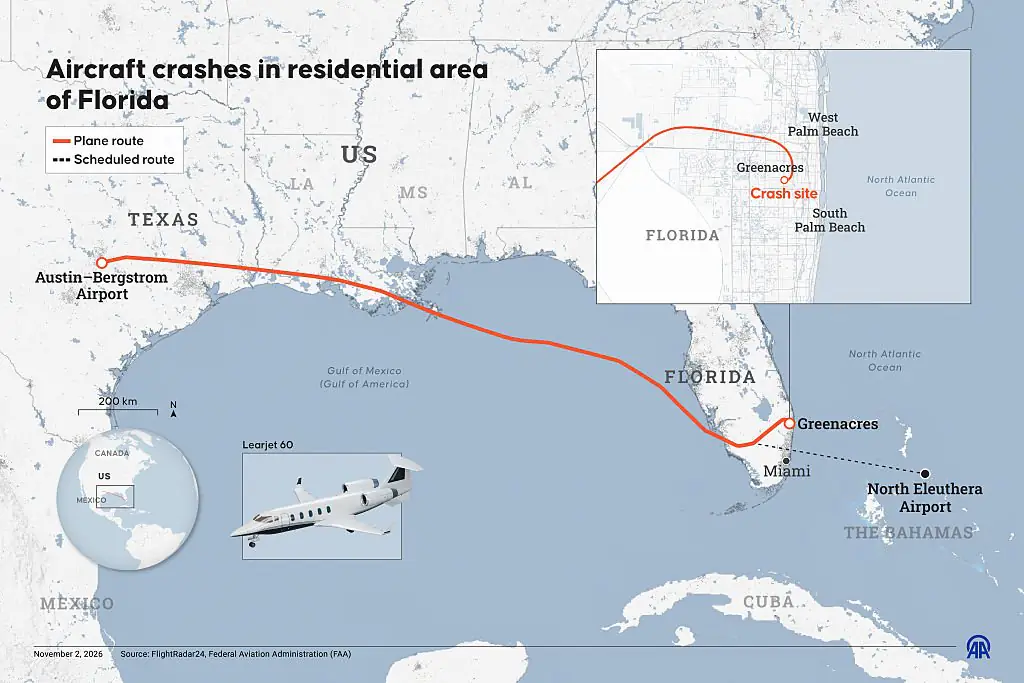
Search teams confirmed that the jet had actually begun breaking apart high above the ground as it plunged through severe weather. National Transportation Safety Board member Tom Chapman announced Tuesday that most of the left elevator was discovered scattered between 1.3 miles and 3.8 miles away from the primary crash site.
The elevator is a crucial section of the tail assembly that governs pitch, and its loss left the flight crew without the aerodynamic tools needed to arrest the jet's dive.
Critical tail sections located far from impact
Investigators identified three separate pieces of the left elevator nearly four miles away from the Greenacres crater. The discovery provided authorities with direct physical evidence regarding the structural integrity of the airframe during its final descent.
"What that means exactly, in terms of what caused the aircraft to lose control, or whether the loss of this piece was a result of the forces on the aircraft, we don’t know yet," Chapman said at a news conference.
Chapman explained that without an operational elevator, the pilots faced impossible odds. "At those speeds I don’t know that it would’ve been effective even if it had still been attached to the aircraft, but knowing that it was lost is a very important piece of evidence in terms of pointing us toward other things to investigate," Chapman said, per CBS News.
Aviation safety expert Jeff Guzzetti told The Associated Press that the parts likely broke free closer to the ground due to violent forces rather than at cruising altitude. Former NTSB member John Goglia reviewed flight data suggesting the plane briefly leveled off near 8,000 feet before plunging.
"He apparently leveled off for brief moments at 8,000 feet and to accomplish that he likely overstressed the tail and the horizontal stabilizer separated from the airplane," Goglia said.

The cockpit distress calls
The aircraft originated from Austin, Texas, and was en route to the Bahamas when it encountered severe atmospheric hazards. Initial findings point to a rapidly intensifying thunderstorm cell as a central focus of the probe.
Moments before the crash, co-pilot Nathalia Gadelha Filgueiras radioed air traffic controllers about heavy ice accumulation and violent turbulence that tossed the aircraft up and down by several hundred feet.
Cockpit communications turned frantic as the jet rapidly shed altitude at more than 20,000 feet per minute. Filgueiras could be heard shouting updates to controllers in the final moments of flight.
"We’re going to crash into the ground," she said, before issuing a final transmission: "We’re out of time!"
A man's voice, believed by close associates to be 55-year-old captain Jeff Gregory, could be heard reciting the Lord's Prayer in the background as the jet went down.
The flight also claimed the lives of technology entrepreneur Adam Robinson, his wife Helen Sharp, their two young children Charlie and Emma, and their nanny Ana María Ramírez Cetina.
Explaining the missing wreckage at the crater
The visual absence of recognizable airplane parts at the impact zone fueled intense speculation online, but aviation specialists quickly clarified that such phenomena are typical in catastrophic vertical dives.
Former inspector general and aviation expert Mary Schiavo noted after reviewing footage, "That is not a controlled descent," adding, "It’s clear, whatever happened, they had lost control of the plane."
Cockpit audio captured warnings that the Learjet had exceeded safe operational limits. When an aircraft strikes the earth at extreme velocity, the kinetic energy drives substantial portions of the structure straight into the substrate, disintegrating metal and equipment on impact.
Heavy smoke, fire, and unstable ground at the crater site further masked the remains from initial view. Investigators scheduled specialized excavation operations to enter the crater and recover the primary flight components buried beneath the pavement.
The NTSB plans to issue a preliminary factual summary within a month, while the full investigation will take upwards of a year to finish.