


US3 min(s) read
Former Navy fighter pilot reveals why Florida Learjet 'should never have been flying' and who he thinks is to blame

Two veteran pilots have analyzed the final moments of the doomed Learjet 60 aircraft that crashed into a South Florida neighborhood on Sunday (November 1).
All nine on board died in the crash, with officials confirming that there were no casualties on the ground.
At a news conference on Monday, the National Transportation Safety Board (NTSB) confirmed that ice began forming on the jet during moderate turbulence, a theory aviation experts have suggested could be fatal.
The final transmission on air traffic control recordings reveals the co-pilot said, "We're going to crash into the ground, 722 Bravo Delta."
"We're out of time," were the final words heard from the cockpit.
The crew of the private jet consisted of 55-year-old captain Jeff Gregory and 20-year-old co-pilot Nathalia Gadelha Filgueiras.
Now, aviation experts have weighed in on the operational pressures, weather hazards, and pilot responsibilities surrounding the crash.
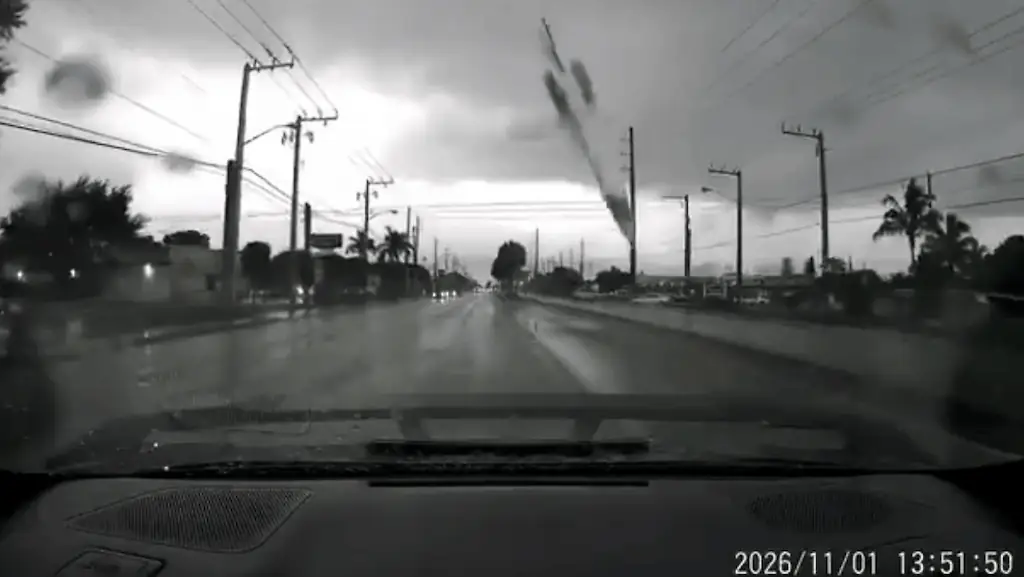
Veteran pilots say they 'should never have been flying'
The captain and co-pilot made a distress call in the minutes leading up to the horrific crash that killed all nine on board, as those on board included entrepreneur Adam Robinson, 44, his wife Helen Sharp, their four-year-old daughter Emma, and their two-year-old son Charlie.
The family was traveling with their nanny, Anita Maria Apellido Cetina, and two close friends, Rachael Reed and Charmi Fehr.
Upon the release of ATC audio that revealed the flight's final moments, two aviation experts have given their two cents on the situation in an interview with the New York Post.
Former Navy fighter pilot Matthew 'Wiz' Buckley questioned the decision to fly, considering the weather, while retired airline captain Steven Arroyo spoke about the plane's final descent.
"You know, hindsight's 20-20, but there's no way in they they should have been flying," Buckley stated.
Arroyo highlighted: "The vertical rate of descent on this aircraft was exceeding 25,000 feet per minute.
"When you compare that to the average rate of descent [music] for an airliner that happens at about 1500 feet per minute to 2,000 feet per minute, it is extreme."
Buckley added: "It's extremely cold up at higher altitudes. If you've ever watched documentaries about climbing Mount Everest, it's freezing up there.
"So, -47° uh which is what the first officer (Gadelha), the young lady, reported, it is not uncommon. But they clearly were entering or in icing conditions. So, they had some turbulence going on."
He then spoke about how the pilots handled the situation, explaining: "They had some icing conditions.
"She communicated that they were managing the icing conditions, which, I've got to be honest, I've been in commercial and military aviation for four decades - you don't manage icing, you get out of icing. You don't fly into known icing," Buckley highlighted.
He went on: "You don't fly into known bad weather and if, God forbid, you do and the wings start icing up, you turn on your engine's anti-ice, the wing's anti-ice system, and you get out of the icing."

Arroyo explains the impact of icing
The former pilot went into the effects of allowing icing to build up.
"If you start accumulating ice on the leading edge of the wing, it distorts the wing and it can disturb the airflow over the wing.
"We call that an aerodynamic stall. And when you're operating at 34,000 ft, those operating margins are very narrow. Turbulence further narrows that operating margin," he said.
"When you encounter icing conditions, usually you're planning for it. So, you'll have those anti- ice uh systems on and working that will dissipate accumulations of ice," Arroyo stated.