


US7 min(s) read
Little-known reason tiny private jets can fly at 51,000ft while passenger planes are stuck much lower after Florida Learjet crash

An aviation expert has explained why some private jets can fly to altitudes of 51,000ft while commercial planes usually cruise thousands of feet lower.
The explanation comes amid continued scrutiny of the deadly Learjet 60 crash in Florida that killed all nine people on board.
The Bahamas-bound twinjet departed Austin, Texas, bound for North Eleuthera on Sunday, November 1.
It plummeted in roughly 77 seconds, crashing near Military Trail in Greenacres and killing Captain Jeff Gregory, First Officer Nathalia Gadelha Filgueiras, and seven passengers.
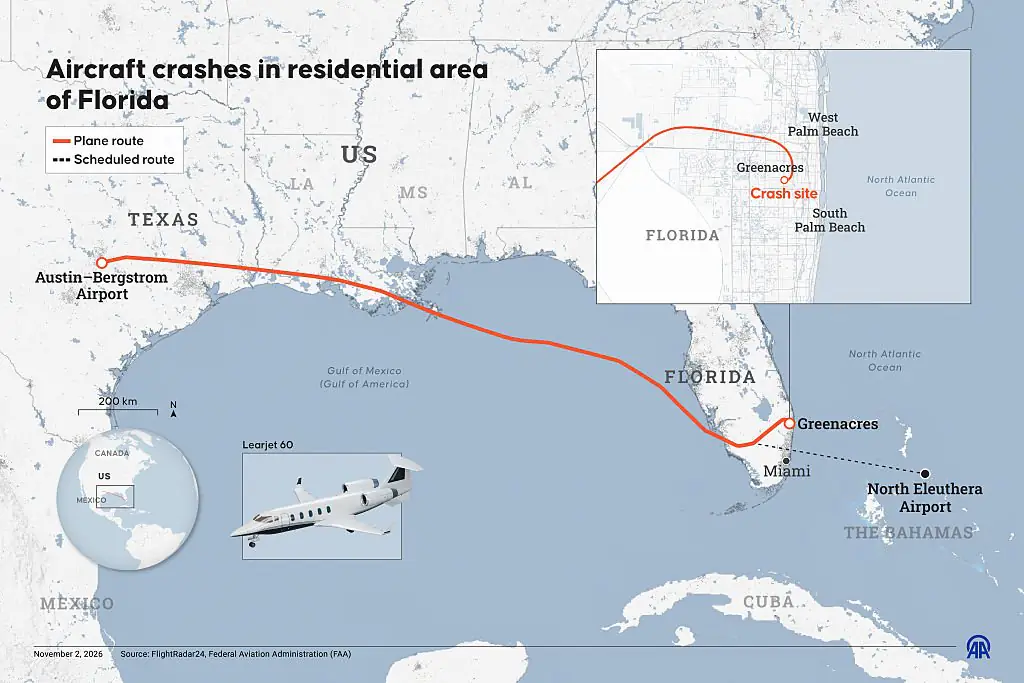
Flight data indicated that the aircraft cruised between 41,000 and 45,000ft before descending to 35,000 ft near Florida, where the emergency unfolded.
While investigators continue working to determine what caused the crash, the aircraft's cruising altitude raises a bigger question: Why can some private jets fly so much higher than commercial airliners, such as the Boeing 777?
Why private jets can fly higher than commercial planes
In an animation shared on the YouTube channel Aviation by Phil, an aviation expert outlined three key reasons private jets can operate at extremely high altitudes than larger passenger aircraft.
The first reason is weight and how much of it a plane has to carry.
"Jets fly most efficiently high up because the air gets thinner as a plane climbs. Thinner air means less drag, so the engines burn less fuel to hold the same speed. At 45,000 ft, for example, the air is only about half as thick as it is at 30,000 ft, and every jet would cruise up there if it could. But thin air comes at a cost because it also holds up less weight," the narrator said.
The expert explained that an aircraft's maximum operating altitude depends partly on how much weight its wings and engines can support in thinner air.
"A plane can climb only as high as its wings and engines can still carry it, and that depends on how heavy it is compared with the size of its wings and the power of its engines. That's where a private jet comes out ahead. When a 777 takes off fully loaded, every square foot of its wing has to hold up about 165 lb, while every square foot of a typical private jet's wing holds up about 90 lb, which is way less than the load a 777 swing has to carry."
"A private jet also carries far more engine for its size, and for every pound it weighs, its two engines can give it as much as 30% more thrust than the 777. That spare thrust matters a great deal because jet engines lose most of their power in thin air."
According to the expert, these differences allow certain private jets to reach cruising altitudes much faster than larger commercial aircraft.
"Even fully loaded, a mid-size private jet can climb from the runway to 41,000 ft in about 18 minutes. And as it burns fuel and gets lighter, it can keep climbing to 45,000 ft or higher. The 777 is in the opposite position," they said.

Cabin pressure creates another major limitation
The second reason involves cabin pressurization, which allows passengers and crew to breathe comfortably while flying at altitudes where the outside air contains too little oxygen for normal breathing.
"At 40,000 ft, the air is far too thin to breathe, so the cabin is pumped full of air. The rules say the air pressure in the cabin always has to feel like 8,000 ft or lower, which keeps the air inside at least as thick as the air in Aspen, Colorado, even as the air outside keeps getting thinner," he said.
"All that air pushes outward on the walls of the plane, while the thin air outside barely pushes back. And the higher the plane flies, the bigger that difference gets. Every plane's body is built to take a set amount of that push, and a 777's body can take just enough to keep the cabin comfortable up to 43,100 ft, which is as high as any 777 is allowed to fly."
The expert said that the much larger diameter of a commercial airliner's cabin creates additional engineering challenges.
"This is where the size of the cabin matters most. The wider the plane, the more air it holds, and that air pushes its two sides apart. Just to give you context, the cabin of a 777 is about 19 ft wide against barely 6 ft for a mid-size private jet."
"So, at the same pressure, a 777's walls have to hold back more than three times as much push as a private jet's. Making a 777 strong enough for 51,000 ft would mean adding metal along all 240 ft of the plane. And that's the weight the airline would rather fill with passengers and cargo."
Smaller business jets can be designed to withstand higher-altitude pressure differences without the weight penalties faced by much larger aircraft.
"A private jet, being so narrow, can cruise at 51,000 ft and still keep its cabin feeling like 8,000 ft or lower. So, a private jet can fly much higher than a 777, but being able to fly that high is only half the story. The people on board also have a very good reason to want to be up there."
Flying above commercial traffic can save time
The third advantage is that airspace above 41,000 feet is typically much less congested than the altitudes used by most commercial passenger aircraft.
The YouTuber said: "Between 29,000 and 41,000 ft, air traffic control stacks planes just 1,000 ft apart, and that's the band where nearly every passenger plane in the world cruises. Above 41,000 ft, the gap doubles to 2,000 ft, but hardly anyone is up there to need the room."
"On its busiest days, nearly 2,000 flights crossed the ocean between Europe and North America, and about half of them have to squeeze onto a handful of set routes, flying one behind another at the same speed, like cars stuck in a single lane of a highway. Once a plane joins that line, it can't simply speed up, pass the plane in front, or climb whenever it wants, because there's often another plane in the way."
Private jets flying above much of that traffic may have more flexibility in route and cruising altitude, though they remain subject to air traffic control instructions and airspace restrictions.
"A private jet flying from New York to London at 45,000 ft is above all of that traffic, so it can usually take the most direct route and fly at its own pace. That's what private jet passengers are paying for. Up at 45,000 ft, a jet is far less likely to be held at a lower height, sent around other traffic, or made to wait for its turn to climb."
"It gets where it's going faster, and for people who fly private to save time, that's the whole point. The thin air also means the jet burns less fuel along the way," the narrator concluded.

NTSB completes on-scene investigation into deadly Florida crash
Investigators examining the deadly crash have completed their on-scene investigative work.
The National Transportation Safety Board (NTSB) confirmed the development in an update posted on X: "The cleared areas include Green Acres Mobile Home Community, Reading Truck, Silver Oaks Plaza, Value Store It Self Storage and John I. Leonard High School."
The NTSB also provided an update on the aircraft wreckage recovered so far, revealing that investigators had identified components from across the jet, which include parts of both wings, both engines, the flight deck, vertical and horizontal stabilizers, the left elevator, sections of the ailerons, and several flap track assemblies.
Some of the recovered components have been transported to NTSB laboratories in Washington, DC, for "closer inspection," where specialists will examine the evidence as part of the ongoing investigation.