Loading...
Health1 min(s) read
us1 min(s) read
Published 13:34 14 Nov 2019 GMT
world3 min(s) read
health3 min(s) read
health1 min(s) read
health3 min(s) read
Published 16:24 01 Jan 2020 GMT
The BBC and others have reported on a remarkable medical case in recent days, after a man had to have a five-inch horn-shaped growth removed from his back.
The case was detailed in the British Medical Journal, where its authors wrote of the man's risk factors;
"A 50-year-old manual labourer presented with a 3-year history of a progressively enlarging lesion to the lower back. In terms of risk factors, the patient had no significant sun exposure, no previous or family history of skin malignancy and was not immunosuppressed."
Watch as doctors remove an enormous tumor from a women's abdomen:
[[jwplayerwidget||https://content.jwplatform.com/videos/186SXNYm-dkXnENEs.mp4||186SXNYm]]
The "enormous" growth had developed over the course of three years, the authors of the study wrote. The patient was operated on at the Countess of Chester Hospital, Cheshire, by plastic surgeons.
Per the BBC, doctors were surprised to learn that the patient had no abnormal growth in his lymph nodes, while the authors of the study in the BMJ, Agata Marta Plonczak, Ramy Aly, Hrsikesa Sharma and Anca Breahna, hoped to raise further awareness of skin cancer.
They wrote;
"We report a rare case of an extremely large well-differentiated SCC [Squamous Cell Carcinoma] that was neglected by a patient living in a developed country with access to free healthcare.
"This highlights that despite current public skin cancer awareness and rigorous healthcare measures, cases like this can still arise and slip through the net."
The type of skin cancer the 50-year-old had is the second most common non-melanoma skin cancer, the BBC reports, but most cases are treated before becoming what are known as "dragon horns".
A 81-year-old man, who hails from New Jersey, US, is currently recovering at home after surgeons removed a massive tumour the size of his head from his neck.
Milton Wingert, who was released from Mount Sinai Hospital on Tuesday, had been watching the cancerous tumour grow in size over the last few months, and it was beginning to impact his quality of life.
"When I was referred the patient, the referring doctor sent me a clinical picture and picture of the MRI and my initial reaction was that’s a pretty massive tumor," Wingert’s head and neck surgeon at Mount Sinai, Dr. Nazir Khan, said when speaking to Fox News.
In other news, the Bangladeshi "Tree Man" recently received life changing surgery:
[[jwplayerwidget||https://content.jwplatform.com/videos/5vQW0hmw-Q0L14jDU.mp4||5vQW0hmw]]
The retired electrician told the New York Post that he was forced to stay indoors, despite efforts to cover the mass with a hanker-chief.
"I was so self-conscious," he said. "[People] would make fun of me."
The tumour appeared on his neck around seven months ago, and quickly began increasing in size. Wingert consulted numerous doctors, but the more the mass grew, the less willing they were to remove it, being concerned that surgery could compromise his carotid artery or clavicle.
"I kept seeing different doctors and going to different hospitals, and it kept growing and growing and getting bigger and bigger," the 81-year-old continued. "I was getting worried, wondering when I was going to get that operation."
By the time Wingert had met with Dr. Khan the mass had grown to around 23 centimetres (9 inches), which is roughly the size of a soccer ball.
"It was the largest [tumor] I’ve ever operated on," Khan told the publication. "It had caused him significant quality of life [issues], so I felt sorry that it had gotten to this point."
If the tumour was allowed to keep growing, Khan says that "it would have essentially compressed his airway," and suffocated Wingert.
During the surgery, which took place on the 5th of November, thoracic and vascular surgeons were on hand in case the tumour proved too difficult to remove. "We were prepared for the worst, but hoped for the best," Khan said.
Thankfully, the operation went smoothly. Wingert will still have to undergo additional treatment, including radiation or chemotherapy, but according to medical staff, he should be out of hospital by the time his birthday rolls around later this month.
"I’m going to celebrate my 82nd birthday," Wingert concluded, "It’s a miracle."
Published 11:34 23 Feb 2018 GMT
In recent history, medicine has progressed in leaps and bounds. In fact, in little over a hundred years, we've gone from being a species that performed haphazard operations without anaesthetic to an advanced race that has essentially eradicated many of the world's most deadly diseases.
However, every now and then, even the most capable of doctors are baffled by a medical condition - either because it's extremely rare, difficult to treat, or simply unheard of.
Just recently, a shopkeeper from the Indian state of Uttar Pradesh made the news after it emerged that he had what is believed to be the biggest tumour in the world. Growths of any kind often prove to be difficult to treat - even with the fantastic medical capabilities we have today - yet this one was particularly troubling, as it was located on the man's brain.
But, against all odds, doctors were able to successfully remove it.
Santlal Pal, who is 31 years old, had been suffering for more than three years as a tumour - which weighed 1.9kg (4.1lbs) - grew out of the back of his scalp, making it appear as if he had a second head. Not only did the weight of it cause him a great amount of discomfort, but the condition actually caused him to go blind, too.
He and his wife had previously been to several hospitals in an attempt to have the mass removed, but had been told the procedure was impossible.
However, after Pal was beginning to get desperate in his search for help, he was offered a lifeline by the BYL Nair Charitable Hospital in Mumbai. A team of experts agreed to operate on the tumour, despite being staggered by its size.
Initial scans revealed that the mass had invaded into Pal's brain on both sides of the midline through his skull, and had been fed by a blood supply from that point.
The surgery took over seven hours, during which time Pal needed a transfusion of 11 units of blood. Things weren't looking great for a while, either, as the shopkeeper had to spend three days on life support following the removal of the tumour.
But, despite having undergone such an extreme procedure, he pulled through.
Dr Trimurti Nadkarni, who led the surgery, explained that such large tumours are a complicated challenge for even the most adept of medical professionals. However, his team managed to complete the operation, and Pal is apparently making a good recovery.
"There was a heavy blood loss and this required great team skill in perioperative monitoring for a successful result," said Dr. Nadkarni. "The patient has made good recovery and is now ambulatory and on full diet. He feels relieved of 'a large burden on his head'."
The team made note of the size and weight of the growth, saying that it far outweighed the previous biggest brain tumour, which had a mass of 1.4kg (3.1lbs).
Thanks to the efforts of the team, Pal is now able to lead a normal life again. Though he has been permanently blinded by the tumour, he is no longer at risk of succumbing to his condition.
Published 12:00 04 Apr 2018 GMT
The human body is a weird and wonderful thing. It sweats, sprouts hair, produces gas, converts food into energy, allows us to see and hear and taste and smell, grows, shrinks, ages, improves, declines, and - ultimately - allows us to function as the most advanced species on the planet.
However, it doesn't always work as it is supposed to.
Every now and then, a person's biology decides to go a bit rogue, and they end up with an extra toe or a weird bald patch; and it's just something they have to live with. Sometimes, though, an individual will start to grow horns - and that's not as easy to hide.
Cutaneous horns, to give them their proper scientific name, are compact clumps of keratin that form horns of various shapes and sizes on the surface of the skin.
Though incredibly rare, they are real, and people afflicted by the condition in the past may have been the inspiration for certain mythical creatures or apocryphal legends. Witches, for instance, are often depicted with growths on their faces, and devils or demons are usually associated with having horns.
But the growths don't always sprout in such a classic horn shape. In fact, they're unpredictable in a lot of ways.
For instance, if someone develops the condition, they usually only grow a single horn - but it is possible to develop more. Unfortunately, they usually spring up on the face, ears, or backs of the hand, so they're quite difficult to hide if you have one."Nail horns" have also been known to spring up on other parts of the body, too: most commonly on the big toes, but also (very rarely) on the penis.
And, so far, scientists aren't entirely sure what causes them.
What we do know, however, is that there are a number of factors which will increase a person's chances of developing a cutaneous horn. Age is one of the main ones, as growths like these are not normally seen in people under the age of 50. Having a white or fair complexion is another risk factor, as is sustaining a lot of sun damage to the skin - so if you're pale and easily at risk of being burnt, remember to slap on some cream before heading out in the heat.
And for the few of you out there who are thinking, "actually it would be pretty cool to have horns", you might also want to know that the condition can be fatal. While around 60 per cent of horns turn out to be benign, the remaining 40 per cent are either cancerous or precancerous - usually a squamous cell carcinoma.
But, if the growth isn't a symptom of some other disease, then a person can actually live with one without experiencing any other health problems. Indeed, one of the most famous examples of someone with a cutaneous horn was Madame Dimanche, a Parisian woman who lived in the 1800s. She had a horn on her forehead for six years, and it supposedly reached 9.8 inches in length. It was eventually removed by a surgeon.
Removing a horn isn't as simple as just chopping it off, though, as any damage to it will be just as painful as an infliction to any other part of the body. However, it can be done under local anaesthetic, and a doctor will either surgically remove the unwanted tissue or apply liquid nitrogen to the horn. With the latter method, the extreme cold causes the growth to eventually fall off.
So, the good news is, if you've ever had dreams of becoming a unicorn - congratulations, you might still have a shot one day! The bad news, on the other hand, is that, should you develop a cutaneous horn, you'll quite likely have to have it removed. Sorry about that.
Published 07:54 21 Oct 2019 GMT
An Australian father has taken to Facebook to warn others about the dangers of unprotected sunbathing, after he lost a huge "slab" of skin following a skin cancer diagnosis, Yahoo News has reported.
After losing a friend to melanoma, 37-year-old Ryan Glossop was advised by a friend to visit a doctor in order to have a freckle on the back of his neck inspected. Sadly, the Perth-native was diagnosed with skin cancer, and was forced to undergo several procedures in order to completely rid himself of the disease.
Following minor surgeries in the area, tests continued to come back negative, and so doctors made the decision to remove a large part of his neck and back. A strip of skin 40cm (15.7") long and 8cm (3.1") wide was grafted from the health and safety advisor's legs in order to cover the surface on his neck.
[[facebookwidget||https://www.facebook.com/Alittlebeautyperth/photos/pcb.2420471178049983/2420471061383328/?type=3&theater]]
After entering recovery, Glossop is now speaking out about his ordeal, in an effort to deter sun worshippers from suffering the same fate or even worse. Speaking to Yahoo News Australia, Glossop says he wants to use this "opportunity to motivate at least one person to have a skin scan and potentially save a life".
[[facebookwidget||https://www.facebook.com/Alittlebeautyperth/photos/pcb.2420471178049983/2420471001383334/?type=3&theater]]
He continued: "I was fortunate to have a skin check at work. Fortunately for me the rest is in the past and I’m moving forward. But please have a skin check. Going through that was scary at first, but then once they said, 'If we can get this skin graft done, we think you’ll be in the clear', it was more dealing with the fact I’d have fairly significant scars.
"It’s a common perception that melanoma, although can be deadly, can be removed pretty easily and there’s only a small scar."
[[facebookwidget||https://www.facebook.com/Alittlebeautyperth/photos/pcb.2420471178049983/2420471144716653/?type=3&theater]]
Following his initial diagnosis in November 2018, Ryan has endured 40 biopsies of his neck and back, one of his lung. He then underwent four surgeries on the area. The most recent surgery, which occurred back in May, involved the removal of large strips of flesh from his neck and legs
[[facebookwidget||https://www.facebook.com/fallon.carter.718/posts/10162261556535305?__tn__=-R]]
In a Facebook post, Ryan's wife Fallon explained: "With any skin cancer, not only do they remove the affected area of skin, but they also take a boundary around it.
"Ryan’s boundaries kept coming back abnormal, which was then found to be a skin condition called Nevus Spilus. It’s very rare for it to transition into melanoma, but in his case it did.
"In May 2019 a large area of skin from his neck and back needed to be taken. So in his 4th surgery, Ryan had a skin graft, removing skin from both legs to cover (the) section on his neck and back."
[[facebookwidget||https://www.facebook.com/Alittlebeautyperth/posts/2420471178049983]]
Fallon then used to opportunity to praise her husband for his strength: "This whole experience has been hugely challenging for all of us, but if anything good is to come out of this, it is that we now want to help raise more awareness of skin cancer.
"Melanoma accounts for 10% of all skin cancers, which is why it is so important that everyone has regular skin checks. Your life is too precious to just bake yourself in the sun and not worry about your skin."
Published 13:57 10 Oct 2022 GMT
A man has been diagnosed with stage four cancer after his hairdresser encouraged him to get an unusual mole checked out.
Nicholas Smithson, 38, from Queensland, Australia, first noticed the black mole growing on the back of his neck in late 2021.
He then went to see multiple doctors who examined the mole and assured him that there was nothing to worry about even after it grew to the size of a pea and started to scab.
Nearly three months later, his hairdresser, Vicki, raised grave concerns and urged him to go and see a skin specialist who took his biopsy immediately.
The results from the man's appointment at the clinic showed that the growth was a nodular melanoma - which is an aggressive form of skin cancer - and that it had spread beyond the dark mole and to his lymph nodes.
According to Healthline, Nodular melanomas can scatter across other parts of the body in as little as three months if not treated quickly.
After the revelation, Nicholas was driven to Brisbane where he had a bilateral neck dissection - which is a 10-hour operation to remove the lymph nodes in the neck.
Eleven days later, he then noticed another growth behind his ear which led to a Positron emission tomography (PET) scan that revealed his organs were also affected by the cancer.
Sadly, after many hospital appointments, Nicholas was officially diagnosed with stage four melanoma and was given just six months left to live.
Nicholas revealed to 7News's Sunrise that since the doctor informed him of his cancer diagnosis, each day has been a tough battle for him.
"Mentally... I have my days where I’m OK and then there are other days where I’m very manic, and I am reaching out to friends for support, it’s all just a bit overwhelming," he said.
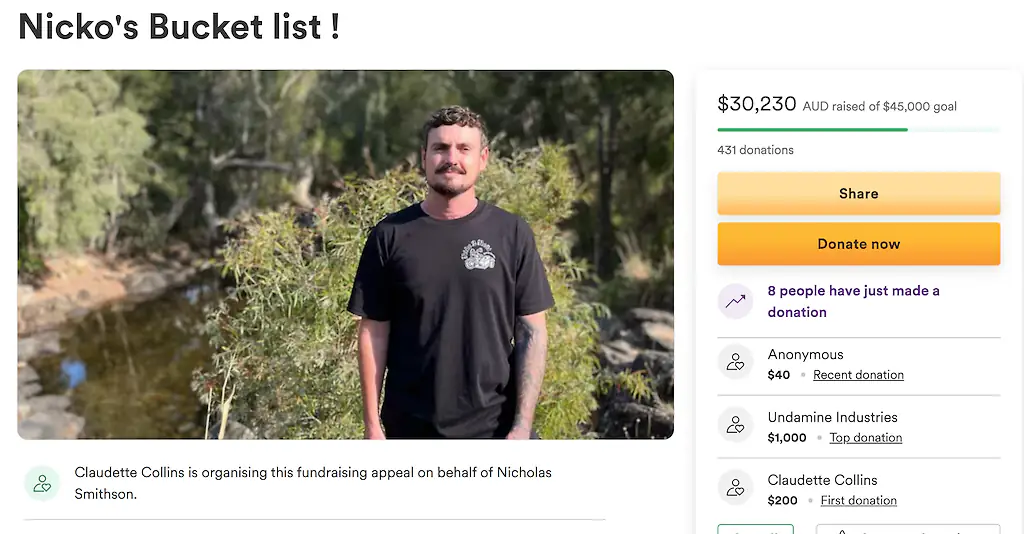
His friends have started a GoFundMe for his travel expenses to help him "kick off his bucket list" before he dies. Thus far, they have raised over $30,230 in donations after setting a $45,000 goal.
"Nicko has expressed that he would like to do as much traveling as possible while he still can," the page read. "Those of you who do not know Nicko, he is a kind, generous human being with a beautiful soul."
His friend Jamie Humble told Sunrise that he "didn’t know how to help" Nicholas after finding out about his cancer diagnosis and decided that creating the GoFundMe page was the best way to help him achieve his final goals.
"We thought we'd help him achieve his bucket list and his goals of traveling, and the only way we knew how was to start this GoFundMe page," he said.
"But we also started it to help raise awareness to others, to go get your skin checked, because these things, they creep up onto you," Jamie added.
Nicholas shared that among traveling to other countries being on his bucket list, he also wants to have some outdoor adventures in his last few months.
"On my bucket list, I’d love to go to Dubai and Japan, New Zealand, I’ve got a fair few things that I’d like to do... like the mega swing, and do a bit of skydiving," he added.