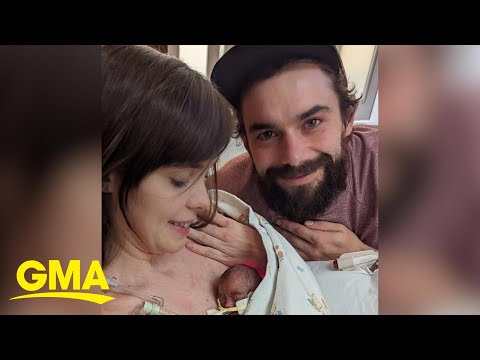
A baby boy who was born at 25 weeks finally went home with his family after spending the first 460 days of his life in the neonatal intensive care unit (NICU).
Fifteen-month-old Kendall Jurnakins left the NICU at Ascension St. Vincent Women's Hospital in Indianapolis on March 16.
Staff at the hospital gave their former patient an elaborate send-off, lining the halls and applauding the little one as he was taken out of the hospital in his stroller on his way home with his parents, Sparkle and Keith Jurnakins.
Mom Sparkle, 41, gave birth to her youngest child on December 11, 2020, via emergency cesarean section as a result of her high blood pressure, a situation made more precarious by the fact that she also has diabetes and only one kidney.
Kendall was born after just 25 weeks and weighed only 15 ounces. According to estimates by the doctor, the newborn had a 50-50 chance of survival at the time.
Dr. Taha Ben Saad, the neonatologist who took care of Kendall, explained to Good Morning America: "When he was born at 25 weeks and based on his weight, national data and international [data], his chance to survive was around like 50 to 60% ... this is only survival, not survival with complication or long-term problems, but he actually beat some odds."
Jurnakins told GMA she worried that her baby would not survive after being born prematurely. "I just was scared my baby wasn't gonna make it because they said at that small, he probably wasn't gonna make it," she recalled.
Kendall was suffering from respiratory distress syndrome and chronic lung disease and eventually developed problems with eating.
"I was going to visit him every day. He was really sick in the beginning," the doting mother said. "We couldn't figure out why he couldn't get his lungs together. So we had to, they told me that his lungs wasn't really fully developed like they should. They was gonna have to trach it. So we ended up having to have that big surgery, a trach put in for him to be healthy."
Kendall received a tracheostomy and was put on a ventilator to help with his breathing. He was later given a gastrostomy tube for feeding.
Around eight months into her son's treatment, Jurnakins became ill with Covid-19 and began receiving treatment of her own at the same hospital. She told GMA, her illness was so severe she "almost" died from it.
Like her son, Jurnakins was placed on a ventilator and got a tracheostomy. She was in the intensive care unit for two months.
Eventually, the doting mom recovered and she reunited with her infant in December 2021.
He was discharged just over three months later, with Jurnakins calling it "the best day of my life."
We wish this amazing family all the best for their future!
The world's smallest surviving newborn has recently been discharged from the hospital, five months after she was born. The child, named Saybie, was born in December 2018 at just 23 weeks gestation, according to the hospital. When she was delivered, she weighed just half a pound.
A press release revealed that Saybie was delivered at the Sharp Mary Birch Hospital for Women & Newborns in San Diego, where the mother was forced to undergo an emergency cesarean. The c-section was necessary after the mother experienced severe complications in the pregnancy.
Doctors discovered that the baby wasn't gaining weight and that the mother was suffering from preeclampsia and low blood pressure, putting her life at risk. "It was the scariest day of my life," Saybie's mother said, in a video later released by the hospital. "I just felt very uncomfortable, and I thought, maybe this was part of the pregnancy."
According to the mother, Saybie's father was told he would likely only have any hour with the newborn before she would die, but they were soon proven wrong. "But, that hour turned into two hours, which turned into a day, which turned into a week," she said.
Saybie has been reported to be the smallest baby ever to survive, according to the Tiniest Baby Registry (maintained by the University of Iowa). The baby weighed around half of what fetuses are expected to weigh at 23 weeks, NICU nurse Emma Wiest said.
"So, I went and saw her, and we could barely see her in the bed, she was so tiny," Wiest explained.
Following the birth, neonataologist Dr. Paul Wozniak worked to stabilise the newborn. The hospital's advanced life support team worked around the clock to keep her alive, before she was transferred to a neonatal intensive care unit. This team of experts continued to care for Saybie in the following five months in the NICU.
"Even when I'm not here I think about her, like 'how is she doing today?'" NICU nurse Kim Norby said. "She's a miracle, that's for sure."
A young family is getting the greatest Christmas gift of all, as their baby girl is finally coming home after almost nine months in hospital.
In a remarkable journey of resilience and hope, baby Evangeline "Evie" Statler has defied the odds and been discharged from St. Louis Children's Hospital, much to the joy of her parents, Maddie and Dylan Statler.
As reported by PEOPLE, Evie's miraculous story began when she was born prematurely in March - a staggering 16 weeks ahead of schedule and weighing just 14 ounces.
The Statler family's journey was shared in a news release by BJC HealthCare, which includes St. Louis Children's Hospital among its 14 hospitals.
Maddie, Evie's mother, recalled the initial shock and fear of having a baby born so prematurely, saying, "It was definitely scary. We didn't know if we both would make it or not and didn't know what would really happen. She was so tiny, like a little baby bird."
Evie's premature birth came with a host of health challenges, including pulmonary hypertension. The couple was informed that their newborn had a 50-60% chance of survival. Dylan, Evie's father, described the whirlwind experience, telling KSDK: "It all happened so fast."
In July, on what would have been Evie's due date, she was transferred from a hospital in Cape Girardeau, Missouri, to St. Louis Children's Hospital for advanced treatment.
Dr. Melissa Riley, a neonatologist who played a crucial role in Evie's care, highlighted the advancements in neonatology that have enabled medical professionals to push the limits of viability for premature babies in similar situations to Evie.
Over the ensuing months, Maddie and Dylan juggled the responsibilities of caring for their son at home while visiting Evie in the neonatal intensive care unit (NICU).
Despite the turbulent ups and downs, Evie's remarkable progress has been described as "almost a complete 180". Her health has improved to the extent that she was finally discharged from the hospital on a momentous Monday (December 18) - which means she will be home for her first Christmas.
Mom Maddie expressed the overwhelming relief of having Evie home, saying: "It feels like we can breathe again. A lot of days it felt like we were holding our breath underwater and couldn't come up for air."
Dr. Riley praised the collaborative effort of the medical team and the family's unwavering determination - highlighting that many people had worked toward the goal of giving the Statler family the best possible gift for Christmas.
And, as a result, the Statler family has developed deep bonds with the medical staff during their challenging journey. Maddie revealed how "the nurses and whole team feel like family now and brought light into our darkest days" at the hospital.
As the family welcomes their daughter home for the holidays, Maddie affectionately described it as "the best Christmas gift ever."
Parenting, while ultimately a fulfilling and joy-filled experience, has its fair share of stressful moments. Yet the anxiety of bringing up children and keeping them from danger isn't just relegated to when they're walking around of their own volition. Pregnancy itself can be an anxiety-driven experience as you worry about the health of the mother and her child.
As you can imagine, even the slightest hiccup along the way would be enough for any parents to freak out over all the things that could possibly go wrong. That goes for some bad bedside manner from the doctor or some problems that most pregnant women go through, so when things actually go south it would be an intensely stressful experience for everyone involved.
This was the case for 48-year-old mother Seeta, when she was rushed to the hospital to give birth prematurely. Once she arrived, doctors had to take immediate action as her blood pressure had risen to dangerously high levels, endangering the mother and her baby. They gave her an emergency C-section and managed to deliver the baby, but she was incredibly small and unlikely to survive in her current state.
The baby girl, Manushi, was born 12 weeks premature following the complications her mother went through, and weighed just 400 grams. With her foot the same size as her father's thumbnail, she ended up being one of the smallest babies to ever survive. Dr. Sunil Janged, the chief neonatologist at the hospital, said:
"When the baby was born, we were uncertain of what could happen. She was struggling to breathe, so was immediately put on advanced respiratory support ventilator to expand her tiny, immature lungs. She could not be fed adequately due to immaturity of her gut."
At the time of Manushi's birth, at only 28 weeks, she was only 8.6 inches long. She was barely able to breathe with underdeveloped organs, but made it through and was eventually discharged. Her parents are ecstatic now that she has beaten the odds and survived, calling the experience a miracle. "She's just fought and fought against all the odds, but she's made it," the 50-year-old Giriraj said.
Manushi, who was born on June 15 in a hospital in India, is now functioning perfectly, with her brain and other organs developing normally. After seven weeks in the hospital, she was able to take milk, and eventually reached a weight of 5.2 lbs. Then, after six months in the hospital, she was discharged. The treatment should have cost one million rupees ($15,730), but thankfully the doctors charged the family a nominal fee due to their low income.
It's incredible that a newborn baby that only weighed 14 ounces at the time of birth managed to recover to be a healthy child. It goes without saying that the family in question felt an overwhelming wave of relief once they received the good news, and are ecstatic to be raising a child despite the complications and stress they faced at the beginning.
A miracle baby who was given just one day to live has reached his first birthday despite the odds.
As reported by the BBC, Marie Clare Tully was told by doctors after she gave birth to her son Hector - prematurely at just 23 weeks on November 12, 2021 - that he would probably only have a day to live.
His mother was told to say her goodbyes because the one-year-old had a very low chance of survival as he has hydrocephalus, which means spinal fluid cannot flow around the body, due to a bleed on his brain. He also has chronic lung disease, retinopathy, a feeding tube, and centralized sleep apnoea.
Having had 15 operations so far, little Hector has now celebrated his milestone first birthday and his 41-year-old mother couldn't be more delighted.
As the brave baby boy was born during a time of heavy COVID-19 restrictions, he was put into isolation until he tested negative for the virus.
Hector's mother and his father, Angus, were not allowed to visit him for the first 40 hours of his life, and hospital staff sent them picture updates of their tiny son while he battled for life in an incubator.
The mother, who is a chief executive of a charity, explained to BBC Scotland that she "felt devastation" and "heartbreak" that she couldn't be with her son during the early "crucial" moments of his life.
"I saw him when he was born and gave him a kiss and then he was wrapped in plastic to keep him warm and rushed to the resuscitation department," Marie Clare said.
The mother also spoke about her son's battles to the publication and said: "His case is unique as he has extra complications due to his prematurity. He has also been very unlucky as the shunt inside his head keeps blocking."
She revealed that after almost two days, they were allowed to make brief visits to see him, and after five days, they were able to be with him all day.
Hector reached his first birthday two weeks ago. Credit: EyeEm / Alamy
After 42 days at the hospital, doctors took Hector off his ventilator and announced to his parents that he would live.
"When I heard, I let out a wail that came from the bottom of my soul, I can't articulate it, it was the greatest feeling in the world," the mother told BBC News. "There was still a long way to go but to know the team thought he was going to survive was so great."
However, it was not until April 2022 that the baby was allowed to go home - more than five months after he was born. Now, he is still a regular patient at the Royal Hospital for Children and Young People and has been rushed to ER 25 times.
The harm to his brain from hydrocephalus can induce a wide range of symptoms, including sickness, blurred vision, headache, and difficulty walking.
Despite the health struggles, the courageous mother said: "I feel like the luckiest person, he's so fun, he brings so much joy to so many people. I'm so proud of him. He is a miracle, he is beyond a miracle and I am so proud of him."
Marie Clare also shared her gratitude for everyone's positive prayers, and said that she makes sure "every day is great" for Hector by surrounding him "with all the love and joy and hope".
To celebrate their spirited son's first birthday, the couple stood at his cot at 1:14AM, as that was the time he was born, and "had a quiet moment" to appreciate him.
"We reflected on how he had made it and how we were the luckiest people," Marie Clare said, adding, "It's been the best year of my life."
It's an unfortunate reality of life that the more premature a baby is, the slimmer their chances of survival will be. However, thanks to technological advancements, those odds are increasing with every passing day, and in a study published by the British Medical Journal, it was revealed that since 1997, the odds of babies born between 22-31 weeks surviving have increased by 6%.
Despite this, there is a cut-off point at which survival is nigh impossible, and the most premature baby to ever survive was born at 21 weeks and 5 days gestation. After all, premature babies have not had a chance to develop properly in the womb, and it is incredibly difficult to recreate those conditions externally. So when baby Cullen was born at 22 weeks, the odds were far from being in his favor.
In fact, Cullen's start to life was so bleak that when his parents discovered he was going to be born at 22 weeks, a whopping 16 hospitals turned his mom away because they didn't have the resources necessary to treat a baby that premature.
[[imagecaption|| Credit: Robert Potter]]
His parents, Molli and Robert Potter, then discovered that most hospitals don't treat babies born before 24 weeks because the odds of survival are so slim, and babies born at 22 weeks like Cullen have a mere 2% chance of survival.
[[imagecaption|| Credit: Robert Potter]]
But Cullen's father finally got some good news when he called up the University of South Alabama Children's and Women's Hospital. They agreed to admit Molli and deliver Cullen by C-section as they had treated babies younger than 24 weeks before.
[[imagecaption|| Credit: Robert Potter]]
Cullen's birth, however, was not the first struggle that Molli and Robert had as parents, and a year ago, they sadly lost their daughter Ellie to a miscarriage. The picture above demonstrates just how small she was when she was born. The couple then had yet another miscarriage before Molli fell pregnant with Cullen - just two weeks after losing a second baby.
When Cullen was born, he too was a minuscule size and weighed a mere 13.9 oz - which is 0.8 lbs.
[[imagecaption|| Credit: Robert Potter]]
The couple's ordeal began when Molli began to experience bleeding early in her pregnancy and feared that she was about to lose a third baby to a miscarriage. This bleeding continued for a few weeks, and Molli had no option but to visit the hospital when the amount of blood she was losing increased. However, she was released after being told there was no cause for concern.
[[imagecaption|| Credit: Robert Potter]]
Then, just one day later, Molli was readmitted to the hospital - "this time for good" recounted Robert.
"I rushed to the hospital from off the boat (I work offshore pushing barges in the river system) praying for the whole 5 hours it took to make it there that her body could hold on and Cullen would be fine. That never happened. The hospital she was in wouldn't save a baby before 24 weeks and treated her all over again like she was going to miscarry and there was nothing they could do to stop it. She sat in that bed for 3 ½ weeks scared, nervous, confused, helpless and in pain. I thought I was a strong man until I saw the hell my wife went through during this whole process… I wish that on no one, EVER."
[[imagecaption|| Credit: Robert Potter]]
"After the 3 ½ weeks the doctors tried to convince her every day to remove the cerclage and save herself. That thought NEVER crossed my wife's mind. We made a promise to each other when we lost Ellie that if our baby was fighting, WE WERE FIGHTING! The high-risk doctors brought in the neonatologist and he looked her in the eyes and told her Cullen would have a 2% chance to make it and if he did would be mentally handicapped… a mentally handicapped child is still a child and still deserves to be loved and would be loved whole heartedly by us. A 2% chance is still a chance… that 2% we were willing to take… the hospital refused to help. They told us their policies wouldn't allow it.
"We were frantic! We knew by doing a TON of research that hospitals were trying to save babies before 24 weeks and some having great success with it. I called 16 different hospitals in 3 states and found the University of South Alabama in Mobile, AL. With some very strong convincing and a desperate race against the clock, we got her transferred there. As soon as we got into a room they had doctors from each department come to evaluate her and come up with a treatment plan. They were going to do everything possible to try to get Molli to the 22-week mark and bring Cullen into the world as healthy as he could be when he came."
[[imagecaption|| Credit: Robert Potter]]
"At 12:01 midnight on the day she hit the 22 week mark they treated her like we had a viable baby and we had hope. That hope was all she had left at this point. She was physically and emotionally drained. I was emotionally drained and felt like there was nothing I could say or do to comfort her, so I focused on trying to make sure her care was 110% right all the time. She went into labor pains on and off for the next couple days, then it happened… we reached the point her cerclage could no longer stay in and it was now life or death that it had to come out. When it came out, she had blood clots and tissue come out larger than my hands and I saw grave concern in the doctor's eyes. She was rushed for an emergency C-section. Cullen was coming, whether he was ready or not."
[[imagecaption|| Credit: Robert Potter]]
"Cullen was born March 14, 2018. His due date was July 16, 2018. The team from the NICU franticly worked on him as they worked to save my wife. It was a fight for them both at this point. The room was sheer controlled chaos, almost choreographed. We heard my son cry… we cried and we focused to make sure she made it out of surgery so we could see what our miracle looked like."
[[imagecaption|| Credit: Robert Potter]]
"I had to wait an hour to see him in the NICU… it was the LONGEST hour of my life. When the nurse came and got me I rushed to see him… he was the most beautiful tiny sight I had ever seen in my life. I was so happy and so scared at the same time because I knew his fight was just beginning."
Thankfully, during a whopping five months in intensive care (160 days to be precise), baby Cullen slowly but surely thrived. He soon won the hearts of all of the staff at the hospital who were fighting to give him the best possible chance of survival.
So, when the time finally came to discharge Cullen from the hospital, they wanted to mark the occasion in a special way.
[[imagecaption|| Credit: Robert Potter]]
On August 21, he was dressed in a tiny graduation crown and cap and proudly walked out ICU by one of the nurses.
To see the touching moment Cullen graduated from intensive care, check out the video below:
As Cullen prepared to finally leave the hospital, he stopped for a picture with one of the doctors who had helped care for him.
[[imagecaption|| Credit: USA Children's and Women's Hospital]]
Despite enduring so many difficulties in their quest to have children, Cullen was not Molli and Robert's first-born child. And when he finally got home, he was able to meet his big brother - who will undoubtedly be taking good care of him.
Robert said that he decided to share the family's incredible story so that other people who find themselves in a similar situation know that there is hope - even when the odds are stacked against them. He also wanted to draw attention to the need for hospitals to treat babies born before 24 weeks as Cullen's story is a testament to the fact that they can survive and thrive.
[[imagecaption|| Credit: Robert Potter]]
"These hospitals that refuse to save children because of policies are wrong," Robert wrote. "These babies deserve a chance and Cullen is a reason why. He has NO ISSUES and would have been left to die if not given a little help at first."
[[imagecaption|| Credit: Robert Potter]]
"The technology and education is there!" he said. "There are hospitals that WILL TRY to save these babies, so at least give parents information to give them a choice to transfer."
[[imagecaption|| Credit: Robert Potter]]
We would like to take this opportunity to wish Cullen and the Potter family all the best. Hopefully, Cullen's story will help save other babies born before 24 weeks. Where there is life, there is hope, and no child should be denied the chance to survive - no matter how slim the odds are.