


US4 min(s) read
Neuroscientist explains tragic reason co-pilot’s mic was left on in final moments before horror Florida Learjet crash

A neuroscientist and psychologist has explained why the co-pilot's microphone was left on during a tragic crash of a Learjet 60 into a South Florida neighborhood.
Photos of debris that found its way into a woman's home following the crash were also released earlier this week.
The National Transportation Safety Board (NTSB) provided updates on its investigation into the jet, revealing that most of the Learjet 60's left elevator was recovered in three pieces, scattered up to 3.8 miles from the crash site.
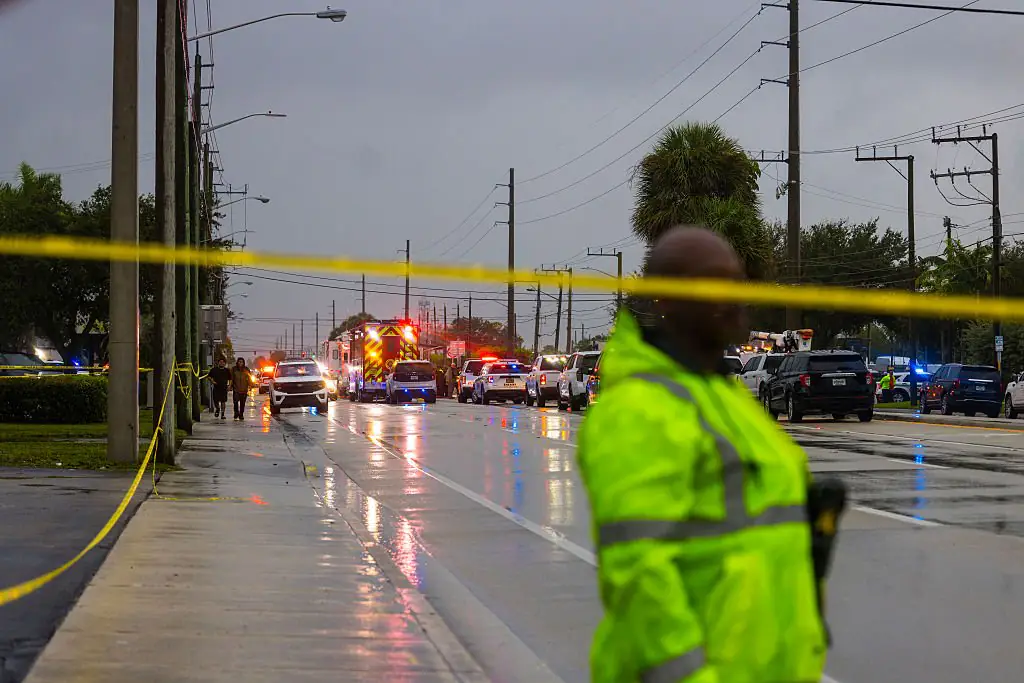
The Bahamas-bound private jet was flying at an altitude of 35,000 ft before plummeting into the ground in just 76 seconds, bursting into a ball of flames on Sunday.
Unfortunately, all nine souls on board were killed in the horrific crash, with all the victims identified.
But now, a neuroscientist has suggested why the co-pilot could be heard speaking as the aircraft went down.

Neuroscientist explains radio recording
Derek Van Schaik is a neuroscientist with Master's Degrees in Psychology and Forensic Psychology, among other qualifications.
He posts videos featuring psychological commentary and opinion on a number of subjects, from celebrities to tragedies.
In a video focusing on the Learjet 60 crash, he plays a snippet of the audio that was captured by the co-pilot, where she can be heard screaming: 'Look outside'.
The crew on board the jet consisted of 55-year-old captain Jeff Gregory and 20-year-old co-pilot Nathalia Gadelha Filgueiras.
Van Schaik noted: "First, it's interesting that Nathalia is communicating a flight deck conversation to ATC (Air Traffic Control).
"However, this is what makes this crash so unique. This type of pilot-to-co-pilot conversation is usually only found after listening to the flight voice recorder."

He explained: "But since she was holding down the push-to-talk button, we're hearing all of this because it's available live and immediately as public information.
"But why was she holding down that push-to-talk button?" he asked.
Well, it turns out that there are a few explanations for this happening, as the neuroscientist explained that it was a moment of 'extreme stress', with her focus on the situation at hand so it's likely 'she didn't realize she was still pressing it'.
"Under intense stress, our attention narrows, making us less aware of less significant actions like maintaining our grip, holding down a push-to-talk button," Van Schaik suggested.
But that's not all, as he further suggested: "She may have deliberately kept transmitting in hope that ATC could somehow help or subconsciously understand the importance of leaving a clear record of what was happening before they sadly crashed."
Playing the audio once again, he points out that Filgueiras shrieks as she starts to understand 'what their fate will be.
"Keep in mind there are the flight crew responsible for the health and safety of everyone on board, and realizing that there are seven passengers, two of which are very young children," he added.
Van Schaik said that this must have been 'unbearably heavy' and highlighted that the pilots likely met the passengers before they boarded the aircraft.
NTSB spokesperson reveals more about crash
Speaking on Tuesday, NTSB spokesperson Thomas B. Chapman explained in a press conference that the discovery of the left elevator changes the shape of the investigation.
"It tells us that at least some components, some pieces of the aircraft, important pieces of the aircraft separated before the impact," he said.
"What that means exactly in terms of what caused the aircraft to lose control, or whether the loss of this piece was a result of the forces on the aircraft, we don't know yet. It's going to take some more analysis."
He also explained that the distances the elevator pieces were found at showed they broke off before the plane crashed, instead of being scattered upon impact.
Chapman added: “The function of the elevator is to control pitch up and down,
“At those speeds, I don’t know if it would be effective even if it had still been attached to the aircraft.
“But knowing that it was lost is a very important piece of evidence in terms of pointing us toward other things to investigate,” he stated.
He also confirmed that weather conditions are 'a key focus of the investigation.'