


US5 min(s) read
NTSB finds Learjet 60 tail pieces miles from Florida crash site

Investigators have found pieces of the tail of the Learjet 60 that crashed in Florida on Sunday scattered up to nearly four miles from the impact site, confirming that part of the aircraft broke apart in the air before it hit the ground.
The left elevator, a component on the tail that controls the aircraft's pitch by moving the nose up and down, was found in three separate pieces between 1.3 and 3.8 miles from where the jet struck the ground in Greenacres, Palm Beach County.
The distance alone tells investigators that the pieces came off during the descent, not on impact.
Without the elevator, the crew would have had no way to pull the nose up.
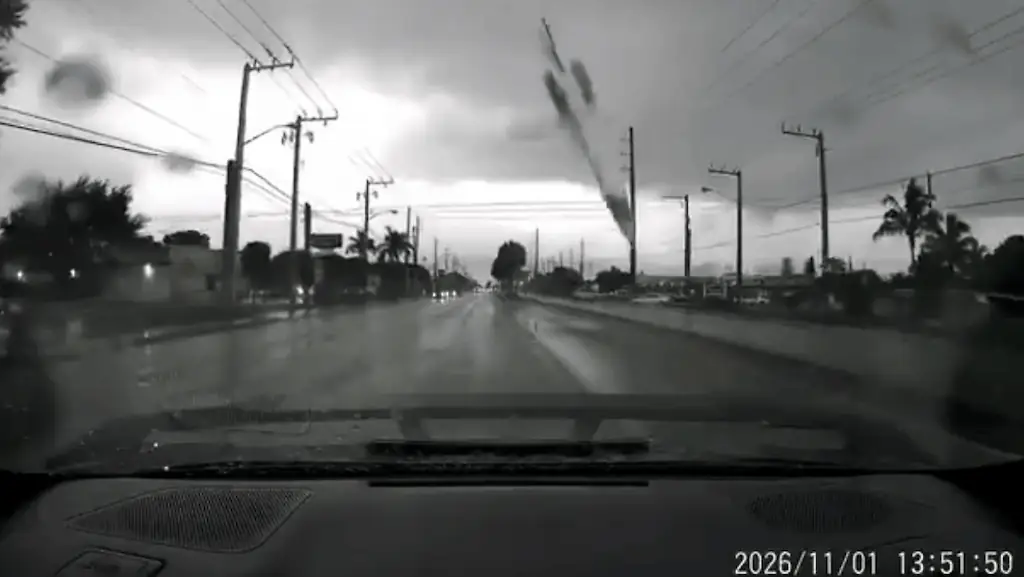
That would explain why dashcam footage shows the jet plunging almost vertically into the ground at a rate the NTSB now says reached 32,000 feet per minute.

What the NTSB said
National Transportation Safety Board spokesperson Thomas B. Chapman told a press conference on Tuesday that the discovery changes the shape of the investigation.
"It tells us that at least some components, some pieces of the aircraft, important pieces of the aircraft separated before the impact," he said.
"What that means exactly in terms of what caused the aircraft to lose control, or whether the loss of this piece was a result of the forces on the aircraft, we don't know yet. It's going to take some more analysis."
That last point is critical. The elevator may have broken off because of a structural failure or maintenance issue, which would mean it caused the crash. Or it may have broken off because the aircraft was already in an uncontrollable dive and the aerodynamic forces tore it apart, which would mean the icing or another factor caused the dive and the tail failure was a consequence rather than a cause.
Both possibilities are on the table. The NTSB has not ruled either in or out.
What we already knew
Cockpit audio released via LiveATC captured the crew reporting icing conditions and moderate turbulence before declaring a mayday. The pilot reported an 'overspeed condition' and a descent rate that climbed rapidly from 10,000 to 20,000 feet per minute. The final words from the cockpit were: "We're out of time."
The descent rate has since been revised upward.
The NTSB now says the aircraft was falling at approximately 32,000 feet per minute when it hit the ground, significantly faster than the 22,000 feet per minute reported from the cockpit audio.
At 32,000 feet per minute, the jet was falling at roughly 360 miles per hour straight down.
Nine people on board were killed.
They have been identified as tech entrepreneur Adam Robinson, 44, his wife Helen Sharp, their children Emma, 4, and Charlie, 2, their nanny Anita Maria Apellido Cetina, friends Rachael Reed and Charmi Fehr, captain Jeff Gregory, 55, and co-pilot Nathalia Gadelha Filgueiras, 20.

What investigators are doing now
A major storm in Florida on Monday hampered the investigation, but on Tuesday, NTSB teams were able to collect and document evidence at the crash site and along the debris trail where the elevator pieces were found.
Investigators are now seeking documentation related to the aircraft's maintenance history and crew performance records. The Learjet 60, registration N722BD, was owned by a Delaware-registered corporation and operated as a chartered flight from Austin, Texas, to the Bahamas.
Chapman said he was confident investigators would find what they needed.
"Despite the challenges, I feel confident they're going to find what they need to help put together what happened here and why it happened."
Why the elevator matters
The elevator is the primary flight control that allows a pilot to raise or lower the nose of the aircraft.
Without it, the crew cannot control pitch.
If it failed during or immediately after the icing event that was reported in the cockpit audio, it would explain why the pilots were unable to recover from the dive despite clearly trying to do so.
The fact that the three pieces were found spread across a 2.5-mile stretch, starting 1.3 miles from the crash site, suggests a progressive failure rather than a single catastrophic break.
The elevator may have cracked, then split, then separated entirely as the forces on the aircraft increased during the descent.
Whether the icing caused the elevator to fail, or whether the elevator failed independently and the icing was a coincidence, is the question the NTSB is now trying to answer.
The maintenance records, the wreckage analysis, and the flight data recorder will all play a role in that determination.
The investigation is ongoing.