ADVERT
Weird1 min(s) read
Published 15:02 23 Aug 2019 GMT
Those of us who are light sleepers know how difficult it can be to fall asleep and, most importantly, stay asleep without the slightest hint of noise waking us up from our short-lived slumber.
But you certainly don't have to be a light sleeper to be seemingly unable to fall asleep - if the person you are sleeping next to happens to be a particularly loud snorer. I mean, every single one of us snores every now and then - some people, however, snore from the moment their head hits the pillow, and at an insufferably loud volume.
It's not all bad, though, because if you do happen to share a bed with someone who snores incredibly loudly, they might just be in with a chance at landing a spot on an upcoming TV show.
Yep, a brand new show is on a quest to find the UK's loudest snorers. So if you happen to be a loud snorer or know someone else who is, this could be your ticket to fame.
Producers for the currently unnamed show are specifically looking for couples in which one partner is significantly impacted by other's snoring.
Here's a brief run-through of what the producers are looking for, courtesy of Firecracker Films spokesman:
"Is your partner's snoring ruining your life? Is sleep a long and distant memory? Are you at the end of your tether? If so, we want to hear from you. Firecracker Films is making an exciting new show for a major terrestrial broadcaster and we're looking to find some of Britain's biggest and loudest snorers."
Not everyone is kept awake at night as a result of unbearably loud snoring. This woman has a condition which has earned her the nickname, 'Sleeping Beauty':
[[jwplayerwidget||https://content.jwplatform.com/videos/4475YRj2-sKUnNGKf.mp4||4475YRj2]]
If you're interested in appearing on the show, fill out the application form here. Also, note that all participants must be 18 and over and that filming is set to begin next month.
relationships1 min(s) read
Published 09:27 17 Oct 2019 GMT
Those of us who are light sleepers know how difficult it is to fall asleep and, most importantly, stay asleep without the slightest hint of noise waking us up from our short-lived slumber.
But you certainly don't have to be a light sleeper to be affected by surrounding noises - if the person you are sleeping next to happens to be a particularly loud snorer. I mean, most people snore from time to time - some, however, snore from the moment their head hits the pillow, and at an intolerable volume.
Not everyone is kept awake by unbearably loud snoring. This woman has a condition which has earned her the nickname, 'Sleeping Beauty':
[[jwplayerwidget||https://content.jwplatform.com/videos/4475YRj2-sKUnNGKf.mp4||4475YRj2]]
If your partner happens to be a loud snorer, you'll be pleased to hear that a device has been developed - by a team of scientists, no less - which promises to bring an end to all the insufferable sleepless nights.
According to scientists from Araba University in Spain, a new battery-powered buzzer, known as the Somnibel, is designed to help people suffering from obstructive sleep apnea (OSA), a potentially dangerous condition which causes breathing to repeatedly stop and start during sleep.
The Somnibel is worn on the snorer's forehead and sends out vibrations the moment they roll onto their back, and continues to do so until they go back on their side. The Daily Mail reports that the device also suppresses snoring in one in three snorers.
Their website states that it "reduces the incidence of sleep apnea and/or positional snoring".
It adds: "It consists of a small and light device attached to the forehead that applies a soft vibration while the patient sleeps supine (on their back) to induce him to change position, thus reducing the incidence of sleep breathing events, whether apneas or positional snoring."
Professor Jaydip Ray, an ear, nose and throat consultant at Sheffield University, told the Daily Mail: "Simple snoring is a common social and medical problem that adversely affects many people. Easy to use, unobtrusive wearable devices using miniaturised accelerometers are a welcome solution for many of them. This initial study is encouraging."
The Somnibel is not yet available to buy but will be soon, according to Sibelmed, the company that is producing the device.
health2 min(s) read
Published 10:57 27 Jan 2021 GMT
We all know there's nothing more annoying when you're trying to go to sleep than listening to someone else snoring.
Seriously, when it's getting late and you've got to get up early the next day, it can be really aggravating lying there in the dark next to someone whose sinuses are making a noise like a chainsaw revving.
So if you're missing out on some much-needed shut-eye because of someone else's loud snoring, then I have some good news for you. A doctor has gone viral on social media this week after sharing a simple trick to stop other people from snoring.
Take a look at the video on the snoring hack here:According to news.com.au, the genius hack was shared on the British daytime talk show This Morning, when hosts Holly Willoughby and Philip Schofield conducted a virtual interview with sleep expert Dr. Sophia Bostock.
In the interview in question, Dr. Bostock explained that snoring often occurs when someone sleeps on their back.
However, if you contrive a way to attach a tennis ball, or similar-shaped object, to the back of your pajamas, this will prevent you from resting horizontally - and supposedly keep you from snoring.
Dr. Bostock stated:
While you're at it, take a look at this hilarious video of a man pranking his wife with an egg yolk:"Snoring gets worse when you lie on your back because when you lie on your back your mouth is more likely to open.
"Anything you can do to keep yourself leaning on the side should help. A tennis ball sewn into the back of your pajamas can make it uncomfortable."
Meanwhile, internationally-renowned Harley Street therapist Karl Rollison concurred with Dr. Bostock's method, stating in an interview with Tyla: "When we sleep on our backs the tongue and soft palate relax, succumb to gravity and rest on the back of the throat and make a vibrating noise.
"The jaw also relaxes so the lips open and the mouth becomes an organic echo chamber amplifying the sound.
"So, when we snore our heads become big, squidgy speakers playing really bad music. Sleeping on your side is less restrictive on the airways and creates better airflow. This is one of the reasons unconscious people are placed in the recovery position."
lifestyle1 min(s) read
Published 17:05 02 Mar 2020 GMT
Those of us who are light sleepers know how difficult it can be to fall asleep and, most importantly, stay asleep without the slightest hint of noise waking us up from our short-lived slumber.
But you don't have to be a light sleeper to be unable to fall asleep - if the person you are sleeping next to happens to be a particularly loud snorer. I mean, every single one of us snores every now and then - some people, however, snore from the moment their head hits the pillow, and at an insufferably loud volume.
Not everyone is kept awake at night as a result of unbearably loud snoring. This woman has a condition which has earned her the nickname, Sleeping Beauty:
[[jwplayerwidget||https://content.jwplatform.com/videos/4475YRj2-sKUnNGKf.mp4||4475YRj2]]
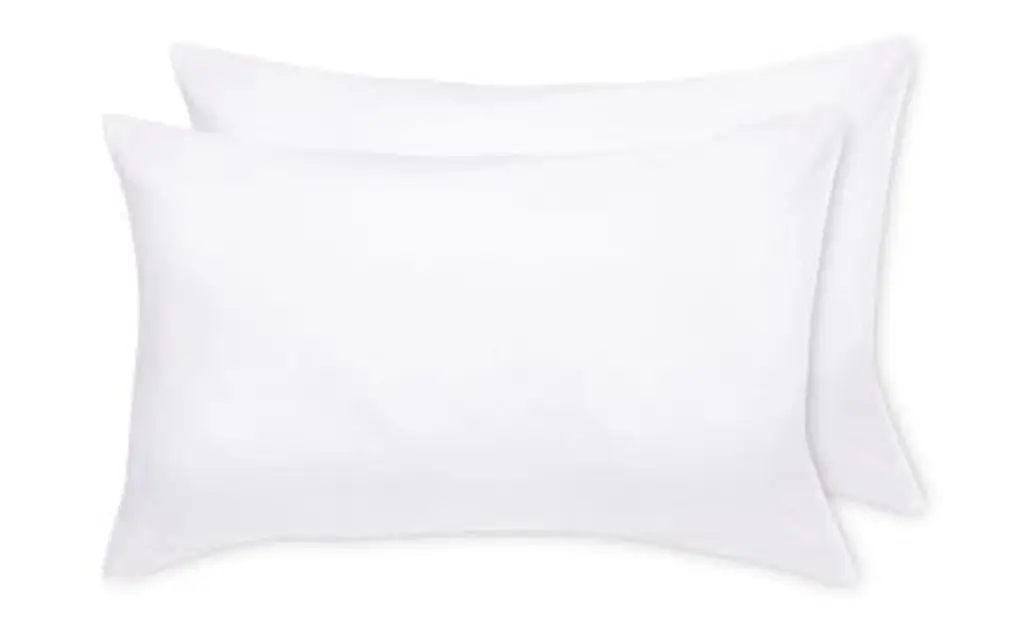
It's not all bad, though, because if you do happen to share a bed with someone who snores incredibly loudly, then you might just benefit from getting Aldi's new anti-snore pillows.
The budget supermarket is selling a two-pack of the item for £11.98. According to Aldi, the pillow lifts the position of the head and allows your airways to be kept free and open as a result.
Take a read of the official description for the product:
"This 2 pack of Kirkton House Anti Snore Pillows is a comfortable way to help snorers, meaning everyone can get a better night's sleep! The S-shaped foam insert wrapped in the hollow fiber helps to elevate the head position, keeping your airways open!"
And the reviews are fairly impressive too!
One buyer wrote: "Lovely and comfy when you get used to it but can’t say it stopped his snoring but it wasn’t as bad."
Another added: "These pillows are excellent my neck is much better supported than with any pillow I've tried in the past."
A third said: "Got new bounce back duvet so bought new pillows anti snore pillows and bounce back so I had a set."
A different buyer gushed: "Very comfortable value for money good quality will buy again."
lifestyle1 min(s) read
Published 17:26 12 Mar 2020 GMT
Snoring is one of the most annoying sounds audible to the human ear. And although it's never intentional, it can make even the most pleasant people an occasional nuisance.
The trouble is, though, if you, as the snorer, aren't even aware that it's happening - there's very little that can be done about it. I mean, there are only so many times a partner or roommate can nudge you before one, or both of you, feel completely exasperated.
Related - this girl has a rare condition, which causes her to sleep for days and has earned her the nickname Sleeping Beauty:
[[jwplayerwidget||https://content.jwplatform.com/videos/4475YRj2-sKUnNGKf.mp4||4475YRj2]]
Not all of us are able to fall asleep at the drop of a hat - and allow our slumber to immediately drown out all the snoring. But if you're one of these people, fret not! Because someone has invented an award-winning anti-snoring device.
The product in question, known as the Snooezeal, was invented by British surgeon and sleep disorders expert Professor Anshul Sama. His gadget works by zapping the snorer's tongue with a tiny electric current.
Impressively, the Snoozeal has enjoyed a 70 percent success rate in trials conducted in Britain and Germany, as reported by the Mirror.
Per the Mirror, one London-based user of the product, Louise Fitzpatrick, swears by it. Apparently, Fitzpatrick's snoring was so bad that she would sleep in the spare bedroom away from her partner Martin Whelan.
She started using the Snoozeal after being placed in a trial for the oral device at University College London Hospital - and it worked a treat.
Here's how it works: you place it into your mouth for 20 minutes at any time of day - just not while you're asleep - for six weeks.
It contains two electrodes that rest against the tongue on both sides. An app on your smartphone then transmits a tiny current to the device and passes into your tongue. The current is supposed to tighten floppy muscles in your tongue and near the back of your throat, which should in turn significantly help with the snoring problem.
Who knew it was that easy?
health2 min(s) read
Published 18:05 04 Dec 2018 GMT
There's nothing better than a long lie-in, right?
Seriously, every morning when my alarm sounds, I moan and groan and pray to God for an act of divine intervention to make sure I get to stay in bed just a little bit longer. The thing is, I don't really appreciate how lucky I am. As it turns out, there are people out there who are literally sleeping their lives away. One such person is 18-year-old law student Megan Firth, who suffers from Kleine-Levin syndrome - also known as Sleeping Beauty syndrome.
Megan, who was first diagnosed back in 2013, can now sleep for up to 20 hours a day as a result of her hypersomnia. Her condition affects only affects only one person in every million, and means she spent months in bed; only rising to use the bathroom and eat. Although she doesn't sleep all the time, her hypersomniac episodes are often triggered by the cold and dark winter season, as well as by air travel. Meghan often experiences an intense 'brain fog' and occasionally becomes unable to distinguish between dreams and reality when in a fugue state.
Commenting on her condition, Megan stated:
"[My family] are all pretty used to it by now and know not to bother me, as I can become very panicked when I’m woken up in the middle of a long sleep. It’s quite difficult because you can really feel like you’re missing out, when all these new friends are going out until late each night and you have to be back in bed before midnight. Luckily, I have made some really great friends who have been very understanding, but I still have to think about it all the time, otherwise, if I stay up too late, I can trigger another episode and become bedridden for several weeks."
She added:
"My mum and dad were very worried and thought I might have a brain tumour, because the doctors I saw had no idea what it could be. But then one day my mum was up late Googling my symptoms and Kleine-Levin popped up. It seemed to match perfectly with what I was experiencing, so she suggested it to the doctors in Queensland Children’s Hospital, where I was being treated, who agreed."
"KLS has meant sacrificing a lot. I played county cricket for Oxfordshire, but I found that I couldn’t keep that up and do my school work, because I was just losing so much time sleeping ... I have to think about it a lot and be careful to make sure everyone at uni knows that I have this problem. All of my friends are very aware of it, and so is the university, who give me longer to hand in my essays and extra time in exams. The worry is that one day I could fall asleep and never wake up, so I text my mum every morning to tell her I’m awake and if I don’t, she’ll ring one of my friends and ask them to wake me up."
Despite her rare condition, which meant that she spent far less time in school than her classmates, Megan has still managed to get a place at Nottingham University to study law, and so far her first term has gone well. She's only had two sleepy episodes since starting, and says that her tutors and fellow students have been very understanding. Even after everything she's been through, Megan is confident she can live a normal life.
So next time you start whining about having to get out of bed early, or moan about not being a morning person, then just remember that it could be worse!