Uncategorised6 min(s) read
uncategorised6 min(s) read
"Would the children understand what the doll was to begin with? Would the child understand? Because I think the child would see it as a doll. Those are my thoughts. Unless it's explained, and then the explanation would have to take quite an adult turn. The dolls are for quite youngish children and I think it would go over their heads, so it would be difficult to explain exactly to a young child. They're not dolls, they're for an older child. I wouldn't give it to my child. They don't even have the life skills to grasp other things. I'm not against transgender people, I just feel that there's an age that you can explain it. It's too early."
- Gerald, 58
"Absolutely, yes! I'm so on board with this! I'm a teacher, so I try to stay as woke as possible for the kids. There's just no point in trying to box people in, like 'oh you have a Barbie doll, oh you have a superhero'. Like what the hell? Do whatever you want. Might as well give them the option."
- Alyssa, 26
"I know it's not PC to say, but I don't really get the transgender thing. So, no. I would not give that to my child. I know I'll get a lot of flack for this, but if you were born as a boy, you're a boy. Act however you want in the body that's been given to you, but I don't get changing your body to be a certain gender."
- Tom, 81
[[instagramwidget||https://www.instagram.com/p/BQWoM33giJI/]]
"My youngest son played with dolls, I supposed they were all female dolls. I don't think anything else was available at the time. In principle, I'd have no problem at all, because I think young kids, if they're thinking about their gender, then that can't be a bad thing. You'd have to be a bit brave to choose that for your kid, but in principle, I think it's good because the earlier the kid thinks about their gender, the better."
- Bill, 47
"It would be confusing. I think you go have an operation done to change a certain look, you're already male or female, you're not born anatomically that way."
- Ebony, 43
"I'm transgender myself and I would not give the doll with the penis to my child. I think that children don't need to see that stuff yet, they're innocent. The fairy doll looks like it's for a really young child, like what? Three or four? They haven't developed yet, so they don't need to be thinking about that on their toys. Saying that, of course I want to encourage people to accept transgender people and I am fully one hundred per cent behind the Jazz Jennings doll. I'd buy that doll in a heartbeat, and I might."
- Harry, 26
"I don't see a problem with it. It might be difficult to explain to the kid but they have the right to know, because some people feel like that. They [transgender people] are human beings, like everyone else."
- Kasha, 26
"I think it would be more confusing. I don't know what the purpose would be. I don't think normalising transgender people is going to be done with a doll, it's going to be done with mentors and parenting. I don't think they're pretty. I don't think they're cute and cuddly. I never gave my kids a doll so they can help identify what their sexual identity is. It's more about imagination and dressing. For girls, it's about dressing the doll for clothes, you're not interested in the anatomy. That's not their first concern and I don't want that forced upon them, unless they ask. They're not developed yet anatomically and their mind is not developed yet, so all in good time."
- Robin, 46
"Nope, I wouldn't give it to my kid. It's a boy no matter what anyone says, born a boy, always gonna be a boy"
- Valerie, 34
[[instagramwidget||https://www.instagram.com/p/BcoBJWXB2PT/]]
"I think it's a great idea. Who cares whether the doll has genitalia or not? Children are just going to look at it as a doll, they're not going to sexualise it. And if they play with transgender dolls, when they see a transgender person in real life, they're just going to think that's normal, which is was it's all about. We need to push for acceptance, not discrimination."
- Emma, 32
"I would give my child the Jazz Jennings doll, but certainly not the doll with the penis. No other children's toys have intimate parts, why should this one?"
- Antonio, 29
"It's an awesome idea. Definitely needed. Why not diversify how children grow up with the world, if that's really the world around them? Bring up the idea that it's okay to be whoever you want to be from an early age, because it is."
- Felicity, 25
So, there you have it. The question of whether parents would give their children a transgender doll was incredibly divisive among the people of London and it seems that no two people really had exactly the same point of view. All we know is that, with Playboy announcing their first ever transgender playmate, and transgender men giving birth to gender-neutral children, the future looks bright for the LGBTQ community. Featured illustration by Egarcigufilm & tv2 min(s) read
Eddie Redmayne has opened up about his 2016 portrayal of a transgender woman in the Oscar-winning movie The Danish Girl.
The critically acclaimed film, which earned Redmayme an Academy Award nomination for Best Actor, centers around Lili Elbe who is believed to be the first person to undergo gender reassignment surgery.
Redmayne, a cisgender man, played Lili in the movie - and this casting choice remains a subject of criticism to this day. Transgender activists argue that the role should instead have gone to a trans woman.
It's been half a decade since the movie's successful release, and it turns out, in that time, Redmayne has come to agree with the critics that, in hindsight, it was wrong for him to take the role.
In an interview with The Sunday Times, he was asked whether he would choose to play the character today, given the criticism it sparked previously.
Redmayne responded: "No, I wouldn't take it on now. I made that film with the best intentions, but I think it was a mistake."
At this point in the interviewer, journalist Kirsty Lang mentioned that the film was only given the go-ahead when Redmayne was cast after he won an Oscar for his performance in The Theory of Everything.
To which, Redmayne replied: "The bigger discussion about the frustrations around casting is because many people don't have a chair at the table. There must be a leveling, otherwise, we are going to carry on having these debates."
Redmayne's co-stars in the movie have continued to defend Redmayne's portrayal of a trans woman.
Back in August, Alicia Vikander - who won the Academy Award for Best Supporting Actress for her portrayal of Gerda Wegener in the movie - told Insider that she thought Redmayne did "a wonderful job in the role."
"I totally understand the criticism that has been out there, because we need to make a change and we need to make sure that trans men and women actually get a foot in and get work," Vikander said.
"My only concern is that we may need to get to a point in the end where we have trans women and men playing cis characters. Because that is the main thing, you know?"
lgbtq5 min(s) read
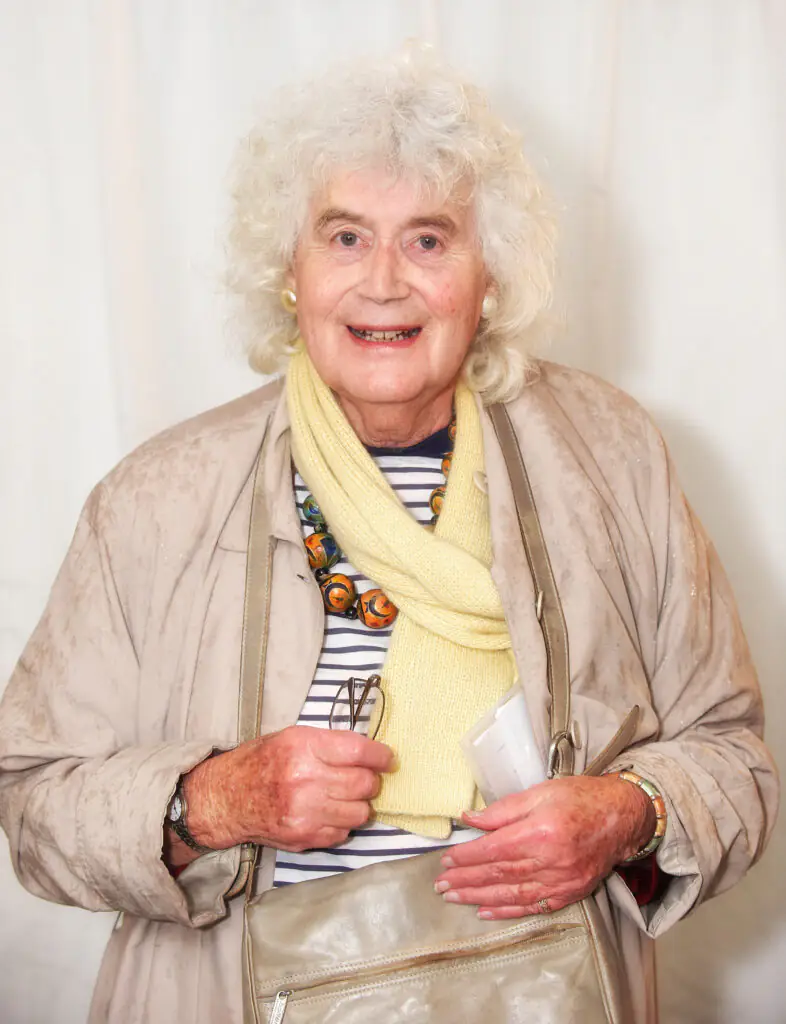
Jan Morris had a colossal impact on the transgender community.
The Welsh historian, author, and writer is hailed as an LGBTQ+ "pioneer" for her book Conundrum.
Opening up about her gender transition from man to woman, Morris poured her heart out in the 1974 book, recalling how she knew at the age of three or four that "I had been born into the wrong body, and should really be a girl."
Describing that realization as a "cherished secret" she fought to keep for many years, the "conviction of mistaken sex" became "no more than a blur, tucked away at the back of my mind."
As Morris desperately battled to try and suppress her "secret", she couldn't stop a yearning from eating her up inside.
She wrote: "It was as though there were a piece missing from my pattern, or some element in me that should be hard and permanent, but was instead soluble and diffuse."
Morris, who was born as James in 1926, joined the army in 1943, before studying English at Oxford University and began working as a journalist.
Per the Guardian, she was sent to climb Everest in 1953 by The Times, and gave them the scoop that the mountain had finally been conquered by writing the following coded message: "Snow conditions bad stop advanced base abandoned yesterday stop awaiting improvement."
The news that Everest had been conquered for the first time was published on the morning of Queen Elizabeth's coronation and marked a huge victory for Britain.
After making history in the British Mount Everest expedition, Morris spent the next year traveling from New York to Los Angeles – a journey that became the basis for her first book, Coast to Coast, in 1956.
It was described by the Guardian as "admirably evocative" at its best where Morris had "drunk deeply of American life".
She then went on to work for the Guardian and traveled to Egypt on behalf of the newspaper.
This role saw her once again break major historical news – the first evidence of French collusion in the Suez conflict. Namely, this was the incineration of Egyptian lorries and tanks, which French soldiers told her had been supporting the Israeli campaign with napalm bombs.
For the next five years, Morris continued to work for the Guardian and wrote another six writing books on South Africa and the Middle East, with the publication of her book Venice in 1960.
While she was writing Venice, Morris decided to start addressing her "secret" and made the decision to start taking hormones. In 1972, she completed her transition with the help of a surgeon in Casablanca.
"I should have been terrified, but I wasn’t," she told the New York Times in 1974. "It was inevitable – I'd been heading there mentally all my life."
Jan Morris discusses her life in a 2000 interview with CBS:Two years later, Conundrum hit shelves for the first time.
At first, critics struggled to decide how to react to the pioneering book.
Reviewing the book, AN Wilson of the Guardian admitted that he was unsure as to why it was easy "to let a little bitchiness creep into one's comments on Miss Morris's most interesting book."
Meanwhile, Rebecca West wrote in the New York Times that "now we are both women he mystifies me".
The journalist then went on to question the validity of Morris's trans identity, writing: "She sounds not like a woman, but like a man's idea of a woman, and curiously enough, the idea of a man not nearly so intelligent as James Morris used to be … I cannot accept Conundrum as the story of a true change of sex."
However, while critics might have struggled to accept Morris's story, she received a much more welcoming reaction from those in her hometown, explaining that no one batted an eyelid when she introduced herself as Jan instead of James.
"I put it down to kindness," she told the Observer in 2020. "Just that. Everything good in the world is kindness."
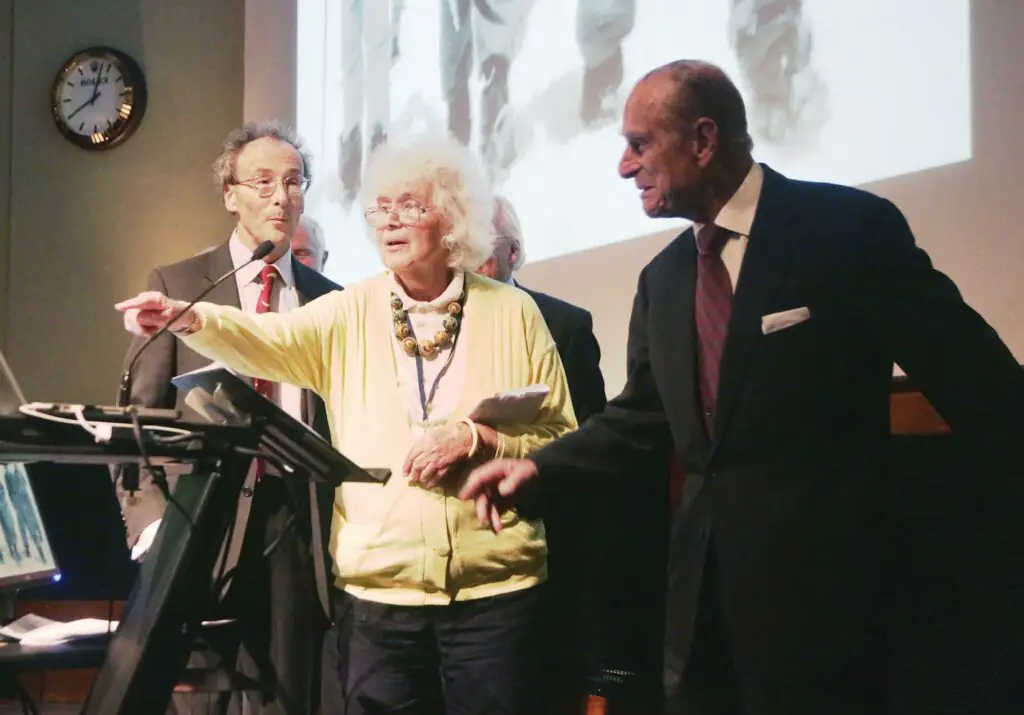
Morris is pictured below in 2013 with Prince Philip.
Despite some negativity from critics, Conundrum went on to become a worldwide bestseller and helped validated many who were in the process of questioning themselves at a time when transgender identities were far less understood than they are today.
However, this was far from Morris' only notable literary achievement, and her three-volume history of the British Empire, Pax Britannica, was completed in 1978, and her novel Last Letters from Hav, was shortlisted for the Booker prize in 1985.
Looking back at her life in an interview with the Financial Times in 2018, Morris said that her transition no longer felt like the defining moment of her life. She said that it hadn't changed her writing "in the slightest" and that "it changed me far less than I thought it had".
Towards the end of her life, Morris lived with her partner Elizabeth. In November 2020, she passed away at the age of 94. She wrote on the epitaph: "Here are two friends at the end of one life."
Paying tribute to the LGBTQ+ icon after her passing, Wales' First Minister, Mark Drakeford wrote on Twitter that Morris was "a real treasure to Wales".
*LGBTQ+ History Month – to fully understand the present, we must educate ourselves on the past.
lgbtq2 min(s) read
Jareth Nebula wants to raise awareness for those who feel like they're from another planet - and officially identifies as a genderless alien.
Nebula, 33, was born female, but transitioned to male when they were 29 years old, changing their name to Jareth (inspired by David Bowie's character in the Guillermo del Toro film Labyrinth).
Now though, the Washington receptionist feels as if they not only don't feel tied to any particular gender, but doesn't really identify much as a human either. Instead, Nebula thinks of themself as an alien with no gender, describing themself as "otherworldly".
"After coming out as transgender and believing I had finally found myself, I realised I was wrong, they explained. "I wasn’t male or female, or even human. I don’t think or feel like humans. I can’t really explain it to others – I’m simply otherworldly. I didn’t feel comfortable as either gender or even anything in between. I know I’m stuck in a human form and that’s how I’m perceived by others – but to me, I’m an alien with no gender."
Jareth has felt like they don't belong in the crowd for quite some time. It was an issue that plagued them for the longest time, and followed a diagnosis of Ehlers-Danlos syndrome (EDS). EDS is a condition that affects skin and joint connection tissue, and as a result of the illness, Jareth had an increased range of mobility, as well as extra stretchy skin.
"The condition [EDS] means I can pop my joints out on purpose, which was a fun party trick when I was a kid," Jareth, who wished not to disclose their birth name, explained.
Dubbed Mr Elastic by their doctors, Jareth suffered from chronic pain. "I get to a chiropractor once every two weeks and see a physical therapist once a week, as well as smoking medicinal marijuana for the pain – but there is currently no cure for EDS," they said.
Jareth initially described themself as a "hyper-feminine female" and even modelled in their teens, by their late 20s, Jareth decided to transition to male, and began hormone treatments right away, changing their sense of style toward something more masculine and getting their breasts removed in surgery.
But Jareth found they were no more comfortable living as a man than they were living as a woman, stating:
"I thought being a trans man would solve all of my issues and inner battles with finding out who I was, but I wasn’t as happy as I expected to be. I felt like I was trying to fit into someone else’s box. I didn’t want to be constrained – that’s when I discovered what agender was."
Jareth considers themself to be neither male nor female and - although they are happy to be referred to as 'he' or 'him' - feels as if living as an alien would be more suited to how they felt on the inside.
"I’d always been obsessed with aliens, too, and what it means to be extraterrestrial, so the idea of being an agender alien fit perfectly as an identity for me," explained Jareth, before revealing the body modifications they have undergone to fully commit to being a genderless alien.
"To feel less human, I have a huge circuit board tattooed on my face – which makes me feel more android and disconnected from humanity. I don’t have nipples, as I had them removed during my top trans surgery. I shave off my eyebrows and have lip, septum and nose bridge piercings."
Unfortunately though, not everyone is on board with Jareth's latest transition - they explained that, although their family understood and welcomed their transition from male to female, they were less supportive of them identifying as an alien.
"My family still see me as a trans man, because they don’t understand what agender or alien really means. I have online friends who support me, but offline is harder. Not everyone understands – but that’s okay. I don’t expect them to get it, I only want acceptance."
"People treat me like a freak because I’m an alien, but it’s a completely valid thing to call yourself," Jareth added, revealing they have suffered from abuse online due to their appearance.
They're happy with how they look, however, and try to brush it off the best they can, stating: "I’m happy with who I am and will continue to become more alien-like every day."
sport2 min(s) read
Laurel Hubbard has made history today by becoming the first transgender woman to compete at the Olympics.
The 43-year-old took part in the women's +87kg weightlifting on Monday, August 2, at the Tokyo International Forum.
Sadly, Hubbard's Olympic dreams were short-lived, as she was knocked out of the competition after a failed attempt to lift 120kg and two failed efforts at 125kg in the snatch.
Regardless of her performance, Hubbard was showered with praise from the crowd as she received a standing ovation for her historic participation.
She is one of five women competing for New Zealand at the delayed games this year.
This comes after the IOC confirmed per Reuters that Hubbard, who was assigned as male at birth but came out as transgender back in 2013, would be able to join the women's team, in an official statement issued on Saturday, July 17.
Commenting on the decision in an official press conference, IOC chief Thomas Bach stated: "The IOC is in an inquiry phase with all different stakeholders… to review these rules and finally to come up with some guidelines."
Bach continued: "The rules are in place and the rules have to be applied and you cannot change the rules during an ongoing qualification system. This is what all the athletes of the world are relying on: that the rules are being applied."
On Friday, July 30, Hubbard responded to the ruling in an official statement of her own, claiming per the Daily Mail:
"I see the Olympic Games as a global celebration of our hopes, ideals, and values and I would like to thank the IOC for its commitment to making sport inclusive and accessible."
Hubbard's appointment to the role has proven divisive, with many critics arguing that she could have an unfair advantage over her cisgender competitors.
While Hubbard is the first openly transgender athlete to be picked for a spot at the Olympics, per BBC, she is not the first to compete at the Games.
On Wednesday, July 21, Candian soccer star Quinn, who uses the pronouns they/them, became the first openly transgender athlete to compete in the Olympics.
Quinn shared their thoughts after their team's first match against FC Tokyo, writing: "I feel optimistic for change. Change in legislature. Changes in rules, structures, and mindsets.
"Mostly, I feel aware of the realities. Trans girls being banned from sports. Trans women facing discrimination and bias while trying to pursue their Olympic dreams. The fight isn’t close to over… and I’ll celebrate when we’re all here."