


US3 min(s) read
Captain Steeeve examines new evidence in Florida Learjet crash as chilling detail emerges

An aviation expert has delved into the latest evidence released in the investigation of the tragic Learjet 60 crash in Florida earlier this month.
The pilot has previously examined findings made by the National Transportation Safety Board (NTSB), even suggesting that the jet likely crashed due to an 'icing' buildup.
Known online as Captain Steeeve, the US content creator admitted that the agency had made 'a lot of progress' in the past week.
He previously went over Air Traffic Control (ATC) recordings that were made public following the crash of the Bahamas-bound jet.
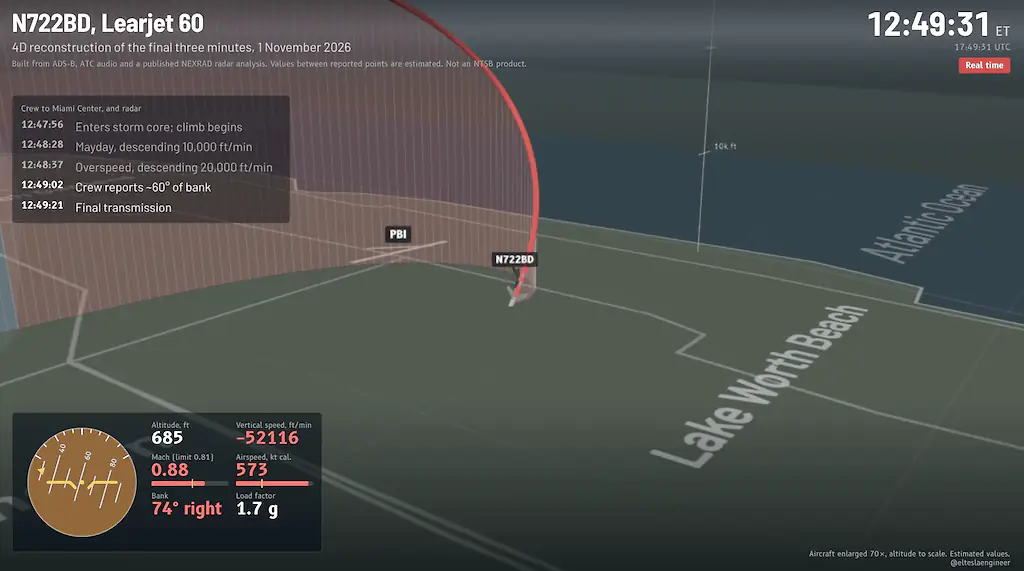
Footage of the tragic crash had circulated online, with the private jet crashing in Palm Springs, Florida, after departing from Austin-Bergstrom International Airport in Texas on November 1.
Now, Captain Steeeve has examined findings that were made public on Monday (November 9), including the recovery of both engines, portions of both wings, the flight deck, and key flight-control surfaces.

Captain Steeve examines new evidence of Learjet crash
While the NTSB previously shared that it recovered most of the Learjet 60's left elevator in three pieces, scattered up to 3.8 miles from the crash site, it has now crucially announced it has recovered the cockpit voice recorder.
The horrific incident resulted in the deaths of all nine on board, all of whom have been identified.
Recorded audio between crew members, 55-year-old captain Jeff Gregory and 20-year-old co-pilot Nathalia Gadelha Filgueiras, has also been key in the investigation.
The captain also spoke about newly surfaced information about the jet, which reportedly encountered severe turbulence during a flight in May 2026.
He suggested that despite warnings from Air Traffic Control (ATC), the pilots may have tried to fly through a gap between thunderstorms.
This is a dangerous manoeuvre known as shooting the gap or entering a sucker hole.

He suggested that storm tops reportedly rose from 36,000 to more than 48,000 feet in just 20 minutes.
Controllers warned the crew about significant precipitation, signaling that their requested route to Freeport looked dangerous, but while they were allowed to figure a way around it, pilots continued to plug away before being handed over to another controller.
Reports say that Filgueiras texted her boyfriend about encountering turbulence and icing, with the crew reporting this to ATC.
The aviation expert once again explained that supercooled large droplets can accumulate on an aircraft, resulting in a disruption in aerodynamics and a loss of lift.
The cause of the crash is yet to be confirmed.
Major discovery about aircraft's history
It's been reported that the same jet, registration N722BD, was part of another incident in New Jersey in May, with recordings showing that it had experienced severe turbulence.
Crew described it as 'moderate' at first, though ATC repeatedly corrected them, explaining that an aircraft unable to maintain altitude was experiencing severe turbulence.
It has raised fresh questions about whether the incident was properly reported, and if the aircraft got the required inspection afterwards.
The NTSB revealed that the on-scene investigation outside the crater is mostly complete, with additional wreckage being recovered.
This includes portions of both wings, both engines, the flight deck, vertical and horizontal stabilizers, flap assemblies, and aileron sections, which have all been sent for lab examination.