


US5 min(s) read
Aviation expert Captain Steeeve shares his theory about what went wrong moments before Florida Learjet crashed, killing all nine on board

An aviation expert has put a theory forward about what caused a Learjet 60 to crash into a mobile home park in Palm Beach County, Florida, on Sunday.
The horrific incident resulted in the deaths of all nine on board, all of whom have now been identified.
The Bahamas-bound private jet went from flying at an altitude of 35,000 ft to plummeting into the ground in 76 seconds.
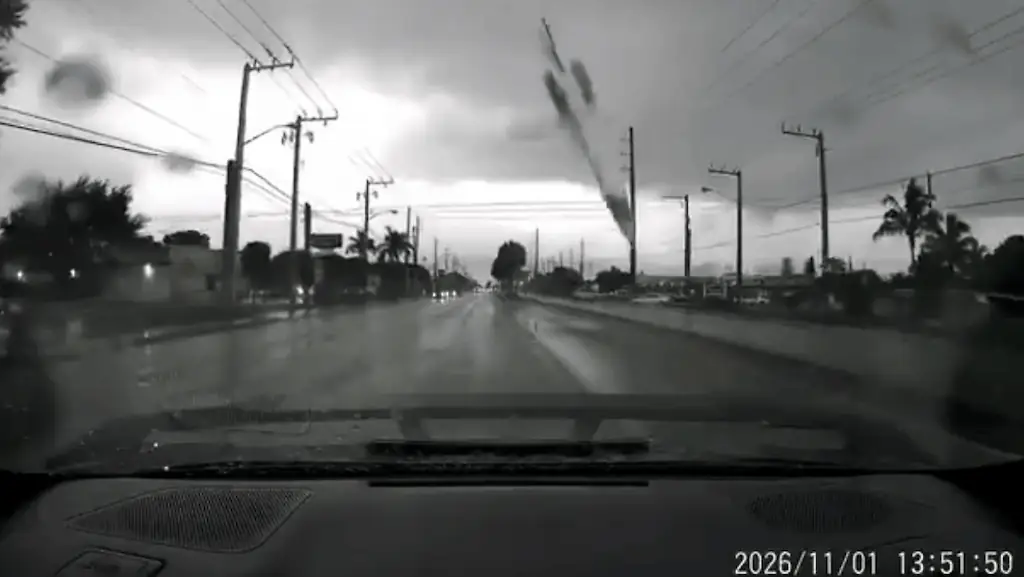
Footage of the tragic crash has circulated online, with the private jet crashing after departing from Austin-Bergstrom International Airport in Texas, as Floridian motorists caught the crash on their dash cameras.
Those on board included entrepreneur Adam Robinson, 44, his wife Helen Sharp, their four-year-old daughter Emma, and their two-year-old son Charlie.
The family was traveling with their nanny, Anita Maria Apellido Cetina, and two close friends, Rachael Reed and Charmi Fehr. None survived.
The crew consisted of 55-year-old captain Jeff Gregory and 20-year-old co-pilot Nathalia Gadelha Filgueiras.
Theory from aviation expert
The aircraft was flying east at approximately 35,000 feet when the pilots reported two problems: icing and turbulence causing altitude fluctuations of up to 700 feet.
And in a video posted to YouTube, aviation expert Captain Steeeve delved into the air traffic control recordings captured by LiveATC.net.
The pilot first said that conditions were manageable, telling ATC: "We have light, clear ice that is manageable and moderate turbulence."
The expert described the temperature they were flying in, -47°C, as a 'normal, very cold temperature at that altitude.'
He then delved into the icing and precipitation aspects, saying of trace icing: "Most pilots are trained to look out the windscreen and there's a little metal windshield wiper out there that just sits there. And if you see a little fleck of ice and then another spot and another one, you've got trace icing.
"That's where you start to have a conversation about, do we want to get out of the icing? We're picking up a little bit of icing. Do we need to turn the anti-ice on? Do we need to turn the de ice on? So, there's a difference between anti-icing and deicing."

He added: "A lot of airplanes have what's called deicing. You wait for a little bit of ice to build up. You monitor how much it is, and then when it gets to a certain point, you turn on the deicing."
This injects hot air, working to break up the ice, though icing can progress to light icing, and even the third category of moderate icing, where 'it starts to get real serious'.
"Moderate icing is constant icing accumulation. It may be hazardous if you don't keep up with it continually. You've got to get out of moderate icing," Captain Steeeve pointed out.
He went on: "If you get into that condition, you're looking for a 180 to get out. You want to descend out of it.
"You want to turn left. You want to turn right, but you don't want to continue to fly into moderate icing."
Severe icing may have caused the crash
The aviation expert explained: "The fourth category is what these guys were encountering. I believe it was severe icing.
"Severe icing is where the ice buildup is so rapid that the aircraft deicing and the anti-icing systems can't keep up with it."
He added: "That introduces something called supercooled large droplets. What are super cooled large droplets? They're called SLDs and they're freezing rain or freezing drizzle.
"Now, you're going to see freezing rain or freezing drizzle probably at a much lower altitude than this. 35,000 ft and -47°C and the introduction of precipitation according to the the pilot monitoring the co-pilot on the radio.
"That's a ripe environment for these super cooled liquid droplets."
He explained that they don't instantly freeze when hitting the leading edge of the wing, where most ice can accumulate.
Due to the size of the droplets, they can freeze on the center portion of the wing, for example, affecting air flow.
"Now, that wing, that large hunk of metal out there, becomes like a vending machine instead of a wing producing lift," he said.
"And that that vending machine then as the air is is flowing over the first part of the wing, but then goes straight up and kind of spirals like like wind when it hits a mountain range."
The pilot explained: "When it hits a mountain range, it's directed up and it just kind of spirals up over the mountains. That is happening on the top of the wing."
Speaking about the harrowing ATC audio, he added: "That wing loses all lift. The aircraft begins to descend. That's where you heard her say that Mayday call. We're at 8,000, then 10,000, then 22,000 ft per minute rate of descent.
"Those super cooled liquid droplets are accumulating and making a ridge on the wing so that this aircraft just stops flying."