


Weird5 min(s) read
Dutch worker goes viral on Reddit after telling US 'hustle' boss they have a life outside of work
.jpg_I4Ebof?tr=cr-0.338.2730.3068,f-webp,q-70,w-100)
A viral Reddit post has reignited a long-simmering debate about work culture, boundaries, and the vastly different ways countries define “commitment”.
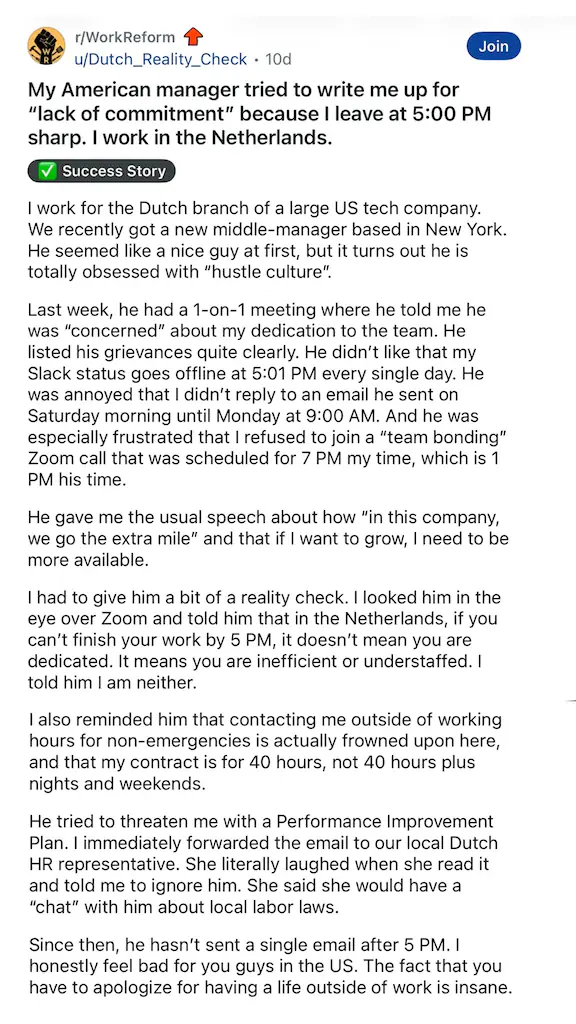
The post was shared on r/WorkReform by Reddit user u/Dutch_Reality_Check, who described a clash with their American manager after being criticised for something many people would consider entirely normal: leaving work at 5pm.
The user works for the Dutch branch of a large US tech company and said the trouble began when a new middle manager based in New York joined the team.
According to the post, the manager quickly made it clear he subscribed to hustle culture and had concerns about the employee’s “dedication”.

Those concerns, as outlined in the post, will sound painfully familiar to many workers. The employee’s Slack status went offline just after 5pm each day.
They did not respond to an email sent on a Saturday morning until Monday.
They declined a “team bonding” Zoom call scheduled for 7pm local time, which conveniently fell in the middle of the American manager’s working day.
The manager reportedly followed this up with the familiar corporate speech about “going the extra mile” and being “more available” if the employee wanted to grow.
That was when the Dutch worker pushed back.
“I told him that in the Netherlands, if you can’t finish your work by 5pm, it doesn’t mean you are dedicated, It means you are inefficient or understaffed. I told him I am neither.”
That line quickly became one of the most quoted parts of the post, with commenter awoodby writing:
“‘If you can’t finish your work by 5 PM, it doesn’t mean you are dedicated. It means you are inefficient or understaffed.’ Hahahah nailed it.”
Things escalated further when the employee reminded their manager that contacting staff outside working hours for non-emergencies is actively frowned upon in the Netherlands, and that their contract was for 40 hours a week, not “40 hours plus nights and weekends”.
The manager allegedly responded by threatening the employee with a Performance Improvement Plan. That threat collapsed almost immediately.
The user said they forwarded the email to their local Dutch HR representative, who “literally laughed” when she read it and advised them to ignore the manager.
She also reportedly told the employee she would be having a “chat” with him about local labour laws.
The result was swift. “Since then, he hasn’t sent a single email after 5 PM,” the user wrote, before adding a line that resonated deeply with readers: “I honestly feel bad for you guys in the US. The fact that you have to apologise for having a life outside of work is insane.”
The comments section quickly filled with stories that echoed the same frustrations.
One commenter, u/TheShrunkenAnus, described working as a top-performing salesperson in the US while still dealing with constant pressure, blame-shifting, and even having their bonus incorrectly paid to someone else.
“Their tune changed super fast when I mentioned legal counsel,” they wrote, adding that the experience permanently changed how they viewed workplace culture.
Others focused on the emotional toll of workplaces where your job is expected to become your identity. “There’s a very strange mentality among many fellow Americans that your job somehow has to be an integral part of your life/personality,” the same commenter wrote. “I show up, do my job well, get paid, and go home.”
Several users discussed deliberately separating their work selves from their personal lives.
ProfessionalConfuser compared work to acting. “I don the attire and slip into the role. I get home and pull a Mr Rogers and take all that back off when I resume my real life.” Another commenter said they call this a “worksona”, a term many readers admitted had stuck with them.
Others noted how deeply embedded work is in social identity, particularly in the US. Multiple commenters pointed out how often the first question people ask is, “So, what do you do?”, with Genaric_white calling it “the writing on the wall when it comes to where we are heading as a culture”.
For many readers, what made the original post so powerful was not the confrontation itself, but how easily it was resolved once labour laws were enforced. The manager’s authority evaporated the moment HR stepped in, not because of company values, but because the law was firmly on the employee’s side.

As remote work and international teams become more common, stories like this are increasingly highlighting just how culturally specific hustle culture really is. What one country frames as ambition, another sees as inefficiency or poor management.
The viral post does not just feel satisfying. It feels like a glimpse of an alternative. One where logging off on time is not a provocation, boundaries are not a performance issue, and having a life outside of work does not require an apology.