Dolphins are one of the most majestic and magical creatures on this planet, and now a photographer has captured the stunning moment a pod glowed blue in bioluminescent waters.
In the footage, which was filmed by Patrick Coyne at Newport Beach, California, on April 15, the animals look like they have, quite literally, turned into giant glowsticks, but don't worry, it's a completely natural phenomenon and not the result of a chemical spill.
Watch the dolphins glow in the bioluminescent waves below:
The process was explained by marine biologist Enrique Ayala Duval on sabersifin.com:
"Bioluminescence is the light produced by living organisms, as a result of a biochemical reaction in which most of the time luciferin (a protein), molecular oxygen and ATP (adenosine triphosphate) take part, which react by the luciferase enzyme as follows way: oxygen oxidizes luciferin; Luciferase speeds up the reaction and ATP provides the energy for the reaction, producing water and light, which is very noticeable at night; As in any reaction in which an enzyme is involved, it is recovered and remains available to catalyze more luciferin and oxygen."
This wasn't the only bioluminescent scene that Patrick witnessed at the beach either. He also saw it with the waves too.
In a nutshell, bioluminescence exists because of evolution:
"There is a hypothesis that the bioluminescence that exists today is the result of evolution: initially, when the Earth’s atmosphere had an almost zero concentration of oxygen and oxygen was gradually increasing due to the increasing presence of photosynthetic organisms, organisms were released from oxygen, which was then toxic to them, with the bioluminescence reaction, producing water."
If this looks like something that you just have to see for yourself, the phenomenon has been recorded at Mexican beaches too. Sightings have taken place at Isla Holbox, Quintana Roo; Chacahua, Oaxaca; Xpicob, Campeche; Lagoons of Manialtepec, Oaxaca; and Bahía de Banderas, Nayarit.
At Xpicob, in particular, the lights are said to be so incredibly powerful that fish at the bottom of the ocean become visible. How magical!
There's no doubt that the natural world can be utterly awe-inspiring ... and completely disgusting. Yes, there are plenty of scenes in nature that David Attenborough wouldn't be willing to film, which are revolting enough to turn the stomach of even the strongest person.
If you want an example of just how gross (and fascinating) nature can be, then take a gander at the following footage, which has gone viral on social media this week.
The incredible short clip shows the world's largest animal, a blue whale, defecating while underwater, creating a mesmerizing luminous green display. The footage was recorded by researchers observing whales migrating south along the West Australian coastline, using drones flying high above Point Picquet; three hours south of Perth.
Take a look (if you dare) at the moment the whale defecates on camera below:
Commenting on the incident in a later interview with ABC News, Ian Wiese and Rodney Peterson (of the West Australian Centre for Whale Research) told reporters that they captured two separate defecations. Peterson stated: "It was the first time I had seen a blue whale, which was incredible enough, but then I realized it was doing something pretty interesting. Fair to say, it left quite a streak in the ocean."
Meanwhile, whale expert Curt Jenner stated: "It's an exciting development given [blue whales] are still one of the more endangered animals on the planet, yet we know so little about their behaviour. Knowing they are able to source a regular food supply is an indication of the health of the ocean and that should be of interest to everyone."
He continued: "[As whales] swim along and beat their tails, they distribute their feces and similarly, as they dive to the depths and surface again, they're mixing that throughout the different layers of the water columns."
Check out this cool video of a humpback whale surprising paddlers:
He added: "It's an incredible process of taking the bottom part of the food chain up to the surface then back down again ... Oddly, it smells a lot more like dog poo than anything fishy. It's otherwise perfectly disgusting."
Every now and again, humans catch amazing glimpses of nature that feel too pure for us to witness. From different animals gently interacting with each other to double rainbows, sometimes the earth surprises us.
Last month on June 21, Terry and Tomás Deane witnessed an amazing spectacle. While on their rib boat off the Co Kerry coast in Ireland, the father and son saw a pod of three humpback whales while the animals were feeding. The pair watched them for an hour before the whales swam over to inspect the boat. But the excitement didn't stop there.
[[imagecaption|| Credit: Getty]]
While they were 15 miles northwest of Brandon, underwater footage - as well as Terry's recording of Tomás on his phone - shows one whale "spyhopping" out of the water to check things out. Spyhopping often happens with aquatic animals when they appear above water to better see what's around them.
Terry, who hails from Camp, took his son on the trip specifically to look for whales. He said the longest day of the year is perfect for the activity, and that they got their wish:
"We were observing three animals feeding for about an hour, but then they came over to the boat to check us out. Tomás was at the end of the rib filming underwater footage with a GoPro camera. But suddenly, one of the humpbacks spyhopped out of the water. There he was just towering over him. It was unreal. We were shaking, not with fear, but in awe."
[[imagecaption|| Credit: Getty]]
The Irish Whale and Dolphin Group said the video is amazing, and put a device in the area to monitor humpback whales, as they can frequent Irish waters.
Though not everyone has the ability to get out on open water and whale watch, remember to open your eyes to the natural beauty you do have access to all around you.
You never know what is lurking beneath in the great open sea, and this spectacular footage is proof that humans couldn't be more out of place when we go for a paddle.
This is the incredible moment a southern right whale and her calf surprised a group of surfers near the shore of Manly Beach in New South Wales in Australia.
Check out the mind-blowing footage below - how would you react to this?
The footage was captured by couple Thom , 29, and Lianne, 26, who originally hail from the Netherlands.
After meeting in Sydney 11 months ago, the couple now resides in NSW and were able to capture this incredible event on Thom's drone.
Speaking of the footage, Thom Van Mil said: "We kind of live on the beach and received a phone call that some whales came very close.
"So I grabbed my drone and ran to the beach where it all happened.
"First of all, I didn't see the whale because I was looking too far. I didn't realize the whale was so close."
Thom added: "In the video, you see a southern right whale with her calf swimming very close to the beach in Manly. There were loads of surfers close to the whales and it looked like the calf wanted to play with the surfers.
"We thought the mother became a bit nervous and swum towards the surfer and hit a few of them with her tail. There was even a diver who sat on the back of the whale. In our opinion they all came too close to the whales and especially the diver shouldn't have try to come so close. But hey, what would you do?"
Per the Greenpeace website, southern right whales are "quite curious and playful when they are close to humans."
In addition, they are one of the largest species of whale in the world - with the average female growing to be about 16 meters (52.5 feet) in length. They can also grow to weigh around 40 tons.
Thom added: "When we saw what was happening we could see everything on my phone. We immediately knew this was something special. The rest is history.
"It's been a massive week since both our faces were visible and all over the world. Especially in our home country, it was a big thing. Right now, to be honest, we are very proud of the footage we have."
You can follow Thom and Lianne’s adventures on their Instagram page, HERE.
A shocking video has ignited global outrage after capturing a terrifying moment at a luxury Mexican resort where a dolphin is believed to have died after jumping out of its pool.
The clip, which quickly surfaced on social media platforms, has led to a flood of negative reviews on the resort’s social media pages -- with many calling for an end to animal performances at the venue.
The video shows three captive dolphins leaping from the water as lifejacket-clad tourists look on.
One of the dolphins, however, appears to miscalculate its jump and misjudge the edge of its enclosure, landing painfully on the edge of the pool.
The animal remains motionless as trainers rush to its aid, sparking concerns about its well-being.
Marine Activist: "It's Completely Inexcusable"
The footage was later shared by the activist group UrgentSeas on Instagram.
"The following incident took place in January, 2025 at @barcelomayagrandresort. The guest who filmed this has asked to remain anonymous," the caption reads. "Though we cannot confirm, we are told that the dolphin has died following this SHOCKING and UNNECESSARY injury.
"Please comment, review and BOYCOTT Hotel Barcelo Maya in Riviera Maya, Mexico.
Warning: The footage contains distressing content and viewer discretion is advised.
Marine mammal activist Phil Demers shared the disturbing footage through his UrgentSeas social media accounts and expressed his disbelief at what he had seen.
“This particular incident is one of the worst. It really, truly is. Even if it survived, its health is going to be severely compromised,” Demers told Yahoo News on Saturday morning.
“It’s completely inexcusable, it’s something that never would happen in the wild. It just eliminates any rationale they should exist in these concrete tanks.”
PETA has also released an article following the incident, where the group calls for the dolphin shows and experiences to stop.
The dolphin show pool. Credit: Google Maps
"These animals are trained to perform unnatural tricks," writes PETA's staff. "In 'swim with dolphins' encounters, they are forced to repeatedly push and pull human tourists around, sometimes over 50 times a day."
Resort Under Fire Over Dolphin Enclosures
The incident is alleged to have taken place at Barceló Maya Grand Resort, located near Cancún, Mexico.
"Step into a breezy open-air palapa to check in, then spend the rest of your experience surrounded by tropical paradise while you interact with the dolphins and learn how to care for the oceans surrounding the Riviera Maya," a website promoting the experiences reads. "For your comfort, you’ll also find amenities like locker rental, changing rooms, showers, and photo/video services." A promotional video can be seen below:
Following the video’s release, the resort’s social media pages were bombarded with criticism, prompting the company to limit comments on recent posts. However, older content remains open, where animal welfare advocates have demanded change.
“This broke my heart and flipped my stomach upside down,” one commenter wrote. Another, posting in Spanish, simply demanded: “We demand the closure.”
Comments on one of the resort's most recent posts. Credit: Instagram
Social media users are voicing their opinions on the resort's Instagram page. Credit: Instagram
Social media users are voicing their opinions on the resort's Instagram page. Credit: Instagram
PETA's message to guests at the resort is "never pay to 'swim with dolphins' or engage in any other activity that sees them exploited for profit."
Yahoo News reached out to the resort’s parent company, Grupo Barcelo, but they did not immediately reply.
"Like a Prison"
Demers first raised concerns about the resort in January - just days before the new viral video surfaced online.
Activists releasing drone footage showing the facility’s dual dolphin tanks, which sit just meters from the open ocean.
Opponents have described the conditions as “like a prison”, arguing that these are among the smallest dolphin enclosures in Latin America.
This video was taken on Jan 22, 2025 above @barcelomayagrandresort in Riviera Maya, Mexico. It is home to 4 captive dolphins in Latin America’s smallest dolphin tank. Please BOYCOTT HOTEL BARCELO," one caption reads.
Following this latest incident, Demers reiterated his call for the dolphins to be removed, emphasizing that their confinement is both cruel and dangerous.
“This is the reality. We can close our eyes, but that's not going to serve the animals.”
Joint Statement Released
Following the incident, several animal rights organizations have come together to release a joint statement.
"For a year now, the organisations Animal Heroes, Dolphin Freedom, Marea, and Oceanos De Vida Libre have maintained a permanent campaign demanding the closure of this dolphinarium, which is one of the smallest in Mexico," the statement begins. "We have delivered letters to both Barcelo in Playa del Carmen and in Mexico City, as well as letters from schoolchildren in Baja California pleading for an end to the exploitation of dolphins, yet they have never been willing to receive us."
They add: "In addition, we have exposed other tragedies, such as the deaths of the dolphins Alex and Plata in just one year, which were never properly investigated.
"We have shown that the dolphin pool is smaller than those for humans, despite the fact that in the wild they swim vast distances and depths, that they have no shelter from the sun, and so on."
Investigation Underway
Mexican environmental authorities have launched an investigation into the deaths of two dolphins used for tourist entertainment at the Barceló Riviera Maya Hotel.
PETA states on its website: "Two dolphins, Plata and Alex, suffered severe injuries and died within 12 months of each other after being attacked by an incompatible tankmate at Barceló."
The Federal Attorney for Environmental Protection (Profepa) confirmed the inquiry in a press release, stating: “On January 24, Profepa requested the submission of the documentation with which the Dolphinaris Barceló dolphinarium, located at the Barceló Hotel, notified the Directorate General of Wildlife (DGVS) about the death of the dolphin named Plata.”
Authorities also demanded records related to a second dolphin named Alex, requesting his transfer authorization and, if applicable, official notification of his death.
The investigation will also review the resort's dolphin inventory from 2018 to 2024, tracking animal acquisitions and removals to ensure compliance with legal ownership regulations.
Following the deaths, Playa del Carmen Mayor Estefanía Mercado addressed the situation, emphasizing the importance of animal welfare protections.
“In light of the events surrounding the death of a dolphin at the Barceló Riviera Maya Hotel, we inform you that our Ministry of the Environment is in communication with state and federal authorities, who have taken over the investigation.”
She also reaffirmed her administration’s commitment to strengthening regulations for captive animals, stating: “From the Government of Solidaridad, we reaffirm our commitment to animal protection and will work on proposals to strengthen regulations that guarantee their well-being because the right to human enjoyment should never cost the life of a living being.”
With scrutiny mounting, the resort and its Dolphinaris Barceló dolphinarium could face serious consequences if found in violation of wildlife protection laws.
Fans have been left shocked after seeing a bizarre sea creature transform into a completely new type of beast when underwater.
Taking to YouTube, user CaptainJRD posted a one-minute clip of the creature just floating along in the water before it was triggered into morphing into a completely different type of being which has left people baffled.
In the caption, the YouTuber wrote: "This video was taken by an ROV (remotely operated vehicle) at a depth of 3753 ft in the Indian Ocean within close proximity to a drill wellhead."
It continued: "Near the end of the footage, you can see the creature getting caught up in the output from the ROV thrusters. The video has not been altered and was taken off the East coast of Africa."
Have a look below:
The footage shows a black circular-type creature floating about before it goes into itself, transforming into some sort of black squid-like animal with seemingly fluorescent lights towards the back end of it.
The video, which has been viewed over 5.9 million times since it was posted, has received thousands of comments about what it could potentially be.
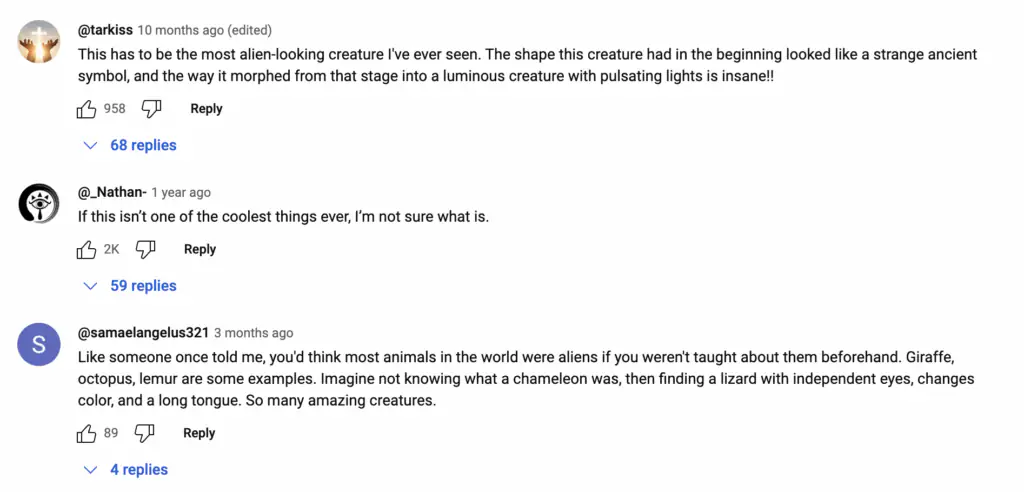
"This has to be the most alien-looking creature I've ever seen," wrote one user. "The shape this creature had in the beginning looked like a strange ancient symbol, and the way it morphed from that stage into a luminous creature with pulsating lights is insane!!"
"If this isn’t one of the coolest things ever, I’m not sure what is," added another.
A third also made a good point: "Like someone once told me, you'd think most animals in the world were aliens if you weren't taught about them beforehand. Giraffe, octopus, lemur are some examples. Imagine not knowing what a chameleon was, then finding a lizard with independent eyes, changes color, and a long tongue. So many amazing creatures."
Credit: YouTube
Someone else also offered an answer to all of our questions about what the creature could possibly be stating: "...This is a Bloodbelly Comb Jelly also called Lampocteis. Really beautiful creatures."
For those of you that might not be aware, a Bloodbelly Comb Jelly is a "Brilliant and seemingly glowing" creature that "comes in different shades of red but always has a blood-red stomach," as per Monterey Bay Aquarium.
"The sparkling display on the outside comes from light diffracting and refracting off tiny transparent, hairlike cilia. These beat continuously, propelling the jelly through the water," the description continued.
Scientists believe the bloody-belly's red belly helps mask bioluminescent light from the prey it consumes, though their exact diet has never really been determined.
Steve Haddock, who works at the Monterey Bay Aquarium Institute, explained that these unique creatures "have this whole field that looks almost like a velcro strip or something, with all of these teeth pointed in the same direction.
"And they can actually ratchet themselves over and bite off chunks of other jellies that they've captured," he added. "I use the analogy of spiders. Because spiders can have a sticky web, they can leap out and ambush things, they can make little lasso webs. And ctenophores have similar range of different feeding modes, depending on the species."
But one thing's for sure, you'd have to go pretty deep into the ocean in order to see one, so this is an amazing clip for other social media users to enjoy.