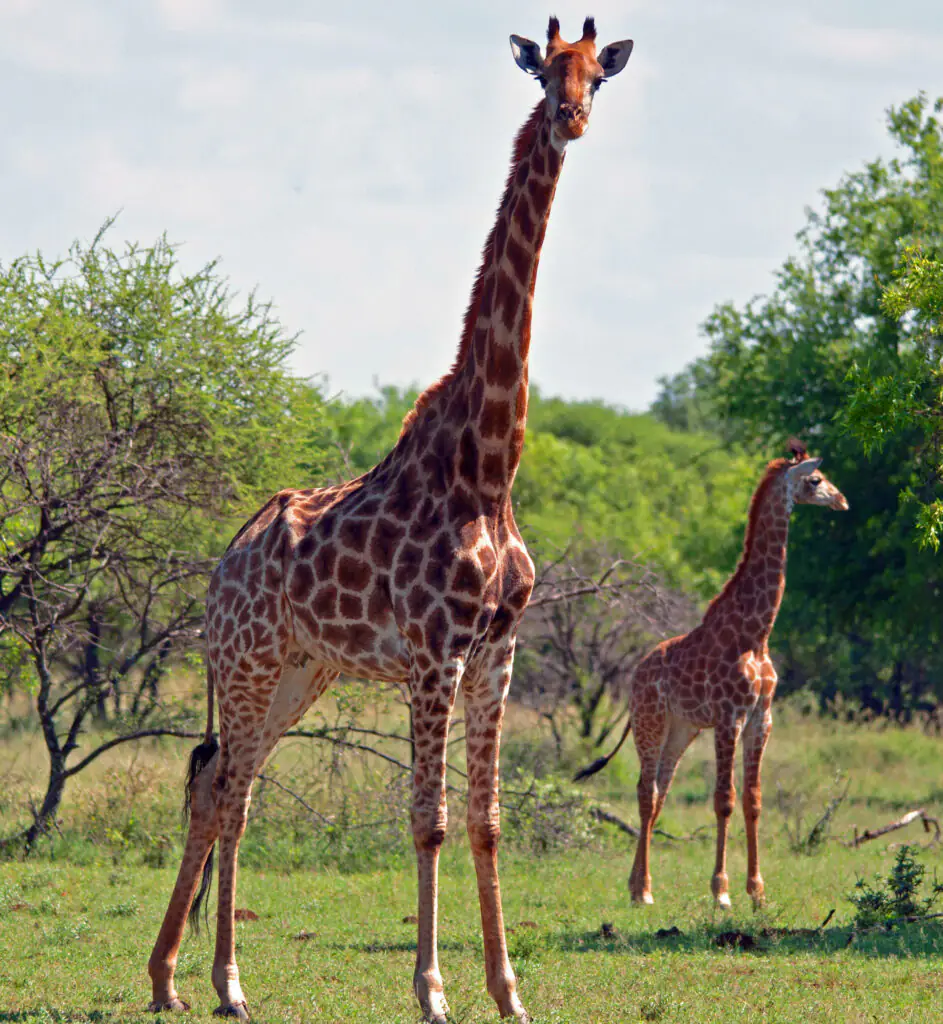
The only white female giraffe and her calf in Kenya have been killed by poachers at the Ishaqbini Hirola Community Conservancy in Ijara, Garissa County, eastern Kenya.
The announcement was made by the conservancy manager, Mohammed Ahmednoor, today when he revealed that after an extensive search, only their skeletons could be recovered.
Because the animals were found in a skeletal state, it is likely that they were killed some time ago by poachers, CGTN Africa reports.
This American hunter went viral for all the wrong reasons after posing with a giraffe she killed:
Per the East African, Ahmednoor said in a statement: "This is a very sad day for the community of Ijara and Kenya as a whole. Her killing is a blow to the steps taken by the community to conserve rare and unique species and a wake-up call for continued support to conservation efforts."
White giraffes are incredibly rare, and the animal's discovery brought a great deal of tourism to the area after it was discovered in 2017, the East African reports.
"This is a long term loss given that genetics studies and research which were significant investment into the area by researchers, has now gone to the drain. Also, the white giraffe was a big boost to tourism in the area," Ahmednoor added.
The female white giraffe and her calf were believed to be the only ones in the world, and now only a lone white bull giraffe remains.
The animal's unusual coloring was speculated by scientists to be the result of a genetic condition called leucism, which stops the skin cells from producing pigment.
While similar to albinism, per CGTN Africa, leucism does not prevent the production of dark pigment in soft tissue, enabling the giraffes to have dark eyes.
This story comes as giraffes were recently added to the list of species threatened by extinction.
A few weeks ago, news of a rare black giraffe that was shot and killed by a trophy hunter went viral after images of the slain animal were posted on social media. The hunter was identified as Tess Thompson Talley, a 37-year-old American woman who has achieved a level of notoriety on the internet for killing wild animals.
"Prayers for my once in a lifetime dream hunt came true today! Spotted this rare black giraffe bull and stalked him for quite awhile," Talley wrote in a Facebook post, which was later shared by an organisation called Africa Digest.
Though she later deleted the post, along with the pictures, they had already been shared by hundreds of people, and Talley has been receiving a huge amount of backlash as a result. However, despite all the criticism she's receiving, the hunter says she has no regrets about killing the giraffe - nor any other animal, for that matter.
"It is something I believe in," Talley told the Daily Mail. "This is more than a hobby for me, it's a passion."
The Texas-based hunter, who has garnered media attention a few times before on account of her controversial hobby, also tried to argue that she didn't do anything wrong by shooting the animal, and - much to the contrary - was actually helping the giraffe population, as well as the local community.
"Other people benefited," she said. "The safari company, the village, the locals, the economy, they all benefited."
She continued:
"This giraffe had killed three younger ones that would have bred. As I was hunting him I was walking over their bones. The herd is flourishing now that he is gone.
"He was 18. He was going out. If you have a dog and it gets old or ill, you take it and you have it put down. This was the same."
But that hasn't stopped her receiving death threats.
"If you post something you believe in, whether it's hunting, religion or politics, there is someone there to hate on you," she explained. "And I'm a woman so they are going to make it worse. Men don't get the grief."
Her husband, 43-year-old Andrew Talley, actually posted a warning on Facebook to anyone who dared to take action against their family because of their trophy hunting:
"You people have no concept of what hunting or game management is even about.
"You put human life value below animal rights however you have no issue with wearing your leather belts, boots, carrying your leather purses…all of which are from animals that are tortured before death and not in any way humanly (sic) put down.
"I realize I'm talking to a brick wall with you people, but if you want to message her, threaten her life, please feel free to PM me and I will get you coordinates to where you and I can meet up instead of playing keyboard warrior. You guys talk a big game, but let's see if you can back it up. My wife is very proud of her harvest of the old bull, as am I. So here I am let's see what you got."
Many people believe, though, that if Talley and others like her really cared about the positive side of their actions, they'd forgo the hunting part and just donate money to the organisations who benefit from the death of an animal. However, as this activity is still legal in some parts of the world (and just strategically unregulated in others) it is likely that people will continue to hunt wild game for a long time to come - regardless of the consequences.
In the USA, about six per cent of the population (just over one in 20 people) goes hunting every year. Most of these people kill domestic wild game such as boar or deer, but others will venture further afield in order to satisfy their apparent need to take a life. In fact, some will pay tens of thousands of dollars in order to take down something particularly rare or dangerous.
But, while most people are happy to eat meat or see animals kept in captivity, hunting is an activity that many find repugnant, and those who partake in the so-called "sport" are often called out on social media.
Most recently, a woman named Tess Thompson Talley was named by the Twitter account AfricaDigest for killing an incredibly rare black giraffe.
"White American savage who is partly a neanderthal comes to Africa and shoot down a very rare black giraffe courtesy of South Africa stupidity. Her name is Tess Thompson Talley. Please share," Africa Digest tweeted.
They added:
"If our so called governments can’t care for our wildlife then its time we stand up and responsibility of our continent, lands, resources and wildlife….share share share! and lets have a united voice against pillage of Africa, it’s the only home we have."
Other social media users soon flocked to call Talley out for her heartless actions.
"Their brutality knows no boundaries," wrote one commenter.
"This is horrific," said another. "1st. Why and how are we (#africans) allowing this? 2nd. If you pride yourself at killing animals.... how about a really fast and powerful one. A girafe ? That’s so cruel. So so cruel. [sic]"
Others, however, were defending the hunter, saying that it is the fault of African governments for creating an economy in which hunters' bloodlust is valued more than an animal's life.
"What rubbish," said one person. "She is a hunter. We allow and indeed encourage hunting as an important tourist activity. And on top of which you play the race card. This is virtue signalling, not social commentary."
It is true that "Trophy Hunters" (people such as Talley, who kill for sport rather than necessity) contribute a significant amount to the economies of African governments, and some reports put the income of the business as a whole at around $200 million annually.
What's more, it's also correct that a hunt is often strategically set up so that the target is very weak/old, and was a detriment to its group anyway - therefore making the slaughter somewhat beneficial, in a way.
While many people may argue that there are benefits to trophy hunting, however, the whole business has been proven time and time again to be corrupt.
A recent report from the Democratic staff of the House Committee on Natural Resources found that trophy hunting poses a significant threat to the populations of endangered animals, and that - quite frequently - any money that changes hands during the transaction does not often end up going towards conservation efforts, as is often claimed it does.
"Trophy hunters do not always play by the rules, and the trophy hunting industry needs to be regulated and held accountable for there to be any hope of a consistent conservation benefit," they said.
As these pictures of Tess Thompson Talley show, however, the industry still needs a great deal of regulation if we are to have any hope of conserving the planet's most endangered species of animals.
A baby girl has been killed and her mother critically injured after they visited a conservancy in South Africa.
As reported by BBC News, the mother and daughter lived at the luxury Kuleni Game Park in KwaZulu-Natal province in South Africa. The large game park has 14 lodges, with its website boasting "individually styled, eco-sensitive, timber structured lodges that offer absolute luxury in the bush." South African outlet IOL News reports that the mother
The tragic incident reportedly occurred on Wednesday afternoon, with local police telling the BBC that the full details are currently unknown and that an inquest had been opened in order to establish the facts.
It is not known exactly where in the park the incident took place.
Police Lieutenant Nqobile Madlala told BBC News: "The child was taken to the nearest doctor's room where she died."
A giraffe and her calf. Credit: RooM the Agency / Alamy (Stock photo unrelated to this story)
Speaking to IOL News, Shawn Herbst from Netcare 911 said: "When a team of operational paramedics arrived on scene they found the mother in a critical condition.
"The mother was treated on scene, however due to the nature of the patient’s injuries and distance to an appropriate hospital, a decision was made to activate the Netcare 911 Helicopter Air Ambulance to fly the patient to a specialist facility."
Trustees of the Kuleni Game Park later said in a statement: "As the mother, a qualified guide, and her children walked past the herd, we assume that one of the giraffes attacked the older child, before turning on the mother and the younger child. We do not know what caused the giraffes to behave in such an unusual way."
Chairperson of the board of trustees Brian Ring added: "The trustees of Kuleni Game Park are devastated by the incident and the trauma the family is going through. These are residents of our park and a much-loved part of the extended Kuleni family, and we are still reeling from the shock of what has happened."
Ring added that there had not been an incident in the park's over 20-year history, before going on to offer thanks and gratitude to the first responders and paramedics, and the Hluhluwe community.
Trustees have also responded to allegations that the giraffe involved in the incident was put down, saying: "The giraffes, including the mother and calf, moved off into the surrounding bush, unharmed."
The Kuleni Game Park is located 10 miles outside of Hluhluwe in KwaZulu-Natal, with its website also claiming to offer guests "close encounters with animals while walking or cycling the numerous trails."
Per PEOPLE, the site adds that guests may wander freely around the park, excluding areas marked with a "no entry" sign.
BBC News adds that it is rare for giraffes - the world's tallest mammal - to attack people, with many game lodges across the world offering up-close experiences with the animals.
Although the animals are not usually aggressive, they can become combative when defending they calf.
Our thoughts are with everybody affected by this tragedy at this time.
Warning: This article contains subjects and images that some people will find upsetting.
A woman who posed with the dead body and heart of a giraffe that she hunted is defending her deadly hobby.
Merelize Van Der Merwe, 32, took to Facebook on Valentine's Day to share photos of her posing with the cut-out heart of the giraffe she had just killed.
She explained in the caption that the heart was a Valentine's Day "present" from her husband.
"Ever wondered how big a giraffe's heart is? I'm absolutely over the moon with my BIG valentines present!!! [sic]," Van Der Merwe wrote.
In an earlier post, she revealed that her husband had paid for her to shoot the mammal and also posted two photos of it after she'd killed it.
She explained in the caption: "Two weeks ago a dear friend Chrisjan Bakker contacted me regarding my request for a big old bull and I couldn't believe my eyes, big black, and old, so old that he was way over his time and the owner didn't know if he will last another 3 months!!!
"My husband booked a trip for us to the palace of the lost city situated in Sun City for our Valentine's weekend, but our plans changed quickly."
Van Der Merwe went on to say that her "wonderful husband" knew that this was her dream and "fully supported" her.
"I was literally like a little child for two weeks and counted down the days. Afterwards I was flooded with emotions as I've been waiting years to have this opportunity!!"
Despite her evident enthusiasm for hunting wild animals, she has widely been criticized for the killing.
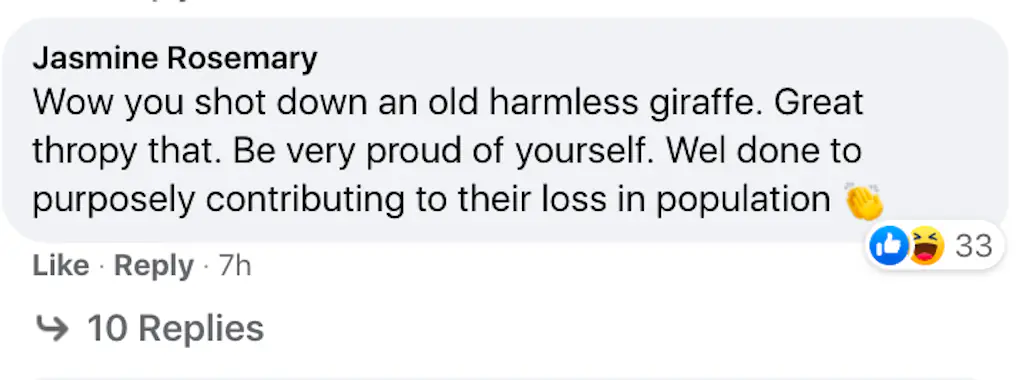
One person commented: "Wow, you shot down an old harmless giraffe. Great trophy that. Be very proud of yourself. Well done to purposely contributing to their loss in population."
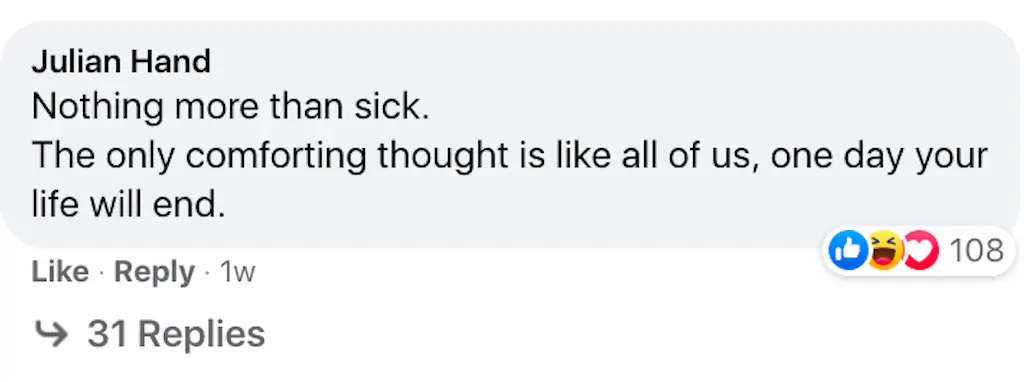
Another said: "Nothing more than sick. The only comforting thought is like all of us, one day your life will end."
Credit: Facebook
Credit: Facebook
It didn't take long for her posts to go viral and spark backlash around the world.
But in spite of the backlash, Van Der Merwe has remained defiant in her belief that hunting animals for sport is not unethical.
In fact, she even laughed at the idea of there being a petition against her. Taking to Facebook she wrote: "New petition against me.... thought I'll help their small minded cause a bit."
Now in an interview with The Mirror, Van Der Merwe, who started hunting aged five, claimed that killing the giraffe actually helped to save threatened species in South Africa.
She said the death of the old giraffe would mean "a new bull can take over and provide new strong genetics for the herd."
Furthermore, she claimed that it created "work for 11 people that day" and "a lot of meat for the locals."
Van Der Merwe added: "If hunting is banned, animals will become worthless and will disappear. Hunting has helped bring back a lot of species from the brink of extinction. The only people protecting these animals are trophy hunters."
It should be noted, however, that conservationists deny the claim that killing old giraffes helps younger members of the species.
But Dr Mark Jones of the Born Free Foundation told the publication: "Trophy hunters' claims they are concerned about wildlife conservation are highly misleading.
"Trophy hunting is not a conservation tool, nor does it contribute significant funds to local communities."
We reported that Kenya is planning to introduce the death penalty for convicted wildlife poachers. This included a quote from Tourism Minister Najib Balala given to China’s Xinhua news agency, during a meeting held on May 10, 2018. However, Balala was not at that meeting, and told AFP Africa there was no such plan.
We want to make clear that this was an editorial error and apologize profusely to our readers for this.
At VT we take false news very seriously and want to assure all our readers that our articles are fact-checked strenuously before publishing.
Poaching is one of the world's least divisive issues. Almost everyone would agree that endangered animals should be allowed to live in peace - and roam their natural habitats without humans endangering their lives.
However, it remains a huge issue in African countries - including Kenya - where animals such as rhinos and elephants are targeted for their horns and tusks for alternative medicine and ivory, respectively. But the government is taking drastic steps to stem the bloodshed.
"We have in place the Wildlife Conservation Act that was enacted in 2013 and which fetches offenders a life sentence or a fine of U.S. $200,000," Cabinet Secretary for Tourism Najib Balala told China’s Xinhua news agency. "However, this has not been deterrence enough to curb poaching, hence the proposed stiffer sentence."
[[imagecaption|| Credit: Getty]]
In 2017, poachers killed nine rhinos and 69 elephants - cancelling out the growth rate of their populations. The number of black rhinos in the country is now below 1,000. Balala added that the law to see poachers face the death penalty, while not yet enacted, was being fast-tracked.
“Across the continent’s diverse wild lands, management authorities need data-driven solutions to enhance anti-poaching capacity to allow remaining priority populations to recover from previous, and current, crises," stated the African Wildlife Foundation.
"Meanwhile," they continue, "community-level interventions must explore different economic opportunities that secure rather than destroy biodiversity as pressure on natural resources grows with increasing development, infrastructure, and urbanisation.”
Ghana, home to animals as diverse as lions, elephants and monkeys, is seeing the rapid spread of human life - as the metropolis leaches into the countryside. But the main problem here, as it is in large swathes of Africa, is traffic. Meetings and functions usually start 45 minutes late and locals joke that "GMT" stands for "Ghana Maybe Time".
[[imagecaption|| Credit: Getty]]
In 2005, there were 159,000 registered vehicles in the country. Just 10 years later, there were already 890,000. Inevitably, as well as the impact on humans, wildlife is affected too - unless the animal in question is lucky enough to live on a protected wildlife reserve.
“Not only can KWS [Kenya Wildlife Service] catch wildlife criminals but now they have the capacity to ensure those criminals are convicted under Kenya’s robust laws," stated Max Graham of Space for Giants. "A ranger in the field should not have to experience the frustration of confronting a wildlife criminal they arrested a week earlier walking free again because of an acquittal. This is a critical step up in the battle against the illegal wildlife trade."
[[imagecaption|| Credit: Getty]]
However, as to whether Kenya's decisive steps to protect wildlife are progressive is up for discussion. The United Nations (UN) opposes the death penalty. The UN General Assembly has recommended a phasing-out of capital punishment and the Office of the High Commissioner for Human Rights advocates its abolition worldwide.
Furthermore, the idea that poachers enjoy what they do is misconceived. In many cases, it may be the only way they can provide for their families - creating a difficult moral dilemma for those tasked with policing the situation.
Kenya’s tourism chiefs say that the number of poaching incidents has reduced thanks to investment in conservation and wildlife law enforcement. These individuals, dubbed wildlife "bodyguards", also helped to publicise the desperate fight against poaching.
[[imagecaption|| Credit: Getty]]
“These efforts led to an 85 per cent reduction in rhino poaching and a 78 per cent reduction in elephant poaching, respectively, in 2017 compared to when poaching was at its peak in 2013 and 2012 respectively,” the ministry said.
"At current poaching rates, elephants, rhinos and other iconic African wildlife may be gone within our lifetime,” the African Wildlife Foundation states. They add that poachers “use high-powered technology and weaponry to track and kill many animals at once without being detected.”
However, conservationists are also turning to technological methods. Certain Kenyan rangers have started using thermal and infrared cameras in the hopes of spotting poachers before they spot their targets.
[[imagecaption|| Credit: Getty]]
“In the past, we would never have found these people,” explains Brian Heath, who runs the conservation group the Mara Conservancy. “Now the poachers are saying it’s just not worth going out because the chance of getting caught is getting higher and higher. It has been a big deterrent. In other areas, like South Africa where most rhinos live, dozens of rhinos have actually been airlifted out of poaching-prone areas and into safer locales, like Botswana, where poaching is rare.”
Vietnam has typically been thought of as the dominant market for rhino horn, while up to 70 per cent of illegal ivory ends up in China, where it sells for up to $1,000 a pound. But there are also tonnes of it in the west, forming a burgeoning antique ivory market. That said, its future - at least as a legal trade - looks increasingly uncertain.
While not divisive as a conversation topic, poaching remains an important source of income for some of the world's most impoverished people. Unfortunately, the issue isn't straightforward and enacting the death penalty will be seen by many not as a step forward, but a step back.
If you would like to help protect endangered species, you can donate to Drive4Wildlife - a conservation group formed of three brothers from Britain's Paradise Wildlife Park who recently travelled through Africa to get a better perspective on the issue of poaching