Loading...
Health2 min(s) read
health3 min(s) read
travel1 min(s) read
travel4 min(s) read
health3 min(s) read
Published 14:12 12 Jul 2018 GMT
It's no wonder that most of us shuffle off the aeroplane after a long flight looking puffy and lifeless when there's less than 20 per cent humidity in the cabin. That's less than some deserts, meaning that if you're on a long-haul flight for more than six hours, your skin becomes severely depleted of moisture.
It leaves you dehydrated, your face feeling inflated, and makes you really, really want to wash your visage. But somehow, the flight attendants on board always look immaculate. Their makeup never slides off, and their skin looks healthy and fresh even though they spend a significant portion of their days up there in the moisture-sucking atmosphere that wreaks havoc on the rest of us.
So how do they do it? These flight attendants have revealed all...
1. Moisturiser matters more than makeup
If they're not working, flight attendants prefer to remove their makeup on board and slather on an intense moisturiser instead. It's better for your skin, and who really cares what you look like on long-haul flights anyway?
"Load up on a heavy moisturiser or even a night cream when you’re doing a transcontinental flight," Marsha McCray, who's worked as a flight attendant for over 20 years, told People. Then before landing, cleanse your face with a face wipe and apply a light coat of makeup "and you can still look fresh".
2. Choose lasting products
If you really insist on keeping your makeup in place during the flight, then choose your products wisely. Flight attendants know this all too well: "Once I apply my make up for the flight, it's not coming off until I'm at the hotel," Australian flight attendant Anastasia Andreev told the Daily Mail. Her go-to is Estee Lauder's Double Wear foundation, which "literally stays put for 24 hours and ensures I need as few touch ups as possible through the flight".
Hydrating products are also super important. She makes sure that her liquid lipstick "doesn't dry [her] lips out" while still being "the perfect colour to complement the pink in our scarves". "Never forget to touch up before touch down, that's key," she concluded.
[[instagramwidget||https://www.instagram.com/p/BcoPwKBhJ9W/?hl=en&taken-by=anastasiandreev]]
3. Use a face mist
When your skin starts to feel dehydrated or tight, they recommend spritzing with a rosewater face mist. "[It] smells like Monet’s garden and wakes up full, tired skin," Lauren Gaynor told News.com.au of her favourite mist product.
[[instagramwidget||https://www.instagram.com/p/BfQT1BADTdF/?taken-by=elena.on.air]]
4. Rock a sheet mask
More and more people are sharing selfies from inside the cabin of themselves wearing sheet masks. It's probably in an effort to laugh about themselves and inform their seat neighbours that they know what they're doing is kind of odd, but they also know that leaving a mask on for 20 minutes in-flight is one of the best ways to give your skin a well-needed drink. If you're not up for the weird looks, then applying a sheet mask before or after a long flight will do you good as well.
[[instagramwidget||https://www.instagram.com/p/BjtsITnFFU2/?taken-by=zotheysay]]
5. Aim to drink a litre of water for every four hours in the air
"Bring your own water bottle, and ask the flight attendants to fill it up for you before take off," American flight attendant Samantha Sweeney told People. It'll save you from asking them every half an hour for a new cup of water, and hydrating from the inside will keep you looking and feeling fresh. Avoid drinking coffee, tea and alcohol on board as these will only dehydrate you further.
6. Apply lipstick to look more alive
Flying makes everyone look kind of dull and puffy, so a slick of lipstick before you land will help make your teeth look whiter and add some colour and energy to your look. "Throw on some oversized shades and a glossy lip," says flight attendant Marion Chan. "You will look glam coming off a long flight – even without makeup!"
[[instagramwidget||https://www.instagram.com/p/BkM8CxxhMrG/?tagged=flightattendantlife]]
7. Serums are your friend
"Using a serum under your moisturiser helps lock in extra moisture that you will need on a long-haul flight," says Samantha. It also gives your skin plenty of nutrients, and ones with hyaluronic acid are best for water retention.
Lauren seconds this, saying she applies a serum while napping on board: "I slather this on during our crew rest period and wake up looking dewy and rested — even when I’m not."
[[instagramwidget||https://www.instagram.com/p/BX0pSZFHmC4/?taken-by=flighthacks]]
Time to book an exotic holiday somewhere far away? I think so too.
Published 09:28 27 Mar 2018 GMT
There's nothing more exciting than an upcoming trip. But whether you're jetting away to some exotic locale, or taking a mini-break in a picturesque European city, one thing is for sure: the travelling portion of your holiday is seldom enjoyable.
Sure, the top one per cent are able to travel in luxury, on the other side of the grey curtain where they are served cocktails and gourmet meals. Us scrimpers and savers, on the other hand, have to contend with knocking our knees against table trays, eating food with plastic cutlery, and standing in never-ending bathroom queues.
But in one regard, we're all equal. Regardless of how great your fortune is or how influential you are, we all have to deal with the toll that long haul flights take on our body, and it extends far beyond just jet lag...
Aside from dealing with crying children and subpar airplane food, those who fly long-haul can expect it to take a toll on their health, and in some cases it can even be serious.
Your chances of getting deep vein thrombosis are tripled from taking long-haul flights. A study found that women, especially those who take the contraceptive pill, and people who are particularly tall, short and overweight are most at risk.
It makes sense - if you're cramped in a confined space for over eight hours - you can expect to be at greater risk of blood clots. It can be prevented by a few simple measures, however. Ensure that you're moving about the cabin as often as possible, and invest in properly fitted flight stockings - which help speed up the flow of blood in the veins.
We should also ensure that we're hydrated when cruising the skies. This is because humidity on planes can get as low as 10 per cent, which is incredibly low. In fact, there are times when the humidity of the world's deserts are significantly higher than that.
Alcohol should accordingly be avoided. Not only does it dehydrate you, but it also acts as a diuretic - meaning that even more fluid is passed out of the body as urine. If you're still intent on getting through the G&T's, however, try to balance it out with plenty of water.
The lack of humidity also dries out your mucus glands, meaning that it's easier to counteract someone else's cold or flu.
It's common knowledge that airplanes are hotbeds for bacteria and viruses. They reside all over the armrests, in the seat pockets, the toilet cubicles, and hover in the air, just ready to pounce.
Microbiologists have tested planes and discovered that germs certainly are commonplace, and can survive for hours or days after the passenger who brought them on board has departed. As well as being responsible for the common cold and flu, these bugs can cause everything from stomach upsets to skin diseases.
But, there is some good news. The theory that the air circulation systems within planes recycle all the germs and bacteria found inside is a bit of a myth, as they take in air from outside as well as re-circulating air from within.
Well, if you're not rethinking your 12 hour flight now, you better begin hydrating, stat.
Published 15:34 27 Sep 2019 GMT
Flight attendants have a tough job, especially if they're working on long-haul flights. Travelling is one of the most exhausting things a person can do, and the moment the attendants' trolley creeks down the aisles, the requests start coming in thick and fast.
Now, a flight attendant, has explained why no one who sees the back scenes will ever order a warm drink on a plane. She made the revelation in an interview with Inside Edition, and to be honest, it's enough to put you off flying for life!
[[instagramwidget||https://www.instagram.com/p/BrZBYHLA6dH/]]
She said the pipes used to distribute the water in coffee and tea aren't cleaned very often.
In addition to this, even if you want a soft drink instead, you should avoid Diet Coke because, for some bizarre reason, at a high altitude, it takes a lot longer to pour than other drinks. The more you know, eh?
Regardless, even if you're willing to risk it with the allegedly dirty pipes and force the service staff on your plane to pour you Diet Coke, there's one thing which you should never ask them to do: help you with your luggage.
Why? Well, firstly, they're not technically working until the boarding door has been shut.
And secondly, if your suitcase is particularly heavy and they sustain an injury as they help you store it overhead, they can't claim it on their insurance as an on-job injury.
[[instagramwidget||https://www.instagram.com/p/BjZ1-fQFKKN/]]
But back to the subject of cleanliness, if you're a massive germophobe, avoid the blankets and pillows provided.
"Bring your own. These get washed, but we are not so sure how great they are washed. Same for the pillow. They will take the lining off the pillow and give you a new one but you still have the pillow in there that's dirty," she said.
Oh, and if you've ever wondered, yes, yes the cabin crew are judging you for your fashion choices.
"We're not supposed to tell you this, but we think, 'Why would you wear that on a plane?'" she said.
[[instagramwidget||https://www.instagram.com/p/BeTu3YthyMt/]]
She ended her interview by saying that as is the case in just about every other industry, manners really will get you everywhere with flight attendants.
"We are more likely to help you find a better seat if you are nice to us and maybe get an extra drink or two," she said.
[[instagramwidget||https://www.instagram.com/p/Bkr4alJlIcO/]]
Since the interview was published, Airlines for America (A44) has responded to the claims about the water quality on planes.
In a statement to Inside Edition, A4A said: "Every crewmember's number one priority - from boarding to arrival - is safety, and they take that responsibility seriously. Flight attendants work hard to get travelers safely to their destinations across the country and around the world, while ensuring an enjoyable environment for everyone.
"The safety of passengers and crew also includes the provision of clean drinking water and amenities. The onboard water systems are filled with water from municipal systems, which is the same water source used throughout the airport, including for water fountains and restaurants, and delivered to homes, businesses and local communities each and every day."
She statement continued: "Airlines work closely with the Environmental Protection Agency (EPA) to ensure that water received from municipalities is safe and to maintain that safety by following rigorous sampling and management requirements, which include disinfection and flushing of the aircraft water tanks on a schedule required by regulation.
"Airlines work continuously to ensure a clean and comfortable cabin area for their passengers, as carriers know that the cleanliness of the aircraft is important to customers when they make their travel decisions."
Published 11:43 30 May 2024 GMT
Any frequent flyers reading this will know that after a certain number of flights, all journeys start to feel pretty repetitive.
You check in, go through security with your teeny tiny bottles of shampoo, you spend three hours in purgatory (I mean, duty-free), then you queue for your gate, get your boarding pass checked, sit in a cramped chair for six hours, stand up way too early once the plane's landed, and then quietly race everybody else to baggage claim.
However, despite appearing to be very 'routine', there's a lot that goes on behind the scenes that most passengers are completely unaware of.
For example, flight attendants have a lot of confidential methods that they use to communicate with one another in order to help the flight go smoothly without alarming any of the passengers.
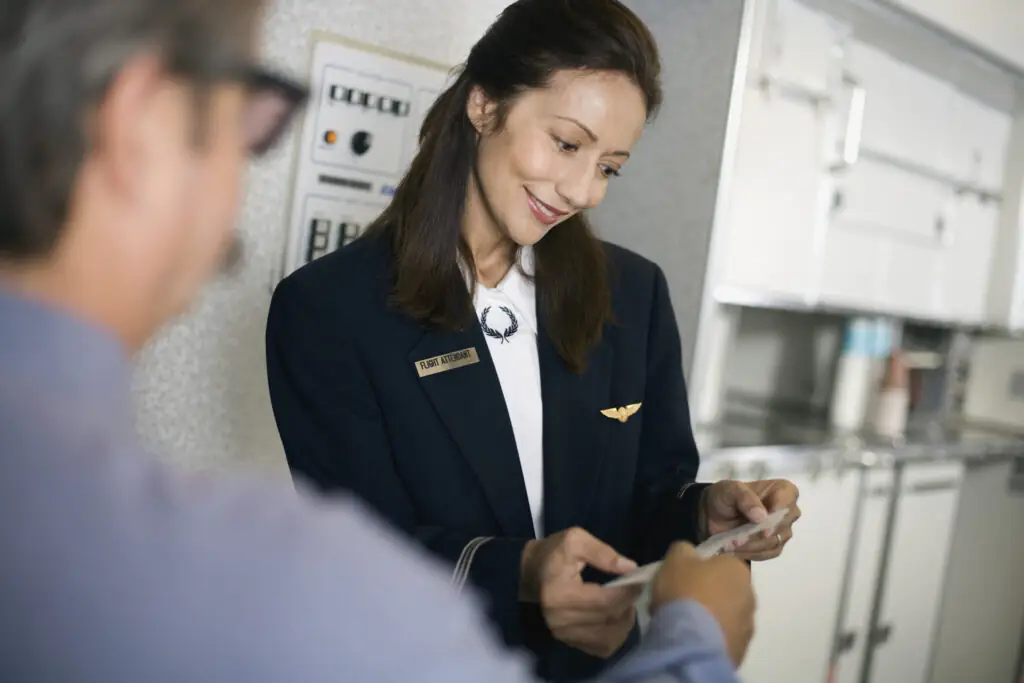
In fact, one cabin crew member took part in a Quora Q&A that revealed the real reason why flight attendants greet passengers as they board the plane and why they ask for their boarding passes.
Now, most of us will probably assume they're just being polite and helping to direct us to our seats - but that's not the case. (I mean, unless you're going in the cockpit, you can safely assume you're going down the fuselage where all the seats are.)
It actually has a hidden security purpose that I guarantee you'd never have thought of, and that is to assess the health and general wellbeing of the passenger, and confirm that they are indeed in a fit state to fly.
Shrey P, who claims to have been a flight attendant for five different airlines, stated that the crew "check plenty of things and it will all happen in a glance". Some of the main points Shrey listed were:
Shrey then stated: "The list can go on which usually happens in few minutes of boarding time."
Some of Shrey's points were also confirmed by TikTok user Kat Kamalani, who said in an eye-opening video: "Have you ever walked on the plane and seen the flight attendants standing here greeting you, or the flight attendants walking up and down the aisle? Well, I'm about to tell you what we're really doing.
"When you walk on the plane and see our happy, smiley face, we're actually looking you up and down and trying to find our able-bodied people. So these are people who are going to help us in an emergency."
Kalamani says that flight attendants often keep their eyes peeled for military personnel, firefighters, nurses, and doctors on board the aircraft.
Myriam Frafar, a flight attendant for German airline Condor, also confirmed Shrey's points, explaining the valid reason for the cabin crew asking for your boarding pass on the thread.
Frafar explained: "I check if they are drunk, drugged, sick, angry or afraid. That is extremely important as if I have the possibility to avoid any kind of troubles over the Atlantic, then I address it on ground. I say 'Hello, welcome on board', and I listen to how they respond."
Another attendant stated on the thread that they also use the meet and greet moment at the aircraft door to check whether a passenger is ill and may need further treatment on the ground, stating: "I've had passengers board who look pasty and pale, deathly ill. We removed them; nobody wants their flu germs!"
Shrey also revealed the truth about your in-flight meals, saying: "[They] are very unhealthy. Even if you have ordered that raw meal, vegan meal, bland meal etc. The food on your tray is prepared not in the galley but in the aircraft catering which is often done 12 hours before and even days before the aircraft departure. Now, how many such industries do you know where the hot or cold meal was made days before you consume it?
"The scrambled egg or the omelet that you just had was not only egg but can be a mix of egg and other substitutes. That cut fruit which is on your tray still looks fresh and how is that possible when it was cut hours before the departure, have you ever wondered?
"Most of us aren't aware of this, but when we are at cruise, the air pressure in an airliner is equal to about 8,000 feet above sea level (6,000-ft in a Dreamliner). In addition to making your ears pop, it causes our taste buds and sense of smell to go partially numb.
"This has major impact on how food tastes & smells [making] it super bland. So airline catering in recent years has really pumped up the spices, salts, and fats - all to make your mouth happy."
Per BBC News, this was confirmed in a 2010 study by Germany's Fraunhofer Institute for Building Physics, which confirmed that passengers lose around 30% sensitivity in their taste buds to sweet and salty foods.
Published 16:10 29 Dec 2022 GMT
A flight attendant has taken to TikTok to explain why passengers should refrain from wearing shorts on a plane, including several other things you should definitely not do on an aircraft.
Tommy Cimato, a flight attendant from Arizona, has garnered close to 500,000 followers on the social media app for documenting his life working on the job.
In his video - which has been viewed 4.6 million times and received 654,000 likes - Tommy lists five things traveling passengers should definitely avoid while flying.
And while many holidaymakers might choose to travel home in shorts to show off their tan, apparently that's a big no-no.
"Number one," he begins, "do not ever touch the flush button or lever with your bare hands. It's honestly just super unsanitary and it's pretty gross so when you flush, use a napkin or a tissue that's in the lavatory."
His second tip? "Don't forget to drink water," he urges. "Stay hydrated! You want to have about 16 ounces for every flight that you go on," he adds.
Another tip Tommy gives viewers is to not lean or sleep on the window. "You're not the only one who has done that and you don't know how many children have wiped their hands or other things all over the window," he explains.
"Number four, don't - or try not to - wear shorts when you're on an airplane. It's the same thing as the window; you never know how clean it's going to be. So, if you have pants, you're going to have less germs," Tommy adds.
The final tip the flight attendant leaves his followers is: "Do not be afraid to let a flight attendant know if you're feeling sick. We are there to help so if you need food, water, or an air sickness bag please feel free to let us know."
Many viewers have taken to the comments section to voice their opinions, with several people expressing their shock at Tommy's revelations about hygiene and cleanliness on airplanes.
"don't they sanitize after every flight?" one person wrote.
To which Tommy replied: "the ground crew does all the plane cleaning, they try their best to keep it clean but this is just in case if it gets missed!"
Another user added: "Everyone laughed at me for wiping down my family’s row before we sat down -everything from the window wall, trays, arm rests, back of chairs, etc..."
While a further viewer chimed in with a comment on their own flight experience, writing: "When I went on an airplane a month ago, they had said the plane was clean and ready to go. I get to my seat and…. There is barf all over the seat……."
Well, I don't know about you, but I'm definitely stocking up on Clorox wipes for my next flight! Yikes...
Published 15:53 16 Jul 2018 GMT
Unless you're lucky enough to travel in first class, most of us don't expect fine dining on a flight - but it turns out we might be better off not eating anything on-board at all. Writing on a Quora thread, user Shreyas P, who claims to have been a flight attendant for five major airlines, warned that airline meals are "very unhealthy", even if you've opted for the raw or vegan option - hard to save the planet 40,000 feet in the air (especially in a gas guzzling machine).
"The food on your tray is prepared not in the galley but in the aircraft catering which is often done 12 hours before and even days before the aircraft departure," Shreyas wrote. "Now, how many such industries do you know where the hot or cold meal was made days before you consume it?" If you're flying in the morning or overnight, she said you should be particularly wary of your breakfast.
"The scrambled egg or the omelette that you just had was not only egg but can be a mix of egg and other substitute," Shreyas wrote. "That cut fruit which is on your tray still looks fresh and how is that possible when it was cut hours before the departure, have you ever wondered?"
Shreyas added that most people aren't aware that when a plane is cruising:
"The air pressure in an airliner is equal to about 8,000 feet above sea level (6,000 ft in a Dreamliner). In addition to making your ears pop, it causes our taste buds and sense of smell to go partially numb, compared to on ground. This has major impact on how food tastes and smells. This makes it super bland. So airline catering in recent years has really pumped up the spices, salts, and fats - all to make your mouth happy."
Shreyas said this is one of the reasons why the cabin crew prefer to bring their own food on board. The flight attendant added: "A passenger bringing his own food shows a lot of awareness." According to a flight attendant who spoke anonymously to Vice, you should watch out for the drinks, too.
"Don't drink the coffee on airplanes," she said. "It's the same potable water that goes through the bathroom system. "We recently had a test for E. coli in our water, and it didn't pass, and then maintenance came on and hit a couple buttons and it passed. So avoid any hot water or tea. Bottled and ice is fine, of course."
Even celebrities bear caution when they are flying. He may be able to eat at his own restaurants when he's on the go but if Gordon Ramsay's not flying out of Heathrow, he'll never, ever eat plane food: "there’s no f***ing way I eat on planes."
Ramsay says: "I worked for airlines for ten years, so I know where this food’s been and where it goes, and how long it took before it got on board." The same applies to business and first class, so it might be a good idea to start eating before you get on the plane. Or, bring a cheeseburger or fried chicken onboard. I'm sure no one will mind that much on a long-haul flight.