


Health4 min(s) read
Woman whose ears wouldn't pop after flight gets horrifying diagnosis
.webp_lli6Ty?tr=cr-74.9.445.380,f-webp,q-70,w-100)
A woman whose ears failed to pop after a flight has revealed the shocking diagnosis she received from her doctor.
For most people, flying is the part of their vacation that they enjoy the least - from the endless lines at TSA to being cramped up in an economy seat for several hours, there are plenty of parts that aren't much fun.
One common ailment many travelers find is that their ears pop when the plane is ascending or descending, but it usually only lasts for a short amount of time before it unpops itself and goes back to normal.
However, that wasn't the case for Aida Burkins, after her ears refused to pop following a flight to Illinois.

The 22-year-old mom of two, who is from Hemet, California, was heading to Chicago in May 2025 when she realized her ears refused to pop.
By the time she returned home, her condition began deteriorating rapidly, and she began suffering with other symptoms that she could not explain.
She told Newsweek: "It all started with my ear not popping after my flight to Chicago in May 2025.
"I started bleeding into my throat, which would only come out of my nose if I was bent at the hip at about 90 degrees."
Burkins, who has one- and three-year-old children, revealed that her hearing "got worse and worse" following the flight, adding: "Then I started getting more tired and losing weight."
She sought help from multiple doctors and underwent several tests, but was repeatedly told that it was likely to be down to "just altitude sickness".
Burkins added: "Everything sounded so muffled, and I had a ringing that wouldn’t go away."

Finally, one doctor was able to find out the real cause of Burkins' symptoms - a mass was blocking her Eustachian tube - the narrow channel that connects each middle ear to the back of the nose and upper throat.
She was then referred to an ear, nose, and throat (ENT) specialist, who identified the mass and said there was a chance it could be cancerous, though it was unlikely due to her young age, and that her adenoids were enlarged and inflamed and needed removal.
Burkins underwent a biopsy but while waiting for her results, the left side of her throat started swelling up, forcing her to undergo a second biopsy.
She explained: "The doctor told me he had never seen anything quite like what I had going on. He couldn’t be sure it was cancer, but he said it was very suspicious."
CT scans revealed that she had "lumps and bumps everywhere", including the cervical lymph nodes near the base of her skull, and she underwent surgery.
This confirmed her worst nightmare - she was diagnosed with nasopharyngeal carcinoma (NPC) - a rare type of head and neck cancer that begins in the nasopharynx, the upper part of the throat located behind the nose and above the back of the mouth.
NPC is not common in the US - with less than one case per 100,000 people per year - and it is strongly associated with Epstein-Barr virus (EBV) infection, as well as genetic factors and certain environmental exposures.
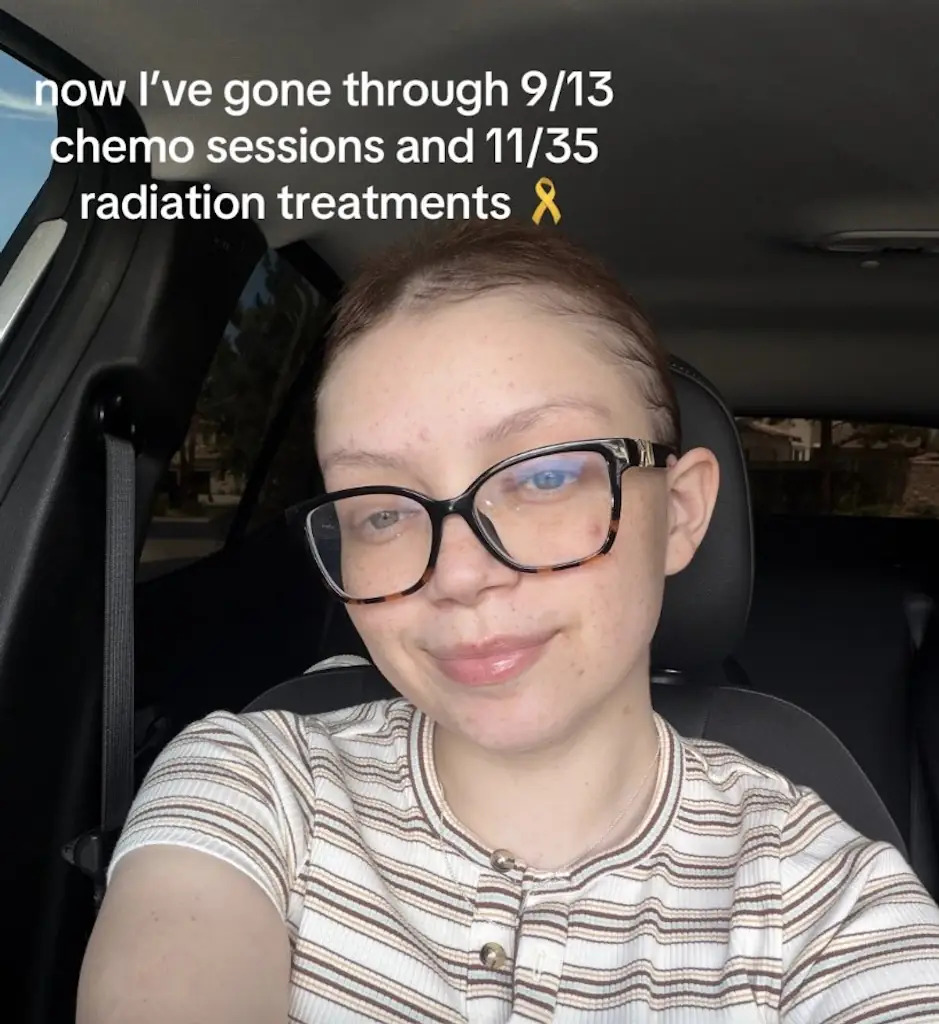
She recalled: "Hearing I have cancer, all I thought about was not being able to see my babies grow up or do the things they want to do in life. It was horrifying."
After her diagnosis, Burkins underwent chemotherapy and radiotherapy, which made the tumor shrink significantly.
Burkins revealed: "Everything is shrinking and responding to the treatments my doctors have been giving me, so they’re optimistic that I’ll be cancer-free."
She added that she chose to speak publicly about her diagnosis to remind people that "cancer doesn’t discriminate" and can affect people of all ages.