


Relationships4 min(s) read
Couple make love inside MRI scanner and the photo results are mindblowing
.webp_lli6Ty?tr=cr-74.9.445.380,f-webp,q-70,w-100)
People have been given a better look at what happens inside the body during sex after a couple got intimate inside an MRI scanner.
Sexual intercourse is something most people find important in a relationship, but MRI images have let people see the act in a whole different light.
Two willing participants, Sven and Michaela, hopped into an MRI scanner to give the world a better insight into what happens within the body, right from the start of foreplay.
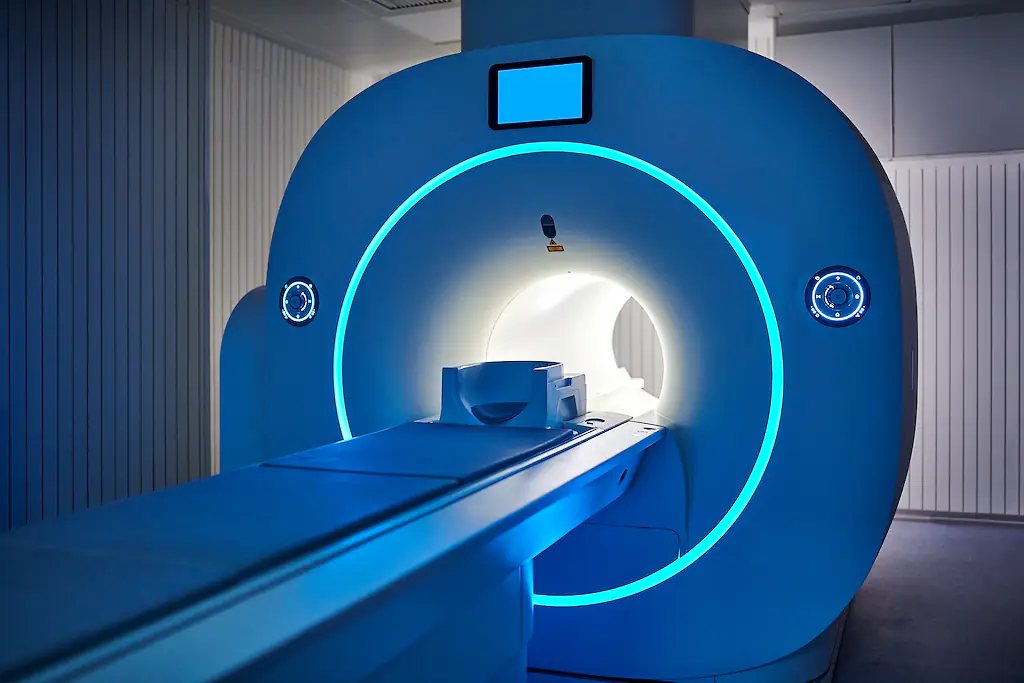
As they began kissing inside the machine, which was recorded for the BBC's show The Human Body: Secrets of Your Life Revealed, the voiceover explained: "The brain sends signals to the adrenal gland, which secretes a hormone, adrenaline, causing the heart to beat faster and stronger.
"Nerve cells in our brain release dopamine, also known as the reward hormone, and all this gives us an unstoppable craving, and focuses our attention on our loved one.
"This is to ensure one thing happens... The smallest cell of the body, the male sperm, unites with the largest cell, the female egg."
Sven and Michaela are not the only people to have sex inside an MRI scanner, as Ida Sabelis and her boyfriend Jupp helped to change the understanding of the female anatomy forever after they had sexual intercourse in an MRI machine in 1991.
The couple took part in the experiment, run by their friend, Dutch scientist Menko Victor ‘Pek’ van Andel, who wanted to see what happens inside the body when a couple has sex.
Ida and Jupp's images were the first of their kind, and became the focus of a well-known British Medical Journal entry in 1999 when a more detailed study was conducted, and is still read by thousands of people every month.
While the images were captured over three decades ago, they went viral once again after being shared on TikTok.
Scientists had initially believed that the vaginal canal was straight, but the images captured by the MRI machine helped them discover it was actually curved. .
People were also stunned to find out how the images were captured, with Ida and Jupp having to get into their rhythm before stopping and holding still when instructed to by the researchers, for the still images to be created.
Ida told the publication that she'd agreed to take part in the unusual study as a "favor" to Pek, who was her best friend's partner at the time.
She was also a big campaigner for women's rights and wanted to help science broaden its understanding of the female body.
Ida and Jupp were initially supposed to have sex in a standard missionary position in the machine, but Ida - who is a professor of organizational anthropology at Amsterdam’s Vrije University - suggested a spooning position instead, explaining: "[Missionary is] a position that for me produces hardly any arousal. Anyway, Jupp would have been too heavy in that tiny tube."
She revealed that there was plenty of laughter as the pair wriggled around inside the small tube to get into position.
The hard work was worthwhile as it helped make the groundbreaking discovery that the vagina is not a straight "tunnel", as was previously believed including in early depictions such as the famous Leonardo da Vinci drawing from the 1492 showing the vagina as a straight cylinder.
However, the MRI proved that "the penis has the shape of a boomerang” when inside a woman's body, bending to fit the shape of her anatomy without causing the male partner any pain.
The discovery was enormous, and led to Ida and Pek conducting a formal study between 1991 and 1999, the results of which were published in the BMJ.
These experiments recorded participants - who were all volunteers over the age of 18 who could quit at any point should they choose to - as they engaged in the missionary position.
None of the participants opted to drop out, but it was noted that it was only Ida and Jupp that were able to complete the test without the use of Viagra.
She told Vice: "It became pleasantly warm in the tube and we truly succeeded in enjoying each other in a familiar way.
"When I saw them [the images] it was just like, ‘aww that’s how we fit together’."
The article, which was published in 1999, remains one of the medical journal's "most popular articles of all time" and was even honored by BMJ on its 20th anniversary in 2019.
People were left stunned after seeing the resurfaced images, writing: "OK but like how is there space."
Others added: "They just don't do science like this anymore," and: "the most surprising thing is that they managed to get 2 ppl in an old school MRI machine... there's barely room for one person!"