ADVERT
Travel3 min(s) read
Published 12:34 24 Jul 2026 GMT
When a 23-year-old traveler left his home to live in an extremely remote part of the Amazon rainforest, he met the love of his life, but their relationship was far from smooth sailing - and one impulsive decision meant he had to stay away from pregnant women.
Although his father was Amazonian, Justin Alvo grew up in the US, but when he reached his twenties, he decided to return to his father’s homeland, as he always felt “something was missing” in his life.
Before moving to America in search of a better life and meeting Justin’s mother in a Chinese restaurant, his father grew up in a remote part of the eastern Ecuadorian Amazon called Tres de Noviembre. It was so isolated that he did not see a radio until he was 14 and still cannot be sure exactly how old he is, as the community did not track birthdays.
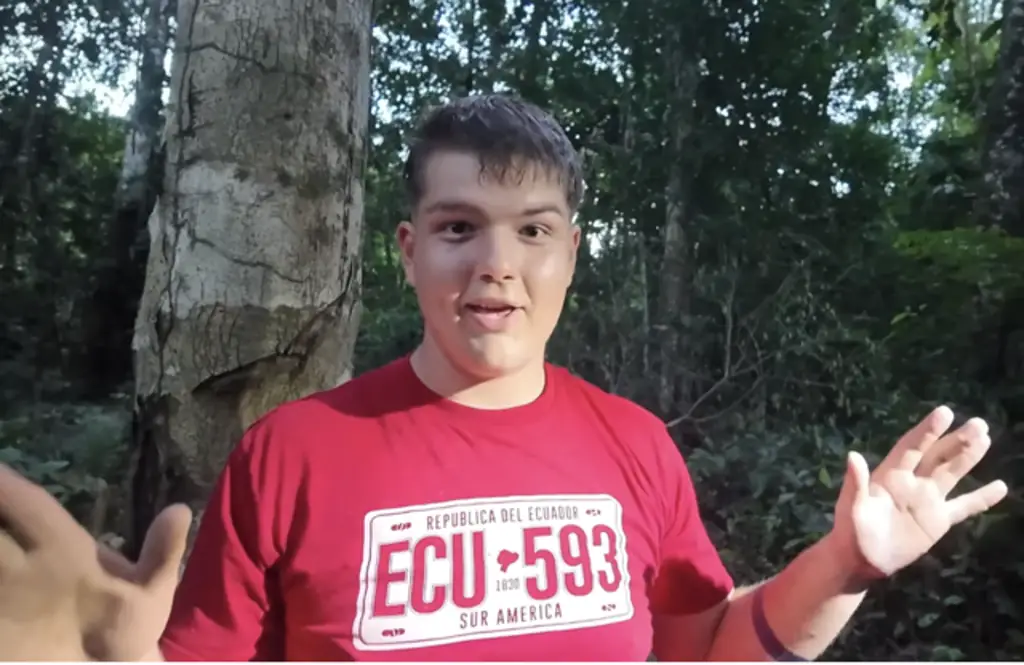
When Justin decided to visit where his father was raised to document the culture on his YouTube channel, he unexpectedly met the woman who would soon become his wife.
Maria was working as a chef at an Amazonian restaurant when she met Justin and agreed to be part of his documentaries about the Shuar people.
Justin told UNILAD: "I basically said, 'Hey, I like you a lot, you're really cute, and I want to make documentaries and videos about the Shuar people.' She said 'yes, let's do it.'"
However, keeping in touch with her was difficult as Maria has one of those “$20 phones that barely works,” which she only used to call family members in emergencies.
Recalling their first date, Justin said: "I genuinely thought I might get kidnapped; we were meeting in the middle of nowhere."
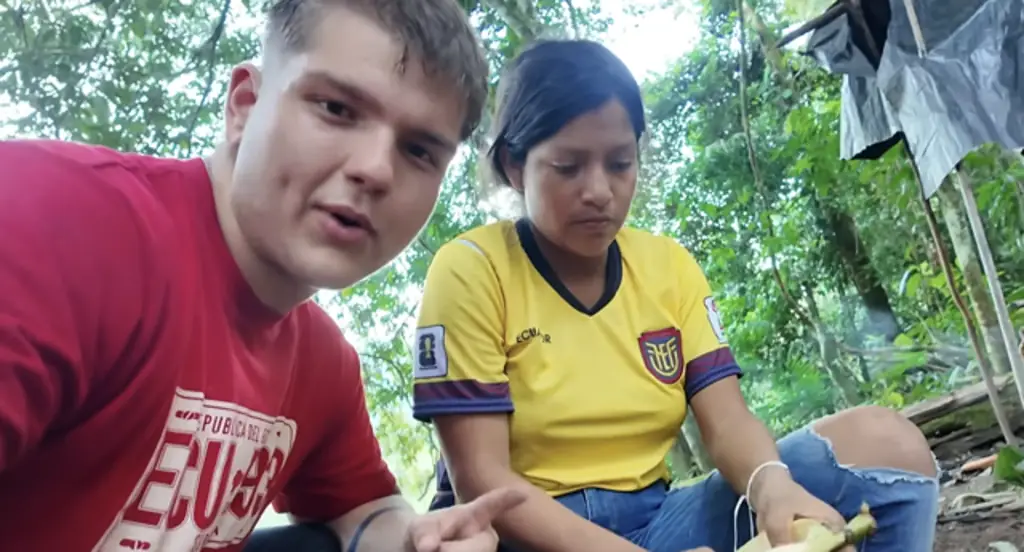
Despite his Amazonian heritage, Justin described tribal life as “an alien world.”
Thankfully, the tribe was quick to educate him on which insects to avoid, which snakes could kill him, and other crucial survival tips.
However, on one fateful day, Justin decided to ignore the locals' advice for the sake of filmmaking and got close to a deadly boa that slithered past. He was strictly warned not to approach the snake but couldn’t resist the opportunity.
He said: "They told me, 'whatever you do, don't go near that thing,' but I love animals, so of course I caught it and started showing everyone."
As Shuar people view boas as spiritual animals, after he had touched the snake he was seen as having bad energy, so was banned from being near any pregnant women in the community.
The amateur filmmaker was forced to be “cleansed” as the community feared he might pass on bad energy.
Since he was cleansed, Justin has become well integrated into the isolated community and is now happily married to Maria, with whom he welcomed a child at the start of the year.
world3 min(s) read
Published 21:28 20 Jul 2018 GMT
lifestyle2 min(s) read
Published 07:50 13 Oct 2018 GMT
travel3 min(s) read
Living in the world we exist in - surrounded by computers, aeroplanes and iPhones - it's hard to believe that anyone has managed to stay completely away from the technological sphere. But, while it might seem crazy, it's true that there are multiple reclusive tribes around the world that have nothing to do with the modern world. This was highlighted recently when remarkable footage was released of one uncontacted indigenous man who has lived alone in an Amazon forest for at least 22 years.
Known as "the indigenous man in the hole", the man in question is believed to be the sole survivor from an isolated tribe, a group of six, five of whom were killed during an attack by farmers in 1995; survivors of other indigenous groups in the region have described how farmers shot at their backs when they fled raids on their village.
Thought to be in his 50s now, the unidentified man survives by sustaining himself on pigs, monkeys and birds caught using a bow and arrow, trapping his prey in hidden holes filled with sharpened staves of wood. He apparently lives in a shelter built deep in the forest, sleeping in a hammock strung over yet another hole in the ground, and has protected his area since the 1990s. It appears he has only ever been caught on film before once; a glimpse of his face filmed in 1998 was shown in the Brazilian documentary Corumbiara.
In the video, he looks to be in excellent health and is seen semi-naked, swinging an axe vigorously as he fells a tree. "He is very well, hunting, maintaining some plantations of papaya, corn," said Altair Algayer, a regional coordinator for the Brazilian government indigenous agency Funai in the Amazon state of Rondônia, who was with the team who filmed the footage from a distance. "He has good health and a good physical shape doing all those exercises."
In addition, Fiona Watson, the research and advocacy director of Survival International, a non-profit group that works to protect indigenous peoples, spoke about the footage, stating that it was "extraordinary", particularly when you consider the fact that the 8,070 hectares of protected forest the man lives in is completely surrounded by ranches and farms. "Funai has a duty to show that he is well and alive," she said. "The crucial thing is Funai has managed to keep his territory. The fact he is still alive gives you hope. He is the ultimate symbol, if you like."
[[youtubewidget||https://www.youtube.com/watch?v=bsXj15ECoCU]]
The man was first located by Funai in 1996 and the group have been monitoring him ever since. Although they have a policy of avoiding contact with isolated groups, in an attempt to help him, the Brazilian government indigenous agency reportedly left axes, machetes and seeds traditionally planted by indigenous people for the man to find, however, have claimed that he wants nothing to do with mainstream society. "I understand his decision," said regional coordinator Algayer. "It is his sign of resistance, and a little repudiation, hate, knowing the story he went through."
At the moment, Funai specialists think that there are 113 uncontacted tribes living in the Brazilian Amazon - 27 groups have been confirmed so far - and one tribe living outside. In addition, there are 15 uncontacted tribes in Peru, Watson, as well as others in Bolivia, Ecuador and Colombia.
Published 11:36 05 Jun 2024 GMT
Published 11:09 13 Jun 2024 GMT
The leader of an Amazon tribe who was reported to have become addicted to p*rn after receiving internet access has hit back at those claims.
As previously reported, the Marubo tribe, who reside along the Ituí River, were connected to the web for the first time, thanks to high-speed internet provided by Starlink's low-orbiting satellites.
Initially, the introduction was met with enthusiasm. "When it arrived, everyone was happy," 73-year-old Tsainama Marubo told The New York Times.
However, the elders soon began to notice troubling changes.
The report highlighted access to vital health information and the ability to video chat with loved ones as positives, but also mentioned negative impacts such as social media addiction and exposure to explicit content.
Marubo went on: “But now, things have gotten worse. Young people have gotten lazy because of the internet. They’re learning the ways of the white people.”
He described the community's struggle with issues familiar to many households worldwide: teens glued to phones, group chats filled with gossip, addictive social networks, online scams, misinformation, and minors watching pornography.
Alfredo Marubo, leader of a Marubo association of villages, voiced concerns that the tribe’s oral traditions and knowledge might be lost.
“Everyone is so connected that sometimes they don’t even talk to their own family,” he said.
The New York Times reported that Alfredo was particularly disturbed by the spread of explicit videos among young men, a significant shift for a culture that discourages public displays of affection.
“Elders are worried young people are going to want to try it,” Alfredo said, noting that some leaders had already observed more aggressive sexual behavior from young men.
Enoque Marubo, the 40-year-old Marubo leader who facilitated Starlink’s introduction to the tribe, vehemently opposed these claims in a scathing Instagram video on Sunday night.
“I am here to repudiate the fake news that has been circulating around the world in the last week, alleging that the entry of the internet into our communities has resulted in addiction to pornography,” he said.
“These statements are unfounded, false and only reflect a biased ideological current that disrespects our autonomy and identity.”
Enoque criticized the portrayal of the Marubo as a “showcase” for the world and emphasized their desire for autonomy.
“We want our autonomy and we are tired of the violation of our rights,” he stated. He expressed disappointment with The New York Times’ focus on negative aspects, which he argued led to a distorted and damaging view.
“I want to reiterate the repudiation [of] all these publications of unfounded lies that appeared on the internet,” he said, adding that the internet is “a very important tool” for the Marubo.
“Internet saves lives — that would be enough,” Enoque asserted. He highlighted its role in facilitating communication with distant relatives, assisting teachers, and enhancing territorial security.
He also condemned “non-Indigenous or white people” who attempt to dictate what is best for Indigenous communities, stating: “It hurts us, disrespects us, disrespects Indigenous peoples.”
Alfredo, who raised concerns about pornography in the original article, released a statement on Tuesday, acknowledging the misleading headlines’ potential for irreversible damage.
The New York Times defended its reporting, blaming other media outlets for sensationalizing its content. “No, a remote Amazon tribe did not get addicted to porn,” read a follow-up headline from the newspaper on Monday.
Did you know that there are still tribes that live without contact with the modern world? In fact, there are an estimated 113 uncontacted tribes in the Brazilian Amazon, with 27 confirmed sightings, and the Brazilian government has recently released incredibly captivating drone footage of one of these tribes, providing us with an unprecedented insight into how its members live on a day-to-day basis
The video of this never-before-seen tribe was released last Tuesday night, but it was actually filmed last year by Brazil's agency for indigenous affairs. Drones were used to capture the rare footage in order to monitor the isolated tribes. To see the incredible drone footage of this never-before-seen tribe for yourself, check out the video below:
[[jwplayerwidget||https://content.jwplatform.com/videos/yqLaTNpz-Q0L14jDU.mp4||yqLaTNpz]]
In the video, you can clearly see 16 members of the tribe walking around. One appears to have a bow and arrow and there is evidence of crops and deforestation. Handmade tools and lodging have also been discovered. The tribe lives in the Vale do Javari region, which is in the southwest part of the Amazon. This area houses more tribes than any other part of Brazil and has been an area of interest to researchers for years, but the recently released video is the first of its kind.
"These images have the power to make society and the government reflect on the importance of protecting these groups," Wallace Bastos, president of the indigenous affairs agency, said.
So little is known about this tribe that researchers don't even know its name. Guesses have been made not only about what it calls itself, but also about the members' ethnicity and the language they speak. The goal in discovering more about these hidden cultures is that knowledge can help the Brazilian government better protect them.
The agency does not seek to make contact with the tribes. After all, these tribes do not attempt to make contact with the outside world at all. "If they wanted contact with the outside world, they would seek out ways to communicate with us," said Bruno Pereira who works for the agency.
So far, 107 isolated groups in Brazil have been registered. It seems they are aware of cities and villages in their proximity but traumatic experiences with outsides have led to maintaining solitary tribal lives. For example, last year 10 tribespeople were allegedly killed by gold miners who stumbled into the area. This isn't the first deadly attack on a tribe. There have been many clashes with nearby civilizations and even epidemics when viruses unknown among the tribes are passed from outsiders. Without modern medicine, entire tribes can be wiped out.
Take a closer look at the drone footage to get even more of an insight into their world:
[[jwplayerwidget||https://content.jwplatform.com/videos/Ol1WfpH2-dkXnENEs.mp4||Ol1WfpH2]]
In one tribe, all inhabitants except for one were murdered by farmers 22 years ago. Footage of the lone survivor was captured by researchers who nicknamed him "the man in the hole". He has been seen attempting to survive alone without any other human contact.
He received his nickname after he was often found to be digging holes in the ground, which were for him to hide in or to set traps for animals. He has not attempted to make contact with any outsiders but has accepted handmade weapons that have been left for him by the indigenous affairs agency.
Despite giving him makeshift items such as axes and machetes, the agency has a policy of not interfering with his way of life. They have never offered any modern tools or goods and have never let any of the researchers be seen by him.
"The man in the hole" uses a bow and arrow to hunt pigs, birds, and monkeys, wears nothing but a loincloth, and lives in a hut made from local trees. He also has managed to create his own papaya and corn plantation.
"I understand his decision. It is his sign of resistance, and a little repudiation, hate, knowing the story he went through," said Altair Algayer, who also works at the indigenous affairs agency. As a result, the agency has granted "the man in the hole" a territory of 8,070 hectares to protect his way of life.
The agency really wants to be able to show that these tribes are alive and thriving. In order to do that, they must grant land territory to them. This has been a source of conflict for some greedy outsiders who would want the land for themselves.
Similar to "the man in the hole", researchers have been monitoring the long-lost Moxihatetema tribe who live in an isolated part of the South American jungle. They seemingly went missing for a period of time, but images taken from a passing airplane revealed that they were alive and well in a portion of the Amazon rainforest in Northern Brazil.
They did not seem to appreciate the small intrusion from outside as one of the photos revealed the tribespeople not looking too pleased. One even shook a spear toward the camera as the plane passed by overhead.
This tribe is heavily monitored because of concerns over clashes with nearby miners who illegally trespass onto the protected land in search of gold. Hopefully, the use of drones and other new technology will better enable the agency to monitor these tribes with little interference.
It is important that we learn all we can about these indigenous people so that they can be better protected and their cultures and ways of living can remain preserved.
Published 17:11 18 Jan 2026 GMT