


Travel4 min(s) read
Tesla Cybertruck takes on Ram 2500 in an 8,000lb electric vs. diesel towing test and the result is a major mismatch
.jpg_I4Ebof?tr=cr-0.338.2730.3068,f-webp,q-70,w-100)
Someone finally tested what happens when you make a Tesla Cybertruck and a Ram 2500 Cummins diesel tow the same 8,000lb trailer along the same road, and the result is not going to make Cybertruck owners happy.
The Cybertruck's battery was down to half after 43 miles of towing. It covered 85 miles total before it was done. The Ram just kept going.
The test
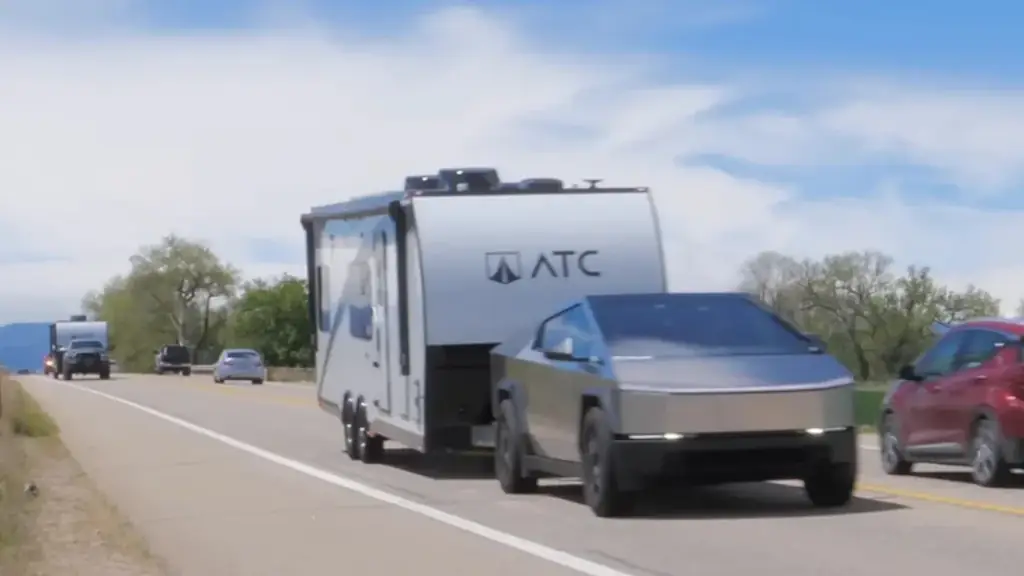
Andre Smirnov, host of YouTube channel The Fast Lane Truck, hitched identical 8,000lb 28ft trailers to both trucks and drove them along Interstate 25, which runs through New Mexico, Colorado, and Wyoming.
On paper, the Cybertruck had plenty going for it. Air suspension. Four-wheel drive. Integrated trailer brake controls. It is, by most metrics, one of the most technologically advanced trucks on the road.
The Ram 2500 Cummins had something simpler going for it. A 6.7-litre turbo diesel engine, a 20,000lb maximum towing capacity, and a fuel tank that does not halve itself after 43 miles of work.
What happened
The Cybertruck started strong. It towed the trailer comfortably. The ride was smooth. The electric torque pulled without complaint.
Then the battery started dropping. Fast.
After 43 miles of towing, it was sitting at roughly 50%. By the time Smirnov called it, the truck had managed 85 miles total. For context, that is not even enough to get from Denver to Colorado Springs and back.
The Ram, meanwhile, just drove. No range anxiety. No hunting for a charger. No need to unhook the trailer, leave it somewhere, drive to a Supercharger, charge, drive back, rehitch, and carry on.
That last point is one Smirnov made directly. The infrastructure for electric trucks towing heavy loads simply is not there yet. Most Supercharger stations do not have pull-through bays that can accommodate a truck with a 28ft trailer still attached. That means every charge stop becomes a 30-minute process of unhitching and rehitching on top of the actual charging time.
"The Cybertruck performed very well as designed," Smirnov said. "There should be more DC fast chargers with pull-through spots for trucks that are towing trailers. The process of unhooking the trailer, leaving it somewhere, driving up to the Supercharger adds a lot of time and hassle."
The cost argument
The one area where the Cybertruck has a potential edge is fuel cost, and a representative for TFL Studios pointed this out after the test.
"Today's diesel prices at an average of $5 or more a gallon are certainly going to tilt the results in the Cybertruck's favour," they said. "Though volatility with energy prices on a per-kWh basis could also cancel out the Tesla's advantage."
They also flagged that future software updates from Tesla could improve how the Cybertruck handles battery conditioning and energy management while towing. It is a fair point. Tesla updates its vehicles over the air regularly, and efficiency gains are possible.
But right now, today, with the software and infrastructure that currently exist, the Cybertruck ran out of road after 85 miles while the diesel kept driving.
What this actually tells us
Fellow presenter Roman Mica summed it up after the test in a way that neither side of the electric-versus-diesel debate is going to love: "It's all about the right tool for the right job."
If the job is commuting, short hauls, or towing light loads over short distances, the Cybertruck is more than capable. If the job is hauling 8,000lbs across state lines without stopping, diesel still wins and it is not close.
The Cybertruck starts at around $80,000. The Ram 2500 Cummins starts at $55,000. One of them can tow a trailer across three states without thinking about it. The other needs a nap every 43 miles.
Electric will get there eventually. The technology improves every year. But for anyone buying a truck right now to do actual truck things over long distances, this test told them what most of them already suspected.