Uncategorised6 min(s) read
world5 min(s) read
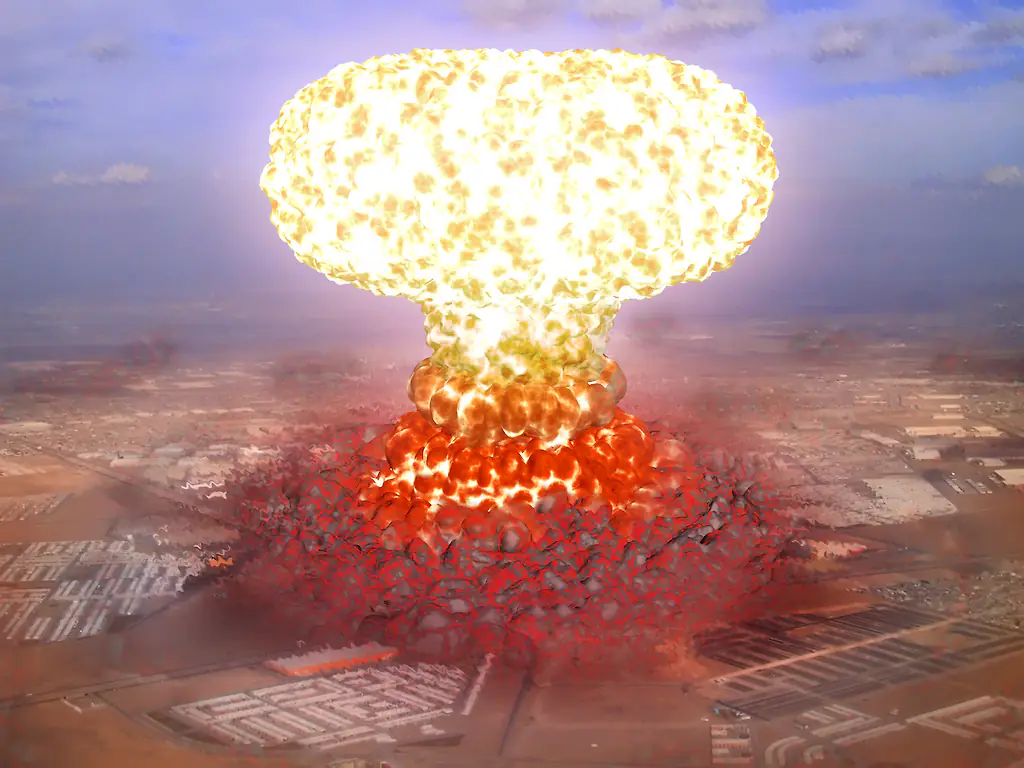
A terrifying new simulation has revealed the devastating consequences of a potential Russian nuclear strike on New York City.
The simulation, shared by YouTuber Visualiser 3D, emphasizes the existential threat posed by nuclear weapons.
The clip begins with the narrator describing Russia's 800-kiloton Topol M missile as a "very powerful nuclear charge," and noting that New York City could be a prime target due to its status as the world's financial center, its symbolic importance, and its concentration of critical infrastructure.
According to the clip, if the bomb detonates in Times Square, a fireball with "temperatures comparable to the sun will expand to a radius of 0.6 miles".
The iconic Empire State Building would be instantly vaporized, residents inside would instantly be killed, and landmarks like Bryant Park, Hell's Kitchen, and the Theater District in Manhattan would "cease to exist in seconds".
The destruction would extend to a five-mile radius, affecting neighborhoods like Harlem, Williamsburg, Astoria, and Jersey City.
"Buildings would collapse and streets would be littered with deadly debris," the narrator warns. Given New York City's high population density, the death toll "could exceed 1 million, and more than 1,500,000 people would be injured".
The energy of the blast would also spread up to seven miles, causing third-degree burns and igniting anything flammable, including "fuel stations, vehicles, electrical grids, and more."
Areas like Flatbush, Elmhurst, Fort Lee, and Ridgefield Park would be "engulfed in fire", adding to the chaos. An additional "600,000 people could die in that radius from burns, radiation sickness, and falling debris, and another 1,100,000 would be injured."
Beyond seven miles and up to twelve miles away, the shockwave would shatter all glass, leading to casualties from "glass cuts and wave force" in areas as far as Yonkers, Elizabeth, and Hempstead.
The estimated fatalities from such an attack are "1,740,660" with "2,888,820" estimated injuries.
The simulation further details the devastating impact of fallout. If the explosion were to occur above ground, "the radioactive contamination would be significant, and the entire area from New York City to Boston, depending on the wind direction, would be exposed to heavy radiation contamination".
The Topol M missile, with Russia having about 72 in service (though this number is gradually being reduced in favor of newer systems like the Yars), can be launched from both stationary silos and highly maneuverable mobile launchers. It takes an average of 15 to 20 minutes for a missile to travel from Russia to New York.
The horrifying animation left many online users deeply disturbed. "We might get to see this scenario in the next 4 years. Hope not,” one user wrote, while another exclaimed: “Oh no!!! Not [Fort] Lee”?!?
This chilling video mirrors a previous simulation uploaded by the same YouTuber, which showed the potential impact of nuclear strikes on other global targets.
As previously reported, it's been alleged that Russia has marked out 32 potential targets across Europe for a nuclear attack, including key locations in northern Britain.
Visualiser 3D imagined a nightmare scenario in which Russia launched a nuclear assault on the UK, estimating that "about one million" people across the UK and Russia would be dead within two hours from an attack designed to obliterate military capabilities.
A subsequent "stage two" targeting major population centers could lead to an estimated 50 million lives lost, with the objective of preventing effective nuclear retaliation.
The final phase, "stage three," envisioned widespread nuclear fallout causing "radiation sickness" and mass death, plunging the world into chaos with overall fatalities potentially reaching up to half a billion.
While there is currently no concrete evidence of an imminent strike, British defense experts are not dismissing the risk.
Air Commodore Blythe Crawford, who recently retired as Commandant of the UK’s Air and Space Warfare Centre, revealed that after Russia invaded Ukraine in 2022, the UK military ran its own simulation using a "synthetic environment," which he admitted was "not a pretty picture," adding: “It reinforced the fact that we really need to get after this," per The Sun.
In light of these growing threats, Britain is now taking unprecedented steps to bolster its nuclear deterrence. For the first time since the Cold War, the UK is considering arming jets with nuclear weapons.
As part of a major strategic defense review, Defence Secretary John Healey and Admiral Sir Tony Radakin are in talks with US officials to acquire aircraft capable of deploying tactical nuclear gravity bombs, such as American-built F-35A Lightning stealth jets. This would complement the UK’s current sea-based deterrent, enabling launches from both air and sea.
“The world is definitely becoming more dangerous. Nuclear risks are rising,” Healey said. “For the first time since the Cold War, we face seriously increasing risks of state-on-state conflict.”
Prime Minister Sir Keir Starmer has declared it’s time to "transform how we defend these islands," adding: “We will meet this moment head on - by mounting the kind of response not seen before in most of our lifetimes."
He continued, "We will restore Britain’s war-fighting readiness as the central purpose of our Armed Forces. We are being directly threatened by states with advanced military forces... So we must be ready to fight and win. After all, the best way to prevent conflict is by preparing for it.”
world4 min(s) read
A 'Godzilla El Niño' event is about to impact the US, as confirmed by the National Oceanic and Atmospheric Administration (NOAA).
Experts have issued official advice, as it is expected to gain strength as winter approaches, with forecasts predicting a 63% chance it will reach the “very strong” threshold.
This would make it one of the strongest events on modern record, which dates back to 1950.
Global warming is already an issue that is taking its toll on our planet, with record highs being recorded in various countries this summer.
But an El Niño, let alone a 'Godzilla' version of it, may bring about drought, wildfires, and more hurricanes in certain areas.
In fact, a report published by Climate Impact Lab claims that a 'super' El Niño event could result in 451,000 deaths across the world between September 2026 and February 2027.
If forecasts are accurate, we may experience a 44% increase in extremely hot days, which is caused by sea surface temperatures in the Pacific Ocean increasing. It's noted that the Global South will feel the effects the most.
The threat brought about by this event is a cause for concern, but the Trump Administration doesn't seem too fussed.
Trump has previously poked fun at Global Warming on social media, so it shouldn't be a surprise that he is doing next to nothing ahead of this event.
Just this spring, the National Science Foundation (NSF) began 'descoping' the Ocean Observatories Initiative, which is a network delivering real-time ocean data from over 900 sensors.
Essentially, the Trump Administration has gone out of its way to dismantle this program, with the agency announcing that all sensors, buoys and other equipment would be removed from four of the program’s five sites.
These are located from the Gulf of Alaska to the Irminger Sea between Greenland and Iceland, and then south to the waters of North Carolina.
It cost an eye-watering $386m to build over the course of a decade, with the system regarded as one of the most advanced ocean-observing networks in the world.
But it may soon be no more, after being cut down to the bare bones.
In an explanation to VT, the UK's Met Office explained what a regular one is like, saying: "El Niño is a naturally occurring weather cycle in the Pacific Ocean characterized by unusually hot waters near the equator, which changes the circulation of air in the atmosphere.
"But the effects of El Niño do not stay limited to that part of the Pacific; they ricochet outward to affect weather and climate patterns around the globe."
However, a strong or "Super El Niño" is when sea surface temperatures increase by more than 1.5°C, with this occurrence possibly taking place this fall.
This change started in June 2026 and could peak around November 2026, when sea surface temperatures are predicted to reach around 4°C above average.
Scientists think it could result in 2027 becoming the warmest year on record, with the estimated likelihood of a Super El Niño being increased by professionals in recent weeks.
The NOAA ENSO forecast page also details where the affected areas will be and how we will be impacted over the seasons.
Scientists are starting to describe it as 'Godzilla-level', though this term isn't being used by the World Meteorological Organization (WMO).
A 44 percent increase in extremely hot days will result in higher humidity levels, with the temperature making it harder for humans to cool down.
The predicted 451,000 deaths will be a result of the physiological impacts of heat, with experts explaining that the death toll could be far higher due to indirect casualties.
An El Niño will cause flooding, droughts, food shortages, crop failures, wildfires, and a spike in tropical diseases, among other effects.
Scientists believe that areas that are already naturally hot and poor in the Southern Hemisphere will be impacted the most.
The last Super El Niño occurred during the 2015–16 period and was one of the strongest on record.
Prior to that, notable Super El Niño events took place in 1997–98 and 1982–83.
Experts caution, however, that no two El Niño events are identical in their impacts, making direct comparisons between past and future events difficult.
us6 min(s) read
With the rising tensions around the world - particularly in the Middle East - there are growing concerns of nuclear war.
While this remains highly unlikely, morbid curiosity can still take hold about what impact this would have.
With that being said, here's what YouTube channel Science Time has to say about a nuke hitting New York City.
The effects of a nuclear bomb detonating over New York would be catastrophic.
To understand the magnitude of this disaster, let’s consider a bomb similar to the "Little Boy" atomic bomb dropped on Hiroshima in 1945.
The Little Boy bomb had an explosive yield of approximately 15 kilotons of TNT, resulting in massive destruction and a devastating loss of life.
If a similar bomb were dropped on Manhattan, the damage would be on a much larger scale due to the city’s dense population and infrastructure.
In the immediate aftermath of detonation, everything within a 650-foot radius would be vaporized. This includes buildings, skyscrapers, and people.
The blast wave would then spread outward, causing severe damage to structures up to 1,000 feet away.
Concrete buildings, even those designed to withstand significant forces, would be either severely damaged or completely demolished, with fatalities approaching 100%.
Beyond the initial blast zone, the heat generated by the explosion would ignite a firestorm, spreading fires across large portions of the city.
People within an 11-square-kilometer (4.4 square-mile) radius would suffer third-degree burns - severe injuries that destroy skin tissue and can lead to permanent disability or the need for amputations.
The aftermath of a nuclear explosion isn’t just about the immediate destruction; it also involves radioactive fallout.
The explosion would send radioactive debris into the atmosphere, carried by wind patterns. This fallout would spread over a vast area, making the environment hazardous for survivors and first responders.
The radiation would continue to contaminate the environment, affecting not only New York City but also neighboring areas.
This radioactive debris would pose long-term health risks, including cancer, genetic mutations, and other severe illnesses for anyone who survives the initial blast. The city’s infrastructure would be shattered, hospitals would be overwhelmed, and rescue operations would be nearly impossible.
The psychological toll on survivors would be immense, and the city would face an incredibly difficult path to recovery, if recovery were even possible.
While a nuclear bomb like "Little Boy" detonating over New York seems terrifying, the likelihood of such an attack is relatively low.
The bomb’s potential detonation would most likely come from a nuclear-armed state rather than a terrorist organization, which makes this scenario even more alarming.
New York City, while an iconic symbol of American power, lacks significant military targets, making it less likely to be a primary target in a nuclear conflict.
Washington, D.C., for example, holds the concentration of the country’s political and military leadership, making it a more probable target.
Similarly, U.S. nuclear silos - designed to withstand attacks - are high-priority targets in the event of a nuclear war.
However, there is a strategy called "countervalue targeting," which involves attacking densely populated civilian areas like New York City to maximize casualties and create widespread panic.
The idea is to break the enemy's will to fight by causing massive civilian and infrastructural losses.
While the scenario of a nuclear attack on New York from a terrorist group is unlikely, nuclear-armed states continue to develop and maintain powerful arsenals.
Both the U.S. and Russia hold vast stockpiles of nuclear warheads. As of now, Russia possesses approximately 5,997 nuclear warheads, and the U.S. is close behind with 5,550.
Among the most terrifying weapons in these arsenals is Russia's RS-28 Sarmat missile, also known as the Satan 2.
This missile is designed to carry multiple warheads and can bypass missile defense systems, making it a deadly tool of destruction. A single Satan 2 missile can carry up to 15 separate warheads, each with a yield of 1 megaton of TNT, ensuring that no target is beyond its reach.
Imagine the power of a Satan 2 missile launched at New York City. With its 15 warheads, each carrying 1 megaton of TNT, the missile could deliver catastrophic destruction.
The Satan 2 missile has an enormous payload capacity of up to 50 megatons of TNT. This is a thousand times more powerful than the "Little Boy" bomb that devastated Hiroshima.
If the Satan 2 missile were to detonate over New York City, the destruction would be far beyond what any city could recover from.
The blast would create a fireball with a radius of over 2.6 miles, incinerating everything within that area. The intense heat would cause third-degree burns over a 21-mile radius, affecting most of the New York metropolitan area.
The Satan 2 missile is one of the most powerful weapons ever created. If detonated over New York, it would obliterate the city, turning it into a smoldering wasteland.
The effects would extend far beyond the city, with devastation affecting surrounding regions for miles.
Let’s take it a step further. The most powerful nuclear weapon ever detonated was the Soviet Union’s Tsar Bomba, with a yield of 50 megatons of TNT.
If this bomb were to detonate over New York City, the destruction would be unimaginable.
The Tsar Bomba was so powerful that its explosion could be seen from hundreds of miles away, and the shockwave from the blast circled the Earth three times.
If a bomb of this magnitude were to strike New York, the fireball alone would incinerate everything within a 3-mile radius.
Blast damage would extend over 9 miles, covering over 250 square miles, and moderate blast damage would spread to a staggering 20-mile radius, affecting more than 1,350 square miles.
The thermal radiation would cause third-degree burns up to 37 miles away, and the heat would ignite fires across this vast area.
In short, New York would be destroyed, and the surrounding regions would suffer massive damage. The likelihood of such a scenario is extremely low, but the sheer magnitude of this bomb shows how catastrophic the use of nuclear weapons could be.
A nuclear attack on New York City, especially from a weapon of the magnitude of the Tsar Bomba or Satan 2, would trigger immediate retaliation from other nuclear-armed states.
This retaliation would likely plunge the world into a global nuclear war, causing unimaginable destruction and loss of life on a global scale.
The consequences of such an event would be far-reaching. It would not only mark the end of New York City as we know it but could also lead to the collapse of global civilization. The world would be forever altered, and the human race would face a grim future.
us3 min(s) read
New Yorkers were seen wading through high levels of floodwater in subway stations after Storm Elsa's heavy rainfall caused chaos.
Flash floods in Manhattan saw people brave "chest high"dirty water in a desperate bid to catch a subway train, per Daily Mail.
Footage shared on social media sparked serious concerns over health as locals were plunging into the contaminated water while the stations kept flooding.
Thunderstorms caused widespread flash flooding across NYC, with waist-high water deluging Washington Heights subway station and cops deployed to rescue stranded motorists.
The Bronx was also hit with torrential flooding, as one local was seen using a jet ski to cross a road under several feet of floodwater.
The city's emergency management division issued a flash flood warning for Brooklyn, Manhattan, Queens, and the Bronx from Thursday afternoon into the evening, warning that "heavy rainfall will cause flooding of highways and streets."
NYPD added that "slippery conditions are possible," advising locals to "use caution when driving, walking or biking."
Elsewhere, New Yorkers were forced to leave their stranded cars on flooded streets.
The NYPD Special Operations' Disorder Control Unit responded to the situation, and "with a little ingenuity, officers used a barrier truck & safely removed over a dozen people from their stalled vehicles," police said on Twitter, sharing photos from the scene.
NYPD then tweeted: "Due to flooding, expect delays in all major crossings and road closures. Stay off the roads and use public transportation if possible."
Some subway stations, however, were severely flooded as people took drastic measures to board trains.
One video that went viral on Twitter showed people wading through dirty water trying to get through turnstiles and into the station, the water reaching their waist.
The user who tweeted the footage said it was the 157th Street station for the 1 train. As of Friday morning, no stations were flooded, MTA spokesperson Renee Price told CNN.
In addition to rainfall and high winds, "a tornado or two will be possible through the early afternoon for parts of Long Island and southeastern New England," per National Hurricane Center.
Interim President of New York City Transit Sarah Feinberg tweeted Thursday night: "Drains are working remarkably well, and NYCT crews are, as always, working hard and fast and doing great work. Give them room to work and be safe. Water is receding. Stay alert for additional storms. Working as quickly as we can to get everyone where they're going."
Meanwhile, Eric Adams, who won New York City's Democratic mayoral primary earlier this week, re-shared the video of the flooded subway station on Twitter, writing: "This is what happens when the MTA makes bad spending decisions for decades.
"We need congestion pricing $ ASAP to protect stations from street flooding, elevate entrances and add green infrastructure to absorb flash storm runoff. This cannot be New York."
world news4 min(s) read
It might sound like something from a sci-fi disaster film, but scientists say the threat of the Doomsday Glacier is very real, and potentially catastrophic.
Deep in West Antarctica lies Thwaites Glacier, a colossal and unstable mass of ice that researchers have ominously dubbed the “Doomsday Glacier.” Its nickname isn’t an exaggeration. If Thwaites collapses, the consequences could be felt around the globe.
Roughly the size of Great Britain and more than 2 kilometres thick in parts, Thwaites holds enough water to significantly raise sea levels worldwide. Scientists warn that if it were to fully give way, global sea levels could rise by around 65 centimetres, per the British Antarctic Survey.
“If Thwaites Glacier collapses it would cause a rise of around 65cm (25 inches) in sea level,” said Dr Alastair Graham of the University of South Florida.
That might not seem like a dramatic number on its own, but the real-world impact would be devastating. A rise of just half a metre would mean regular flooding for many coastal cities. Places like New York, London, and Bangkok could face chronic inundation. Even Australia isn’t spared: large swathes of its population live in low-lying suburbs in Sydney, Melbourne, and the Gold Coast, making them especially vulnerable to even modest sea level rise.
And the crisis isn’t some distant future scenario. Thwaites is already melting, fast. Its flow of ice into the sea has doubled since the 1990s, and the floating ice shelf that helps hold it back is cracking under mounting stress.
“This year is really different,” said Ted Scambos, a glaciologist at the University of Colorado Boulder and leader of the Science Coordination Office for the International Thwaites Glacier Collaboration, speaking to CNN.
“It’s very difficult to recover from this in one season. The game has changed.”
Some researchers fear parts of that ice shelf could disintegrate in the coming years. If that happens, the glacier’s movement into the ocean could accelerate dramatically, and with it, the contribution to rising seas.
Even more worrying is the role Thwaites plays in the larger Antarctic ice system. Often described as a “keystone” glacier, its collapse could destabilise surrounding glaciers, setting off a chain reaction that could eventually unlock enough land-based ice to raise sea levels by several metres over the coming centuries.
While that kind of worst-case scenario would unfold over a longer timeline, scientists stress that Thwaites is already contributing to sea level rise, and how quickly it worsens depends heavily on our emissions and the warming they cause.
This isn’t just about Thwaites either. Antarctica as a whole is sending out warning signals. According to the National Snow and Ice Data Center, “Antarctic sea ice has hit record-low levels for winter.”
While melting sea ice doesn’t directly raise sea levels, it plays a vital role in Earth’s climate system. It reflects sunlight like a mirror, helping to keep the planet cool. As that ice disappears, darker ocean waters absorb more heat, further warming the region.
That warmth can then seep beneath floating ice shelves (like the one at Thwaites) and cause them to melt from below. When those shelves weaken, they can no longer act as barriers, and inland glaciers begin sliding more quickly into the sea.
This chain reaction is exactly what scientists fear could happen across West Antarctica. The frozen parts of our world are shifting faster than expected, and those changes may reshape coastlines, displace millions, and ignite enormous economic and humanitarian crises in the decades to come.
The message from scientists is clear: the time to act on climate change is now.