


UK4 min(s) read
Police issue warning to parents if they see this horse emoji on their child's phone
.webp_SmgFsc?tr=cr-292.0.1244.952,f-webp,q-70,w-100)
Parenting in the digital age presents a range of modern complications. Technology evolves rapidly, bringing the entire world to a person's fingertips in seconds. The internet makes it simple to communicate, access entertainment, and learn new skills, which transforms daily routines for families everywhere.
At the same time, this constant connectivity introduces new obstacles for parents. Young people grow up surrounded by fast-changing trends, online slang, and digital spaces. Because children and teenagers are naturally curious and eager to feel included, they can be vulnerable to negative influences or risky online behavior.
Recently, law enforcement officials raised awareness about how everyday emojis can carry hidden meanings. Symbols like the horse emoji, for instance, might represent something far more serious than a simple animal. Emojis usually serve as harmless fun, but this warning shows how digital symbols can occasionally conceal dangerous activities.
For parents, the primary goal is not to panic, but to remain well-informed about modern online communication.
Hidden meanings behind everyday emojis
Many parents first realized that text icons could carry subtle code words after watching the popular Netflix project Adolescence.
The British psychological drama follows a 13-year-old boy arrested after a female classmate is killed. The plot shocked viewers by showing how ordinary phone symbols can mask troubling topics among young people.

Following the release of the series, parents flooded social media to share how they began paying closer attention to the icons appearing in their children's text threads. Many adults realized for the first time that simple shorthand could hide references to dangerous behaviors.
In Adolescence, the main suspect, Jamie Miller, is influenced by hateful online content that promotes hostile attitudes toward women. The show explores communities associated with this mindset, including so-called incels, or involuntary celibates, who define themselves by an inability to form romantic relationships.
To communicate subtly, members of these groups sometimes adopt specific symbols. One frequent example is the pill icon, which references concepts from the manosphere.
In an article for The Conversation, Dr. Robert Lawson, a sociolinguistics expert at Birmingham City University, explained: "The cyberpunk blockbuster The Matrix is the source of a key symbol in the manosphere – the red pill."
Dr. Lawson continues: "In the manosphere, those who have been 'red-pilled' see the world as it really is, understanding the so-called 'real' nature of women's behavior and dating preferences."
In the drama, DI Bascome, played by Ashley Walters, learns that a dynamite emoji can represent an exploding red pill. The 100 symbol is also referenced in relation to the belief that "80 per cent of women are attracted to 20 per cent of men."
The show also details how heart colors might carry extra meaning. As a fictional teenager from the show explains to his father, "Red means love, purple horny, yellow 'I'm interested, are you interested?', pink 'I'm interested but not in sex,' orange 'you're going to be fine,' it all has a meaning – everything has a meaning."
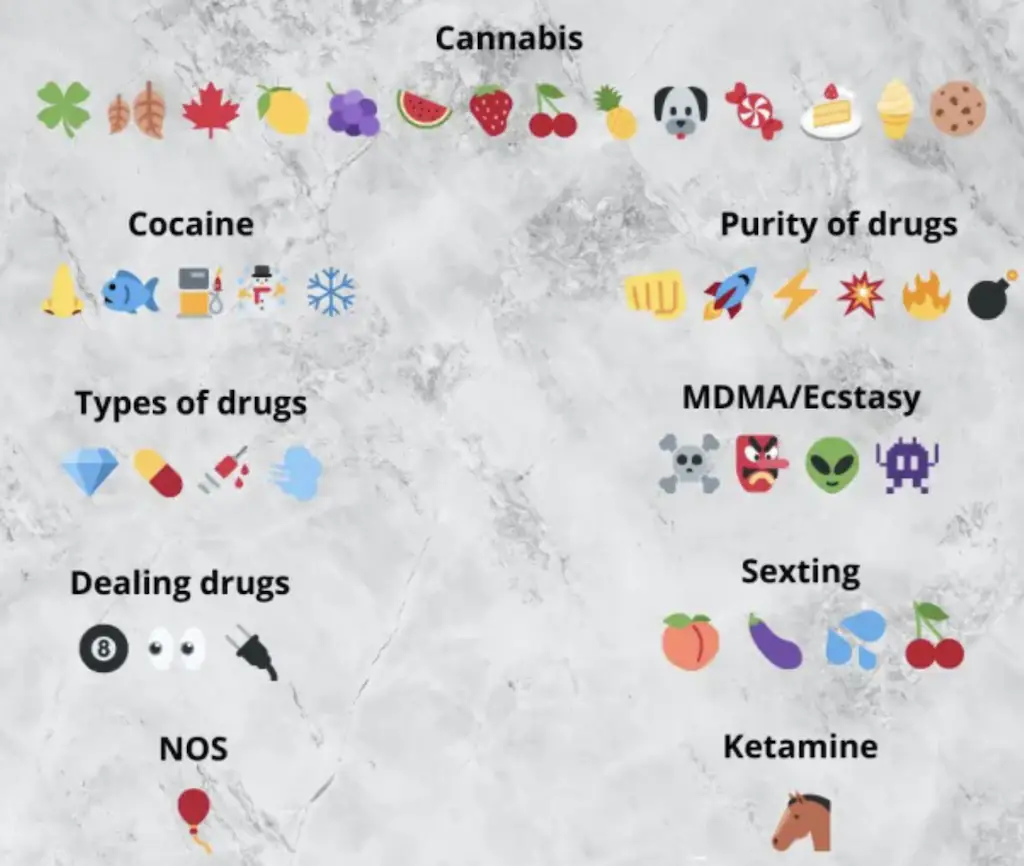
What law enforcement wants parents to know
While the television show highlights ideological messaging, police guidelines focus heavily on how emojis relate to illegal substances. In 2023, Surrey Police in the UK published educational guidance to help families recognize digital drug codes.
The guidance notes that a horse emoji might refer to ketamine, a substance used in veterinary medicine. Other icons like an alien, demon mask, space invader, or skull can point to MDMA.
Similarly, snowflake, snowman, or blowfish emojis often refer to cocaine. Cannabis is represented by items like dogs, cake, ice cream, lemons, grapes, trees, or leaves. Meanwhile, a plug icon frequently refers to a supplier.
It is critical to evaluate context before drawing conclusions, as a single symbol on a phone does not automatically confirm bad behavior.
Addressing the guidance, a statement from Surrey Police said: "What is vital in these discussions is trust. We're very aware that checking phones could break down this trust between a parent and their child, and therefore we are not suggesting parents do this. Instead, we want people to be aware of what these emoji mean, in case they do happen to see them."