


US6 min(s) read
Man asked AI to predict who will win the 2028 US presidential election and got a 'jawdropping' response
.webp_QQJmGo?tr=cr-345.0.1535.1190,f-webp,q-70,w-100)
A new simulation of the 2028 presidential election is turning heads online after YouTube channel Election Time asked Grok AI to forecast the race and generate a full Electoral College map.
Grok, owned by Elon Musk’s xAI, was tasked with projecting a hypothetical matchup between former Vice President Kamala Harris and incumbent Vice President JD Vance.
The video walks through early primary polling, betting market odds, and state-by-state projections before revealing the final map.
As the host explains: “In this video, I asked Grok AI to predict the 2028 presidential election and give us a map forecast.”
Democratic and Republican primary outlooks take shape
On the Democratic side, Harris leads early primary polling with 32 percent support, putting her ahead of California Governor Gavin Newsom, who trails at 23.8 percent.
Pete Buttigieg sits in a distant third at just under 10 percent, followed by Representative Alexandria Ocasio-Cortez and Pennsylvania Governor Josh Shapiro.
The host notes that Harris’s resurgence may surprise some observers, given that 'many people did write Kla Harris off following her 2024 election defeat.'
However, new polling shows her regaining the lead.
Betting markets also suggest momentum, with a 56 percent chance she will run for the Democratic nomination in 2028.
Just months earlier, those odds stood at 11.2 percent.
“Today, it is more likely than not that she is going to run again,” the video states.

On the Republican side, Vice President JD Vance dominates the early field.
He commands 49.2 percent support, far ahead of Donald Trump Jr., who trails by 29 points.
Senator Marco Rubio posts 12.5 percent, followed by Florida Governor Ron DeSantis at 9.2 percent.
According to the projection, Vance is the clear favorite to secure the nomination, with a 46 percent chance of becoming the GOP standard-bearer. Rubio follows at 18 percent.
The host summarizes the outlook bluntly: “If nothing big changes, he will very likely become the party’s nominee in the next presidential race.”
Solid and likely states give Vance an early advantage
Grok’s simulation begins by allocating solid states, defined as those decided by 15 points or more.
Vance’s solid column includes Utah, Idaho, Montana, Wyoming, North Dakota, South Dakota, Nebraska except its second district, Kansas, Oklahoma, Missouri, Arkansas, Louisiana, Mississippi, Alabama, Tennessee, Kentucky, West Virginia, Indiana, South Carolina, and Ohio.
Ohio’s classification marks a significant development.
Once a perennial battleground, the state has shifted sharply right.
The host explains that with Vance at the top of the ticket, “it is not difficult to see that he will carry the Buckeye State by a solid 15-point margin,” especially after Donald Trump’s double-digit win there in 2024.
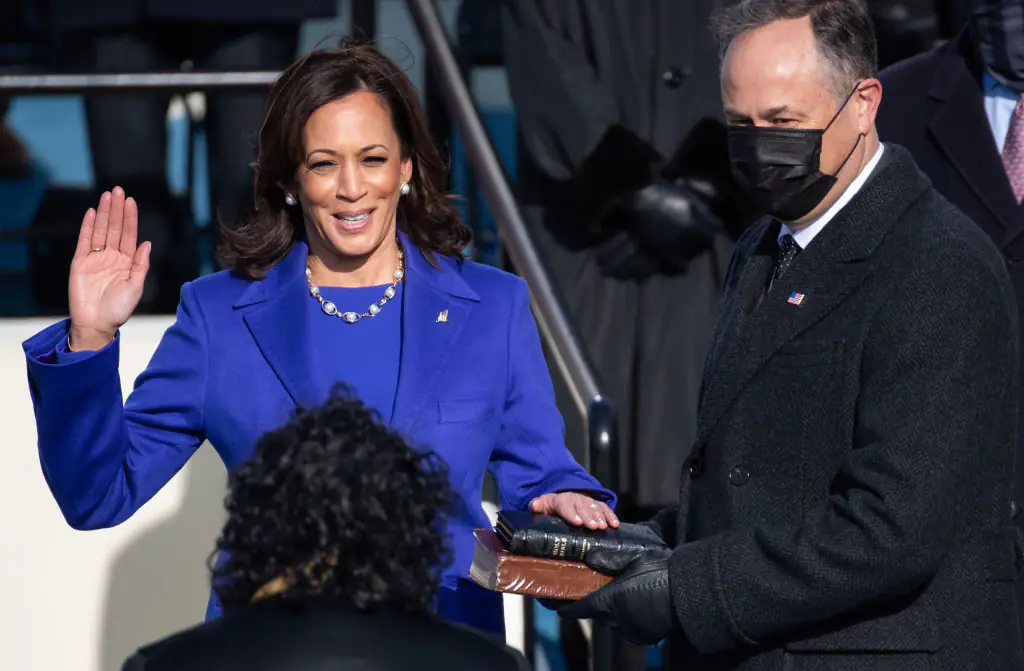
Harris’s solid states closely resemble her 2024 coalition, though Grok gives her slight improvements in a few places.
She is projected to win Washington, California, Hawaii, Vermont, Massachusetts, Connecticut, Delaware, Maryland, the District of Columbia, and Maine’s first district by at least 15 points.
Notably, the model has her securing Connecticut and Delaware by solid margins after failing to do so in 2024.
After the solid states are allocated, Vance leads 139 to 108 in electoral votes.
The likely category, defined as margins between 5 and 15 points, further expands Vance’s advantage.
He is projected to win Iowa, North Carolina, Florida, Texas, Arizona, Alaska, and Maine’s second district.
Florida and Texas are described as firmly red after large Republican gains in recent cycles. In Arizona, which Trump carried by 5.5 percent in 2024, Grok projects Vance maintaining a similar margin.
With solid and likely states counted, Vance reaches 246 electoral votes, just 24 shy of the 270 needed to win.
Harris’s likely states include Oregon, Colorado, New Mexico, Illinois, New York, Maine statewide, Rhode Island, and Virginia.
Illinois and New York are highlighted as warning signs for Democrats after narrower margins in 2024. Harris carried Illinois by under 11 points and New York by 12 percent, both significantly weaker than prior Democratic performances.

Upper Midwest and Sun Belt shifts define the battleground
The lean category, representing margins between 1 and 5 points, reflects what the host calls a reshaped map. Nevada and Georgia fall into the lean Republican column.
Nevada had not voted Republican since 2004 before flipping in 2024, and Grok projects Vance holding it. Georgia, long competitive, is also forecast to remain narrowly red.
The three upper Midwestern states of Wisconsin, Michigan, and Pennsylvania are projected to move together once again. The video emphasizes their long history of voting as a bloc, noting they have backed the same candidate in every election since 1992.
After Trump reclaimed all three in 2024, Grok predicts Vance will carry them as well, each by a lean margin.
On the Democratic side, New Jersey and Nebraska’s second district are categorized as lean blue. Harris is projected to win New Jersey by just under five points following a significant drop from Joe Biden’s 16-point margin there in 2020.
At this stage of the map, Vance stands at 312 electoral votes to Harris’s 212.

Minnesota and New Hampshire emerge as surprise tilt states
The final two states, Minnesota and New Hampshire, are labeled tilt Republican, meaning they are projected to be decided by less than one point.
Minnesota has not voted Republican in a presidential race since 1972, yet the video notes how close it has come to flipping in recent cycles.
Harris won the state by just 4 percent in 2024, even with Governor Tim Walz as her running mate. In 2016, Hillary Clinton carried Minnesota by only 1.5 percent.
Grok places Minnesota in the Republican tilt column, suggesting Vance could edge out a narrow victory. “It is essentially a pure toss-up,” the host says.
New Hampshire follows a similar pattern. Harris won it by 2.8 percent in 2024, while Clinton’s 2016 margin was just 0.37 percent. Grok projects it narrowly favoring Vance in 2028.
Final Electoral College projection shows 326 to 212 result
In the end, Grok AI’s forecast gives JD Vance 326 electoral votes and Kamala Harris 212. The projection has Vance winning every state Donald Trump carried in 2024, along with Minnesota and New Hampshire.
“This is the 2028 presidential election map,” the host concludes. “According to Grok AI in a matchup between Vice President JD Vance and former Vice President Kla Harris, it gives Vance 326 electoral votes and Harris 212.”