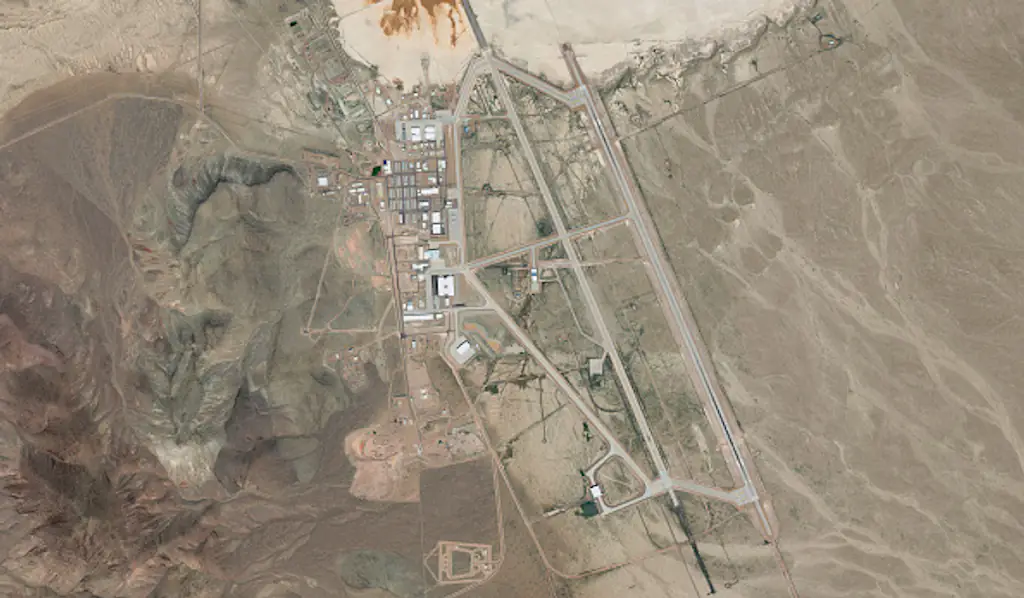
The US government has quietly expanded the restricted area surrounding the infamous Area 51, closing off thousands of acres of public land in a move that has fuelled fresh speculation about what is happening inside the highly secretive military facility.
The newly restricted zone covers around 23,000 acres in Nevada and includes Tikaboo Peak, widely regarded as the last legal location where members of the public could catch a distant glimpse of Area 51 from roughly 26 miles away.
Anyone caught entering the newly closed-off area now risks substantial fines and up to a year in prison.
While the Bureau of Land Management (BLM) says the closure is intended to protect public safety, longtime Area 51 researcher Joerg Arnu believes there is another reason behind the sudden decision.
What is the government intending?
The US government has expanded Area 51. Credit: Maxar/Getty
According to Arnu, the government is attempting to shield classified military programmes involving advanced fighter aircraft and artificial intelligence-powered combat drones.
"Signs were set up overnight – literally overnight," Arnu told the U.S. Sun.
"There was no public notice, no hearing, no nothing. Signs were simply put up stating that this area is now closed to the public."
The BLM has maintained that closing the land is necessary because of the area's hazardous terrain, arguing hikers could be injured.
Arnu, however, dismissed that explanation.
"In the notice, it says that although nobody has ever gotten hurt, they just want to prevent it," he said.
"So basically, while no serious accidents have occurred, they have preemptively closed those whole mountain ranges. It's absolutely irregular."
The BLM declined to comment when contacted about the allegations.
The abrupt nature of the closure has surprised researchers who have followed Area 51 for years. Previous expansions of the military site's boundaries have typically involved environmental reviews, public consultations and formal hearings.
"I have never seen anything like this happen," Arnu said.
"Normally, Area 51 has grabbed land before, and normally it goes through a process of public hearings, environmental impact statements, and so forth. None of that has been done here."
Tikaboo Peak has long been considered the closest legal viewpoint overlooking the secretive installation, although its distance means only limited details are visible.
"Tikaboo Peak is the closest viewpoint to Area 51, but it is still 26 miles away, so you really don't see all that much," Arnu explained.
"From 26 miles away, all you can see are some dots in the distance; those are the hangars."
Despite that distance, Arnu believes several cutting-edge defence projects are now being tested at the base.
"There are three interesting projects right now that I think are moving into Area 51, and those are the reason for the closure," he claimed.
"One project is the Boeing F-47—that's the new Next Generation fighter jet. Another related project is the Next Generation Air Dominance project, abbreviated as NGAD. The third project is a new Navy fighter jet, commonly known as F/A-XX."
According to Arnu, these aircraft represent the next phase of military aviation, combining traditional fighter jets with autonomous drone technology.
"It's always a cat-and-mouse game," he said, referring to competition between the United States and rival nations including China and North Korea.
"The latest step in that spiral is what we call '6th Generation' technology."
He described future combat operations in which human pilots oversee fleets of AI-controlled drones.
"Essentially, the pilot acts as a 'quarterback,' saying, 'Okay, drone, go take out this target on the ground,' and the drone moves in and does everything completely independently via AI control."
Arnu believes military officials are increasingly concerned about observers witnessing not only experimental aircraft but also how they are being deployed.
"In the past, they had one aircraft being tested," he explained.
"But now, you have specific procedures and tactics being tested, and I think they don't want the public to see those tactical procedures."
What has prompted the decision?
He also suggested rising international tensions could have accelerated the decision.
"There may be a bit of urgency due to current events," he said.
"They feel they have to step up their game and accelerate things."
The newly restricted area extends beyond Tikaboo Peak itself, encompassing two mountain ranges, hiking trails, campsites, off-road vehicle routes and historic Native American rock art sites.
Arnu warned the closure could have a serious financial impact on nearby communities that benefit from Area 51 tourism.
"Our biggest revenue generator is tourism, and this closure is going to hit that hard," he said.
He also expressed concern that hunters and hikers unfamiliar with the changes could unknowingly enter the prohibited area.
"If people who aren't aware of the restriction go hunting or hiking there and accidentally stray into the zone, what happens?" he asked.
"Do they get arrested? It's ridiculous."
According to Arnu, tensions had already been growing around Tikaboo Peak before the closure, with some visitors allegedly being confronted by the Air Force.
He also claimed one Area 51 enthusiast was detained and pressured to admit violating federal photography laws, although he declined to discuss the case in detail beyond confirming the individual had safely returned home to Poland.
The BLM again declined to comment on those allegations.
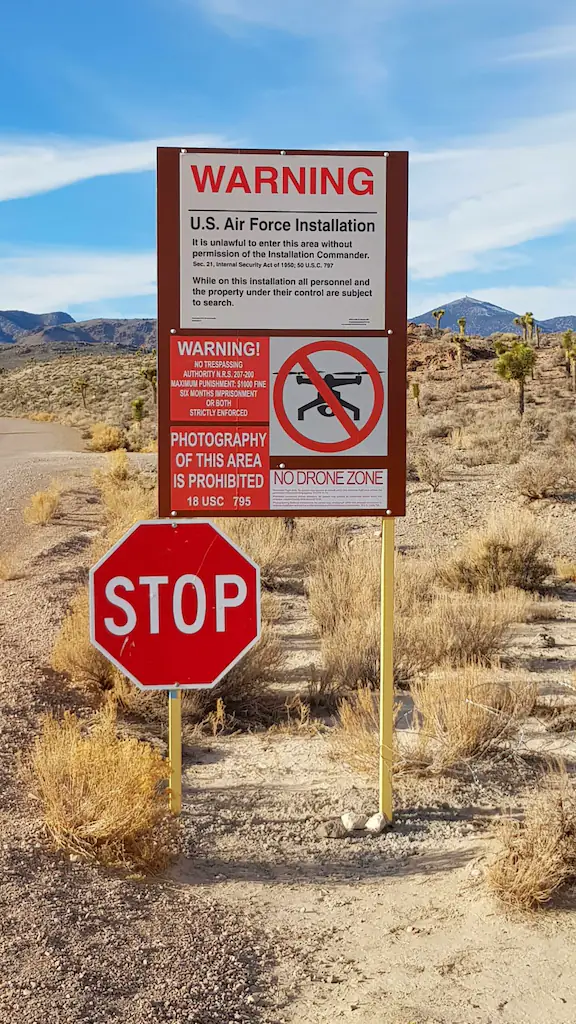
New warning signs installed around the restricted area reference federal law 18 USC 795, which prohibits photography of military installations.
Arnu believes officials would rather avoid having that legislation challenged.
"18 USC 795 is not a law they want tested in court!" he said.
For aviation enthusiasts and conspiracy theorists alike, the closure has only intensified intrigue surrounding one of the world's most secretive military sites, leaving the last public vantage point of Area 51 officially out of reach.
Whilst we all know what Area 51 is, very few of us actually know anything about it. Shrouded with an air of mystery, Area 51 is hidden deep inside the depths of the Nevada desert, and refers to a highly classified United States Air Force Base where the Nevada Test and Training Range operates.
Located 83 miles north of Las Vegas, Area 51 has been plagued with rumours about extra-terrestrial activity since its conception in 1955. And it has inspired a plethora of alleged UFO sightings, conspiracy theories and endless amounts of films and books.
No one quite knows what goes on in Area 51. It was initially set up to test Lockheed U2 reconnaissance planes, but no one except the top ranking officials in US government and the USAF are aware of what the base is currently used for. As such, there is wild speculation around the base, which is only fuelled by the fact that no one is allowed to get too close to Area 51 as authorities tend to lose their cool, and point guns at anyone who dares come near.
However, such threats didn't discourage top alien investigators, Tim Lee and Tracey Sue, who run the UFO seekers website and YouTube channel, from going on a trek to the top of Tikaboo peak to get a better picture of the so-called military base.
From a vantage point of 8,000ft they were able to take some amazing footage of some never-before-seen aspects of Area 51 using a super-long-distance lens aimed 25 miles to the east of the area. They used such a camera to ensure that they didn't get stopped by the security that so vigilantly patrols the site.
Check out the footage they obtained below:
One of the most popular conspiracy theories surrounding the mysterious area is that it harbours the alien spaceship and extraterrestrial bodies from the Roswell UFO incident - which believers think crash-landed in New Mexico in 1947.
All that has been confirmed about Area 51, in fact, is that it actually exists.
In 2013 US officials acknowledged the base's existence for the first time. This only came after more information about the site was demanded from a Freedom of Information request. But even then, the report that was put together by Jeffrey T. Richelson only referred to the base as "Area 51" a handful of times.
Theorists regularly flock to the site to try to witness some of the extra-terrestrial activity that they believe goes on there. Alien aficionados claim that everything from time travel, alien abduction and teleportation take place there.
But, as of now, Barack Obama remains the only US President to have referred to the base as "Area 51". Whilst he didn't confirm that he knew anything about the secret site, believers got very excited that the base had been acknowledged by someone so influential.
Well, it's evident that these snaps are the clearest images of Area 51 that we've ever seen, and probably will see for some time. As any budding conspiracy theorist will know, it's impossibly hard to get anywhere near the place.
Credit: Getty[/caption]
Area 51 is one of the most mysterious places on the planet. Shrouded in secrecy, the military base's existence was not officially confirmed by the US government until 2013, but its history goes a lot longer back than this. With reports from as early as the 1980s suggesting that it's home to all things extraterrestrial.
The base has recently hit the headlines thanks to a Facebook event, which aims to discover the truth about the base. It's been dubbed "Storm Area 51, They Can't Stop All of Us", and over a million people have clicked attend, prompting the US government to warn that force will be used to stop anyone on a mission to "see dem aliens". So, before you actually join the rade, here are some facts you don't need to put yourself in danger to discover!
[post_page_title]How Area 51 Got Its Name[/post_page_title]
Now, the name Area 51 is so synonymous with aliens that it's hard to believe it's derived from anything, well, ordinary. But that is indeed the case and this is how the top-secret base got its name.
[caption id="attachment_1080" align="aligncenter" width="760"]
Credit: The National Security Archive / Via nsarchive2.gwu.edu[/caption]
A little known fact about Area 51 is that it's named after a grid reference on an atomic energy commission map. Don't worry, we're as surprised as you that it's not the site of a crash-landed UFO or something like that.
[post_page_title]Its Had Other Names[/post_page_title]
However, there is no reason to be totally disappointed as the base has had other names in the past, which are arguably even more fitting to a place as shrouded in secrecy as Area 51. This is what they are...
[caption id="attachment_1125" align="aligncenter" width="760"]
Credit: Getty[/caption]
The base has also been known as Paradise Ranch, Watertown, and Dreamland. Yup, we're thinking it too - they all sound like the names of amusement parks. But maybe there's some truth in this... for aliens.
[post_page_title]The Base Was Established In 1955[/post_page_title]
While rumors of the base's association with extraterrestrial research have been around for decades, the base itself has existed for over half a century, and it was actually created way back in 1955.
[caption id="attachment_1082" align="aligncenter" width="760"]
National Geographic / Via nationalgeographic.com.au[/caption]
Back then, all that was known about Area 51 was that it was the location of a secret project dubbed "Aquatone" - the code name for the aircraft pictured above which was used to spy on the Soviet Union.
[post_page_title]There's No Fences[/post_page_title]
While it's no secret that Area 51 is a restricted area, with signs surrounding the base warning that the "use of deadly force" has been "authorized", anyone who turns up for the air could find something very unexpected.
[caption id="attachment_1101" align="aligncenter" width="600"]
Credit: Getty[/caption]
Unbelievably, despite being one of the most-talked-about mysterious places in the world, there are absolutely no fences surrounding Area 51, making the proposed raid not such a far fetched idea.
[post_page_title]But Seriously Don't Cross The Borderline[/post_page_title]
We know that the use of deadly force is authorized on anyone who dares cross the threshold into Area 51, and this is what one former guard had to say about what could happen to people who trespass on the site.
[caption id="attachment_1102" align="aligncenter" width="600"]
Credit: Getty[/caption]
According to the National Geographic, a former Area 51 security guard, said that he'd been told he had the "call clear" to "waste" (yup, that word exactly) anyone who dared "penetrate" the borderline.
[post_page_title]The Restricted Area 51 Terminal[/post_page_title]
By now, you're probably wondering how the people who actually work in Area 51 access the facility without, well, getting shot, and it turns out that they have an access route as secretive as the base itself.
[caption id="attachment_1087" align="aligncenter" width="760"]
Credit: Google[/caption]
Area 51 employees access the base by plane through a restricted airport terminal at McCarran International Airport in Las Vegas. It's called the "Gold Coast". One thing's for sure - we don't think there will be a Starbuck's inside.
[post_page_title]The Area 51 Airline[/post_page_title]
Unsurprisingly, you won't see any American Airlines planes landing in Area 51. Instead, the base has its own airline, and there's one distinct feature which will tell you which planes are heading there...
[caption id="attachment_1088" align="aligncenter" width="760"]
Tomás Del Coro / CC / Via en.wikipedia.org[/caption]
They are all unmarked and belong to an airline called Janet. Seriously. So if you're ever in McCarran International Airport and want to imagine what it's like to work there, you know what planes to look out for.
[post_page_title]The Original Area 51 Location[/post_page_title]
Another little known fact about Area 51 is that its current location in the middle of the Nevada Desert was not, in fact, its original one. It was actually originally located on the edge of an abandoned airstrip at the edge of Groom Lake.
[caption id="attachment_1089" align="aligncenter" width="760"]
Credit: TD Barnes and Roadrunners Internationale / Via cia.gov[/caption]
This was a place the government had already used, namely, for nuclear testing. In fact, Groom Lake was also another name for Area 51 in the past. Not going to lie, we've had a chat, and we think Dreamland is the best previous name!
[post_page_title]Edwards Air Force Base[/post_page_title]
Because employees traveling to Area 51 do so through an airport in Nevada, it's only natural to assume that the base is administered by an airforce there too, when, in reality, it's actually administered by an airforce in California.
[caption id="attachment_1103" align="aligncenter" width="600"]
Credit: Getty[/caption]
Area 51, which is located 150 miles northwest of Las Vegas, is actually administered by Edwards Airforce Base in Southern California.
[post_page_title]Bob Lazar's Interview[/post_page_title]
Although Area 51 was established in the 50s, it didn't really capture anyone's imagination until the 80s when a former employee named Bob Lazar gave an interview about his time working there to KLAS-TV.
[caption id="attachment_1090" align="aligncenter" width="760"]
Credit: 8 News NOW / Via youtube.com[/caption]
He told the news station that he worked at a "secret facility", but most interestingly of all, a facility that was kept a secret because alien technology was being "reverse engineered" there.
[post_page_title]He Drew The Spacecrafts[/post_page_title]
Obviously, the moment Lazer mentioned alien technology, people were sent into a frenzy, and the former Area 51 employee revealed a sketch he'd made of the spaceship he was working on.
[caption id="attachment_1091" align="aligncenter" width="760"]
Credit: 8 News NOW / Via youtube.com[/caption]
The drawing of the ship, which, admittedly, looks like media and sci-fi representations of flying saucers, was dated March 29, 1989.
[post_page_title]But There Was One Crucial Difference[/post_page_title]
However, not everything Lazer had to say about the spacecraft he was working on sounded like something straight out of a mad man or someone on the hunt for fame. This is the unexpected way that he said it operated.
[caption id="attachment_1093" align="aligncenter" width="760"]
Credit: 8 News NOW / Via youtube.com[/caption]
Lazer said that the spacecraft he worked on didn't hover as you might expect. Instead, they flew with their "bellies" or "bottom" forward. Interesting...
[post_page_title]There's Evidence![/post_page_title]
Now, while Lazer's revelations could be seen as the ramblings of a mad man or someone on the hunt for fame, they do actually match some pretty convincing evidence of a UFO.
[caption id="attachment_1094" align="aligncenter" width="600"]
Credit: To The Stars Academy of Arts & Science / Via youtube.com[/caption]
Featured below is the "Gimbal UFO" a video the Pentagon released in 2017. As you can see, the UFO is flying bottom first, just like Lazer said!
[post_page_title]The CIA's Acknowledgement[/post_page_title]
Despite the base clearly existing, its existence wasn't officially confirmed by the CIA until 2013, which naturally begs the question, why?
[caption id="attachment_1095" align="aligncenter" width="760"]
Credit: ABC / Via youtube.com[/caption]
According to Reuters in 2013: "Released by George Washington University's National Security Archive, the 400-page CIA history contains the first deliberate official references to Area 51 as a site developed by the intelligence agency in the 1950s to test fly the high-altitude U-2 reconnaissance plane."
[post_page_title]What The CIA Document Didn't Mention[/post_page_title]
By the time Area 51's existence was confirmed, it had been associated with extraterrestrial research for years. However, this was not mentioned in the document released by the CIA.
[caption id="attachment_1119" align="aligncenter" width="760"]
Credit: Getty[/caption]
Instead, all we know for sure is that it's a military training base. However, it's no secret that the US government has spent millions of dollars on extraterrestrial research, it's just a question of where.
[post_page_title]Area 51 Has Grown Over The Years[/post_page_title]
Satellite images have given us a good idea of what Area 51 looks like, and they've demonstrated that the base has grown considerably in size and infrastructure over the years.
[caption id="attachment_1097" align="aligncenter" width="600"]
Credit: National Geographic / Google / Via nationalgeographic.com.au[/caption]
Back in the 50s, all Area 51 consisted of was one runway, a few hangars, trailers, and a mess hall. Now, it's got a number of runways and buildings. Could it be that it really is nothing more than an airforce base?
[post_page_title]The Military Is Watching You[/post_page_title]
There might not be a fence surrounding Area 51, but before you decided to go on a personal investigation mission for YouTube, take note of the fact that it is heavily monitored by the military.
[caption id="attachment_1098" align="aligncenter" width="760"]
Credit: National Geographic / Via nationalgeographic.com.au[/caption]
Sure, you might think you'll be able to dodge the armed guards and security cameras, but you won't. That's why people are planning to storm the base on mass. Safety in the numbers and all that.
[post_page_title]Area 51 On Google Maps[/post_page_title]
Area 51 is so synonymous with aliens that even Google has gotten in on the action, and if you zoom in on the base on Google maps, you'll get a fun surprise when your icon does this...
[caption id="attachment_1099" align="aligncenter" width="760"]
Credit: Google[/caption]
Yup, it transforms into a little spaceship. Pretty neat, eh? I think it's adorable, and if the proposed raid actually takes place, it could turn out to be more than just a quirky joke!
[post_page_title]Is It The Moon?[/post_page_title]
The 1969 Moon landings were one of the most iconic events in human history. As Neil Armstrong so famously put it: "One small step for man, one giant leap for mankind."
[caption id="attachment_1100" align="aligncenter" width="760"]
Credit: Getty[/caption]
However, it's been widely speculted that the moon landings were fake, and some have suggested that the staged event was constructed at the mysterious Area 51.
[post_page_title]Roswell[/post_page_title]
The US's fascination with UFOs reached fever-pitch in 1947 when an alleged spaceship crashed over Roswell, New Mexico. Once Area 51 became associated with extraterrestrial life, many believe it was sent there.
[caption id="attachment_1105" align="aligncenter" width="760"]
Credit: Roswell Daily Record[/caption]
The government, however, dismissed the claims that it was a spaceship which crashed in Roswell, saying that it was nothing more than a weather balloon, albeit an atomic monitoring balloon with nuclear testing capabilities.
[post_page_title]What It's Really For[/post_page_title]
Okay, so we know that Area 51 is an air force training facility, but what exactly does this mean? Well, fake combat scenarios are created there and military crews are trained accordingly.
[caption id="attachment_1106" align="aligncenter" width="600"]
Credit: Getty[/caption]
The military has also given examples, revealing that the U-2 spy plane, an ultra-high altitude aircraft used for reconnaissance, had its first flight at Area 51.
[post_page_title]It's Technically The Government's Fault[/post_page_title]
For years, people have claimed to see UFOs surrounding Area 51, which only contributed to its notoriety. However, the government new what many of these UFO were...
[caption id="attachment_1107" align="aligncenter" width="760"]
Credit: Alien Planet / YouTube[/caption]
But they didn't want to reveal the full capabilities of the US military, which is why they simply let people speculate when, in reality, what they were often seeing had a logical explanation.
[post_page_title]Other Test Planes[/post_page_title]
Alien activity aside, Area 51 has been home to the testing of a number of planes. NBC News reported that these included the Lockheed A-12 Oxcart and the D-21 Tagboard.
[caption id="attachment_1108" align="aligncenter" width="760"]
Credit: Mapping Service / DigitalGlobe / Google Earth[/caption]
Pictured above is a Google Earth view of Area 51 which, no doubt to the dismay of alien hunters, shows runways and a cluster of buildings that suggest it really is nothing more than an airforce training site.
[post_page_title]Captured Aircraft[/post_page_title]
While there is no doubt that secret research into aliens has been conducted by the US government, no official evidence of it exists - yet.
[caption id="attachment_1109" align="aligncenter" width="760"]
Credit: National Security Archive[/caption]
However, a declassified file from 2013 revealed that they tested "secretly obtained" fighters there during the Cold War in the 70s and 80s.
[post_page_title]No One Knows What's Happening There Right Now[/post_page_title]
We might have snippets of information about what Area 51 was used for in the past, but all we know about its current purpose is that it still has one - we just have absolutely no idea what it is.
[caption id="attachment_1120" align="aligncenter" width="760"]
Credit: Getty[/caption]
So, if you just so happen to be in Las Vegas airport and see someone boarding an unmarked plane, your best bet is to ask them. Not that they'd be legally able to tell you anything (well, maybe after one too many at the bar)!
[post_page_title]The CIA Has Investigated Alien Aircraft[/post_page_title]
We know that the US government has spent a lot of money on extraterrestrial research, and part of this has definitely involved researching alien craft after the number of reported sightings dramatically increased in the 50s.
[caption id="attachment_1122" align="aligncenter" width="760"]
Credit: Getty[/caption]
The CIA announced in 1952 that "there is a remote possibility that they may be interplanetary aircraft". So is it a mere coincidence that Area 51 was established three years later? We may never know.
[post_page_title]Paradise Ranch[/post_page_title]
We know that Area 51 was once known as Paradise Ranch and it turns out that it was done for a good reason. It was to encourage members of the military to come and live there and work in the base.
[caption id="attachment_1081" align="aligncenter" width="760"]
Credit: TD Barnes and Roadrunners Internationale / CIA[/caption]
Living in the middle of the desert, after all, is a hard sell. According to Time magazine, this rebranding was the brainchild of engineer Kelly Johnson.
[post_page_title]It Can Trap Daredevil Tourists[/post_page_title]
While trespassing on Area 51 is a feral crime that could see you subject to up to six months imprisonment, or even death, depending on how far into the site you go, it also serves another purpose.
[caption id="attachment_1121" align="aligncenter" width="760"]
Credit: Getty[/caption]
The base can trap daredevil tourists! As it stands, going up to the perimeter of the site is actually a pretty popular tourist attraction. Oh, and in addition to the aforementioned penalties, you could also get landed with a $1,000 fine.
[post_page_title]Hilary's Promise[/post_page_title]
While running for the presidency in 2016, Hilary Clinton promised as part of her campaign trail that she'd make more information about Area 51 public, which means we could have had aliens instead of Trump...
[caption id="attachment_1126" align="aligncenter" width="760"]
Credit: Randy Holmes / ABC[/caption]
"I would like us to go into those files and hopefully make as much of that public as possible. If there's nothing there, let's tell people there's nothing there," Clinton told Jimmy Kimmel on "Jimmy Kimmel Live".
[post_page_title]The Extraterrestrial Highway[/post_page_title]
We might never know if there are any actual aliens in Area 51, but one thing we do know for sure is that nearby there is a stretch of road called The Extraterrestrial Highway which 100% exists.
[caption id="attachment_1124" align="aligncenter" width="760"]
Credit: Getty[/caption]
As the picture above demonstrates, it's full of fun quirky road stops and is a great idea if you're wanting to get in on the alien action without risking the repercussions!
For decades, Area 51 has been associated with UFO's, government secrets, and extraterrestrial life. The air force base in Nevada has always been something of a mecca for conspiracy theorists, but now a viral social media movement wants to actually storm the facility, and discover the truth.
The trouble started when a tongue-in-cheek joke event was posted on Facebook, called: "Storm Area 51, They Can't Stop All of Us." The stunt was a humorous invitation for Americans to overwhelm the guards, and investigate the facility through sheer force of numbers, to find out if there really were any aliens there.
The event's description stated: "We will all meet up at the Area 51 Alien Center tourist attraction and coordinate our entry. If we naruto run, we can move faster than their bullets. Let's see them aliens. [sic]"
However, the idea quickly blew up, and spawned countless memes and image macros on social media. The raid is currently scheduled to take place on Friday, 20 September 2019. But now, the planned event has proven so popular that the United States military has been forced to issue an official response in an attempt to deter potential besiegers.
Speaking to Insider, Air Force spokesman Major Ethan Stroker stated: "The United States Air Force is aware of the Facebook post. The Nevada Test and Training Range is an area where the Air Force tests and trains combat aircraft. As a matter of practice, we do not discuss specific security measures, but any attempt to illegally access military installations or military training areas is dangerous."
Meanwhile, US Air Force spokesperson Laura McAndrews told The Independent: "[Area 51] is an open training range for the US Air Force, and we would discourage anyone from trying to come into the area where we train American armed forces. The US Air Force always stands ready to protect America and its assets."
Guys, I can tell you all now that you won't find any aliens in Area 51 ... they're actually over in Area 52.
For over half a century, Area 51 has been regarded with suspicion by almost all those who have heard of it. And that's no surprise, seeing as the US government still haven't told us very much about the site - nor have they always been incredibly forthright in dispelling the various alien rumours that surround it.
However, despite its covert status, there are some things we know about Area 51. Some of them we've known for a while, and others have only recently come out. Either way, if you're itching for more details on the secretive site, then look no further...
1. It used to be known as 'DREAMLAND'
Somehow, this name makes the place sound even more suspect than "Area 51". It was allegedly named this after an Edgar Allan Poe poem by the same title, in which there is a line: "the traveler, traveling through it, may not-dare not openly view it; Never its mysteries are exposed, to the weak human eye unclosed." It also earned the nickname "Paradise Ranch" at another point in its lifespan - though this was to make it more appealing to people who were sent to work there.
2. It's since been renamed to Nevada National Security Site
Officially, that is. Everyone else still knows it as Area 51 - and it got that name from designations on Nevada Test Site maps from the 1950s. "But what were they testing?" you ask. Well, that's easy: nuclear weapons, purportedly. Hundreds of them - many of which were above ground.
3. The CIA didn't acknowledge it existed until 2013
Area 51 was probably one of the worst-kept military secrets in history in this regard, because everyone knew about it. The CIA was forced to admit it was real just five years ago, though, as a declassified document about the U-2 spy plane programme made many references to the site.
4. Over half of American UFO reports from the '50s to the '60s were accounted for
Sorry guys, but most unidentified flying objects turned out to be perfectly normal occurrences - and many of them were actually the aforementioned U-2 planes. However, many still remain unexplained. This could be because the people that saw them were hallucinating or making it up, or because what actually happened was just a different secret military operation, or because there really were aliens, and we still aren't being told the whole truth.
5.Area 51 didn't really get its extraterrestrial reputation until the late 1980s
In the '80s, a man called Robert Lazar claimed in a TV interview that he worked near Area 51 reverse-engineering crashed UFOs. He was later found to have fabricated his story (well, duh), but the site's reputation has always stuck nonetheless.
6. It used to be really, really boring
The first people who lived at and worked on the site only had access to a single cement tennis court and a tiny bowling alley for entertainment. There was no TV, and radio signals only reached the location at night on account of the mountains surrounding the area.
7. The Roswell Incident was a U.S. government 'cover-up'
But not in the way you think. Yes, the government lied about the origins of the "crashed ship", claiming that it was a weather balloon, but it definitely wasn't alien in origin. In fact, it was a top-secret balloon called "Project Mogul" that was designed to detect nuclear bomb testing in the Soviet Union.
8. Two civilian contractors once died there
Two men passed away after inhaling toxic chemicals at the site, and their wives unsuccessfully sued the government for causing their premature deaths. Apparently, US environmental exposure laws don't apply to Area 51 as they do to everywhere else.
9. Space equipment for lunar landings was tested there
But only in the sense that they did test runs on the site. Various pieces of space equipment, including rovers and life support technology, were tested in and around the restricted location. The moon landing seen in 1969 was the real deal, however.
10. Today, it's apparently used for training purposes
From what the CIA has admitted to, we know that aircraft crews are trained in combat scenarios at the base, and new planes/technologies are sometimes trialled there too. In the past, at least, the area has been used to develop new aerial vehicles such as helicopters and unmanned drones, as well as some secret gadgets that probably never saw the light of day.
11. You really don't wanna trespass
If you're caught sneaking past the guards or ducking under any barriers, you could get arrested. The punishment is usually a $1,000 fine, a six-month prison sentence, or even both.
As far as we know, then, Area 51 has nothing to do with little green men or top secret UFOs. It does, however, have some terrestrial secrets it doesn't want us to find out about. Will we ever find out what they are? Well, maybe one day - but, until then - it doesn't seem worth the trespassing risk to find out.
What happens in Area 51 is a mystery to the vast majority of us, and a lot of people are eager to know if there are any extraterrestrial goings on.
An unnamed man, who claims to be a former CIA agent, may hold the answers those who are seeking the truth crave, having "revealed all" whilst on his deathbed.
Area 51 is a military base at Groom Lake, a dry lake bed in the Nevada Desert, and is often at the center of conspiracy theories regarding aliens, per the BBC.
Members of the public are unable to get close to the base due to multiple warning signs, electronic surveillance, and armed guards patrolling the perimeter, and this only adds to the intrigue of what happens there.
The alleged former CIA agent took part in "The Anonymous Interview", created by documentary filmmaker Jeremy Corbell, as first reported by HowandWhys.
The 77-year-old explained to UFO researcher Richard Dolan that he was speaking at great risk, so didn't want to use his name. He went on to say he hasn't got much time left anyway due to kidney problems.
The man alleged that he worked for the CIA between 1957 to 1960 and his job was to analyze evidence of extraterrestrial beings.
Area 51 is only accessible by authorized individuals. Credit: Peter Griffin / Alamy
He claims that he was transported to Area 51 to look at an array of UFOs that had been discovered by the US military, including the famous flying saucer that supposedly crashed in Roswell, New Mexico in July 1947.
The CIA agent alleged that President Dwight Eisenhower was concerned about a threat to humanity by extraterrestrial beings, so sent agents to Area 51 to gather evidence and report back to him.
It was there that the man claims he observed aliens that were still alive. He described a grey alien that "didn’t look human as far as the skin tone" and outlined features such as a larger brain, with only holes for its ears and nostrils.
The former agent went on to describe how these aliens were able to travel through galaxies. He said that the power source was able to reverse gravity, and even claimed he received the mathematical code as to how this was possible.
Irving Newton holding the debris of the alleged flying saucer in Roswell, New Mexico, 1947. Credit: Chronicle / Alamy
Area 51 was subject to a Facebook event called "Storm Area 51," where those wanting to know the truth were to gather outside the perimeter in September 2019 and rush into the military base together, per the BBC.
The event gathered millions of followers, but only a handful showed up and Area 51 remained uninfiltrated.
You can see the full interview with the former CIA agent here.


.jpg_I4Ebof?tr=cr-0.338.2730.3068,f-webp,q-70,w-100)


.webp_QQJmGo?tr=cr-345.0.1535.1190,f-webp,q-70,w-100)


.jpg_I4Ebof?tr=cr-0.338.2730.3068,f-webp,q-70,w-1024)


.webp_QQJmGo?tr=cr-345.0.1535.1190,f-webp,q-70,w-1024)