


US3 min(s) read
Doomsday map shows what would happen if a nuclear bomb was detonated in the middle of the US

It may sound like the premise of a disaster thriller, but the so-called “doomsday map” depicts a very real and terrifying scenario, the detonation of a nuclear bomb in the center of the United States.
Created using modern modeling tools and historical data, it translates abstract fears into an unambiguous geographical presentation, showing in haunting detail how a single explosion could transform America’s heartland into a landscape of fire, radiation, and ruin within seconds.
What would happen if a nuclear bomb hit Kansas?
Imagine the vast plains of Kansas, often described as the geographic core of the nation, transformed in an instant from open fields to a charred, uninhabitable wasteland. Within seconds, the flat horizon is shredded by a blinding flash, followed by a roaring inferno. At ground zero, everything inside a fireball roughly 1.4 kilometers wide would be completely vaporized. Concrete, steel, and life itself would disappear in the same instant, consumed by temperatures hotter than the surface of the sun.
If the detonation occurred at ground level, the damage would not end with the blast. Radioactive particles, sucked high into the air, would rain down across the countryside, contaminating everything they touch. Scientists call this fallout, an invisible, drifting killer that spreads silently with the wind.
Just beyond the fireball lies the radius of total destruction. Within roughly two kilometers, entire neighborhoods would cease to exist. Concrete buildings would crumble. Survivors would be rare.
Those caught on the margins of this zone might endure another fate: severe radiation exposure. Absorbing a dose of 500 rems would likely prove fatal within a month, while those who endure might still face cancer in the years ahead.
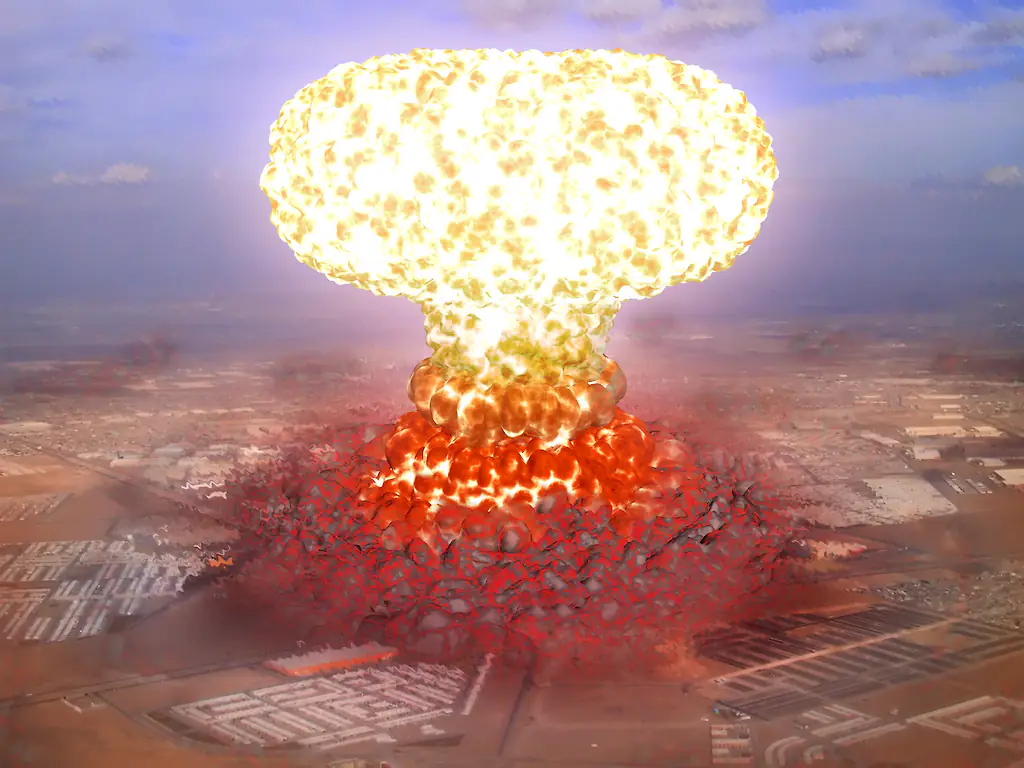
A little farther away, devastation takes on another form. The moderate blast zone, extending nearly five kilometers, would see most residential buildings collapse, trapping people in rubble and setting off scores of secondary fires. Oxygen would become scarce as dozens of blazes combine into a single, consuming firestorm. Even those who survive the blast might find themselves surrounded by spreading infernos and choking smoke.
The destruction does not stop there. At a radius of over ten kilometers, intense thermal radiation would scorch anyone exposed, with third-degree burns penetrating deep into the skin.
Glass windows, up to twelve kilometers out, would shatter in a deadly cascade. The cruel irony is that light travels faster than sound, meaning people drawn to the flash might still be at their windows when the shockwave arrives, turning glass into a storm of blades.
How would outside the bomb site look?
Beyond the immediate devastation, fallout begins its inexorable spread. Particles carried by winds traveling as little as 24 kilometers per hour could contaminate regions hundreds of kilometers away.
The map calculates that areas receiving one rad of radiation per hour could extend nearly 400 kilometers downwind, poisoning vast stretches of farmland and entire towns. Zones measuring 10, 100, and even 1,000 rads per hour would render large areas lethal to humans for weeks or months to come.
The map estimates 20 fatalities and 160 injuries in its model, though the scientists themselves caution that such figures are only illustrative. The real human toll of a detonation, factoring in long-term radiation sickness, infrastructure collapse, and the near impossibility of delivering medical aid, would almost certainly be far higher.
Even in the outermost blast zones, where damage appears “light,” hundreds of people would still be caught in the chaos.