


US4 min(s) read
Expert reveals what would happen if a nuclear bomb landed on Manhattan as World War 3 concerns grow following Iran attacks
.webp_QQJmGo?tr=cr-345.0.1535.1190,f-webp,q-70,w-100)
With recent attacks carried out in Iran by the US and Israel, concerns are growing about a full-scale war, which brings further worries of nuclear action.
So with that being said, what would happen if things escalate to the point where a nuclear weapon is used on Manhattan in New York City?
It is the kind of scenario most people only picture in blockbuster movies - but according to nuclear expert Annie Jacobsen, the reality would be far more horrifying than anything Hollywood has ever portrayed.
In an interview with Hasan Minhaj, Jacobsen laid out in chilling detail what would unfold if a one megaton thermonuclear missile struck Midtown Manhattan.
What happens in the first seconds after a nuclear blast in New York
Jacobsen explains that the very first sensation would not be a sound, but a flash.
"First, it's a blinding light. It's 180 million degrees worth of light. It's a pulse," she said.
That pulse would instantly ignite everything within line of sight for miles. According to Jacobsen, the thermal radiation alone would create an immediate firestorm stretching across a one mile radius.
She went on: "Everything. Within miles is in a line of sight is set on fire. So you have one mile radius of fire. That's 19 football fields of fire."
She urges people to truly picture that scale. Nineteen football fields in every direction, with buildings, vehicles, trees and people all catching fire almost simultaneously. The result would be what she describes as a mega fire engulfing the city within moments.
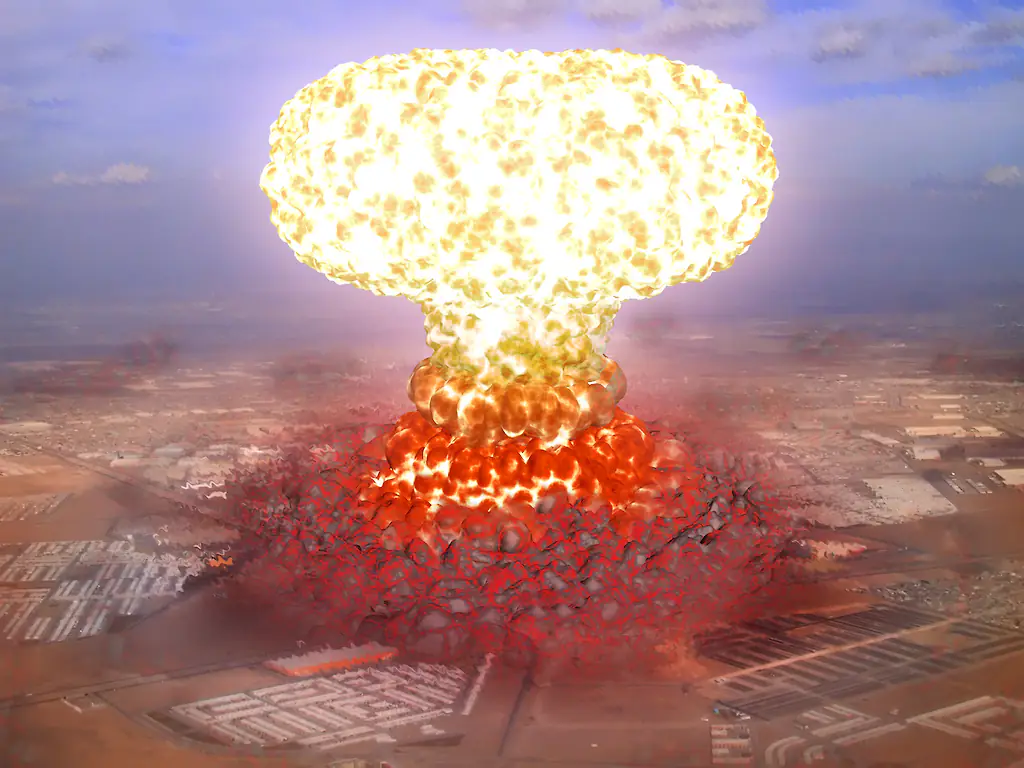
The terrifying power of the mushroom cloud
Many people are familiar with the image of the mushroom cloud, but Jacobsen says the reality behind that shape is even more disturbing.
She said: "So the stem of the mushroom, that stem is a several 100 mile an hour vacuum, okay, I mean a hurricane is 90 miles an hour, sucks everything up that has been turned into combusting carbon, basically, people, things, buildings, in a nine mile radius, everything goes and you have 30 feet of rubble."
She compares the speed to a hurricane, but notes it is far stronger. This vacuum effect would pull in debris from miles around, reducing entire neighborhoods to ash and rubble. In the aftermath, she says, up to 30 feet of debris would blanket the area.
Above it all would sit the massive mushroom cap.
That cloud, stretching between 10 and 30 miles wide, would contain what remains of buildings and human corpses.
What happens next if the US retaliates
Jacobsen warns that the devastation would not stop with one explosion.
"If anyone launches on the United States, they are going to get the mother load in response. 1760 nuclear weapons that we have on ready for launch status," she said.
She claims the United States would respond immediately and overwhelmingly: "We would unload the whole clip, the whole arsenal."
According to her, both the US and Russia maintain launch on warning capabilities.
"Everybody has a launch on warning capacity, or at least we in Russia do. And so if you launch, we launch, and then we're all dead," she said.
In other words, one missile would likely trigger thousands more, escalating into a full scale nuclear exchange within minutes.
How nuclear war could lead to global winter in just 72 minutes
The immediate explosions would be only the beginning. Jacobsen describes a chain reaction that would quickly spread beyond national borders and into the atmosphere itself.
Soot and smoke from burning cities would rise high into the stratosphere, blocking sunlight around the globe for years. She says the consequences would be swift and catastrophic.
"Soot blotting out the sun's rays for eight, nine, 10 years," she said.
Without sunlight, global temperatures would plunge. She describes an extended freezing period lasting roughly a decade, during which agriculture would collapse.
Jacobsen said: "The result is that agriculture fails. You know, you have this incredible freezing world for a decade, and then agriculture fails, and people starve to death 72 minutes from nuclear launch to nuclear winter."
In just over an hour from the first launch, humanity would be on a path toward long term climate devastation and mass starvation.
Jacobsen emphasizes that her account is not speculation pulled from fiction.
"I describe it in great detail, like from Defense Department documents, by the way, like scientific facts about what happens, which should terrify everyone that we actually know such horrors. But we do."