


US5 min(s) read
Learjet expert reveals the fatal mistake pilots made before horrific Florida crash that killed all nine on board

An aviation expert has revealed a crucial error he believes the pilots of a Learjet 60 made that led to the deadly crash.
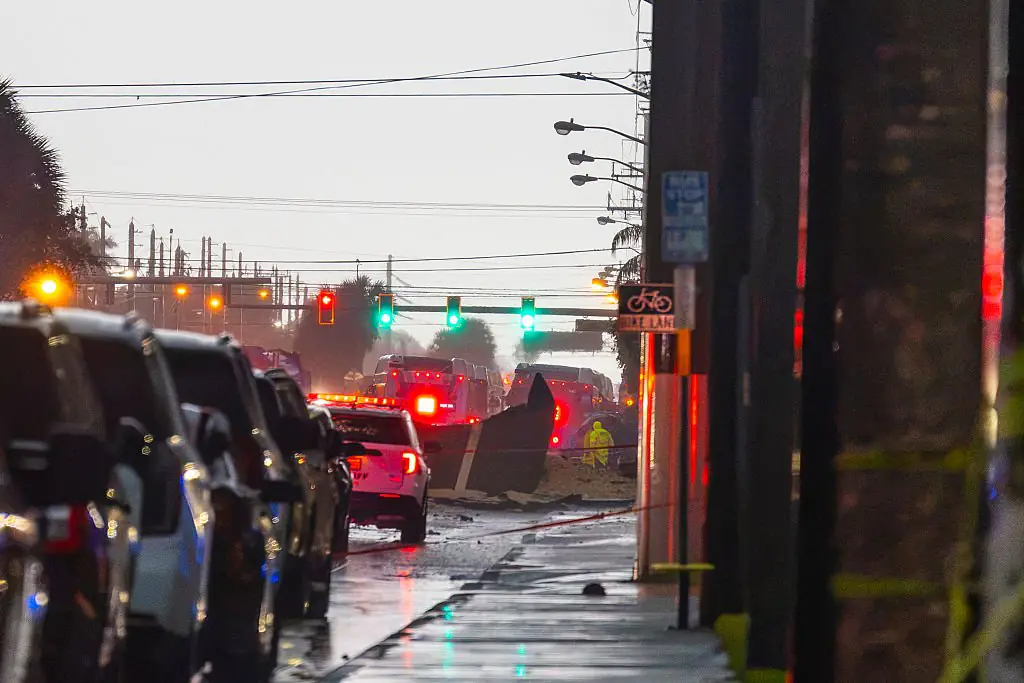
As previously reported, on Sunday, November 1, a private jet carrying two pilots and seven passengers tragically crashed in Florida, killing all nine on board.
The Learjet 60 had been traveling from Austin, Texas, to the Bahamas before it plummeted to the ground in Florida, with the horrific crash being caught on dashcam footage from nearby cars.
All on board were killed instantly, and have been named as pilot Jeff Gregory, 55, co-pilot Nathalia Gadelha Filgueiras, 20, and passengers Adam Robinson, 44, who was a multimillionaire tech exec, his wife Helen Sharp, their two young children - Emma, four, and Charlie, two - and their nanny, Anita Maria Apellido, as well as their friends, Rachael Reed and Charmi Fehr.
Heartbreaking audio recordings between the plane and ATC were released after the tragedy, in which Filgueiras was heard reporting that they were experiencing icing and turbulence, asking to climb to around 37,000 feet to get above the bad weather shortly before the plane nosedived at a rate of over 20,000 feet per minute.
Filgueiras's scream could be heard on the audio recording as Captain Gregory could also be heard reciting the Lord's Prayer as they tried in vain to control the plane before it crashed into the grounds of a mobile home park in Palm Beach County.
The young pilot had also sent a text to her boyfriend, Justin, just 10 minutes before her death, saying: "I’ve got turbulence, I’ve got ice."
Now, aviation expert Justin Crabbe has explained what he believes may have been a crucial error the pilots made that led to the disaster.
The $2million aircraft was flying through a storm when it reportedly suddenly stalled at between 35,000 and 37,000 feet, before plummeting to the ground.
While the official investigation is still ongoing, Crabbe told the New York Post: "They certainly should have gone around [the storm].
"[Air-traffic control] gave them the flexibility to deviate around that weather."

Crabbe, who is a veteran pilot and the CEO of Jettly, a charter-flight booking platform, believes that the pilots may have chosen to fly the more dangerous route through the storm in order to get their passengers to the Bahamas quicker than if they took a longer route around the inclement weather.
He added that he can't say with certainty why the pilots did not go around the storm, but suspects that they were eager to get to their destination, adding: "It’s a theory called ‘get-there-itis,’ and flight schools teach you this very early on.
"It’s a risk factor. You have to sit back as a pilot and understand what is pushing you to do this trip, this maneuver, this journey in a way that may compromise the safety of the flight."
As the plane began to experience the effects of the bad weather in the form of turbulence and icing, Filgueiras asked Air Traffic Control for clearance to ascend from 35,000 to 37,000 feet, having reported that the outside temperature was -47 degrees.
However, experts believe that ice may have played a major factor in why the plane ended up crashing, as a build-up of ice can affect how air flows around the wings and make it harder to stay aloft.
While many planes are equipped with deicers - including the Learjet in question, in the wrong conditions, ice can build up extremely fast.
Crabbe believes that the pilots trying to fly out of danger may have further contributed to the tragic fate of the plane, explaining: "They tried to ascend to get to clearer air, which may have been one of the contributing factors toward accelerating that stall."
As the nose of the plane rises, the "angle of attack" at which the wings meet the oncoming air also increases, and if the wings are covered in ice, they have to work harder to achieve lift, meaning the angle at which a plane stalls can be lower than normal.
Crabbe believes the pilots had a difficult decision to make in the moment - whether to ascend and risk a stall, or lower further into the storm and risk even more ice building up.
He added that it is "extremely easy to say this from the ground and from a position of safety," and to criticize the choices they made when stuck between two bad options.
Attempting that last-minute ascent, even if it had succeeded, may not have made much difference, as the jet was flying through an unusual convective storm system that was almost 50,000 feet high, according to NOAA data.
Aviation lawyer Zachary S. Gorwitz of Podhurst Orseck, which investigates and litigates air crashes, told the outlet: "This was kind of the perfect storm of trouble.
"Ascend and try to go overtop of the weather by increasing the angle of attack which might aggravate, or trigger, the stall on one or both wings.
"You had turbulence. You had icing. You had precipitation. And you had incredibly tall thunderstorms that seem to have formed very quickly."
Once the plane entered its fatal nose dive, the pilots would have been rendered powerless to stop the rapid descent and right the plane, particularly as it is suspected that parts of the aircraft began breaking off before it hit the ground.
Gorwitz added: "At that point, I’m sure the pilot was trying to pull back on the controls and get the nose up, but I’m sure at that speed and that angle, it just wasn’t possible."