


US4 min(s) read
Pilot who flew 'Strike Eagle' in US Air Force for 20 years reveals what Florida Learjet pilots should have done differently

A former military pilot who spent two decades flying the F-15E Strike Eagle in the US Air Force has provided an in-depth assessment of the catastrophic Learjet 60 crash in South Florida.
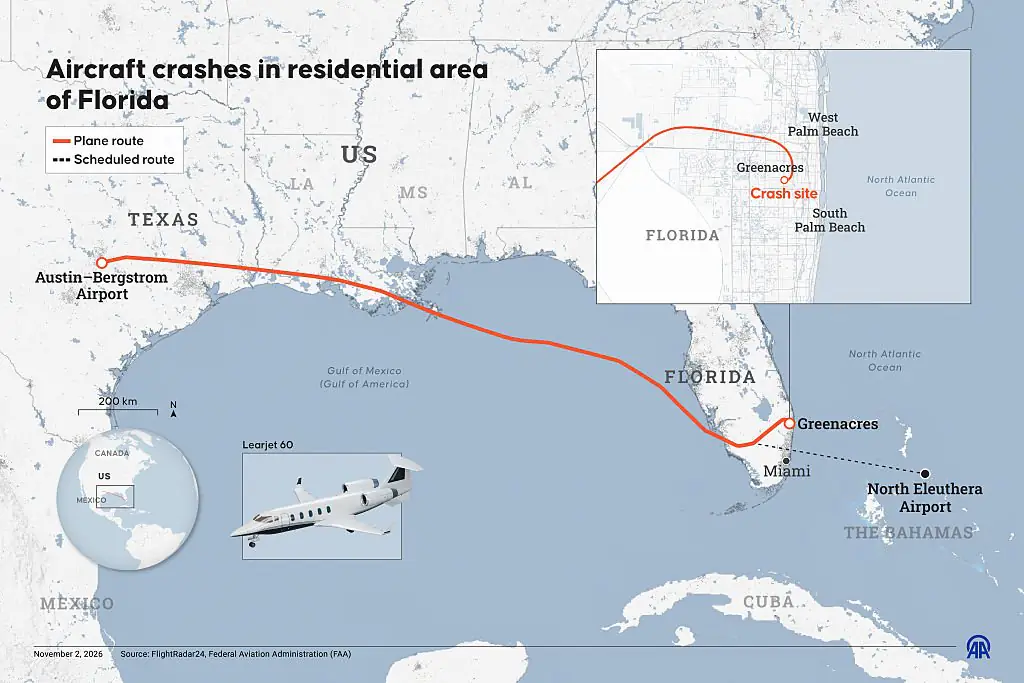
The tragedy occurred on Sunday, November 1, when the charter flight plunged from cruising altitude into a roadway in Palm Beach County, claiming the lives of nine people.
In an analysis shared on his YouTube channel, Pilot Debrief, the retired fighter pilot and current airline captain, known as Hoover, examined the emerging evidence and discussed the critical decisions that shaped the outcome of the flight.
The charter flight, operated under Part 135 regulations by Aurora Aviation doing business as Upper Jets, departed Austin, Texas, on a journey to the Bahamas.
While crossing over Florida at 35,000 feet, the business jet encountered an intensifying system of convective thunderstorms.
Recorded flight data and air traffic control tapes revealed that the aircraft faced severe atmospheric conditions, including turbulence and airframe icing, before entering an extreme dive toward the ground.
Hoover emphasized that while federal investigators continue piecing together physical wreckage, radar returns, and flight records, the sequence of events offers a clear cautionary lesson for all aviators regarding weather penetration and cockpit decision-making.

Why pilots must route around storm systems
According to Hoover, a central issue was the crew attempting to navigate in close proximity to rapidly growing thunderstorm cells. Flight tracking records indicate that the aircraft approached the weather around 12:32PM local time while cruising above the initial storm tops.
At 12:36PM, meteorologists recorded storm tops below 33,000 feet, which placed the aircraft well above the convective activity at 41,000 feet. However, the system intensified rapidly, shooting up to 48,000 feet within twenty minutes.
By the time the Learjet descended through 35,000 feet around 12:46PM, it had entered an active area of explosive weather development.
Hoover explained that air traffic control had already approved deviations, giving the crew latitude to maneuver around the building clouds rather than continuing along their flight path.
Reflecting on his own extensive flight experience, Hoover explained his philosophy on handling convective activity: "That's why I don't mess around with thunderstorms. It doesn't matter what I see on the weather radar in the plane. I always try to find a way around them because it's just not worth the maybe five or ten minutes that you might save by trying to fly close to them or through them."
He also pointed out that onboard weather radar units in corporate jets can present deceptive information in convective conditions, as heavy precipitation can absorb radar energy and cause severe storm cores to appear weaker than they actually are.
Hoover noted that the National Transportation Safety Board has long cautioned crews "that weather radar is for avoiding storms, not for picking your way through them. But you need to be proactive. And don't forget that ATC is there to help."
High altitude flight limits and airframe control
The transcript of the flight revealed that the crew faced icing conditions as well as turbulence at high altitude. Around 12:47PM, co-pilot Natalya reported light clear ice and moderate turbulence before requesting a climb to 37,000 feet.
Hoover pointed out that operating a jet aircraft at high altitudes requires heightened vigilance because the margin between stall speed and maximum operating speed becomes very narrow.
Moments after beginning a climb, the jet entered an upset condition. The co-pilot declared an emergency, reporting descent rates that quickly escalated from 10,000 feet per minute to more than 20,000 feet per minute as the aircraft exceeded operational limits. Flight data indicated that the aircraft eventually pitched downward at an angle reaching 67 degrees.
Investigators recovered pieces of the aircraft's left elevator scattered between 1.3 and 3.8 miles from the crash site. While some have questioned whether a structural failure initiated the event, Hoover analyzed the timing and descent path, concluding that the control surfaces detached during the high-speed plunge rather than causing the initial loss of control.
He believed that proactive avoidance of the storm system in the early stages remained the single most effective action the pilots could have taken to prevent the disaster.