


US5 min(s) read
Six Flags X2 roller coaster linked to brain injuries as two women end up in same hospital
.jpg_I4Ebof?tr=cr-0.338.2730.3068,f-webp,q-70,w-100)
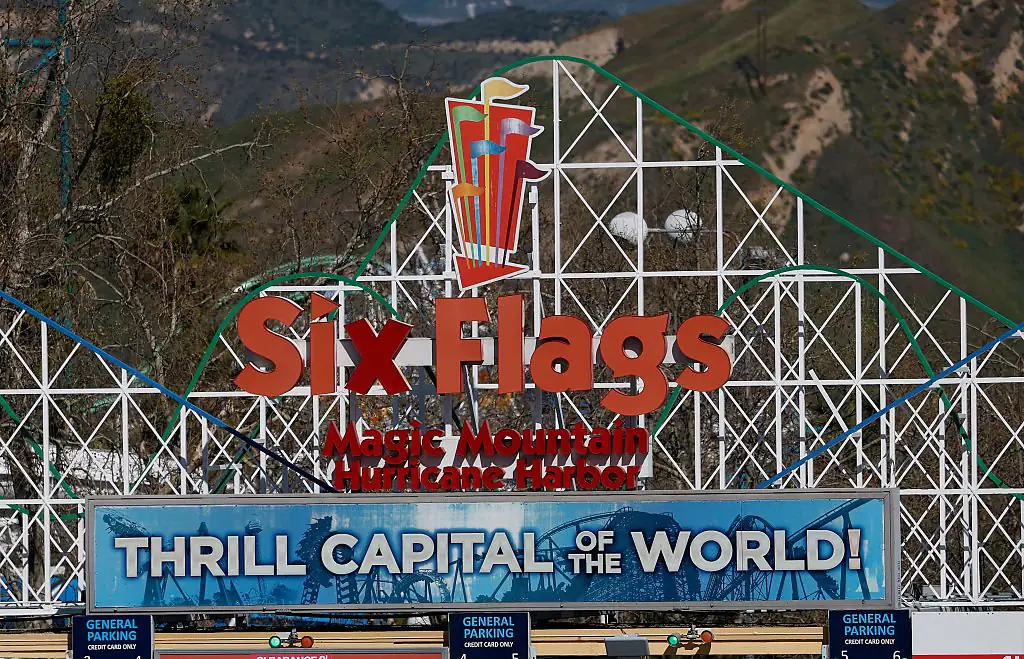
Two women suffered life-threatening brain haemorrhages within six days of each other after riding the same roller coaster at Six Flags Magic Mountain in California this summer.
Both required emergency brain surgery, and one is still in a coma.
The ride is X2, a 76mph attraction whose seats rotate 360 degrees forward and backward while plunging riders through a 200-foot drop and a series of violent half-loops.
Six Flags calls it a 'rite of passage for the ultimate daredevil'. It has now been linked to more than a dozen serious injuries, multiple hospitalisations, and two deaths over nearly two decades.
The ride has been closed since mid-July. Six Flags will not say why.
What happened to Pamela Guillen
Pamela Guillen, 40, was visiting the park from Hawaii with her family for her daughter's 16th birthday.
During the ride, she repeatedly struck her head against the headrest as the seats rotated and jerked through the course.
When the train returned to the station, she could not get out of her seat without help. Then she started vomiting.
Paramedics were called. She was taken to hospital.
Doctors found a brain haemorrhage. She went into emergency surgery and they saved her life.
What happened to Naomi Greer-Wilkinson
Six days later, Naomi Greer-Wilkinson, 25, from Los Angeles, rode X2 with her siblings.
When the ride ended, she collapsed. She was rushed to the same hospital as Guillen. Doctors found a near-identical brain haemorrhage.
Her father, Joshua Wilkinson, told CNN: "The jarring had damaged part of her brain, and it had begun to bleed."
She underwent emergency brain surgery. She survived the operation. She remains in a coma on a ventilator.
What doctors said
The medical team that treated both women wrote in an email obtained by CNN that they believe X2 was directly responsible for the injuries.
"In our professional opinion, the severe brain injuries requiring emergent neurosurgical attention were the result of a traumatic rapid acceleration-deceleration event experienced while on the X2 ride."
They described the injuries as the kind they would expect to see after a high-speed car collision or a violent fall, not after a theme park ride.
The brain had twisted and slammed inside the skull. In both cases, within days of each other, on the same ride.
This is not new
CNN's investigation found that X2 has been linked to more than a dozen reports of serious injuries and hospitalisations stretching back nearly 20 years.
Internal park records cited by an expert witness in court filings show that officials at Magic Mountain have 'long fielded scores of complaints about head and neck injuries' from the ride.
In June 2022, Christopher Hawley, 22, rode X2 with his younger brother and cousin.
As the ride reached its conclusion, it 'suddenly, abruptly and violently jolted to a halt', according to a lawsuit filed by his family.
Hawley stumbled off the ride, grabbed the handrail, said his head hurt, knelt down, and lost consciousness.
A CT scan at Henry Mayo Newhall Hospital showed catastrophic brain trauma. He died the next day.
His family sued Six Flags for negligence, design defects, and failure to warn.
The case was settled earlier this year. The terms were not disclosed.
His family's attorney, Ari Friedman, said at the time: "This is not the first time someone has sustained a serious injury as a result of riding X2. X2 has been linked to previous incidents, where people received whiplash, head and leg injuries, and more, from the ride's sudden shuddering and jolts."
What Six Flags has said
Almost nothing. The ride has been closed since mid-July.
Park officials have confirmed it remains shut. They have not commented on the injuries, the CNN investigation, or the Cal/OSHA investigation that is currently underway.
The California Division of Occupational Safety and Health told KTLA that the investigation is ongoing and that no further details are available.
Why the ride is considered so dangerous
X2 was the last roller coaster designed and built by Arrow Dynamics before the company went bankrupt. It opened in 2002 as X and was refurbished and relaunched as X2 in 2008.
The rotating seats are the problem.
Unlike a standard coaster where the body moves with the train, X2's seats spin independently, meaning the rider's head is being whipped in directions the body is not braced for.
The combination of the drops, the speed, the rotations, and the so-called 'raven turns' creates forces that the human neck and brain are not designed to absorb repeatedly.
One expert quoted in the CNN investigation said it plainly: "I personally don't think head injury should be an expected risk from riding a roller coaster."
Two women in the same hospital, in the same week, with the same injury, from the same ride. One is awake. One is not. The ride is closed. The park is silent. And the question that has followed X2 for 20 years is now louder than it has ever been.