


US4 min(s) read
Trump releases 'evidence' of Bigfoot as man reveals terrifying encounter: 'We had chills'

The Trump administration has quietly released three official government files detailing decades of federal investigations into Bigfoot, including chilling witness accounts and a 1982 expedition into the Pacific Northwest woods.
Made public online by the US Forest Service on October 15, the "Bigfoot/Sasquatch Records" pull back the curtain on how federal agencies handled reports of the legendary cryptid.
Among the documents is a 1980 letter from a Montana hunter named Leo Kinney, who recounted a terrifying 1941 incident near Petty Creek. Kinney and three companions had killed an elk and left the carcass in the woods, only to return and find the massive animal missing.
All that remained were its entrails and a trail of gigantic footprints leading into the forest. "At first we guessed it was a bear," Kinney wrote. "Whatever it was picked up the elk whole and clear off the ground."
The hunters tracked the prints for roughly half a mile, discovering scrape marks in the snow suggesting the elk's antlers had dragged over a large fallen log as it was carried away. Fearing what lurked ahead, the group abandoned their search.

"We were not particularly anxious to catch up to whatever it was, and though we didn’t confess it at this time, in later conversations," Kinney wrote, "we found out that we all had a very uneasy feeling and could feel chills running up and down our backs."
Federal investigators examine Washington footprints
A major portion of the newly released records centers on a June 1982 mission by the US Department of Agriculture in the Mill Creek Watershed of Umatilla National Forest, which spans Washington and Oregon.
Wildlife biologist Rodney L. Johnson was assigned to inspect dozens of mysterious tracks found across three separate muddy locations, including one site near an elk wallow with roughly 18 prints.
Johnson documented the findings in a six-page memo, measuring the impressions at approximately 15 inches long and 7 inches wide, with strides reaching up to four feet. One print even featured a distinctive "deformation of [the] second toe," prompting Johnson to take photographs and make plaster casts.
"If the tracks were faked, someone went to a great deal of trouble and detail," Johnson wrote, observing that some print marks "would have to be very hard to duplicate" and "appear very natural."
Despite the intricate details, Johnson ultimately grew skeptical. He pointed out that the "stride of the tracks did not change with slope" over steep terrain, and his own boots sank deeper into the mud than those of the purported 300-pound beast.
He also found signs that forest litter had been "brushed aside" before the prints were pressed into the ground. "[I]t is my opinion that the tracks observed … were made by something other than a 300 pound plus two footed being," Johnson concluded.
US Border Patrol tracking expert Joel Hardin agreed, warning officials in Walla Walla, Washington, that the prints were likely made using "some type of soft plaster or rubber coated foot" to pull off a hoax.
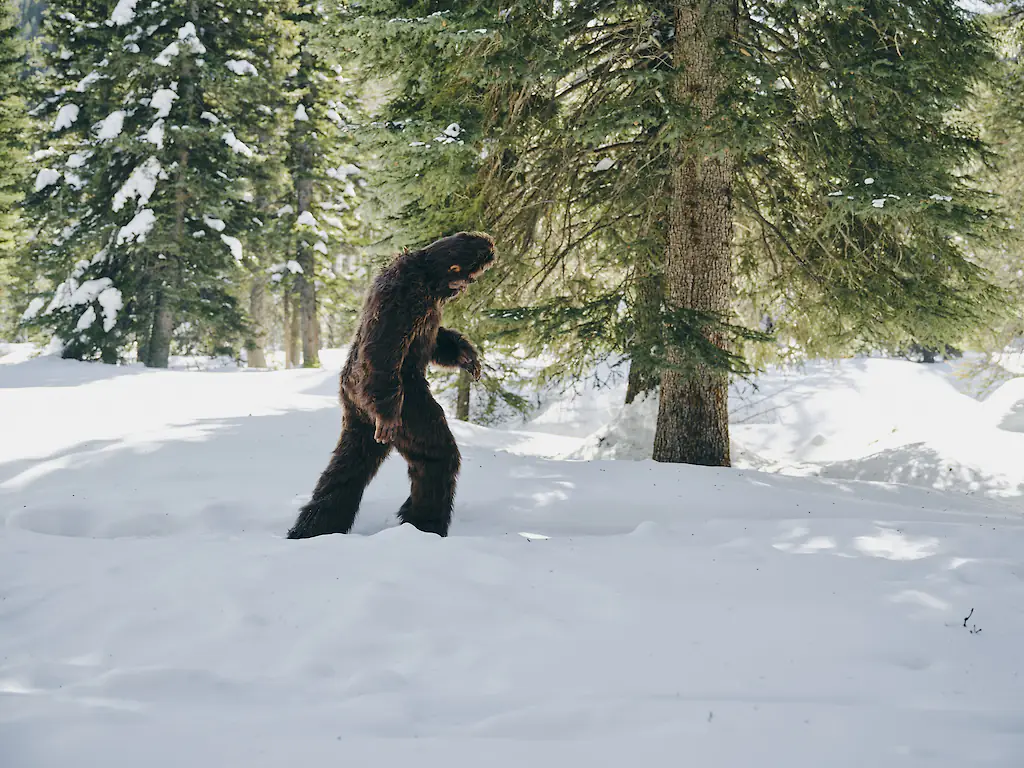
Additional sightings and lingering skepticism
The newly public files also contain a 2003 clipping from the Clark Fork Valley Press regarding hundreds of human-like footprints discovered near a Montana sawmill owned by 87-year-old Jim Rohweder.
Spotted by eight-year-old Austin Petersen, those prints measured up to 16.5 inches long with a five-foot stride. Kinney's 1980 letter also mentioned another hunter, WW Schmitz, who encountered similar tracks in the same Montana area in 1942 before detecting a "strong odor" and hearing "a grunting type noise."
Alongside the Forest Service records, recent disclosures have drawn renewed attention to a separate 60-page Pentagon investigation from 2010 near Fort Duchesne, Utah. That report logged witness claims of glowing orbs, "screaming little people," a "shapeshifter" moving like a "track star," and a fur-covered beast with a pig-like snout, though recovered hair samples turned out to belong to a dog and a raccoon.
While a 2021 YouGov poll shows nearly a quarter of Americans believe Bigfoot exists, scientists remain unconvinced by the government's paperwork. "The articles released don’t provide anything novel that would cause a sceptic or believer to change their mind," anthropology professor David Daegling said.
"Bigfoot has always been a mythological figure, even in the unlikely event that there is a real animal behind it."