ADVERT
US3 min(s) read
Published 16:14 14 May 2021 GMT
A top Biden administration official claims that white supremacists are America's top domestic threat.
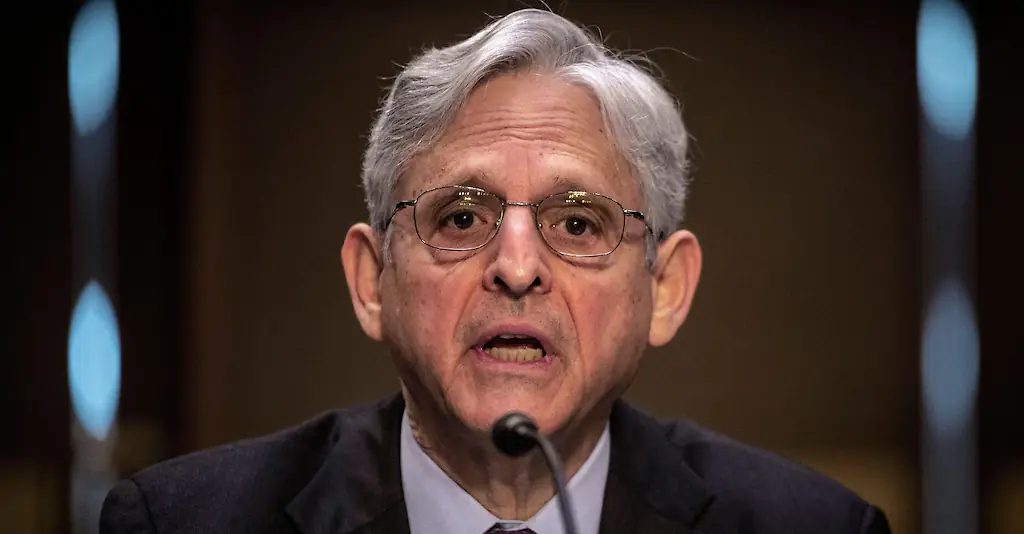
According to The Huffington Post, the comments in question were made by Attorney General Merrick Garland and Homeland Security Secretary Alejandro Mayorka at a recent hearing before the Senate Appropriations Committee about the rise of domestic extremism.
Biden previously branded white supremacy as America's top domestic threat in this speech:Per HuffPost, Garland stated: "Domestic violent extremists pose an elevated threat in 2021, and in the FBI’s view, the top domestic violent extremist threat we face comes from racially or ethnically motivated violent extremists, specifically those who advocate for the superiority of the white race."
Garland continued: "We don’t care what the ideology is. Violations of law are pursued and are prosecuted.
"I think it’s fair to say that in my career as a judge, and in law enforcement, I have not seen a more dangerous threat to democracy than the invasion of the Capitol."
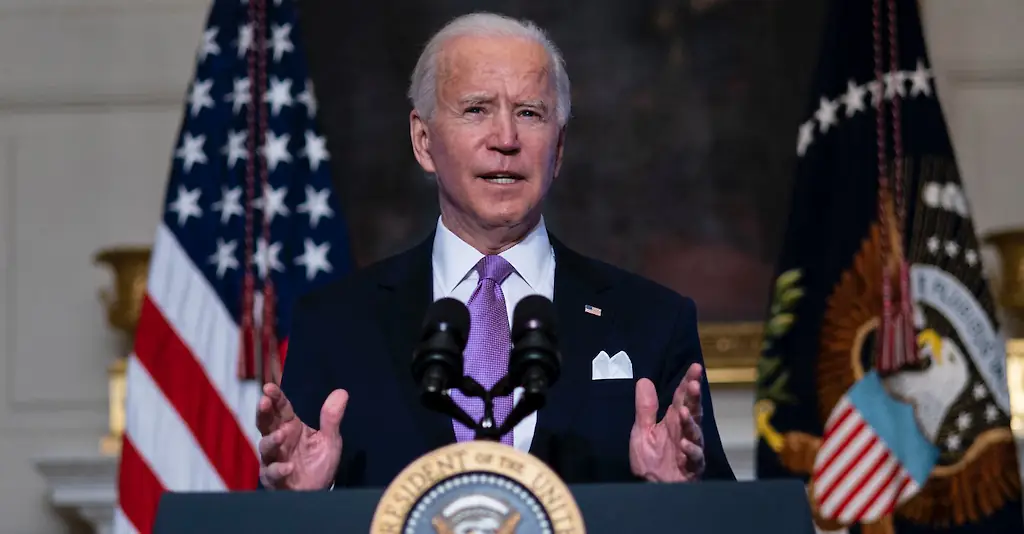
President Biden himself previously spoke about the dangers of white supremacy movements in the wake of the Capitol riots at a CNN town hall meeting held on February 16.
Biden stated: "It's complex, it's wide-ranging, and it's real.
"I would make sure that my Justice Department and the Civil Rights Division is focused heavily on those very folks, and I would make sure that we, in fact, focus on how to deal with the rise of white supremacy."
The POTUS added: "I got involved in politics, to begin with, because of civil rights and opposition to White supremacists.
"The Ku Klux Klan are the most dangerous people in America and they continue to exist. That is the greatest threat to terror in America - domestic terror."
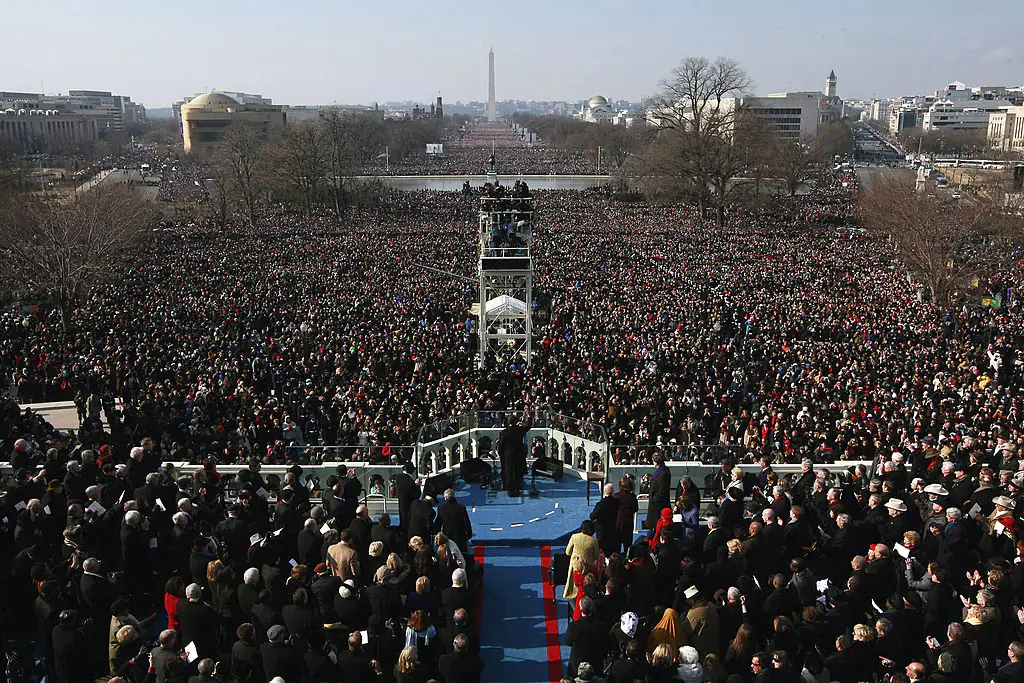
President Biden also condemned white supremacy and other hate groups in his inaugural address made upon assuming office on January 20, addressing: "A rise in political extremism, white supremacy, domestic terrorism that we must confront and we will defeat.
"To overcome these challenges – to restore the soul and to secure the future of America – requires more than words. It requires that most elusive of things in a democracy: Unity. Unity."
us2 min(s) read
Published 15:30 18 Feb 2021 GMT
President Biden has stated that white supremacy is the greatest domestic terror threat in America today.
Speaking at a CNN town hall meeting on February 16, Biden was asked a question about how his administration would address the threat of white supremacy in light of the deadly Capitol riot last month.
In response, the president asserted that those who held white supremacist views were "demented" and "dangerous" people.
This is the moment President Biden says white supremacists are the greatest domestic terror threat in the US:"It's complex, it's wide-ranging, and it's real," Biden said, adding, "I would make sure that my Justice Department and the Civil Rights Division is focused heavily on those very folks, and I would make sure that we, in fact, focus on how to deal with the rise of white supremacy."
He also said that his opposition to white supremacy was his primary motivation for entering politics.
"I got involved in politics, to begin with, because of civil rights and opposition to White supremacists," Biden said. "The Ku Klux Klan are the most dangerous people in America and they continue to exist. That is the greatest threat to terror in America - domestic terror."
He also harked back to Trump's refusal to condemn White supremacist groups when he was in office.
"You may remember in one of my debates with the former president, I asked him to condemn the Proud Boys - he wouldn't do it," Biden said.
Biden went on to say that white supremacy is "a bane on our existence".
The president also insisted that the Biden administration would look into how former members of the military and police officers could potentially affect the rise of white supremacy.
Biden's townhall response comes a month after he used his inaugural address on January 20 to condemn white supremacy.
He said: "[...] and now, a rise in political extremism, white supremacy, domestic terrorism that we must confront and we will defeat. To overcome these challenges – to restore the soul and to secure the future of America – requires more than words.
"It requires that most elusive of things in a democracy: Unity. Unity."
uncategorised5 min(s) read
Published 09:38 17 Nov 2017 GMT
10. Political correctness
Always controversial, the vilifying of so-called political correctness played a key part in Trump's election campaign, with his loose-lipped manner attracting the support of people who defended their right to "free speech", no matter how vile or objectionable that be. It seems that the public are still on side with this approach too, given that it made the top 10, but then maybe it's less shocking when you've grown used to witnessing your leader's own racial slurs.9. National Debt
National debt in the USA now stands at a jaw-dropping $2o trillion, some of which is owed to foreign nations such as China and some of which is provided by national reserves. Considering that for most people a mortgage sounds like an intimidating amount of debt, it's understandable that this ranked so highly, but given that the US hasn't been debt-free for almost 200 years, it's one that's unlikely to change. So there's no point sweating it, really.8. An ignorant electorate
You can always count on the general public to blame each other when something goes wrong - and apparently, you can blame them if something might go wrong too. It's kind of hard to take this one seriously to be honest; of course, an uninformed electorate is a threat, but then, who sets the bar to define what "informed" is? It's all pretty subjective really.7. The influence of the media
Trump may be the person pushing the idea of a distrustful media full of "fake news", but it seems that the voters already have their own dose of cynicism about the influence of the media: "They feed us whatever sells ad dollars and leave out whatever doesn't." Interestingly, this was listed as the top threat by voters in more right-leaning Southern states, but ranked lower down as a concern in other regions.6. Death of the middle class
The idea that the middle class is "dying out" in America has been floating around for some years now, largely owing to stagnating wages, declining disposable income and rising costs of 'big' items, such as college tuition. This is far more than an aesthetic worry, though: as the everyday spenders, the middle classes play a huge part in keeping the cogs turning in the economy. More importantly, the issue is also one of wealth disparity, with more people than ever falling into poverty.5. An increasingly polarised society
Perhaps more than any other event, the 2016 election proved this one to be true; in modern America, it seems you are either alt-left or alt-right, for or against "making America great again", pro-guns or anti-freedom. Worryingly though, a recent study has shown that Americans are also increasingly divided about whether the issues that divide them even exist, with a Pew Report, for example, finding that: "While just less than 1 in 3 Republicans feels that there is a lot of discrimination against Black people in the U.S., almost 8 in 10 Democrats support that statement."
4. Money in government
In another example of a public focus on social issues rather than "big news", voters ranked the potential of money to influence government decisions as one of their highest concerns, voting for it on a platform of: "If our politicians and political parties are controlled by money, do they even bother to listen to anyone who doesn't have it?" They might not be too far wrong - a 2014 study actually showed that of all of the members of Congress, over half had a personal wealth of more than a million dollars.3. Politicians
Hand in hand with a distrust of money in government comes a more general distrust of politicians. Never the most popular of characters, many analysts believe that a lack of faith in the political establishment had a huge impact on Trump's accession to power; Clinton represented the political status-quo, Trump was the "normal guy" just speaking the truth, despite being a billionaire reality TV star. Like I say, a normal guy.
2. Stupid people in government
Are you sensing a theme here yet? Personally, I haven't a clue what may have inspired this addition to the rankings. Maybe, just maybe, the current "dream team" have something to do with it?1. Disregarding the Constitution
Americans are known for loving and defending their Constitution, so perhaps it's unsurprising that this came out on top. Enshrining the right to freedom of speech, movement, religion and equality before the law, among a whole host of other rights, it has to be admired - even if the right to bear arms is more... debatable. Realistically though, there's a whole heap of irony in this coming out on top, because surely with America's long track record of denying people these basic rights, it moved past a threat a long time ago?
So what do these choices say about the state of modern America? Well, one could certainly argue that they represent a strong preoccupation with social issues and an increasing willingness to engage with the idea of democracy. But that said, many of these are also threats that the American public do have the opportunity to influence - you might not be able to stop ISIS, but you can hold your own leaders to account. However, in the meantime, surely we can add climate change somewhere on that list?us2 min(s) read
Published 12:33 12 Mar 2021 GMT
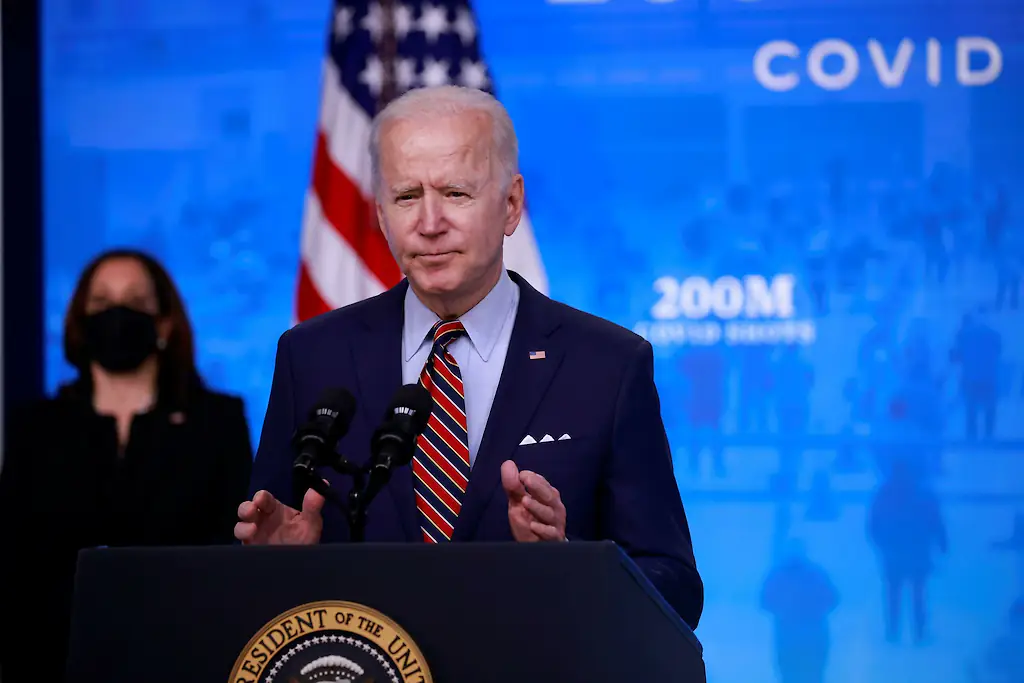
President Joe Biden has condemned the surge in hate crimes against Asian Americans amid the Covid-19 pandemic.
On Thursday night, Biden, 78, spoke about the harassment and scapegoating endured by the Asian community in the US over the past year in his first national primetime address as president.
The speech marked one year since Covid-19 was declared a pandemic by the World Health Organization.
Biden remarked that "too often, we've turned against one another."
Watch Biden's address below:He said during this tough time, there should be solidarity among Americans but instead, there have been extended periods of hostility and violence.
Biden said there have been "vicious hate crimes against Asian Americans who've been attacked, harassed, blamed and scapegoated."
"At this very moment, so many of them, our fellow Americans, are on the front lines of this pandemic trying to save lives and still are forced to live in fear for their lives just walking down streets in America. It's wrong, it's un-American, and it must stop," he added.
In January, the Democrat signed a memorandum denouncing the targeting of the Asian American and Pacific Islander community over the past year, per NBC.
As reported by NBC, lawmakers stated on Thursday that they planned to reintroduce a bill proposing to increase support for law enforcement agencies to focus on prejudice and discrimination during the pandemic.
"We've seen the horrifying consequences of racist language as AAPI communities across our country experience hate crimes and violence related to the pandemic," Sen. Mazie Hirono, D-Hawaii, who helped spearhead the bill, said in a statement.
"The bill also provides resources for communities to come together and fight intolerance and hate. This is no less than victims deserve."
Interestingly, 2020 saw an overall reduction in hate crimes - and yet hate crimes related to the Asian community soared by almost 150% in big cities, according to a report. The increase was mostly seen in New York City and Los Angeles.
The general decrease in hate crimes most likely came as a result of lockdowns and quarantining across the country, meaning that people have a lot less contact with those in other households.
However, with Covid-19's association with Wuhan in China and former President Trump's dubbing the disease the "China Virus", hate crimes have mainly been targeting people of East Asian descent.
us4 min(s) read
Published 16:38 02 Sep 2022 GMT
Donald Trump has taken to his Truth Social account to launch a scathing retort t0 President Joe Biden, branding him "awkward" and "insane".
Trump's seething words come after a recent speech given by Biden at the Independence Hall in Philadelphia, where the POTUS mentioned Trump by name and accused him and his supporters of promoting extreme ideologies and "destroying American democracy," per the Daily Mail.
The eyebrow-raising comments were made in anticipation of the November mid-term elections.
"Too much of what's happening in our country today is not normal. Donald Trump and the MAGA Republicans represent extremism that threatens the very foundations of our republic," the President stated.
He zeroed in on "MAGA Republicans" - referencing Trump's "Make America Great Again" slogan from 2016 - accusing them of thriving on chaos, not respecting the constitution, not being respectful of the law, and living "in the shadow of lies," the Guardian reports.
The 79-year-old added that "MAGA Republicans" seem to "promote authoritarian leaders and they fan the flames of political violence," - adding that Trump's supporters believe "there are only two outcomes to an election: either they win, or they were cheated," per NBC.
"But there’s no question that the Republican Party today is dominated, driven and intimidated by Donald Trump and the MAGA Republicans. And that is a threat to this country," Biden said.
Biden's 24-minute speech seems to have struck a nerve with Trump.
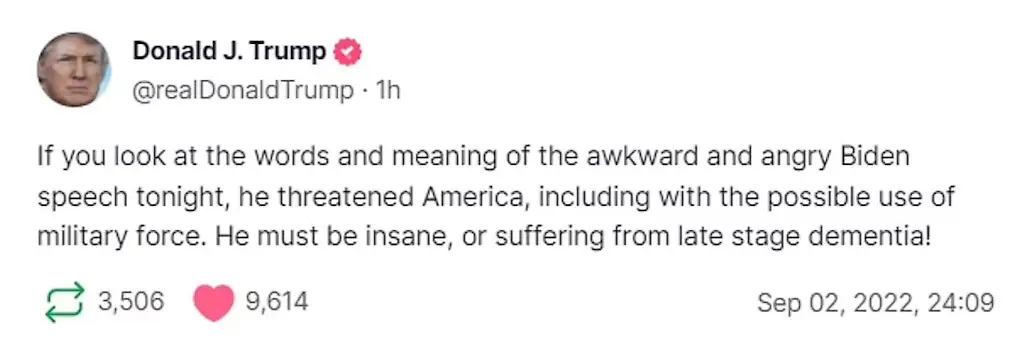
Taking to Truth Social, Trump's alternative social media platform, the 45th President of the US wrote: "If you look at the words and meaning of the awkward and angry Biden speech tonight, he threatened America, including with the possible use of military force."
He continued: "He must be insane or suffering from late stage dementia!"
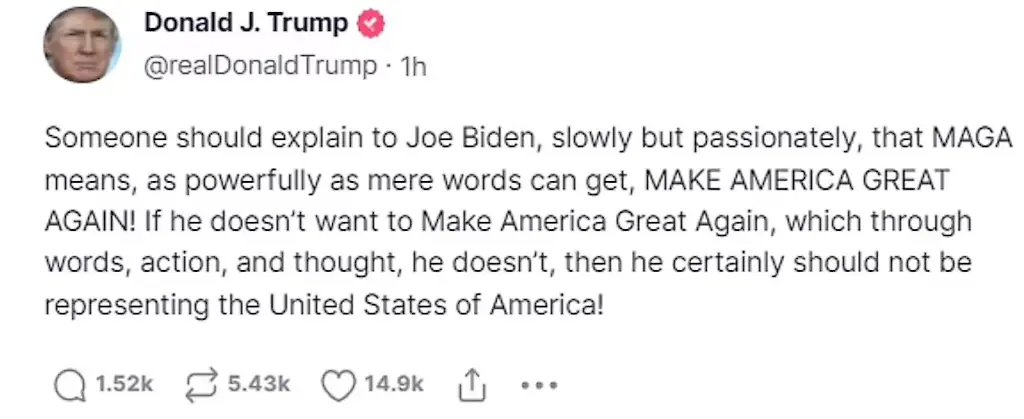
Evidently, the New York native had more to say - even suggesting that Biden should not be in office - writing: "Someone should explain to Joe Biden, slowly but passionately, that MAGA means, as powerfully as mere words can get, MAKE AMERICA GREAT AGAIN!
"If he doesn't want to Make America Great Again, which through words, action, and thought, he doesn't, then he certainly should not be representing the United States of America," Trump added.
The businessman also shared an image that depicted Biden during his speech (with a red background behind him) next to an image of Trump kissing the American flag.
Protestors near the event shared their distaste for Biden's words - shouting: "F*** Joe Biden," and "Let's go, Brandon!" Addressing the hecklers, Biden said: "Notwithstanding the folks you hear on the other side - They're entitled to be outrageous. This is a democracy," the Daily Mail detailed.
Other politicians have spoken out ahead of Biden's speech, with Republican House Minority Leader, Kevin McCarthy, stating: "Instead of trying to bring our country together to solve these challenges, President Biden has chosen to divide, demean and disparage his fellow Americans - simply because they disagree with his policies. That's not leadership."
"When the president speaks tonight at Independence Hall, the first lines out of his mouth should be to apologize for slandering tens of millions of Americans as 'fascists,'" he added.
Speaking to FOX News after the speech, McCarthy even accused Biden of not understanding the "soul of America."
Biden's speech certainly has viewers divided and - with Trump currently under investigation by the FBI for alleged mishandling of classified documents - it should make for an interesting mid-term election, especially as they can have a significant impact on the direction of America.
us4 min(s) read
Published 13:46 20 Jun 2025 GMT
Barack Obama has issued a warning, claiming that the US is in danger under the leadership of Donald Trump.
Speaking Tuesday night at the Bushnell Performing Arts Center in Hartford, Connecticut, Obama criticized current federal government policies amidst heated national debate over immigration raids and deportations.
He began by sounding the alarm over a disturbing erosion in America's commitment to democratic norms.
“If you follow regularly what is said by those who are in charge of the federal government right now, there is a weak commitment to what we understood – and not just my generation, at least since World War II – our understanding of how a liberal democracy is supposed to work,” Obama said, according to Connecticut Public Radio.
He emphasized the importance of resistance from both civil society and government insiders.
“There has to be a response and pushback from civil society, from various institutions and individuals outside of government, but there also have to be people in government in both parties who say, 'No, you can't do that,’” he added.
“It is consistent with Hungarian Prime Minister Viktor Orbán. It’s consistent with places that hold elections but do not otherwise observe what we think of as a fair system in which everybody’s voice matters and people have a seat at the table and nobody's above the law,” Obama warned, cautioning that America, while not fully authoritarian, is veering in a dangerous direction.
“We're not there yet completely, but I think that we are dangerously close to normalizing behavior like that.”
A key concern for Obama was the growing divide over truth itself. “In 2020, one person won the election, and it wasn’t the guy complaining about it,” he reminded, referring to President Trump’s false claims of election fraud.
“And that's just a fact, just like my inauguration had more people... I don’t care, but facts are important.”
He further noted the peril when partisans cling to falsehoods regardless of evidence: “In one of our major political parties, you have a whole bunch of people who know that's not true but will pretend like it is. And that is dangerous.”
This pointed critique echoed earlier controversies, such as when Trump’s first press secretary, Sean Spicer, claimed his inauguration had “the largest crowd in history,” despite clear photographic and empirical evidence to the contrary, per the Independent.
Pressed on how to maintain optimism amid rising political tensions, Obama countered with a note of hope.
“I’m still optimistic – I’m still the ‘hope’ guy,” he said. Highlighting the need for collective action, he urged Americans to be “impatient with injustice and cruelty,” but also to build alliances and coalitions: “If you want to deliver on change, then it’s a game of addition, not subtraction,” he advised.
“You have to find ways to make common ground with people who don’t agree with you on everything but agree with you on some things.”
He drew on Abraham Lincoln’s ideas to underscore the redemptive power of empathy: “When people actually meet and get to know each other... what Lincoln called those ‘better angels’ come out,” Obama said.
“People start recognizing themselves in each other and they start trusting each other, and that's not just the basis for democracy, but that's the basis for our long‑term salvation.”