


Weird4 min(s) read
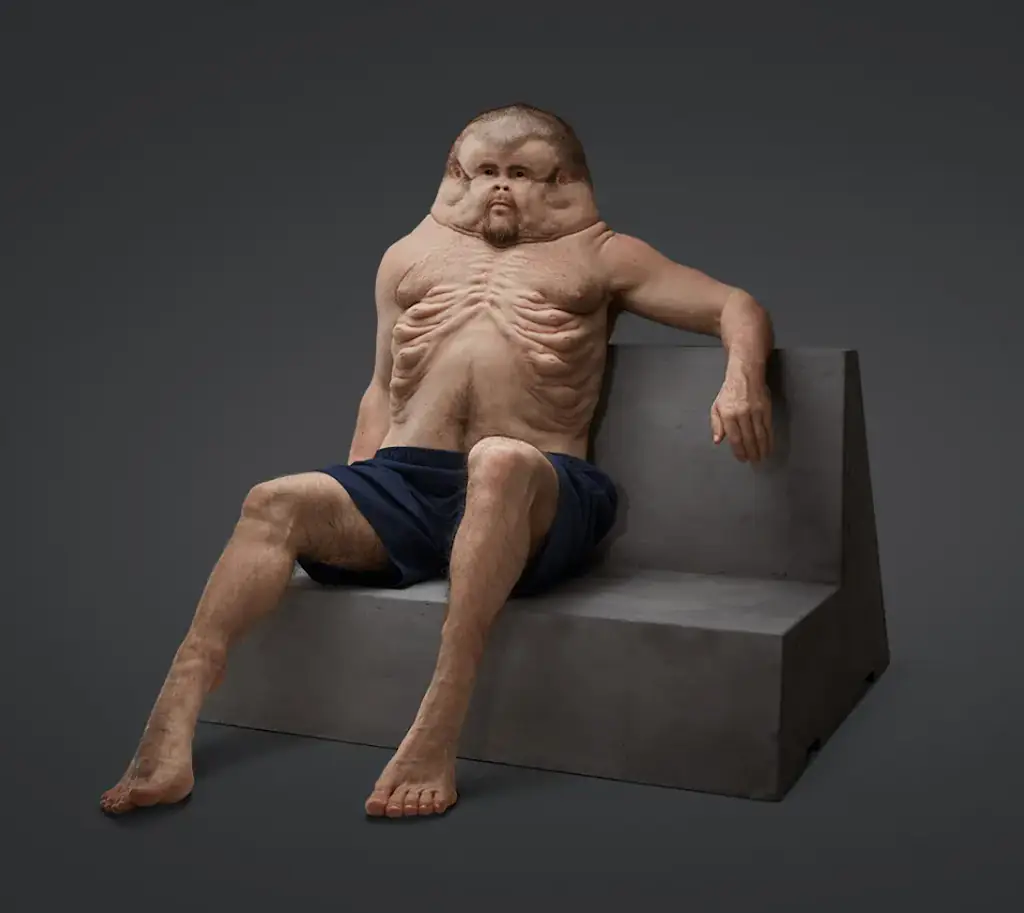
This is what a human built to survive car crashes would look like. Meet Graham.
.jpg_I4Ebof?tr=cr-0.338.2730.3068,f-webp,q-70,w-100)
In 2016, an Australian road safety commission asked a trauma surgeon, a crash investigator, and a sculptor to answer one question: what would a human being have to look like if we had evolved to survive car crashes?
The answer was Graham.
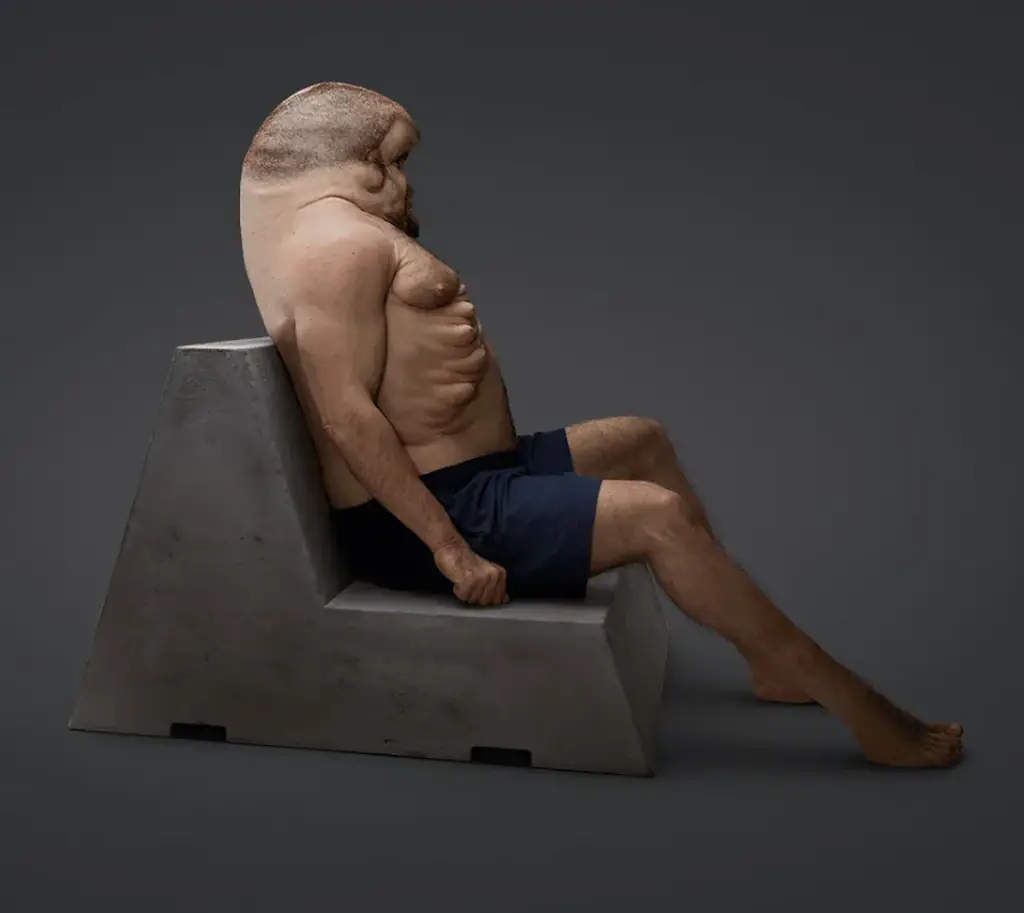
He has a massive skull with a face that looks like it was inflated with a bicycle pump.
He has no neck. His chest is covered in fleshy sacks that function like built-in airbags. His ribs are thickened and reinforced. His skin is thicker. His knees bend in multiple directions. He has hooves instead of feet.
He is, without question, one of the most unsettling things ever made in the name of public safety.
How Graham was made
The Transport Accident Commission of Victoria, Australia, commissioned Melbourne artist Patricia Piccinini to build Graham as the centrepiece of their 'Towards Zero' road safety campaign.
She worked alongside Royal Melbourne Hospital trauma surgeon Dr Christian Kenfield and crash investigation expert Dr David Logan from Monash University's Accident Research Centre.
The three of them spent six months on the project. It cost around $149,000 US. Piccinini sculpted Graham from silicone, fibreglass, resin, and real human hair.
"This is an artwork, and it needs to connect with the audience on an emotional level while still communicating some very serious ideas," Piccinini said at the time.
"The idea is to stimulate conversation and questions rather than tell people what to think or feel."
It worked.
10 years later, images of Graham still go viral every few months because new people keep discovering him and having the same reaction everyone else had.
Why he looks like that
Every feature on Graham's body corresponds to a specific type of crash injury that kills or disables real people.
The enormous skull absorbs impact the way a motorcycle helmet does.
The human skull is not thick enough to protect the brain during a high-speed collision, so Graham's is massively reinforced with built-in crumple zones.
He has no neck because one of the most common fatal injuries in a car crash is a cervical spine fracture.
"The head is quite heavy and at rest we all have the neck muscles to hold it upright," Dr Kenfield explained.
"But in a car crash we don't have the strength to stop that whiplash injury that is so sudden and so forceful that it often causes catastrophic effects."
Graham's solution: remove the neck entirely and let the head sit directly on the torso.
The fleshy sacks across his chest act as organic airbags, absorbing force before it reaches the ribcage.
His ribs themselves are thicker and more elastic than a normal human's, designed to flex rather than shatter on impact.
His legs are built to deal with pedestrian collisions.
The knees have extra joints so they can bend in ways that absorb energy from multiple angles.
The feet are thicker and more hoof-like to give him better stability and a faster push-off if he needs to jump out of the way.
His skin is tougher throughout, designed to resist the cuts, friction burns, and lacerations that come with being thrown across tarmac or through a windshield.
What the whole thing was really about
Graham was never supposed to be a medical blueprint. He was supposed to make you uncomfortable.
"People can survive running at full pace into a wall," said TAC chief executive Joe Calafiore.
"But when you're talking about collisions involving vehicles, the speeds are faster, the forces are greater, and the chances of survival are much slimmer."
The point was to show, in the most visceral way possible, how completely unequipped the human body is for what happens inside a car at 40mph.
Every modification on Graham exists because a real part of the real human body fails at that speed. His face is grotesque because the truth about car crashes is grotesque.
An interactive version of Graham was built online at meetgraham.com.au, where users could peel back layers of his skin using augmented reality to see how each feature worked.
A school curriculum was developed around him. He went on a tour across Victoria after being displayed at the State Library.
Calafiore said the investment was worth roughly a tenth of what a traditional road safety campaign would cost, and the conversation Graham generated went far beyond Australia.
"Graham is going to outlive us all," he said.
He was right about that.
A decade on, Graham is still the most effective argument for wearing a seatbelt that anyone has ever made, and he did it by being so repulsive that you cannot look away.