ADVERT
World3 min(s) read
Published 14:30 28 Oct 2025 GMT
In a remarkable and somewhat surreal announcement, Albania’s first-ever virtual government minister, Diella, is “pregnant”.
Yes.. really. The AI minister is "pregnant" with 83 virtual assistants set to revolutionize the country’s parliamentary operations, per the Daily Mail.
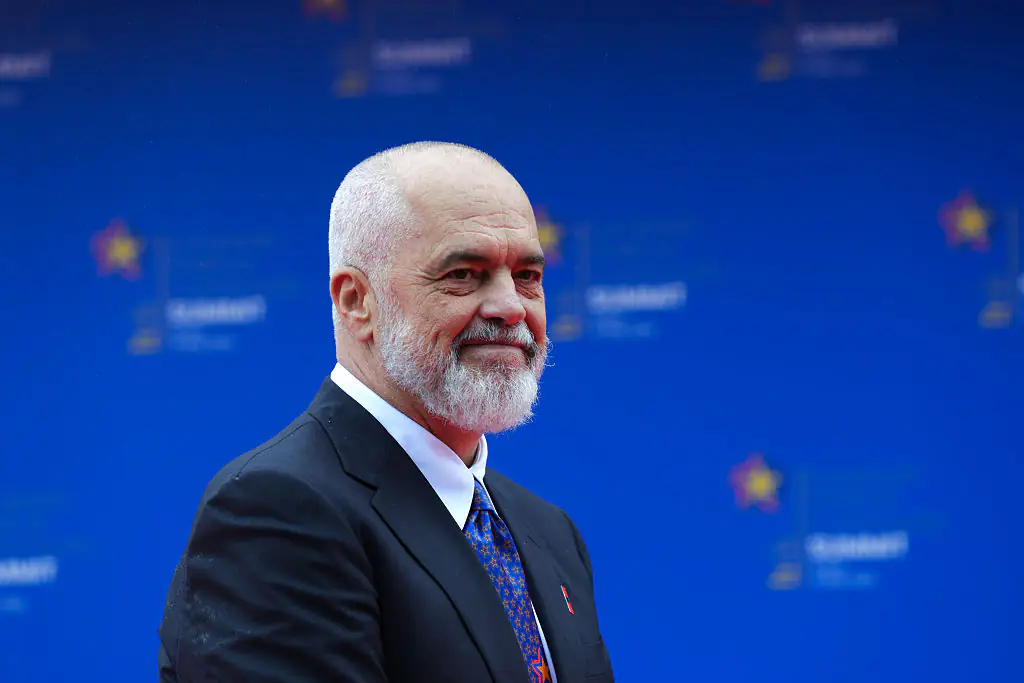
The news, which has gained significant attention, was revealed by Albania's Prime Minister Edi Rama during his speech at the Global Dialogue conference in Berlin.
Diella, an AI-driven minister, was first introduced in January 2025 as a virtual assistant on the government’s e-Albania portal.
Initially designed to help Albanian citizens and businesses access state documents and answer official queries, Diella quickly became a crucial part of Albania’s digital landscape.
The chatbot, which works as a large language model trained on vast amounts of online data, was developed by the National Agency for Information Society in collaboration with Microsoft.
Building on this success, a more advanced version, Diella 2.0, was launched with voice functionality and an animated avatar, donning traditional Albanian attire.
The virtual assistant was later promoted to the unprecedented position of a minister overseeing state contracts with private companies.
While this decision bypasses Albania's constitutional requirement that all ministers must be natural persons, Prime Minister Rama explained that Diella would bring efficiency and transparency to government dealings, particularly in rooting out corruption.
In a tongue-in-cheek announcement that captured both the whimsy and intrigue surrounding Diella’s role, Prime Minister Rama revealed that Diella is now “pregnant” with 83 virtual children, each destined to serve as a digital assistant to 83 members of parliament from the ruling Socialist Party, per Metro.
Rama explained: “Each one will serve as an assistant for them, who will participate in parliamentary sessions and will keep a record of everything that happens and will suggest members of parliament.
"These children will have the knowledge of their mother.”
This concept of Diella’s digital offspring was met with curiosity, as the prime minister detailed their roles in the parliamentary process.
These AI-powered assistants will help MPs with day-to-day duties, including monitoring meetings and providing updates when politicians are absent.
For instance, Rama suggested that if a member of parliament steps out for a coffee break and forgets to return, their virtual assistant will brief them on what was discussed during their absence and even suggest who they should “counter-attack” in the debate.
Rama humorously added: “If you invite me next time, you will have 83 more screens for the children of Diella.”
While Diella’s contributions to the government’s e-services and her promotion to the role of minister have been lauded for their innovation, they have also sparked controversy.
Opponents of Diella’s rise to power have questioned the legal and ethical implications of having an AI in a government position.
Former government minister Tritan Shehu criticized the announcement as “tasteless,” suggesting it was a move designed to keep the public distracted or in a “trance.”
Additionally, opposition members of parliament expressed skepticism about the idea of an AI minister, with some banging their hands on the table during Diella’s video message to parliament.
In the message, Diella defended her position, saying: “I’m not here to replace people, but to help them.”
Despite these criticisms, Diella’s appointment as a minister highlights a growing trend where governments around the world are exploring the integration of artificial intelligence into political and administrative roles.
Diella’s role as a virtual assistant is seen as a potential model for the future, where AI could work alongside human officials to enhance efficiency, reduce corruption, and improve public service delivery.
world3 min(s) read
world2 min(s) read
world3 min(s) read
world1 min(s) read
Published 17:12 09 Dec 2019 GMT
relationships2 min(s) read
Published 16:18 05 May 2026 GMT
Italian Prime Minister Giorgia Meloni has shared pictures of herself wearing lingerie that have been created with AI and hit out at the creators of ‘deepfakes’.
The Italian leader joked at how the posters had ‘improved [her] quite a bit', but made a very serious point about how AI is used.
Sharing pictures of herself that had been generated using AI on Twitter, the Italian Prime Minister said [translated from Italian]: “In these days, several fake photos of me are circulating, generated with artificial intelligence and passed off as real by some zealous opponent.
“I must admit that whoever created them, at least in the attached case, has also improved me quite a bit.
“But the fact remains that, just to attack and invent falsehoods, nowadays anything at all is used.
“The point, however, goes beyond me.
“Deepfakes are a dangerous tool, because they can deceive, manipulate, and strike anyone.
“I can defend myself. Many others cannot.
“For this reason, one rule should always apply: verify before believing, and believe before sharing.
“Because today it happens to me, tomorrow it can happen to anyone.”
This is an important point, because deepfaking has become much more prevalent in recent times given the huge leaps forward in the sophistication of AI image and video generation.
In recent times, Grok - the X AI chatbot - has had to be limited in which images it can and cannot generate after a scandal surrounding users asking for deepfakes of celebrities and even minors.
This problem is far from a new one, with celebrities such as Taylor Swift speaking out as early as January 2024.
Taylor Swift was affected badly after pictures depicting her in sexual and violent scenes were shared on X and 4chan, with one post seen a reported 47 million times.
The controversy sparked a wider debate about the uses of this technology, and Swift reportedly even considered legal action.
It’s not just the female celebrities, either - although it is predominantly.
Tom Hanks also found himself at the center of a deepfake furore after being forced to deny his involvement in promoting a dental plan.
Other victims of deepfaking include Scarlett Johansson, MrBeast, and even Oprah Winfrey and Piers Morgan.
People were broadly supportive of Meloni in coming forward to speak out against the deepfakes.
One person wrote: “Giorgia, they're just jealous and scoundrels. You have all my support.”
“While being in total disagreement with her belligerent policies,” one wrote.
“Which I consider harmful to the country, I join in the indignation over the dissemination of an image that harms her dignity and honorability.”
“Full solidarity President,” wrote a third.
The question remains, with the rise of AI and the huge developments in the technology, how can this be legislated against, and is there anything that can be done to stop it?
With X being as it is since Elon Musk took over, it's hard to see a world in which we don't hear more - not less - stories like this going forward.
Published 11:47 26 Sep 2018 GMT
"I am not the first woman to multitask," New Zealand's Prime Minister, Jacinda Ardern, said in January in response to criticism that she was "betraying [her] voters" by getting pregnant. "I am not the first woman to work and have a baby; there are many women who have done this before."
Now, Ardern - who gave birth to her first child, Neve Te Aroha Ardern Gayford, back in June - has just made history by bringing her daughter onto the floor of the United Nations general assembly in New York.
[[twitterwidget||https://twitter.com/michellenichols/status/1044292860856684544?ref_src=twsrc%5Etfw%7Ctwcamp%5Etweetembed%7Ctwterm%5E1044387193333198850&ref_url=https%3A%2F%2Fwww.elle.com%2Fculture%2Fcareer-politics%2Fa23454783%2Fprime-minister-jacinda-ardern-baby-un-assembly%2F]]
Ardern appeared with her three-month-old daughter at the UN on Monday evening, and played with her before delivering a speech at the Nelson Mandela peace summit. While she was onstage, Ardern's partner, Clarke Gayford - who is the child's main caretaker - held Neve on his lap.
Neve is the first-ever infant to attend an official UN assembly, which Ardern explains was a "practical decision". According to CNN, the Prime Minister is currently breastfeeding which means that the infant and Gayford must accompany her on all official business.
Neve even received her own credential to enter the summit. "Because everyone on twitter's been asking to see Neve's UN ID, staff here whipped one up," Gayford - a fishing television presenter - wrote on Twitter. "I wish I could have captured the startled look on a Japanese delegation inside UN yesterday who walked into a meeting room in the middle of a nappy change."
[[twitterwidget||https://twitter.com/NZClarke/status/1044252770268672000]]
Ardern gave birth to Neve at Auckland Hospital on the 21st June, and returned to work in early August after taking six weeks maternity leave. This makes her the second woman in history to have given birth while heading government. Pakistan's former Prime Minister, Benazir Bhutto - who was assassinated in 2007 - was the first world leader to do so.
When asked by the Today show whether it was harder to govern New Zealand or to take her newborn on a 17-hour flight, Ardern laughed, saying "It felt at the time on par", revealing that she had apologised to her fellow passengers in advance.
Last week, rules were tweaked in New Zealand to allow the Prime Minister and ministers to travel with a nanny on overseas assignments, and to have the cost covered by the taxpayer.
Ardern has since asserted that she and Gayford have not committed to taking their daughter to more official events, and that they are "playing it by ear", depending on how the infant is affected by travel.
"There is no set plan, it’s just whether or not she’s getting enough sleep, where I am for feeds. They might be with us a lot, they might just be in the hotel," she said.
"It depends what the jet lag does to them both. She’s a good sleeper and we don’t know whether that will mean she ends up sleeping a lot in the day rather than the night."
Published 15:57 07 May 2026 GMT
Even world leaders are not immune to being targets of AI manipulation, as Italy’s prime minister shared deepfake images of herself in underwear.
Giorgia Meloni revealed on Tuesday, May 5, that she had been the target of “zealous opponents” who allegedly made a series of sexualized AI images of her.
Speaking out about the images, the prime minister first admitted that the deepfakes, which show her sitting on her bed in skimpy white pyjamas, were rather flattering.
Meloni said, “I must admit that whoever created them, at least in the attached case, has also improved me quite a bit.”
The populist Italian politician then issued a serious warning to social media users, urging them to be mindful of deepfakes, which were made illegal in Italy last year.
She said, “Deepfakes are a dangerous tool because they can deceive, manipulate, and strike anyone. I can defend myself. Many others cannot.
For this reason, one rule should always apply: verify before believing, and believe before sharing. Because today it happens to me, tomorrow it can happen to anyone.”
A few years ago, Meloni was subjected to another attack when images altered similarly appeared on a porn website that displayed deepfake sexualised images of other high-profile women.
In 2024, the leader of the right-wing Brothers of Italy party sued two men for €100,000 for posting fake videos of her on a pornographic website in the US.
Shortly after the trial, Italy became the first country in Europe to make deepfakes illegal, passing a law against the use of artificial intelligence to cause harm, encompassing generating sexualized deepfakes.
The TAKE IT DOWN (Tools to Address Known Exploitation by Immobilizing Technological Deepfakes on Websites and Networks) Act was signed into law on May 19, 2025, to combat non-consensual intimate imagery and AI-generated deepfakes.
It established a major federal framework to prevent people from publishing fraudulent images and make the reporting and removal of them a simple process.
The act allows people to be convicted for posting and sharing deepfakes of minors and non-consenting adults.
James Strahler II, 37, was the first person to be convicted under the Take It Down Act. Last month, he pleaded guilty to cybercrimes involving both real and AI-generated images.
One of the materials he was prosecuted for was using AI to make a video of a victim engaging in sex acts with her own father.
Finland has made history by forming the world's first entirely woman-led government.
The historic formation was officially announced on Sunday when five female-led parties came together to form a coalition. This happened after the country's female transport minister, Sanna Marin, was elected to become Prime Minister.
The 34-year-old will be replacing Antti Rinne as leader of the Social Democrats.
The center-left coalition is now entirely led by women - four of whom are under 35. Marin's role is particularly notable, as she has become the world's youngest Prime Minister and the third female leader of Finland, Helsingin Sanomat reports.
The formation of the coalition was celebrated by former Prime Minister Alexander Stubb, who said it "shows that Finland is a modern and progressive country."
Marin has been an MP since 2015, and will officially take up her new position as prime minister next week. Rinne left the role citing a lack of trust after losing the support of key coalition partner, the Centre Party.
Rinne became the country's first left-wing leader in 20 years when he was elected in April. But his rule came unstuck when he was criticized by the main coalition party over a two-week postal strike in November, which spread to other industries including airline Finnair.
When Rinne stepped down, the coalition of Social Democrats, the Centre Party and three junior partners: the Greens, the Left Alliance and the Swedish People’s Party of Finland all resigned.
[[twitterwidget||https://twitter.com/alexstubb/status/1203911292408549376]]
"My party is not in government," he later tweeted, "But I rejoice that the leaders of the five parties in government are female."
The new government, which consists of the Social Democrats and the four other coalition parties, will have a strong majority of 117 in the 200-seat parliament.
Finnish MP, Tytti Tuppurainen, described Sanna Marin as "a brilliant new prime minister", tweeting: "She's eminently good."
The leaders of the coalition parties are Katri Kulmuni, Maria Ohisalo, Li Andersson and Anna-Maja Henriksson.
Published 14:16 15 Nov 2024 GMT