


World3 min(s) read
Graphic simulation shows what happens to eight people on euthanasia rollercoaster that 'kills anyone who rides it'

A disturbing simulation has offered viewers a virtual front-row seat to what it could be like to experience the infamous euthanasia rollercoaster, a theoretical thrill ride designed to cause death through extreme gravitational forces.
The concept was first introduced in 2010 by Lithuanian artist and designer Julijonas Urbonas, who described his creation as a "hypothetic death machine in the form of a roller coaster, engineered to humanely, with elegance and euphoria, take the life of a human being".
The rollercoaster has never been constructed at full scale, although a scale model was later created, with the process proving divisive.
The simulation displays how people would die on 'euthanasia rollercoaster'
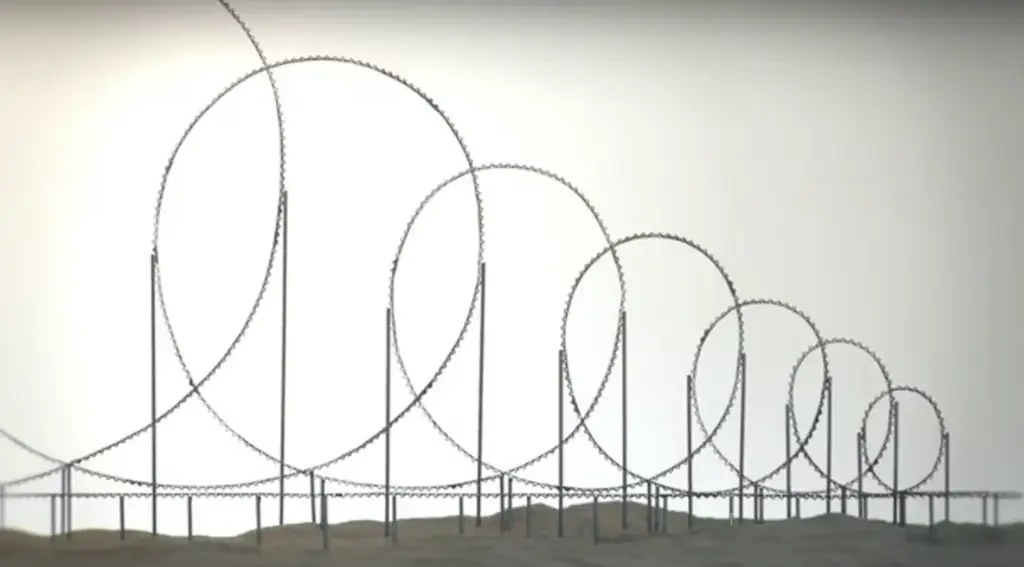
According to the simulation, "Sick people will ride this rollercoaster which will climb over 1500 feet. Next it plummets at over 200 miles an hour, before going through seven shrinking loops."
The video claims the forces generated by the loops would cause riders to lose consciousness almost immediately.
"This creates enough force for the riders to black out immediately," the simulation says. "It cuts off the oxygen to their brains, and then after 60 seconds, this will kill them."
The purpose of the rollercoaster

The original concept was intended for terminally ill patients, presenting an unconventional theoretical option for those seeking to end their lives in a way that's starkly different from traditional euthanasia practices or procedures.
"Now, this ride was designed for terminally ill patients giving them the option of a fun death," the simulation explains. "But only a scale model was ever built."
Urbonas initially developed the project while he was studying for a PhD at London's Royal College of Art. A scale model was subsequently displayed at Dublin's Science Gallery in 2011 as part of the HUMAN+ exhibition.
The simulation shared online depicts a climb to approximately 1500 feet, but before descending at 200mph towards the seven loops that are designed to ensure blackouts for those on the ride.
The coaster's seven inversions are designed with progressively smaller diameters, theoretically allowing the ride to maintain a force of around 10G throughout the sequence.
Another simulation describes what it claims would happen to a rider as the extreme forces took effect.
"You would gradually begin experiencing worsening cases of cerebral hypoxia, meaning your blood would rush to the lower parts of your body, and so your brain wouldn't be getting enough oxygen to survive," Urbonas said, according to Vice.
"The first thing that you would notice is your vision greying out, which would then gradually turn to tunnel vision.
"From there, you would begin experiencing a blackout, and ultimately, you would eventually lose consciousness and die," they added.
The concept remains very much just that: a concept, with some experts even arguing whether the rollercoaster would even lead to death at all, as well as questioning whether it would be as painless as initially suggested.