A shocking video has ignited global outrage after capturing a terrifying moment at a luxury Mexican resort where a dolphin is believed to have died after jumping out of its pool.
The clip, which quickly surfaced on social media platforms, has led to a flood of negative reviews on the resort’s social media pages -- with many calling for an end to animal performances at the venue.
The video shows three captive dolphins leaping from the water as lifejacket-clad tourists look on.
One of the dolphins, however, appears to miscalculate its jump and misjudge the edge of its enclosure, landing painfully on the edge of the pool.
The animal remains motionless as trainers rush to its aid, sparking concerns about its well-being.
Marine Activist: "It's Completely Inexcusable"
The footage was later shared by the activist group UrgentSeas on Instagram.
"The following incident took place in January, 2025 at @barcelomayagrandresort. The guest who filmed this has asked to remain anonymous," the caption reads. "Though we cannot confirm, we are told that the dolphin has died following this SHOCKING and UNNECESSARY injury.
"Please comment, review and BOYCOTT Hotel Barcelo Maya in Riviera Maya, Mexico.
Warning: The footage contains distressing content and viewer discretion is advised.
Marine mammal activist Phil Demers shared the disturbing footage through his UrgentSeas social media accounts and expressed his disbelief at what he had seen.
“This particular incident is one of the worst. It really, truly is. Even if it survived, its health is going to be severely compromised,” Demers told Yahoo News on Saturday morning.
“It’s completely inexcusable, it’s something that never would happen in the wild. It just eliminates any rationale they should exist in these concrete tanks.”
PETA has also released an article following the incident, where the group calls for the dolphin shows and experiences to stop.
The dolphin show pool. Credit: Google Maps
"These animals are trained to perform unnatural tricks," writes PETA's staff. "In 'swim with dolphins' encounters, they are forced to repeatedly push and pull human tourists around, sometimes over 50 times a day."
Resort Under Fire Over Dolphin Enclosures
The incident is alleged to have taken place at Barceló Maya Grand Resort, located near Cancún, Mexico.
"Step into a breezy open-air palapa to check in, then spend the rest of your experience surrounded by tropical paradise while you interact with the dolphins and learn how to care for the oceans surrounding the Riviera Maya," a website promoting the experiences reads. "For your comfort, you’ll also find amenities like locker rental, changing rooms, showers, and photo/video services." A promotional video can be seen below:
Following the video’s release, the resort’s social media pages were bombarded with criticism, prompting the company to limit comments on recent posts. However, older content remains open, where animal welfare advocates have demanded change.
“This broke my heart and flipped my stomach upside down,” one commenter wrote. Another, posting in Spanish, simply demanded: “We demand the closure.”
Comments on one of the resort's most recent posts. Credit: Instagram
Social media users are voicing their opinions on the resort's Instagram page. Credit: Instagram
Social media users are voicing their opinions on the resort's Instagram page. Credit: Instagram
PETA's message to guests at the resort is "never pay to 'swim with dolphins' or engage in any other activity that sees them exploited for profit."
Yahoo News reached out to the resort’s parent company, Grupo Barcelo, but they did not immediately reply.
"Like a Prison"
Demers first raised concerns about the resort in January - just days before the new viral video surfaced online.
Activists releasing drone footage showing the facility’s dual dolphin tanks, which sit just meters from the open ocean.
Opponents have described the conditions as “like a prison”, arguing that these are among the smallest dolphin enclosures in Latin America.
This video was taken on Jan 22, 2025 above @barcelomayagrandresort in Riviera Maya, Mexico. It is home to 4 captive dolphins in Latin America’s smallest dolphin tank. Please BOYCOTT HOTEL BARCELO," one caption reads.
Following this latest incident, Demers reiterated his call for the dolphins to be removed, emphasizing that their confinement is both cruel and dangerous.
“This is the reality. We can close our eyes, but that's not going to serve the animals.”
Joint Statement Released
Following the incident, several animal rights organizations have come together to release a joint statement.
"For a year now, the organisations Animal Heroes, Dolphin Freedom, Marea, and Oceanos De Vida Libre have maintained a permanent campaign demanding the closure of this dolphinarium, which is one of the smallest in Mexico," the statement begins. "We have delivered letters to both Barcelo in Playa del Carmen and in Mexico City, as well as letters from schoolchildren in Baja California pleading for an end to the exploitation of dolphins, yet they have never been willing to receive us."
They add: "In addition, we have exposed other tragedies, such as the deaths of the dolphins Alex and Plata in just one year, which were never properly investigated.
"We have shown that the dolphin pool is smaller than those for humans, despite the fact that in the wild they swim vast distances and depths, that they have no shelter from the sun, and so on."
Investigation Underway
Mexican environmental authorities have launched an investigation into the deaths of two dolphins used for tourist entertainment at the Barceló Riviera Maya Hotel.
PETA states on its website: "Two dolphins, Plata and Alex, suffered severe injuries and died within 12 months of each other after being attacked by an incompatible tankmate at Barceló."
The Federal Attorney for Environmental Protection (Profepa) confirmed the inquiry in a press release, stating: “On January 24, Profepa requested the submission of the documentation with which the Dolphinaris Barceló dolphinarium, located at the Barceló Hotel, notified the Directorate General of Wildlife (DGVS) about the death of the dolphin named Plata.”
Authorities also demanded records related to a second dolphin named Alex, requesting his transfer authorization and, if applicable, official notification of his death.
The investigation will also review the resort's dolphin inventory from 2018 to 2024, tracking animal acquisitions and removals to ensure compliance with legal ownership regulations.
Following the deaths, Playa del Carmen Mayor Estefanía Mercado addressed the situation, emphasizing the importance of animal welfare protections.
“In light of the events surrounding the death of a dolphin at the Barceló Riviera Maya Hotel, we inform you that our Ministry of the Environment is in communication with state and federal authorities, who have taken over the investigation.”
She also reaffirmed her administration’s commitment to strengthening regulations for captive animals, stating: “From the Government of Solidaridad, we reaffirm our commitment to animal protection and will work on proposals to strengthen regulations that guarantee their well-being because the right to human enjoyment should never cost the life of a living being.”
With scrutiny mounting, the resort and its Dolphinaris Barceló dolphinarium could face serious consequences if found in violation of wildlife protection laws.
Footage has surfaced on social media showing the moment a dolphin attacked its trainer during a show at the Miami Seaquarium.
As reported by the New York Post, a marine trainer had to be taken to hospital after a dolphin by the name of Sundance "broke away from routine" during a live show and started ramming the worker.
Footage of the incident was captured by audience member and photographer Shannon Carpenter.
Carpenter later said, per the New York Post: "One trainer that was furthest away from the video either kept getting hit by the dolphin or pulled down by the dolphin."
He added: "The kids were cheering and thinking this was neat... You could tell the adults knew something was wrong."
CBS News reports that the scary incident occurred last Saturday during the park's Flipper Dolphin Show. Following Seaquarium's investigation into the show, officials learned that the trainer accidentally scratched Sundance with her hand, causing the dolphin to start ramming her.
After the trainer was able to make it out of the water, she was taken by ambulance to a local hospital, but did not suffer any serious injuries.
It happened Saturday in front of a crowd during a performance of the Flipper Dolphin Show. A cell phone video shows the trainer struggling to stay afloat as the dolphin, Sundance, dragged her underwater and then pushed her forward.
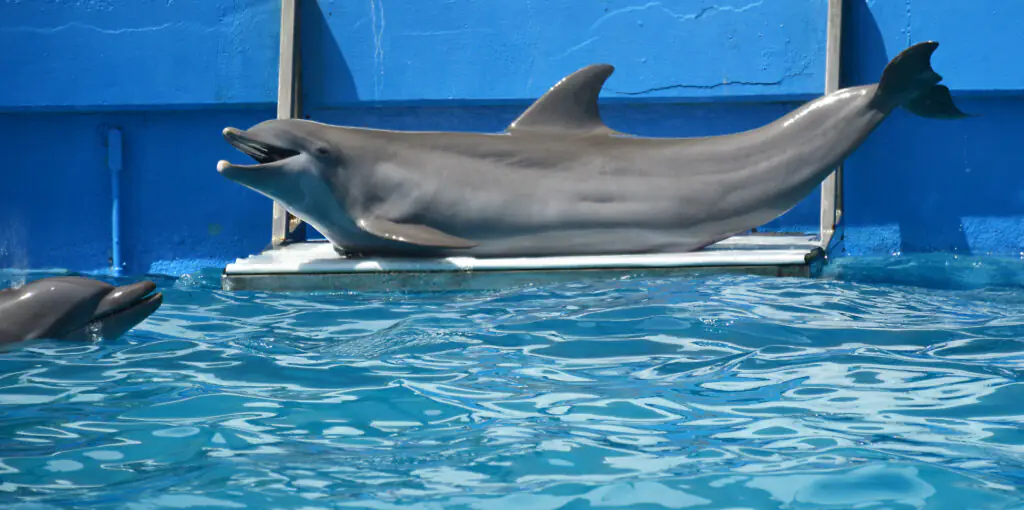
A dolphin performing at Miami Seaquarium. Credit: Arev Hambardzumyan / Alamy
Per Local10 News Miami Seaquarium released the following statement regarding the incident: "A dolphin and trainer accidentally collided in the water on Saturday while performing a routine behavior as part of the Flipper Show.
"This was an uncomfortable interaction for both of them and the dolphin reacted by breaking away from the routine and striking the trainer.
"As a precaution, Miami-Dade County safety authorities were contacted. Our family extends to include the animals in our care, our team members and our guests. While there is no apparent serious injury, a careful watch and follow-up evaluations will ensure the best care for all."
However, PETA has slammed the park following the distressing occurrence. In a statement, the animal welfare group said that "time is up at Miami Seaquarium", and accused the park of housing "long-suffering dolphins" and employing workers who are "at risk".
"PETA urges this abusement park to end its exploitation of dolphins by getting them into sanctuaries as quickly as possible, where they’d never be used in tawdry shows again and no-one else will get hurt," PETA officials added.
Insider reports that this incident comes after Miami Seaquarium was cited for numerous animal welfare violations in a 17-page report by the United States Department of Agriculture (USDA) in June, 2021.
A dolphinarium in the city of Varna on the Bulgarian Black Sea coast has attracted criticism over the reported death of a baby dolphin.
Per BTV Novinite, an audience member alleges that the incident occurred during a live performance at the aquatic zoo earlier this month.
"There was a disturbance, the dolphins stopped playing and performing tricks," recalls spectator, Bisser Lyubenov. He claimed that the show was then cut short, and that they were asked to leave.
Two pink dolphins were spotted in a Louisiana river:
According to another witness, the body of the dolphin could be seen by visitors in the park's cafe.
However, the dolphinarium denies that the animal died during the live show, and in front of children.
[[imagecaption|| Credit: Getty]]
Tsvetan Stanev, a biologist who is employed at the aquatic zoo, says that the calf and its mother had been separated from the other dolphins since its birth.
"You can’t have a mother leaving its child in order to take part in the show. This can happen about six months after the birth. A baby dolphin taking part in performances nine days after it was born – this has never happened in this dolphinarium."
However, concerns for the welfare of the animals at the facility have not been put to rest by this explanation. Yavor Gechev, from the animal protection organisation Four Paws, has highlighted that six animals - five dolphins and one seal - have perished at the park in the last five years. He claims the mortality rate is much higher than in other marine parks.
A man recently spotted a '30-foot' shark swimming near his boat:
"This means categorically that conditions don’t meet even the minimal standards for keeping such animals," he told the publication. "The animals are struggling there, they are not surviving."
Since news of the incident broke, outraged animal lovers have taken to social media to launch a petition calling for the closure of the park.
"I saw the show once and I'm still horrified about the way the dolphins get treated! It's clear that a big profit is made at the expense of the animals who are forced to perform too often," wrote one Facebook user.
SeaWorld has responded to footage of orcas allegedly attacking each other, the Daily Star has reported.
A visitor to the theme park in San Diego captured the video, which appeared to show two killer whales engaging in an underwater scuffle.
In the clip, two orcas can be seen thrashing about in the water, before one appears to beach itself on the tank's ledge. In the background, a child is heard saying: "How is the orca still alive?"
The visitor, who recorded the footage told PETA:"We all immediately saw blood soaking the water which triggered my 9-year-old daughter to start crying [...] Every couple seconds two more orcas would jump out of the water to continuing [sic] attacking the hurt orca."
The footage led to PETA Executive Vice President Tracy Reiman calling for the USDA to investigate SeaWorld "for holding animals in conditions so stressful they would lead to horrific attacks".
Check out the footage below (warning - some people may find this video distressing):
Reiman also called for "families to stay away from any park that imprisons orcas or other animals".
Now, a spokesperson for the theme park has refuted the footage and provided an explanation for the animals' behavior.
Speaking to the Daily Star, the spokesperson said: "The video released by PETA is misleading and mischaracterized. In fact, it shows common orca behaviors exhibited by both wild populations and those in human care as part of natural social interactions."
"During the interaction, one of the orcas sustained some minor and superficial abrasions that pose no serious health risk. Numerous scientific papers have been published about these behaviors among wild orcas," the spokesperson concluded.
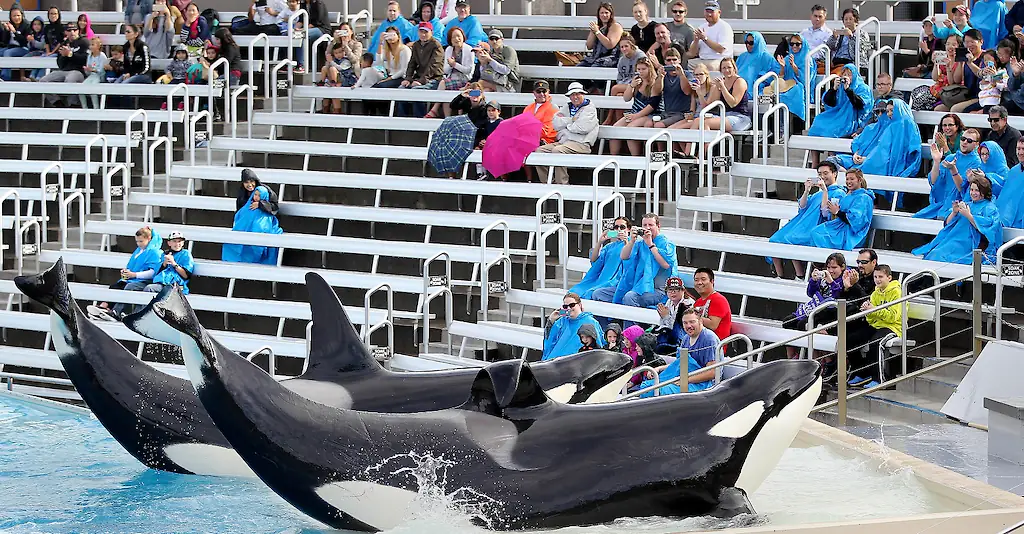
PETA's footage of the orca attack was accused by SeaWorld of being "misleading". Credit: ZUMA Press Inc / Alamy
However, PETA was far from convinced. In a formal complaint to the US Department of Agriculture against SeaWorld, PETA alleged that one of the animals had been seriously injured during the attack, despite SeaWorld's claims that the wounds were superficial.
"The wound appears to extend past the epidermis into the adipose or muscular tissues and will require medical treatment, including antibiotics and topical wound care and/or bandaging, in order to prevent infection and aid in proper healing," the organization stated in their complaint.
Contradicting SeaWorld's statement to the Daily Star, PETA continued: "The orca can be seen in the video beaching themselves which is a highly unnatural behavior and appears to be the only way for the distressed orca to get away from their aggressors."
The disturbing incident occurred just one day after another orca died after being in captivity at SeaWorld for 21 years.
The killer whale, named Nakai, was reportedly suffering from an infection, and despite "aggressive therapeutic and diagnostic efforts", he was unable to be saved.
Per KPBS, the park said in a statement: "His contributions to helping improve the health and survival of whales in the wild cannot be underestimated and will never be forgotten."
If there's one subject that's almost certain to get internet users riled up, it's animal cruelty. All you need to do to incur the self-righteous wrath of countless millions of commenters is to make the mistake of hurting or humiliating some poor defenceless creature, and then sit back and wait for the social media collective to figuratively kick your back doors in. Not only that, but the more committed commenters are to the issue of animal rights, the more vocal they'll inevitably be in their scathing condemnation.
If you want an example of a group whose animal rights advocacy can verge on the fanatical side, then look no further than Peta. Yes, despite their laudable goals and moral intentions, People for the Ethical Treatment of Animals have managed to incur a reputation for irresponsible and provocative publicity stunts, which some critics have decried as doing more harm than good overall.
The latest hot-button topic to ruffle their feathers is a viral video, which shows a beluga whale being treated to an underwater makeover. It all sounds like harmless good fun, but Peta say that the footage is no laughing matter.
The offending video in question apparently comes from the Sun Asia Ocean World aquarium in Dalian, in the Liaoning Province of China. The short clip shows staff at the aquarium diving into the whale's take, and applying bright red lipstick to the marine mammal's mouth.
The video of the cosmetics session was then promptly uploaded to Dou Yin (抖音), a popular Chinese video app, on June 9, and was criticised for its perceived animal cruelty. That was when the uproar from Peta Asia began in earnest. The original video has since been taken down by its uploader as a result of the subsequent backlash.
Press officer Keith Guo, a spokesperson for Peta Asia, stated that the aquarium has angered animal rights activists in the past, since it keeps many of its animals, such as belugas and dolphins, in tanks which the organisation has deemed too shallow to promote their health and well-being. Guo stated angrily that: "Those sea mammals who have social needs and vast water were so anxious and living in pain."
Sun Asia Ocean World has since apologised to the public for the viral video. In a statement, the aquarium appeared to be remorseful for the furore that the clip had caused, stating: "Hereby, we express our sincere apology to all the friends who like Sun Asia Ocean World".
The aquarium also claims that the keeper in the video who can be seen applying the lipstick has since left the company last month, and that it was was filmed in 2017 and uploaded to Dou Yin by someone else - not the trainer in question.
The beluga whale (or the white whale) are a species native to the Arctic Ocean. The easygoing, comparatively friendly nature of the species, as well as their intelligence, has made them popular at various aquariums around the world. However, the beluga is under threat, and have since been added to the red list of endangered species on International Union for Conservation of Nature as of 2008.
What would your reaction be if a huge shark suddenly began swimming in your vicinity during a dip in the ocean? You probably wouldn't be particularly calm, would you?
Which is why the reactions of dozens of beachgoers in Florida have baffled so many people.
A video recorded recently at Navarre Beach in Florida has caught the moment a sizeable-looking shark swims perilously close to a crowd of people enjoying some time in the ocean.
Now, ordinarily, the reaction to a fish big enough to bite one of your limbs off getting up close and personal with a bunch of human beings would probably be one of sheer panic. You'd usually have beachgoers desperately dashing out of the water, trying to save their body parts from becoming a shark's lunch.
Instead, the Navarre Beach faithful, en masse, calmly exited the waters, almost without a care in the world.
From the footage, no one has been able to confirm what species of shark is pictured in the video. However, Florida's waters are home to both Tiger Sharks and Bull Sharks, two species that have been responsible for multiple fatalities in the past.
Sharks normally associate splashing with distressed animals, which would provide them with a relatively easy dinner or maybe a light swimming snack. So the people in the video calmly heading back to the sand are acting exactly as they should. The lack of frantic behavior also doesn't allow the shark itself to become stressed and thus start behaving erratically.
However, when the video hit social media, some commenters were less than impressed with what they saw.
One Facebook user replied, "What happened to the advance warning from the lifeguards? Lifeguards whistling? That's a huge shark. It makes you wanna just stay in a pool."
Beach Safety Director Austin Turnbull reassured everyone that all protocols had been adhered to and that sharks are incredibly common in Florida waters, so the entire situation wasn't really anything to worry about.
"There’s sharks in the Gulf, everywhere. We see sharks almost every day and there’s nothing to be alarmed of for 99.9% of the time," he said, per The New York Post.
We're still very alarmed for that 0.1% of the time, though.


.webp_vBqgAR?tr=cr-242.0.1293.1051,f-webp,q-70,w-100)


.jpg_I4Ebof?tr=cr-0.338.2730.3068,f-webp,q-70,w-100)


.webp_vBqgAR?tr=cr-242.0.1293.1051,f-webp,q-70,w-1024)

.jpg_I4Ebof?tr=cr-0.338.2730.3068,f-webp,q-70,w-1024)


