ADVERT
World7 min(s) read
Rescue crews on Pakistan's Broad Peak have found four bodies after an avalanche struck a group of 10 international climbers on Thursday.
Six remain missing, and among them is Nirmal Purja, the Nepal-born British mountaineer whose 2019 record-breaking ascent of all 14 of the world's highest peaks was the subject of the Netflix documentary 14 Peaks: Nothing is Impossible.
The identities of the four who have been found have not been confirmed. Search and rescue operations are continuing despite severe weather conditions on the mountain.
Three days before the avalanche, Purja posted on X: "Broad Peak, I ask for nothing but safe passage up and back down.
"I take zero mountains for granted. Not one. The moment my foot leaves basecamp, it's 100%. Always has been. Always will be."
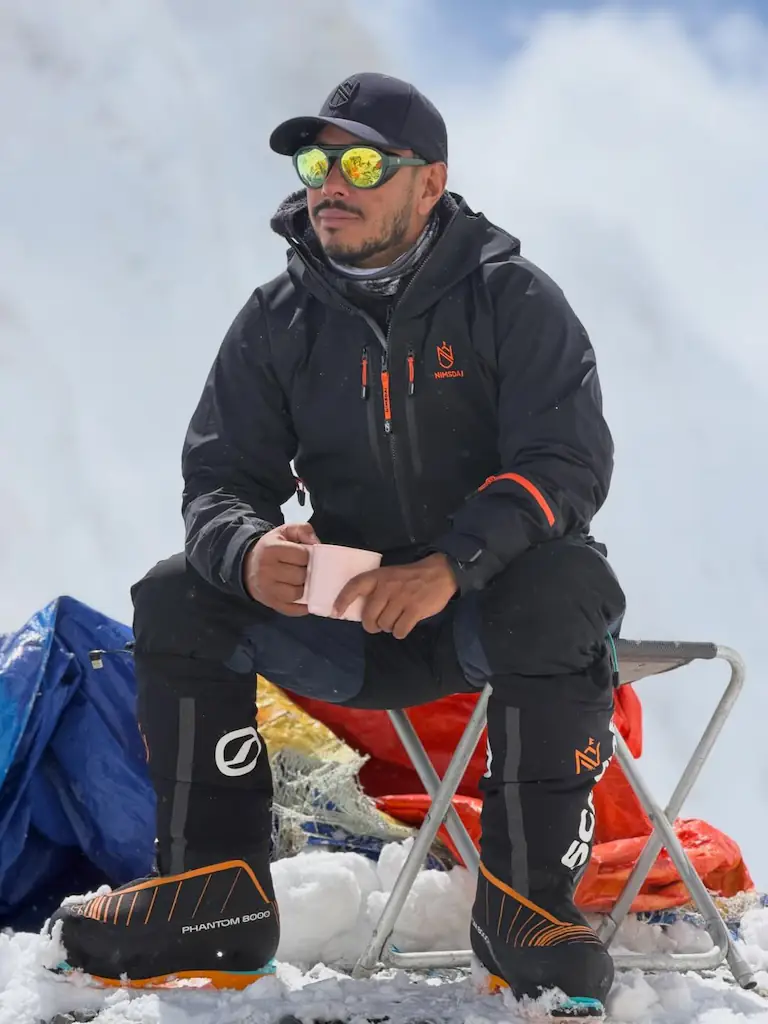
The avalanche hit around midday on Thursday, July 30, on Broad Peak, an 8,047-metre mountain in the Karakoram Range near the Chinese border, roughly five miles from K2. It is the world's 12th highest peak.
The Alpine Club of Pakistan received initial reports of the avalanche and confirmed the 10 climbers had been out of communication since.
"The Alpine Club of Pakistan has received deeply concerning reports of an avalanche that struck a team of climbers on Broad Peak in the Karakoram mountain range," Vice President Karrar Haidri said in a statement.
But there was a significant delay before anyone raised the alarm.
According to ExplorersWeb, the avalanche occurred around 9:20am local time.
No alert went out until almost 13 hours later, at roughly 10pm.
"We only found out at 10pm," Naila Kiani of the Alpine Club told ExplorersWeb. An entire day when helicopters could have reached the site before dark was lost.
ExplorersWeb noted that four separate climbing teams were on the mountain at the time, all with staff at Base Camp, making the delay difficult to explain.
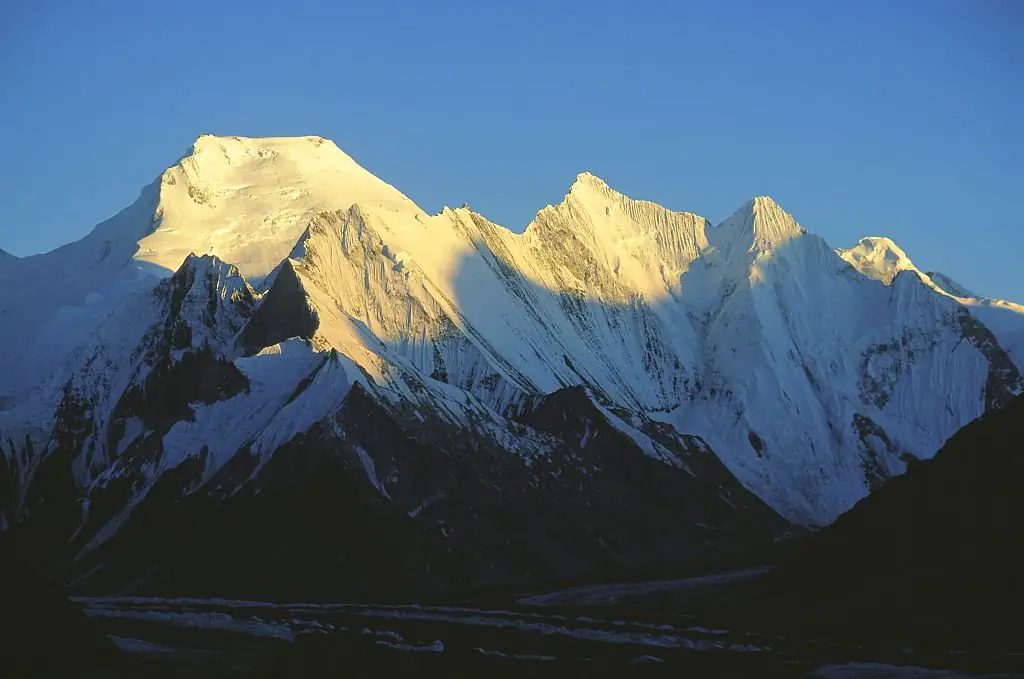
The Alpine Club of Pakistan has named all 10 members of the expedition:
Nirmal "Nims Dai" Purja, 43, Nepal-born British mountaineer and expedition leader.
Pur Bahadur Gurung, Kili Pemba Sherpa, Nima Sherpa, Gyalu Sherpa, and Nawang Thindu Sherpa, all Nepali climbers. Sohail Sakhi, a Pakistani mountaineer from Hunza. Wang Zhong, a Chinese climber.
Mallory Geis, an American climber and wellness entrepreneur on her first attempt at an 8,000-metre peak in Pakistan. Ahmed Abdullah Al Harthy, an Omani climber.
Moving Mountains, the Pakistan-based travel company coordinating logistics for the expedition, had posted on social media late last month wishing the team a safe journey as they set off from Askole towards Base Camp.
The company noted that it was expected to be Sakhi's final 8,000-metre climb.
Not yet.
Irfan Arshad Khan, President of the Alpine Club of Pakistan, confirmed on Friday that ground rescue teams had located four bodies. Efforts to retrieve them were underway despite harsh weather.
"Search and rescue operations remain ongoing, and we urge the public to await verified updates before drawing conclusions," the Alpine Club said in a separate statement.
"The Alpine Club of Pakistan extends its continued thoughts to the climbers and their families during this difficult time."
The four bodies have not been publicly identified at the time of writing. Six climbers remain unaccounted for.
Pakistan has deployed army helicopters, drones, and ground teams to the search area. Nepal's ambassador to Pakistan, Rita Dhital, confirmed the mobilisation.
Officials have cautioned that rescue operations in Pakistan's mountains generally take longer than in Nepal because helicopter deployments are controlled through military channels and require multiple clearances.
Earlier on Friday, before the bodies were found, there had been a brief moment of hope.
Purja's business partner and Nepal MP Mingma Gyaby Sherpa said the tracking device Purja was carrying had shown movement after the avalanche.
"Every possible effort is being made to ensure that helicopter support and all available rescue resources are mobilised at the earliest opportunity, subject to weather and operational conditions," Sherpa said.
A spokesperson for Purja's foundation Nimsdai told CNN its "immediate priority is the safety" of the missing climbers and that it was in contact with authorities.

Nirmal Purja, widely known as Nims Dai, is a 43-year-old mountaineer born in Nepal who holds British citizenship.
He spent 16 years in the British Army, first in the Brigade of Gurkhas and later in the Special Boat Service, an elite unit of the Royal Navy.
His mountaineering career began in 2012 after a trek to Everest Base Camp. Rather than turning back as originally planned, he decided to continue towards the summit. From there, things escalated fast.
In 2019, he climbed all 14 of the world's peaks above 8,000 metres in 189 days, smashing the previous record of nearly eight years.
The achievement was chronicled in 14 Peaks: Nothing is Impossible, which became one of the most-watched documentaries on Netflix after its release in 2021.
His record was surpassed in 2023 by Norwegian mountaineer Kristin Harila and her Nepali Sherpa guide, Tenjen Lama Sherpa, who completed the 14 peaks in 92 days.
Purja was on Broad Peak as part of an attempt to become the first person in history to climb all 14 8,000-metre peaks twice.
He had planned to climb Broad Peak and then move on to Cho Oyu, the world's sixth-highest mountain in the Himalayas, to complete the goal.
Mallory Geis is an American climber and wellness entrepreneur.
This was her first attempt at an 8,000-metre peak in Pakistan. She was climbing with Pakistani mountaineer Sohail Sakhi, who was acting as her guide. CNN has reported that it has reached out to the US State Department regarding Geis.
Broad Peak was first climbed in the summer of 1957 by an Austrian team. It is one of the 14 "8,000ers" and has a long history of fatalities, particularly on descent and in winter conditions.
In 2013, a Polish team summited Broad Peak in winter but two members went missing on the descent and were later declared dead.
In 2021, South Korean climber Kim Hong Bin fell into a crevasse and disappeared after reaching the summit.
The same year, Russian-American climber Alex Goldfarb was found dead after pushing on alone when his partner urged him to turn back in dangerous conditions.
In 2022, RAF Wing Commander Gordon Henderson was reported missing and believed killed during a British services expedition to the mountain.
Pakistan is home to five of the world's 14 peaks above 8,000 metres.
Climbers flock to the country each summer for the brief window when conditions allow attempts on K2, Broad Peak, Nanga Parbat, and the two Gasherbrum summits.
Officials do not list missing climbers as dead until their bodies have been recovered.
The search continues. Weather conditions on Friday have been described as harsh, with rescue teams working in difficult visibility. The Alpine Club has urged the public to wait for verified updates.
If the four bodies are retrieved and identified, the focus will shift to the remaining six. Whether any of them survived the avalanche and the 24 hours that followed, at altitude, in freezing conditions, without communication, remains unknown.
Purja's tracking device showed movement after the avalanche. Whether that movement was his, or the device being carried by snowfall, has not been confirmed.
world3 min(s) read
world4 min(s) read
us2 min(s) read
travel3 min(s) read
world3 min(s) read
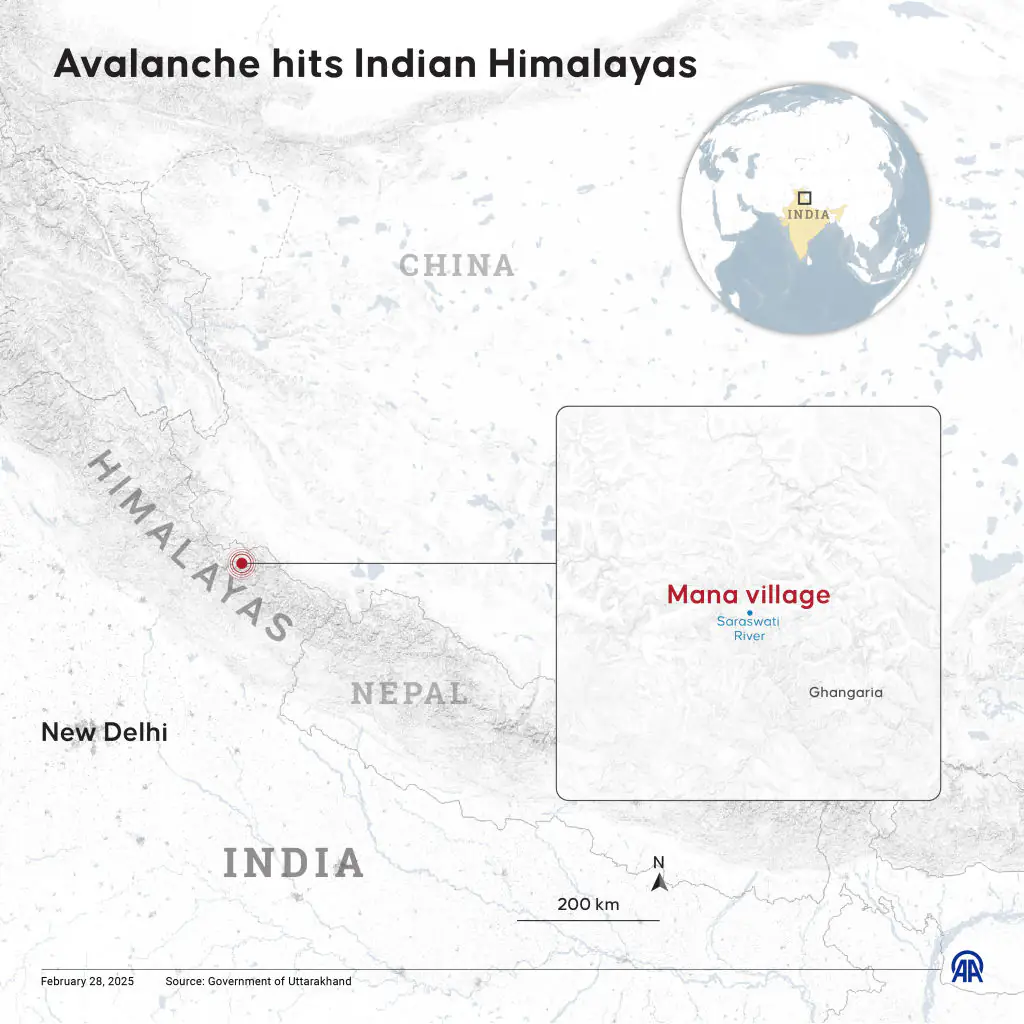
At least four people have died following a powerful avalanche in the village of Mana, in India’s northern state of Uttarakhand.
The tragic incident took place on Friday, February 28.
As well as killing at least four people, several others are still missing, per BBC News.
The avalanche, which hit a Border Roads Organisation (BRO) camp, buried dozens of road construction workers under snow and debris.
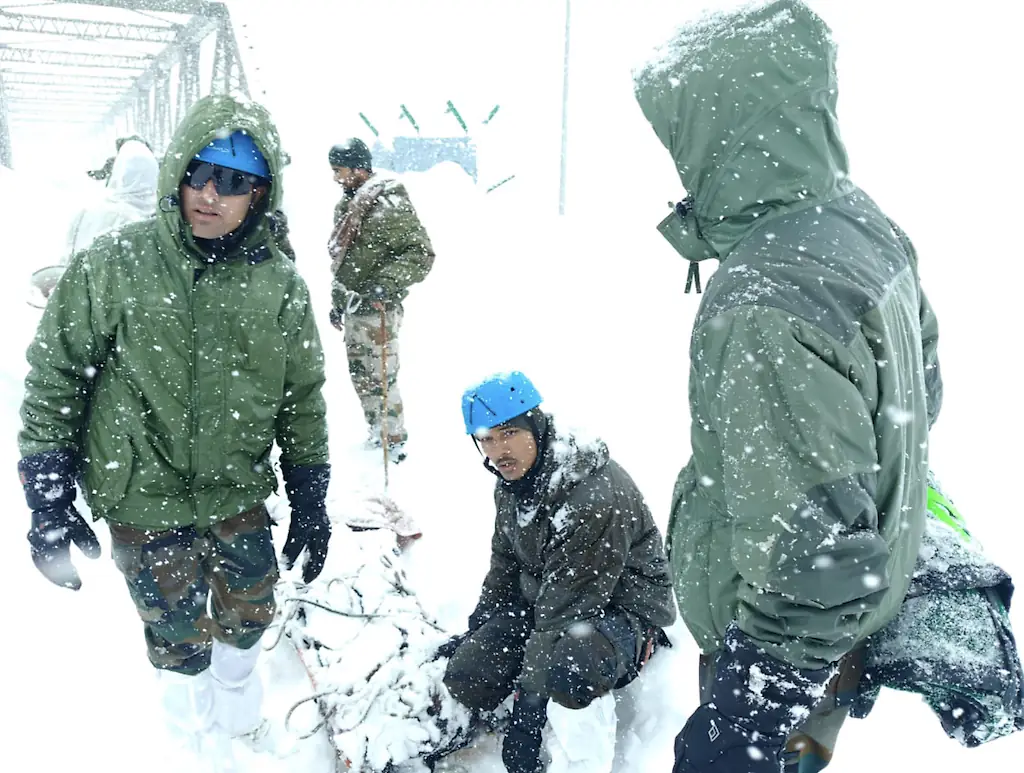
The Indian Army, Indo-Tibetan Border Police, and State Disaster Response Force (SDRF) launched a large-scale rescue operation, successfully pulling 50 people from the snow. However, four later died from their injuries, while five others remain missing (as of this writing).
The Indian Army has deployed helicopters, UAVs, and avalanche rescue dogs to assist in locating survivors.
In a statement shared on X (formerly Twitter), the army noted that “despite harsh weather conditions and continuing snow” teams were working around the clock to extricate the injured. Army doctors have been performing critical life-saving surgeries at the scene, treating those in serious condition.
Helicopters have been continuously evacuating the wounded, transporting them from the avalanche site to medical facilities.
Images shared by the Indian Army show rescuers trudging through thick snow, carrying injured workers on stretchers, and transferring them from helicopters to medical tents for treatment.
Authorities have been using specialized recco radars, UAVs, quadcopters, and avalanche rescue dogs to locate any remaining survivors.
Uttarakhand Chief Minister Pushkar Singh Dhami reassured the public that rescue teams were working tirelessly to save lives.
"The government is fully committed to providing all possible help to the affected people in this hour of crisis," Dhami said. "The safety of the affected workers is our top priority.
"The administration, army, and SDRF teams are continuously engaged in relief work."
Mana, the village where the avalanche struck, is a high-altitude area near the India-Tibet border.
Gaurav Kunwar, a former village council member, told BBC News that the affected area is a migratory region where only road workers and army personnel stay during the winter months.
"No one lives there permanently," Kunwar explained. "Only laborers working on border roads stay there in the winter. There's also some army presence there. We've heard that it has been raining in the area for two days. The road workers were in a camp when the avalanche hit."
AP has since reported that the four individuals who have died were all construction workers.
The India Meteorological Department (IMD) had previously issued heavy snowfall and rainfall warnings across northern India, with orange alerts for snowfall in:
Temperatures in the area at the time of the avalanche had dropped to 10°F (-12°C), creating treacherous conditions for both residents and rescue workers.
With five workers still missing, authorities remain on high alert for further avalanches or extreme weather events. Rescue teams are racing against time to locate any survivors before conditions worsen.
Despite the harsh environment and ongoing snowfall, the Indian Army and disaster response teams continue their search and rescue operations, vowing to do everything possible to find the missing.
Our thoughts go out to the rescue teams working to save lives and to every person impacted by this tragedy.
A climber whose family was told he died while scaling Mount Everest was miraculously found alive by sherpas.
Mount Everest, the world's tallest mountain, has long fascinated explorers, but actually hiking to the summit is no easy feat.
TikTok has recently been flooded with people interested in learning about the "death zone", where climbers often vanish and perish.
Back in May 2006, Lincoln Hall almost became one of the adventurers that never made it back from Everest, after being left for dead by his fellow climbers.
After attempting to revive him for several hours, the other climbers Hall was with had stripped his body of necessary equipment before leaving him exposed on a narrow ridge, 28,000 feet up Everest, believing there was no more they could do for him.
The following morning, on May 26, his family was notified that the 50-year-old had tragically died during the climb.
However, their grief was premature as Hall was very much still alive - and was found Dan Mazur, then 45, who was climbing the mountain with a Sherpa guide and two other climbers.
Hall, who is from Australia, was found without a hat or gloves and with his insulated suit unzipped.
Mazur told People at the time: "We came upon him suddenly. He was just sitting there on the brow of a ridge, with a cliff on one side that had a drop of about 8,000 feet.
"He's got his arms out of his down suit, wearing just a thin fleece top. He's got no hat, no gloves and no goggles. There's no oxygen. He's got no equipment and he was just sitting there gaping."
Mazur added: "He was 'dead,' so the people he was with apparently took all his stuff. He'd had three Sherpas, and I heard they were like poking fingers in his eyes and he wasn't moving. They figured he was dead. Maybe he was almost dead.
"A couple of people later told me they did everything they could. Anyway, he said, 'You must be surprised to see me here.' I said, 'Yeah, buddy, I'm really surprised to see you.'"
While their chance encounter ended up meaning Mazur and his team's plan had to change, he said he and his guides "didn't have a second's hesitation about stopping. How could you just walk past someone like that?"
He added: "He's sitting up, holding his hands up, talking to us. If you walk past someone like that, you're going to hell, dude, you're going to hell!"
Mazur tried to get Hall to zip his coat back up and put on his gloves and hat, but said he kept taking them off.
He described the horrifying injuries Hall had suffered, explaining: "His fingers looked like candles. Frozen down to halfway. All waxy, yellow. It's like minus 20 or minus 30. But there was no wind.
"I'm like, 'Hold out your hand, dude. Is this your glove? Let's get that glove on, man. Okay, where's your hat? Let's put your hat on. Zip up your coat.' He was like a three-year-old."
Hall was beginning to hallucinate from the oxygen deprivation to his brain, and thought he and Mazur were on a boat ride with the sherpas after having his harness clipped on to one of their snow stakes.
He was given a Snickers bar, water, and some oxygen from a spare tank the group had and only then began to become more lucid and mobile.
Hall's base camp was identified thanks to a logo on his jacket and they contacted his group to let them know that Hall was still alive.
Mazur and his group were forced to abandon their climb to the summit after their climb was interrupted by the rescue, but he says that the experience left him "humbled" nonetheless.
Mazur explained: "The four hours we had lost made it risky to go on. Storms come in the afternoon, and we had used a good deal of oxygen just sitting there.
"But I'm humbled, very humbled, by the whole thing. I feel respect for the mountain and for the situation. Sometimes you feel about an inch big. Just tiny. Like you are just a little pea."
Thanks to Mazur and the sherpas' assistance, Hall made it back alive and was treated for frost bite and brain swelling caused by altitude sickness, and ended up making a full recovery barring losing his fingertips from exposure to the cold.
Hall ended up dying six years later from cancer after developing mesothelioma from being exposed to asbestos decades earlier while helping his father build two cubby houses when he was a child.
The mummified remains of American mountaineer William Stampfl have been uncovered - 22 years after he vanished.
Peruvian authorities made the startling discovery in the high Andes mountains, where a climbing expedition on Huascaran - a towering peak exceeding 22,000 feet in elevation - discovered Stampfl's remains.
Stampfl, aged 59 at the time of his disappearance in June 2002, was part of a climbing party engulfed by an avalanche while navigating Huascaran, located in the Cordillera Blanca range, CBS News reports.
Despite initial search efforts, his fate remained a mystery until recently, when melting ice due to climate change revealed his remarkably preserved body, along with his clothing, climbing equipment, and even his passport, facilitating his identification by authorities, per The Independent.
Back in 2002, The Los Angeles Times reported that Stampfl was accompanied by friends Steve Erskine and Matthew Richardson during a 19-day round trip when they were claimed by the avalanche.
Stampfl - a self-employed civil engineer born in Austria - had a "running joke" with his wife that he would always carry a bag of small origami turtles with him on his climbs. "Since I couldn’t go, the turtles went instead," his wife, Janet, said at the time.
The revelation of Stampfl's remains underscores a broader trend driven by global warming: as glaciers across the world recede at alarming rates, long-lost bodies of hikers, skiers, and climbers are being rediscovered decades after their disappearance.
Peru’s glacier shrinkage, exacerbated by rising global temperatures, has accelerated these discoveries. According to Jesus Gomez - director of glacier research at Inaigem - the average global temperature increase has contributed to unprecedented glacier thinning, particularly affecting tropical regions like the Andes.
As such, Stampfl’s discovery is not an isolated incident. Last year, the remains of Marta Emilia Altamirano, known as Patty, were found attached to a glacier in the Andes -- 41 years after she tragically slipped on ice during a 1981 expedition.
And the tragic trend extends beyond Peru. In recent years, similar discoveries have been made in the Swiss Alps and Himalayas, where melting glaciers have unveiled the remains of climbers missing for decades.
Last month, five frozen bodies were retrieved from Mount Everest, per CBS News. And last year, the body of a German climber who had been missing since 1986 was found on a glacier in the Swiss Alps.
Following the discovery, authorities in Peru are now conducting further investigations into Stampfl's death.
Our thoughts continue to go out to his family at this time.
A hiker who found themselves lost on a Colorado mountain mistakenly impeded their own rescue mission because they didn't answer calls from an "unknown number".
As reported by NBC News, the hiker - whose identity has not been made public - ignored repeated calls from rescuers after going missing for 24 hours. The misguided explorer later explained that they did not pick up the phone as the number was unknown to them, per authorities.
The hiker in question was reported missing after failing to return from an expedition on October 18, 2021. They had been attempting to scale Mount Elbert, the highest peak in the state of Colorado, Lake County Search and Rescue said.
The individual was reported late at around 8:00PM after starting the hike at 9:00AM on the same day.
Lake County Search and Rescue stated that while search crews traversed the area the following day, they couldn't locate the individual, who had apparently wandered from the trail and spent the evening attempting to find it again.
After around 24 hours of being lost, they eventually found the trail, and made it to their car — all without knowing that a search team had been looking for them.
In a statement posted to Facebook, Lake County Search and Rescue said: "Multiple attempts to contact the subject via their cell phone were unsuccessful."
"The subject stated they’d lost the trail around nightfall and spent the night searching for the trail, and once on the trail, bounced around onto different trails trying to locate the proper trailhead, finally reaching their car the next morning, approximately 24 hours after they’d started their hike. They had no idea that SAR was out looking for them," the statement continued.
"One notable take-away is that the subject ignored repeated phone calls from us because they didn’t recognize the number," the statement added, before stressing the importance of answering a call if others ever found themselves in a similar situation. "If you’re overdue according to your itinerary, and you start getting repeated calls from an unknown number, please answer the phone; it may be a SAR team trying to confirm you’re safe!
"Finally, to Mount Elbert hikers, please remember that the trail is obscured by snow above treeline, and will be in that condition now through probably late June. Please don’t count on following your ascent tracks to descend the mountain, as wind will often cover your tracks."
After the hiker in question became the subject of criticism, Lake County Search and Rescue came to their defense, explaining that "common sense in hindsight is not obvious to a subject in the moment when they are lost and panicking."
"Please remember that what seems like common sense in hindsight is not obvious to a subject in the moment when they are lost and panicking. In Colorado, most folks who spend time outdoors have a good understanding of the SAR infrastructure that is there to help them, but this is not the case nationwide. Please keep your comments respectful," they wrote.
In all honesty, I've never related more to an individual more in my life.
A desperate search for Russian mountaineer Natalia Nagovitsina, 47, has stretched into its second week, with local authorities stating on Monday that they're abandoning attempts to extricate her from Victory Peak due to bad weather.
Nagovitsina became stranded on August 12, unable to descend from the treacherous slopes in Kyrgyzstan after breaking her leg. Multiple rescue missions have been mounted in the days since, but the efforts have been marred by tragedy and setbacks.
Italian climber Luca Sinigaglia managed to reach her, delivering a sleeping bag to help her endure the brutal -23°C conditions, but he later succumbed to hypothermia and exhaustion. His body was found in an ice cave, and with his death, the already dangerous mission grew even more perilous, MailOnline detailed.
Helicopters were dispatched to try to lift Nagovitsina from the mountainside, but the operations ended in disaster. One aircraft crashed during the attempt, another was forced to retreat in zero visibility, and a final ground effort to climb toward her position was abandoned when worsening weather made progress impossible.
The president of the Kyrgyz Mountaineering Federation has since admitted it is now “highly likely” that Nagovitsina has not survived, saying she was trapped at an altitude “practically incompatible with normal life.”
For Nagovitsina, danger on the mountains was not new. Years earlier, her husband Sergei had died during their own expedition on nearby Khan-Tengri Peak, collapsing after a stroke during the climb. Natalia was told to continue her descent without him but she refused.
“I understand everything, but I will not leave him alone,” she told rescuers at the time, per CNN. Though a team eventually tried to bring Sergei down, he broke free in a delirious state and fell to his death. His body was never recovered.
In a documentary filmed about their expedition, Natalia admitted she had never feared death, only the possibility of losing her ability to climb. “You know, I was not afraid to die. I was afraid to be disabled, that I will get frostbite, they will take away my arms and legs, and what will I do? In fact, this is it. Yes, this is the worst punishment.”
A year after Sergei’s death, she returned to Khan-Tengri to leave a memorial plaque for him on the mountain. It was both an act of tribute and a declaration of her own unbroken connection to the peaks that had shaped her life, and claimed her husband’s.
The haunting clip from that film has resurfaced now, as the world watches the latest chapter in her story. On August 19, a drone spotted Nagovitsina still alive, but heavy snowfall soon blanketed the mountain and shut down further attempts at rescue, according to CNN. Since then, silence.
For those who know her, Natalia’s ordeal carries a tragic symmetry. She once pledged she would not abandon Sergei to die alone on the mountain, and now, years later, she may herself have been left to face the same fate; unmoving, unreachable, and surrounded by the vast silence of the high peaks she loved.