


World3 min(s) read
Pilot uttered 5 haunting words before notorious flight MH370 vanished

The final words of the pilot of missing plane MH370 have been revealed as the mystery remains unsolved, 12 years on.
On March 8, 2014, Malaysian Airlines flight MH370, traveling from Kuala Lumpur to Beijing with 239 people on board, disappeared without a trace.
The plane contained 227 passengers and 12 crew, and last communicated with air traffic control (ATC) around 38 minutes after takeoff while flying over the South China Sea.
The aircraft vanished from ATC's secondary surveillance radar screens minutes later, but was tracked by the Malaysian military's primary radar system for another hour as it deviated westward from its planned flight path, eventually leaving radar range 200 nautical miles west-northwest of Penang Island in northwestern Peninsular Malaysia.

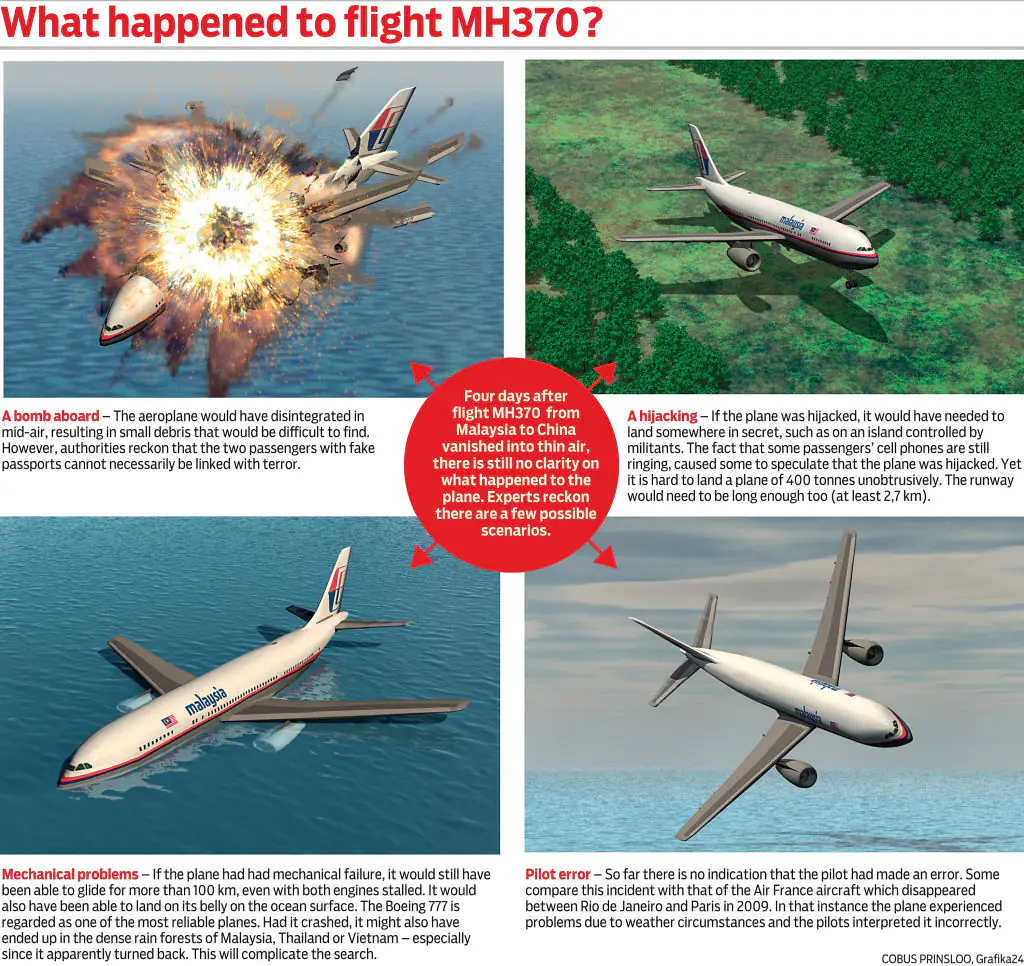
Nothing more was heard from the plane, and there is still no definitive cause for its disappearance, with some fearing it had been hijacked or that the crew may have been involved. All 239 on board are presumed dead.
The pilot on board the Boeing 777 was Captain Zaharie Ahmad Shah, 52, from Penang, who'd joined Malaysia Airlines as a cadet in 1981 and had 18,365 hours of flying experience, while the co-pilot was 26-year-old First Officer Fariq Abdul Hamid, who'd joined Malaysia Airlines in 2007 and had 2,763 hours of flying experience.
Shah's final words to ATC came as he signed off from Malaysian airspace and prepared to cross into Vietnamese airspace, saying: "Goodnight Malaysia three seven zero."
These were the last words ever heard from the cockpit, and mystery has surrounded the communication ever since.
The case has captivated people around the world, as the mystery of how a commercial aircraft as large as a Boeing 777 could simply vanish without a trace, given how closely aircrafts can be monitored in this day and age.
Though some small pieces of wreckage believed to be from MH370 have washed up on the shores of the western Indian Ocean, the final resting place of the fuselage has never been found.
It is widely believed that the plane likely came down in the Southern Indian Ocean, and the Malaysian government has greenlit several searches for the wreckage.
It is believed that the plane likely kept flying for several hours after it "went dark" from the radar, with data indicating that it could have been airborne for a further seven hours before it ultimately vanished.
Simon Maskell, a professor in autonomous systems at the University of Liverpool, told The Diplomat that his team had researched Weak Signal Propagation Reporter (WSPR) data to learn more about the fate of MH370, using low-frequency signals tracked by amateur radio operators across vast distances.
They analyzed years of records from the WSPRnet database to come up with the three most likely scenarios for what happened to the missing aircraft.
Maskell explained to the outlet: "The analysis we did indicated that there are three explanations that appear to be approximately equally consistent with the information we had at the time: there is a chance that a freak accident occurred and the crew were unable to communicate or land the aircraft elsewhere.
"[Or] it was a murder-suicide with the murderer alive when the descent occurred, [or] a murder-suicide with the murderer no longer alive when the descent occurred."
The murder-suicide theory grained traction after Malaysian authorities discovered a flight simulator in Shah's home which contained a route remarkably similar to MH370's final known movements over the Indian Ocean.
However, there is no solid proof or suggestion that Shah or his co-pilot had premeditated plans to deliberately bring the aircraft down.