


Innovation4 min(s) read
AI responds to Bill Gates’ claim that only these three jobs will be safe from being replaced by artificial intelligence
.jpg_xKEaT0?tr=cr-0.328.2730.3058,f-webp,q-70,w-100)
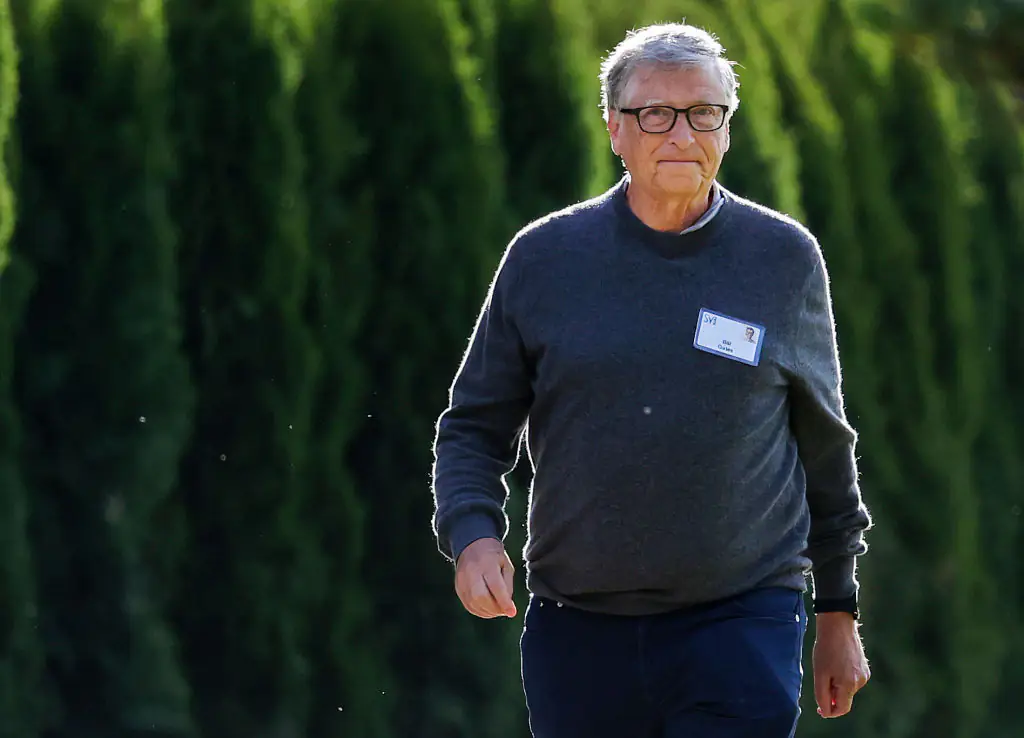
AI has given its own explanation in response to Bill Gates' eerie claim that there will only be three jobs that won't be eradicated by the development of Artificial Intelligence.
When Bill Gates, the co-founder of Microsoft and tech pioneer, gives his thoughts on the state of technology development, you'd be wise to give it a listen.
He had a major part to play in the personal computing revolution that brought laptops, desktops, and eventually mobile devices into everyday life.
As we all know, AI has gained more influence on the world as time has gone on, changing how we search for information, look for advice, and, most importantly, how certain industries work.
Concerns have risen about job loss and economic change, but Gates believes there are a handful of careers where human expertise will remain crucial.
He said that three specific fields would stay in demand as they require human reasoning, creativity, and problem-solving skills - which AI cannot accurately replicate.
Which jobs are safe?
Separately, the billion admitted that athletes may be safe while on The Tonight Show Starring Jimmy Fallon, saying: "You know, like baseball. We won’t want to watch computers play baseball,
"So there’ll be some things that we reserve for ourselves, but in terms of making things and moving things, and growing food, over time, those will be basically solved problems."
But moving on to his predictions, Gates said that one field that will be safe is biology, with specialists in the field playing an important role in scientific discovery and understanding life at its most fundamental levels.
He believes that biologists are key in driving human progress and innovation through creative and intuitive thinking, which AI hasn't quite grasped yet.
Energy expertise was another area in which Gates said humans must remain present, with energy systems around the world facing complex and unpredictable challenges such as climate change and evolving policy landscapes.
AI might create model scenarios and analyse data, but humans must interpret these results and create strategies.
Finally, Gates said that programming and software development are human skills, despite AI now assisting more with code generation and debugging.
So, what does the challenger, AI, think about all of this?
Coders
We asked AI if it agreed with Gates' claims, and it said it "mostly" agreed on this one, explaining: "Coding is already being heavily automated in parts."
They noted that while AI can "generate functions, fix bugs, and scaffold apps," coders likely won't disappear for good, giving this list of reasons:
- Someone still has to define requirements
- Systems still need architecture, debugging, and accountability
- AI-generated code still needs verification and integration
At the same time, the job is changing, and the idea of "writing code" will become less important than "designing systems and directing AI tools,” as coders will evolve.
Biologists
While AI agreed with this, they said that there was an "important caveat."
They claimed that AI is strong at protein folding prediction, analysing genomic data, and scanning research papers.
However, it is weak in the following:
- Forming original scientific hypotheses grounded in real-world intuition
- Designing novel experiments with messy biological constraints
- Making conceptual leaps in unexplored areas
The industry is likely going to stay human-led, it claims, but AI will be used to assist more and more.
It noted that the best scientists will be those who learn to collaborate with AI, instead of competing, in what sounds like a subtle threat.
Energy workers
AI has explained that this is the weakest claim, as while the industry is safety-critical, they are "also highly optimisable and already heavily automated."
It claimed that AI will be able to:
- Optimise grids
- Predict demand
- Manage maintenance
- Improve efficiency in nuclear and renewables
However, humans will remain essential in staying on top of regulation and safety decisions, infrastructure planning, crisis response, and political and economic trade-offs.
It explains that the sector isn't "safe," claiming it is actually "one of the most AI-augmented industries already."
AI concluded that technological change isn't as black and white as eradicating jobs, adding that it doesn't agree "with the implied certainty or the idea that only a narrow set of professions will survive unchanged."