ADVERT
US News2 min(s) read
Published 08:58 30 Jul 2025 GMT
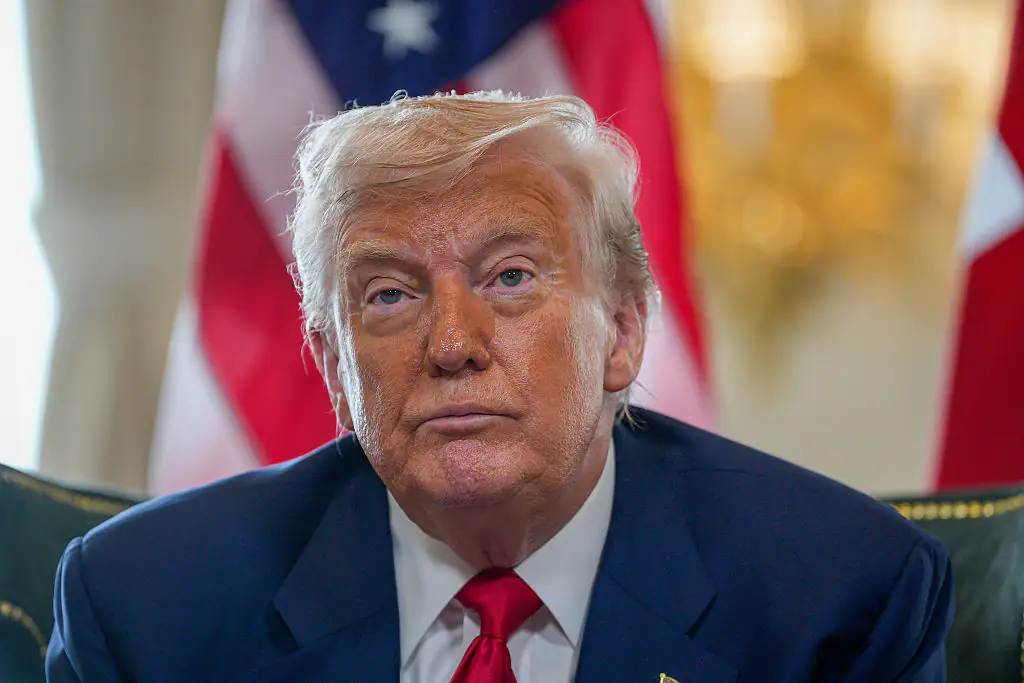
President Donald Trump has issued a public statement following a powerful earthquake that struck near Petropavlovsk-Kamchatsky, Russia, triggering widespread tsunami warnings across the Pacific region, including Hawaii, the West Coast of the United States, and parts of Japan.
The magnitude 8.7 quake, one of the strongest in recent years, struck approximately 80 miles southeast of Petropavlovsk and prompted immediate alerts from global meteorological and emergency agencies.
The U.S. National Weather Service issued a Tsunami Warning for Hawaii and Tsunami Watch advisories for the Pacific coastlines of Alaska and California.
Trump, who recently returned from a five-day visit to Scotland, took to Truth Social to address the unfolding situation and urge residents in affected areas to heed official guidance.
"Due to a massive earthquake that occurred in the Pacific Ocean, a Tsunami Warning is in effect for those living in Hawaii," Trump wrote. "A Tsunami Watch is in effect for Alaska and the Pacific Coast of the United States. Japan is also in the way. Please visit tsunami.gov for the latest information. STAY STRONG AND STAY SAFE!"
The National Weather Service's Pacific Tsunami Warning Center emphasized the seriousness of the threat in its advisory for Hawaii, warning residents: "You are in danger. Get away from coastal waters. Move to high ground or inland now. Keep away from the coast until local officials say it is safe to return."
Tsunami watches and advisories have also been issued for parts of Alaska, including the Samalga Pass in the Aleutian Islands, and along the California coast. The National Weather Service office in Los Angeles confirmed the watch covers San Luis Obispo, Santa Barbara, Ventura, and Los Angeles counties.
In a separate statement upon arriving back in the U.S., Trump also responded to the tragic shooting that occurred in New York City on Monday, calling the event “terrible.”
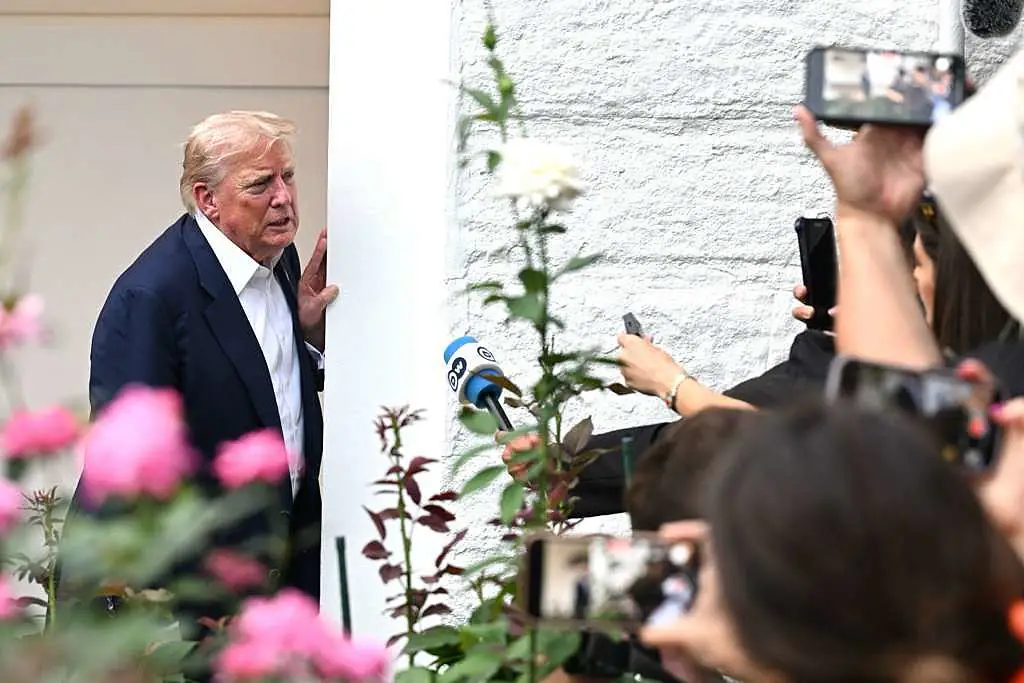
“It’s so bad, so sad to see,” he told reporters. “He’s a lunatic, and we just have to stop it. These people come in, you never want to see a thing like that happen. We’ve expressed our opinions very, very strongly. Terrible thing.”
Authorities continue to monitor seismic and ocean activity across the Pacific, with local officials urging the public to stay informed and follow emergency instructions closely.
world3 min(s) read
Published 08:55 30 Jul 2025 GMT
As a tsunami threatens countries along the Pacific coast, here are all the areas that could potentially be at risk.
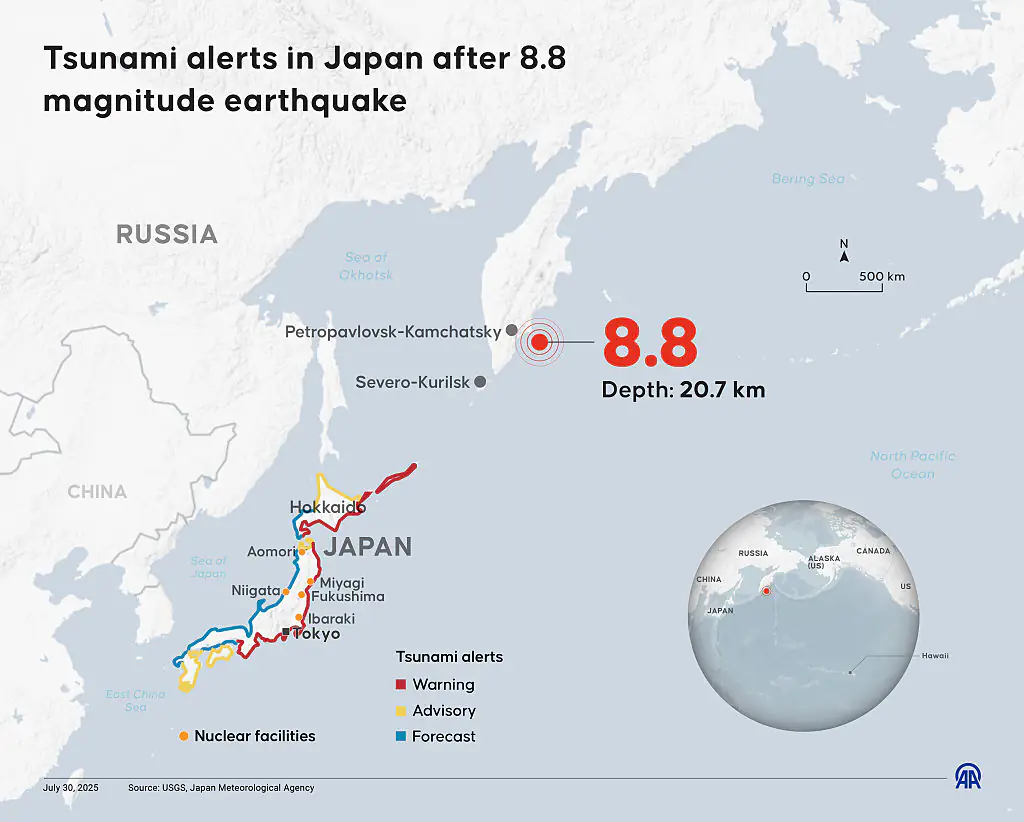
The 8.8 magnitude quake struck near Petropavlovsk, Russia, at 11:25AM local time on Wednesday (30 July), unleashing a powerful shockwave that’s reverberating through coastal regions across multiple continents, per the Independent.
The impact was immediately felt on the Kamchatka Peninsula, where waves of up to 13 feet (4 meters) battered the coast, damaging buildings and flooding streets, according to regional governor Vladimir Solodov.
"Today's earthquake was serious and the strongest in decades of tremors," he said.
Experts are calling this event one of the most powerful quakes in modern history — drawing comparisons to the 2011 Japan earthquake, which reached a magnitude of 9.0 and resulted in a devastating tsunami.
As fears mount over the tsunami’s reach, countries along the Pacific Rim have issued evacuation orders, advising residents to move to higher ground and stay away from coastal areas.
Among the nations under threat are Japan, China, Indonesia, the Philippines, Chile, Mexico, New Zealand, and Peru — all warned to prepare for a worst-case scenario, per CNN.
Even parts of the United States, including California, Alaska, and Hawaii, are on high alert. The U.S. Tsunami Warning System issued statements urging residents in affected regions to take the situation seriously.
Former President Donald Trump also addressed the nation on social media, stating: "Due to a massive earthquake that occurred in the Pacific Ocean, a Tsunami Warning is in effect for those living in Hawaii.
"A Tsunami Watch is in effect for Alaska and the Pacific Coast of the United States. Japan is also in the way. Please visit tsunami.gov for the latest information. STAY STRONG AND STAY SAFE!"
The National Weather Service echoed Trump’s concern, particularly for those in Hawaii. “A series of powerful waves and strong currents may impact coasts around you,” the service said in a statement.
“You are in danger. Get away from coastal waters. Move to high ground or inland now. Keep away from the coast until local officials say it is safe to return.”
So far, the most significant wave heights have varied widely depending on location. In Hawaii, a wave measuring over 5 feet (1.52 meters) was recorded at Kahulu on Maui’s north-central shore.
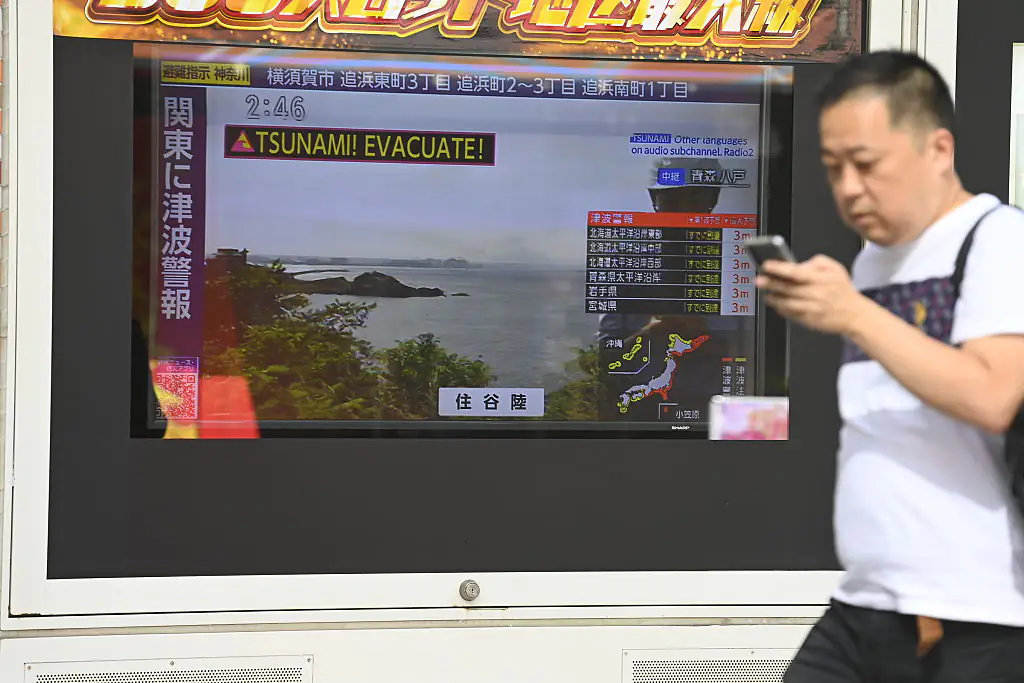
In Japan, the northern coast has seen 40cm surges, with 60cm waves reported in Hamanaka and the Kuji port in Iwate. Alaska has also recorded moderate activity, with waves below 30 centimeters observed in Amchitka and Adak.
A tsunami advisory has also been issued for parts of California. The National Weather Service’s Los Angeles office posted on X: “A TSUNAMI WATCH IS NOW IN EFFECT for coastal San Luis Obispo, Santa Barbara, Ventura, and Los Angeles Counties. An earthquake 8.7 80 miles southeast of Petropavlovsk Kamchatka, Russia. Stay tuned for updates.”
uncategorised3 min(s) read
Published 14:39 23 Jan 2018 GMT
us0 min(s) read
Published 07:35 22 Jul 2020 GMT
A tsunami warning has been issued for much of the southern coast of Alaska and the Alaskan Peninsula following a huge 7.8 magnitude earthquake late Tuesday night local time (July 21).
The earthquake was recorded 75 miles off the town of Chignik at a depth of eight miles, the GFZ German Research Center for Geosciences added.
[[twitterwidget||https://twitter.com/NWS_NTWC/status/1285822164013207552]]
The US National Tsunami Warning Center - which issues tsunami information for the continental United States and Canada - issued the following live event map just moments ago (Wednesday, July 22):
[[twitterwidget||https://twitter.com/NWS_NTWC/status/1285837303726788608]]
Per Fox News, locals of coastal cities along the state have reported hearing sirens - such as the Twitter user below who shared dramatic video footage from Kodiak, Alaska.
[[twitterwidget||https://twitter.com/Tyler82092707/status/1285826396325949441]]
The Mirror reports that an alert said the level of tsunami danger is also being evaluated for other US and Canadian Pacific coasts in North America.
The warning from the official tsunami.gov website reads:
"Tsunami Warning in Effect for:
- SOUTH ALASKA AND THE ALASKA PENINSULA, Pacific coasts from Kennedy Entrance, Alaska (40 miles SW of Homer) to Unimak Pass, Alaska (80 miles NE of Unalaska).
- ALEUTIAN ISLANDS, Unimak Pass, Alaska (80 miles NE of Unalaska) to Samalga Pass, Alaska (30 miles SW of Nikolski).
Tsunami Advisory in Effect for:
- SOUTH ALASKA AND THE ALASKA PENINSULA, Pacific coasts from Cape Suckling, Alaska (75 miles SE of Cordova) to Kennedy Entrance, Alaska (40 miles SW of Homer).
- ALEUTIAN ISLANDS, Samalga Pass, Alaska (30 miles SW of Nikolski) to Amchitka Pass, Alaska (125 miles W of Adak) including the Pribilof Islands."
Other areas at risk are still being evaluated.
[[twitterwidget||https://twitter.com/adndotcom/status/1285844696116260864]]
The warning continues:
"Based on the preliminary earthquake parameters, hazardous tsunami waves are possible for coasts located within 300km of the earthquake epicenter."
The alert read: "If you are in a tsunami warning area, evacuate inland or to higher ground above and beyond designated tsunami hazard zones or move to an upper floor of a multi-story building depending on your situation.
"Move out of the water, off the beach, and away from harbors, marinas, breakwaters, bays, and inlets.
"Be alert to and follow instructions from your local emergency officials because they may have more detailed of specific information for your location."
Other locals are now taking to social media to share footage of the evacuation sirens.
[[twitterwidget||https://twitter.com/TheCoastiemater/status/1285839544558870528]]
[[twitterwidget||https://twitter.com/_drfreeze/status/1285835783631302657]]
[[twitterwidget||https://twitter.com/RobMayeda/status/1285822910834212864]]
It is still unknown if the huge earthquake has caused any injuries or damage.
If the earthquake is not downgraded, it will be one of the strongest reported for 2020.
Stay safe.
us3 min(s) read
Published 11:14 30 Jul 2025 GMT
Oprah Winfrey has hit back at claims she refused to let Hawaiians use her private road as they fled from the impending tsunami.
The 8.8-magnitude earthquake, which struck near Petropavlovsk-Kamchatsky in Russia’s Far East, unleashed tsunami warnings across the Pacific — from Japan and Russia’s Kuril Islands to the U.S. West Coast and Hawaii.
Dramatic videos have shown chaotic evacuations, massive traffic jams in Maui, and huge waves crashing against shores in Hokkaido and Severo-Kurilsk.
The National Oceanic and Atmospheric Administration reported tsunami waves over 5 feet high off Maui’s north-central shore.
As sirens wailed and evacuation orders were issued across the island, social media lit up with criticism directed at Winfrey.
One user wrote: “Oprah won’t open her private road from Wailea to Kula, Hawaii, which would make it much easier for locals to get to higher ground. Massive Traffic in Maui with thousands trying to escape the massive Tsunami coming. Open the road Oprah.”
But Oprah’s team quickly responded to the claims, denying that she had blocked any evacuation route.
“As soon as we heard the tsunami warnings, we contacted local law enforcement and FEMA to ensure the road was opened. Any reports otherwise are false. Local law enforcement are currently on site helping residents through 50 cars at a time to ensure everyone’s safety. The road will remain open as long as necessary,” her spokesperson told The Mirror.
Meanwhile, former President Donald Trump issued his own warning following the quake, posting to Truth Social: “Due to a massive earthquake that occurred in the Pacific Ocean, a Tsunami Warning is in effect for those living in Hawaii.
"A Tsunami Watch is in effect for Alaska and the Pacific Coast of the United States. Japan is also in the way. Please visit tsunami.gov for the latest information. STAY STRONG AND STAY SAFE!”
The National Weather Service echoed the urgency in a bulletin issued by the Pacific Tsunami Warning Center: “You are in danger. Get away from coastal waters. Move to high ground or inland now. Keep away from the coast until local officials say it is safe to return.”
Tsunami watches and advisories were extended to parts of Alaska, including the Samalga Pass in the Aleutian Islands, and along California’s coast.
The National Weather Service office in Los Angeles confirmed that the alert affects San Luis Obispo, Santa Barbara, Ventura, and Los Angeles counties.
Flights to Hawaii have been suspended, and while no significant injuries have yet been reported, flooding has already damaged Russia’s Severo-Kurilsk port. Officials continue to monitor the tsunami threat as aftershocks ripple across the Pacific.
world3 min(s) read
Published 11:46 20 Apr 2026 GMT
Japan has been thrown into a national emergency after a powerful 7.5 magnitude earthquake struck off the country’s eastern coast, triggering urgent tsunami warnings. The quake hit at around 5PM local time near the Sanriku coast, with Japan’s meteorological agency confirming it occurred at a depth of roughly 10km and about 100km offshore.
Authorities quickly issued evacuation alerts for coastal regions, with residents in 11 towns in Iwate prefecture told to leave immediately. Prime Minister Sanae Takichi confirmed a task force has been established to respond to the developing situation and repeated calls for people in high-risk areas to move to safety.
Warnings have continued to escalate in the hours since the quake, as officials assess the possible damage from incoming waves. The Japan Meteorological Agency has urged people to stay away from coastlines and rivers and seek higher ground as a precaution.
Oceanography expert Dr Simon Boxal shared insight into what could unfold, telling Sky News: "You'd expect the main waves to be hitting, probably, given the water depth, about an hour later. So, we'd expect those waves to be hitting pretty soon."
He added: "This has the potential to create a moderate tsunami. When I say 'moderate', you've got to put this into perspective with the huge tsunami back in 2011, which killed over 20,000 people.
"That created waves that were over 10 meters high, which basically breached all of the tsunami defence systems that Japan has very effectively put across their coastline.
"We're now looking at waves of between 30cm and 80cm. That still could cause some damage. Ships have left the ports, because once you get away from the shore you're safe.
"We'll wait to see if we get any bigger waves. There's talk of waves up to three metres and that will cause some destruction, particularly in these low-lying areas.
"This is an important area for tourism as well, you've got a lot of people along that coastline."
Reports from NHK confirm evacuations are underway, while data cited by The Independent suggests waves as high as 80cm have already been detected, with the possibility they could grow stronger.
The regions expected to be hit hardest include the central Pacific coast of Hokkaido, the Aomori prefecture coastline, and Iwate prefecture. Officials have also issued warnings about possible landslides and further seismic activity in the coming days, according to the BBC.
Takichi has confirmed that "human and material damage" has already been reported, while tremors strong enough to affect high-rise buildings have been felt in the worst-hit areas.
Japan’s location along the ‘Ring of Fire’ makes it one of the most earthquake-prone nations on Earth. The country has previously faced severe destruction, most notably in 2011 when a 9-magnitude quake triggered tsunami waves reaching up to 40 meters.
That disaster left nearly 20,000 people dead or missing and remains the most severe earthquake event in Japan’s history. Current warnings are being measured against that benchmark as authorities monitor whether the situation could escalate further.