Unless you count playing Call of Duty, most of us have never fought in war. But we're still fascinated by the reality of it. We read amazing stories about veterans, like Louis Zampini in his biography, Unbroken. We see movie masterpieces like Apocalypse Now, Saving Private Ryan and Dunkirk. We even dress up in full gear at Civil War Reenactments, firing cannons, recreating historic battles, and watching "Abraham Lincoln" make a speech (No spoilers! I don't know how it ends yet).
However, no matter how much we play dress up, we can't recreate the real experience. We don't know what it's like to witness the horrors of war. Nor do we understand the strong bonds forged between fellow soldiers. But each story about it brings us a little closer, and a recent article about two Vietnam vets is pretty incredible.
On New Year's Eve, 1968, some people were at a swanky party. Master Sgt. William H. Cox and First Sgt. James "Hollie" Hollingsworth were hunkering down in a bunker, in the Marble Mountains of Vietnam. While others watched the ball drop in Times Square, they watched deadly rockets and mortar rip through the sky, and drop all around them.
“Charlie (the nickname for the North Vietnamese) was really putting on a fireworks show for us," says Cox.
Cox was an ordinance chief. Hollingsworth was a mechanic. Both were door gunners. They met on their way to Vietnam, served in the same helicopter squadron and flew many missions together. Now, with the shadow of death creeping over them, they made a promise: “If we survived this attack or survived Vietnam, we would contact each other every year on New Year’s."
And guess what? They survived. After the war, they went separate ways. Hollingsworth - aka "Hollie" - settled down in Georgia. Meanwhile, Cox stayed in the Marine Corps for twenty years, and went on to receive the Distinguished Flying Cross. But they kept their pact. Every New Year's Eve, for almost fifty years, they contacted each other.
But that came to an end when Cox discovered Hollingsworth, 80, was terminally ill. He drove 125 miles to visit his old friend in person. That's when Hollie asked him to make another vow: to deliver the eulogy at his funeral.
“I said, ‘Boy, that’s a rough mission you’re assigning me to there,’” Cox said. But he was up for the task. “There’s a bond between Marines that’s different from any other branch of service. We’re like brothers."
Cox, 83, fulfilled his promise. He delivered Hollingston's eulogy, closing with a phrase they used to say during combat missions: "Hollie, you keep ‘em flying, and I’ll keep ‘em firing.” Then he stood guard, without his cane, to pay tribute.
As we keep consuming war in pop culture and North Korea swears "nuclear war could break out at any moment," we hope we never have to fight on the front lines. But if we do end up in World War 3, hopefully we all have a friend like William Cox.
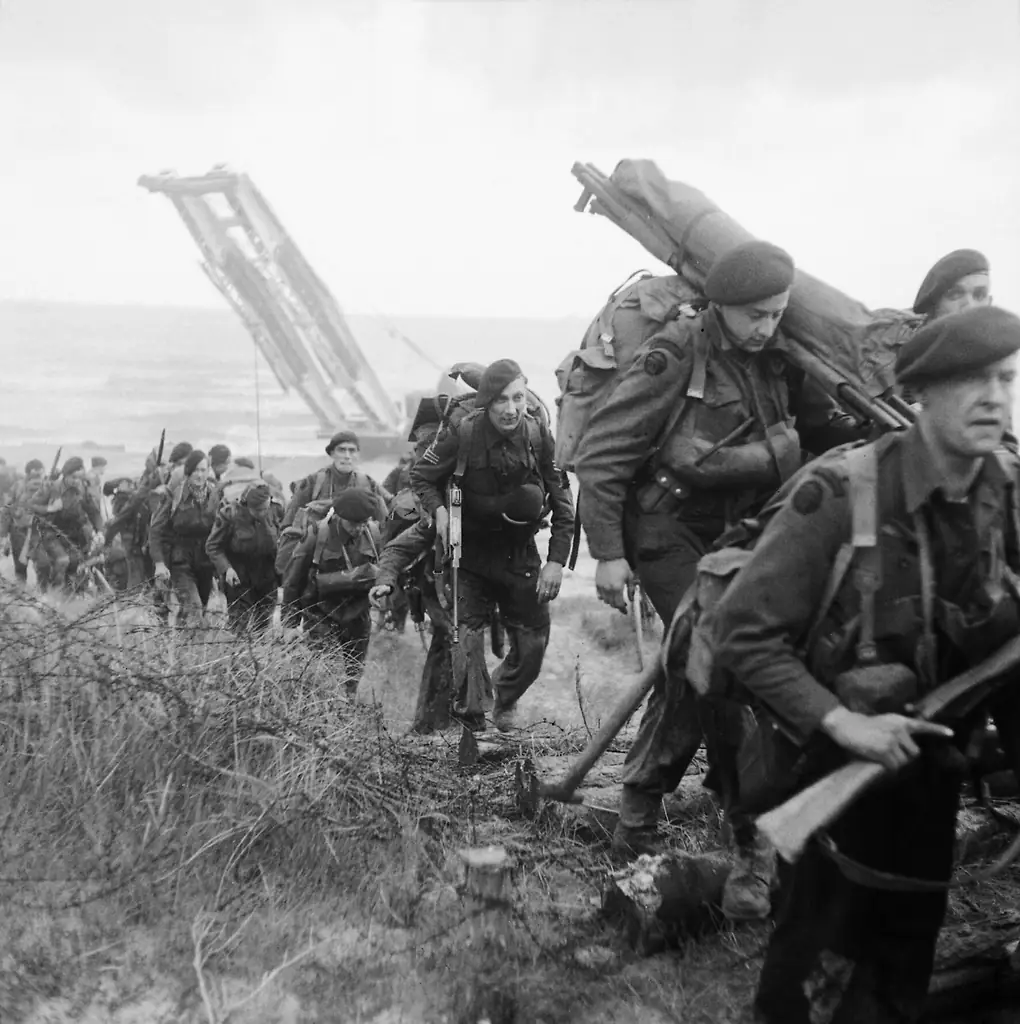
Almost 80 years after meeting in France, a Second World War veteran has reunited with a woman who he met just weeks after D-Day. He has kept a photograph of her in his wallet ever since their meeting.
After the horrors that were seen on the beaches of Normandy on June 6, 1944, a moment of calm was shared between a British soldier and a young French teenager as they shared a sandwich, as reported by BBC News.
Reg Pye, 99, never forgot his chance encounter with 14-year-old Huguette - now 92 - in the midst of war, even if their interaction lasted only seconds.
Now - 78 years later - the pair have reunited in Huguette's care home in northern France. Upon first seeing each other after all these years, Reg jokingly said "Here's a jam sandwich," referring to their meeting in 1944.
The picture Reg has kept hold of for 78 years:
"Nice to see you again after such a long time, we got older but we're still the same," Huguette said to the former soldier.
Reg - from West Wales - was in the 224 Field Company, Royal Engineers during the war. He landed on Sword Beach where the allies were invading mainland Europe in an attempt to regain control from the German enemy.
Speaking to the BBC, Reg recounted how he first met Huguette whilst taking a break. "A van pulled up driven by a chap called Geordie and he offered us a can of pilchards," he explained.
"There was also a slice of bread. He put margarine on with a paintbrush and we also had a dollop of red jam. We walked back to where I had parked my van and I shared the pilchards between me and this other chap.
"Then I looked up and there was a girl standing in front of me. I didn't see her coming. She had a, I shouldn't say it, but a shabby white dress on. She didn't want pilchards."
He went on: "She was staring at me and I thought what is she staring at? I looked down and it was the bread. So I offered her the bread."
Though Reg can't recall whether Huguette took the bread, he recalls her "running across the village square and going into the church. I never saw her after that."
The following morning, he awoke to see his mess tin returned and within it, was a picture of the girl. "And that is the photograph I have kept in my wallet for all that time," he explained.
With the help of Taxi Charity for Military Veterans, Reg was able to track down Huguette, who was "extremely touched" that he had done so.
British troops arrive at Sword Beach, 1944. Credit: CBW / Alamy
Surrounded by family, the pair shared a glass of champagne. Reg was thankful that Huguette was "still alive". He said: "In my own mind, I thought she's probably passed away by now because they'd had a hard time when they were young."
At the end of the meeting, Huguette joked that she would have to dump her current boyfriend and "marry" Reg.
It's all too easy to get wrapped up in the shocking numbers that come with any large scale war, and forget the stories of incredible individual sacrifice and bravery that should be told and retold, passed down the generations.
After all, it is ordinary people who become the victims of war, and ordinary people who have to fight, leave their families, and face untold horrors in times of war.
Now, an incredible story has come to light, after a 99-year-old grandmother finally received a handwritten love letter written by her fiancé, who went missing in the Second World War.
Remarkably, the note was salvaged from the bottom of the Atlantic Ocean. It is believed that a cargo ship that was carrying the note sunk in 1941, which has now been passed on to 99-year-old Phyllis Ponting.
The last exchange between the pair had been a message sent from Ponting to her fiancé, Bill Walker, accepting his marriage proposal. Until now, the 99-year-old had presumed that the fact that Walker had never responded meant that he had had a change of heart of the proposal.
Walker writes that he "wept with joy" when he received her acceptance letter, and expressed his wish that she could have been there when he opened it.
“If you could only know how happy it made me, darling”, he wrote.
Phyllis Ponting still doesn't know for sure if Bill Walker survived the War, but says she doesn't think he did, as he had her address;
"I don't think Bill can have survived the war, otherwise he would have been straight round to my address in Roseland Avenue"
[[imagecaption|| Credit: Getty]]
Ponting eventually married another man, with whom she had four children, but says her life could have been totally different if she'd received Walker's letter and been reunited with him;
"We would have been married. He loved me a lot."
The letter was discovered by marine archaeologists on the lookout for silver; instead, they found hundreds of personal letters, which will now be displayed in a museum exhibition.
Curator Shaun Kingsley said of the collection;
"It's the largest collection of letters since people started to write to survive any shipwreck, anywhere in the world.
"It shouldn't have been preserved, but because there was no light, there was no oxygen, it was darkness, it was like putting a collection of organics in a tin can, sealing it up and putting it in a fridge freezer.
"And in the conservation lab, slowly and suddenly words started to appear. Some 700 letters written from British India in 1940."
It's incredible to think that someone could be reunited with a letter sent 77 years ago that had been laying on the bottom of the ocean, but Phyllis Ponting now knows that her fiance never changed his mind, after all.
An Asian-American township trustee and US army veteran has unbuttoned his shirt during a Town Hall meeting to send an important message about racism in the US.
Trustee Lee Wong was speaking at a West Chester Township meeting in front of members of the community when he started to speak about his experiences since immigrating to America when he was 18-year-old.
During the comments section of the meeting, 69-year-old Wong spoke about a time when he was beaten up in Chicago due to his race. After taking his attackers to court, Wong revealed they received no punishment.
"For too long, we have, I have, put up with a lot of s*** in silence, excuse the language, too afraid to speak out, fearing more abuse and discrimination," Wong said during Tuesday's board meeting.
"Things are getting worse and worse," Wong said.
During his impassioned speech, Wong opened his shirt to show a series of scars across his chest.
As he took off his tie and unbuttoned his shirt, Wong said that will not tolerate racism anymore, telling those in attendance:
"People question my patriotism, that I don't look American enough.
"They could not get over this face. I want to show you something, because I'm not afraid. I don’t have to live in fear, intimidation, insults."
Wong - lifting his vest to show his scars - then told the community: "This is sustained from my service in the US military. Is this patriotic enough?
"I'm not ashamed to walk around anymore."
Per Cincinnati.com, Wong served 20 years in the military.
At the conclusion of his speech, Wong said: "We are all the same. We are all equal." He then walked away from the dais with his jacket in his hand.
The veteran's words come after eight people - six of whom were Asian - were killed in an attack on spas in Atlanta.
NBC News reports that the number of recorded hate crimes against Asian-American people in the United States has increased sharply over the last year.
According to a report from the organization Stop AAPI Hate, approximately anti-Asian 3,800 incidents were reported in the US between February 2020 and March 2021 - around 1,200 more hate incidents than the previous year.
Commenting on the data, a professor of Asian American studies at San Francisco State University Russell Yeung told NBC: "There is an intersectional dynamic going on that others may perceive both Asians and women and Asian women as easier targets."
Now I don't know about you, but I have watched enough scary movies to know that history can inspire the most terrifying of stories. Whether we're talking about creepy serial killers of times past or a bloody battle waged in the medieval era, history is always a rich resource when it comes to horror.
Certainly, Hollywood has drawn much inspiration for their coterie of horror flicks from ancient times. The list is endless; most recently there has been Crimson Peak, but I'm sure that you're more acquainted with names like Dracula, Young Frankenstein and Black Death. Personally, however, I find such movies much more frightening than the gore-ridden slasher films that have become incredibly popular of late.
Imgur user CanadaSpeedoMan proved my point perfectly when he took to the platform to share what happened when he stumbled across a forgotten military site in Greenland...
"Just last week my wife and I had the opportunity to take part in a backcountry expedition to South East Greenland", the Imgur user wrote.
"After days and miles and miles of trekking through the fjords, we arrived at the site of 'Bluie East Two'. It was EXTREMELY remote and pretty eerie to find that far away from civilization."
What the man had stumbled on was a minor United States Army Air Force airfield. Located in Ikateq, East Greenland, it was operational from 1942 to 1947.
As he then explains, "the site was used to refuel planes travelling from the USA to Europe during the war".
"The site could only be accessed by boat during several months of the year. Otherwise, it was completely inaccessible because of the sea ice Thousands upon thousands of barrels for fuel were left. Some still with fuel insideWhen they abandoned the air strip, it appears everything was left as is."
The user also shared a picture of an abandoned hangar.
"The local Inuit people salvaged much of the usable material that could be transported by foot or with their small fishing boats," he added.
The user posted a picture of his wife crossing an old bridge, saying: "ALL the wood had to be brought in by boat. There are no trees in South East Greenland. Any driftwood found comes from Siberia".
And he sourced some pictures of what the airfield looked like back when it was in use - as you can see everything was a lot tidier:
"I could have spent a week here and not have had the chance to see everything. Hope you enjoyed!" The Imgur user wrote before providing interested readers with some more background information on the historic site.
Well, how creepy was all of that? While I'm not going to be flying out to Greenland just to spend some time in an abandoned airfield, if you are keen to visit the site, you better go soon, because as the user explains, it will be undergoing a clean-up process, which is due to start in 2018.
Last Sunday marked the 100th anniversary of the end of the First World War and saw people across the world gather to honour the millions of soliders who gave their lives.
However, one moving tribute on social media in particular brought home the great sacrifice that military servicemen and women regularly make in the line of duty.
A photo uploaded to Facebook by an unknown soldier shows eight pints of beer sitting on a pub table: one drink for each of his fallen comrades who died on the battlefield in Afghanistan.
In addition, a picture of each soldier sits beneath each pint, with a Royal British Legion poppy on top of the glass.
According to reports, the image was first uploaded to Facebook by an unidentified serviceman, who bought the drinks in a pub on Armistice Day. It remains unknown where and when the picture was originally taken.
It moved one soldier so much that he shared it on Twitter, with his post quickly going viral and serving as a poignant reminder of the sacrifice made by millions in World War I andAfghanistan, as well as the many other conflicts over the years.
[[imagecaption|| Credit: Getty]]
Soon enough, hundreds of people from across the globe had taken to the comment section to express how much the image had moved them, with one social media user claiming it was the most powerful image they had seen all week.
"Probably the most powerful image I've seen all week. Something we can all relate to as well in some way," Twitter user @DaveClarkDesign wrote. "We can't all imagine life in the forces and the true horror of war. BUT losing 8 very special people to anything, sometimes needlessly, is heart breaking. Lovely gesture (sic)".
Fellow Twitter user @sjwright agreed, writing: "It’s hard to live a life without the pain of conflict and those that helped you survive it around you any longer. It’s the story behind every photo every pint that makes this person continue there life and honour those left behind."
Another person online mourned the young men who had fallen in the war, with @OBrien1968 saying: "You can just picture the young men sitting around the table chatting and laughing , except they are not. They’re dead and gone."
A total of 456 British men and women died in Afghanistan after the operation to stop the Taliban began in the autumn of 2001.
The First World War was one of the deadliest conflicts in human history, with an estimated 17 million people losing their lives. Of these soldiers, more than 700,000 are said to be British.
Remembrance Day, or Veterans Day in the United States, is a day to remember and honour those who sacrificed themselves to secure and protect our freedom.
It falls on 11 November every year, with a two-minute silence held at 11am to represent that hostilities formally ended "at the 11th hour of the 11th day of the 11th month".