


Celebrity4 min(s) read
Michael Jackson fans horrified after photos of the singer lying dead are discovered on popular image sale site

Michael Jackson fans around the world have voiced shock and anger after discovering that graphic photos showing the late pop star's dead body are currently being licensed on Getty, a major commercial photography platform.
The photos, which depict Jackson lying dead on a hospital gurney, were originally displayed as evidence by prosecutors during the criminal proceedings against his former personal physician, Dr. Conrad Murray.
The controversy erupted after an Instagram account, @MJJVaults, posted a lengthy statement to its stories, sharing its horror after photos shown during Dr. Murray's involuntary manslaughter trial at the Los Angeles Superior Court on October 5, 2011.
MJJ Vaults is a fan-run digital project dedicated to preserving, archiving, and sharing rare archival content, history, and media related to Michael Jackson.
Fans quickly rallied behind the account, expressing disgust that an agency would monetize such sensitive court exhibits alongside standard promotional and concert photography.
Many pointed out that users searching for everyday archival pictures of the entertainer are unexpectedly confronted with photographs taken shortly after his death.
Fan page condemns commercial sale of autopsy trial images
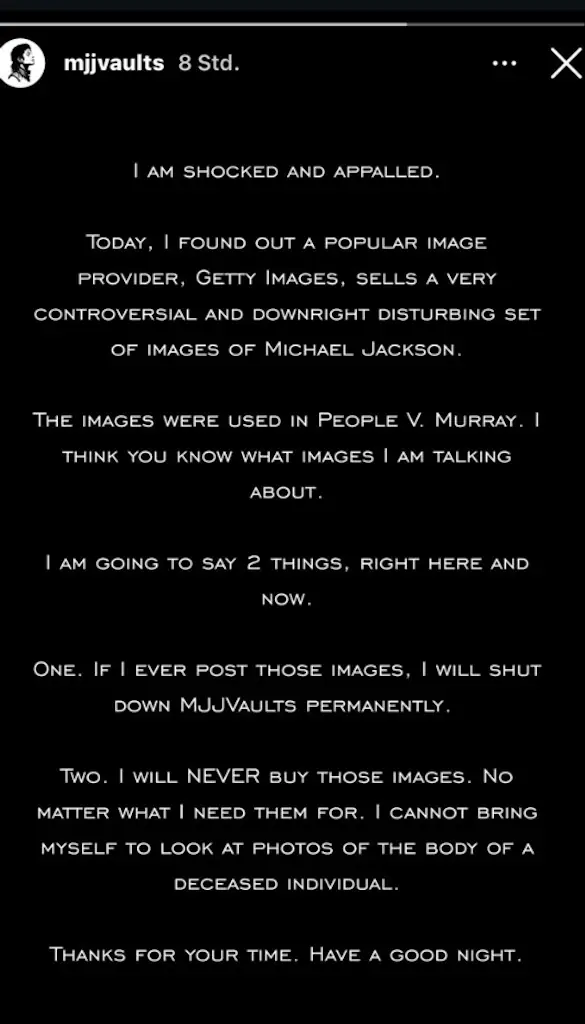
In a lengthy Instagram Story, the creator behind MJJ Vaults detailed the discovery and established a strict personal policy regarding the content. The administrator wrote:
“I am shocked and appalled. Today, I found out a popular image provider, Getty Images, sells a very controversial and downright disturbing set of images of Michael Jackson.
“The images were used in People V. Murray. I think you know what images I am talking about. I am going to say 2 things, right here and now.
“One. If I ever post those images, I will shut down MJJVaults permanently.
“Two. I will NEVER buy those images. No matter what I need them for. I cannot bring myself to look at photos of the body of a deceased individual.”
Supporters quickly echoed these thoughts across social platforms, with many expressing distress at how accessible the courtroom evidence remains to ordinary web users.
Responding to the post, a fan wrote: “The fact that these photos have always been everywhere have broke my soul. when michael passed away, if you typed his name on google it was one of the first pictures that would appear. i was a kid when a saw it. this should never had happen. but they never respected him.”
Another wrote: “How screwed up does the world have to be for people to even decide to sell something like this?People are worst than animals.”
A third penned: “I was scrolling through pictures of mike on getty images a couple months ago and I literally got jump scared by the pics of his body they already have on there. i don’t think i’ve ever felt so uncomfortable. i couldn’t believe they were just in there with normal pics of him.”
Background of the 2011 courtroom evidence
On June 25, 2009, Jackson died of acute Propofol intoxication, which caused him to go into cardiac arrest. His death was the result of a fatal dose of the anesthetic, which Murray claimed he administered at the singer's request to help him sleep.
Jackson's death was ruled a homicide, and the Las Vegas cardiologist was later charged with involuntary manslaughter. Murray pleaded not guilty, with his defense attorneys arguing that the late singer injected the Propofol himself when his doctor's back was turned.
The prosecution said Murray "repeatedly acted with gross negligence" by administering the drug without the right monitoring equipment and waiting over an hour to call 911. In November 2011, he was found guilty of involuntary manslaughter.
The image shown to jurors during opening arguments and witness testimony in October 2011 became a permanent part of the public court record.
VT has contacted Getty for comment.