Uncategorised3 min(s) read
weird3 min(s) read
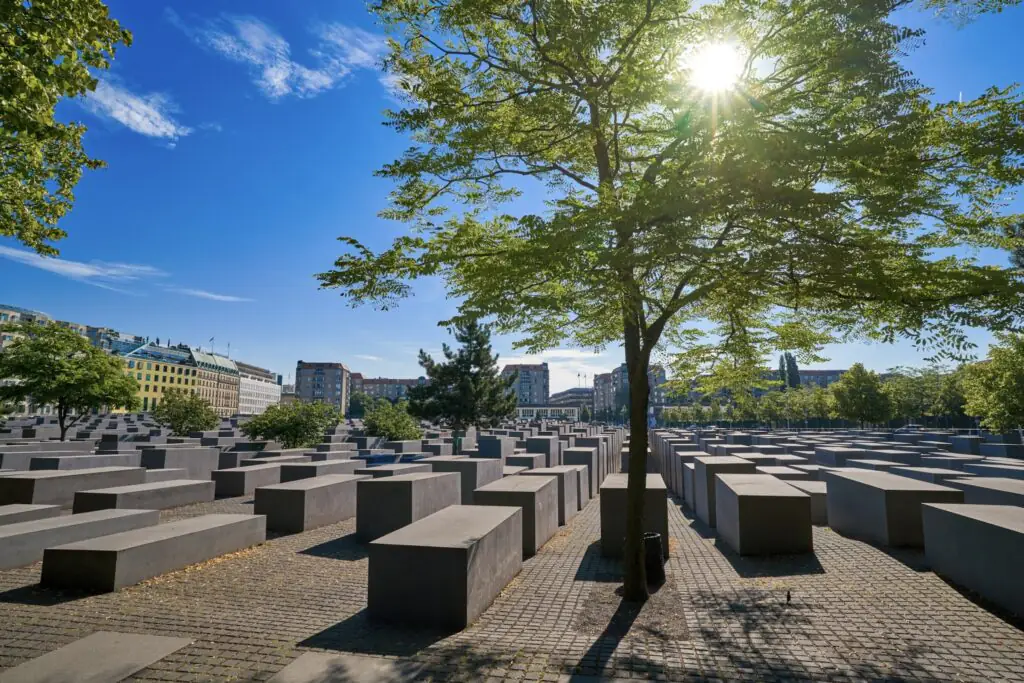
An influencer has been widely condemned on social media after she was filmed posing while sitting on the Holocaust Memorial in Berlin, Germany.
TikTok account that goes by the handle @influencersinthewild shared the video of a woman, sitting on one of the concrete slabs of the memorial, wearing a black sports bra and leggings. She appeared to be getting ready to pose for the photographer that was with her.
The photographer then gave her instructions, and the woman leaned back, moving her hair to avoid it being messed up by the wind.
Unbeknownst to them, they were being filmed and a woman can be heard talking about the pair, saying: "I'm horrified beyond words".
The footage has garnered millions of views on the social media platform, with many labeling the influencer as "insensitive".
At the time of writing, over 1.7 million people have liked the post, and it has received more than 30.5K comments.
One outraged critic wrote: "Notice how everyone is staring at her bc it is so disrespectful [sic]," while another added: "the people saying 'the artist said it's ok to take photos' are completely missing the point of why this is disrespectful."
A third added: "'I'm horrified beyond words. That sums it up."
The latter comment refers to a statement made by the architect, Peter Eisenman, back in 2017, in response to a surge in people taking selfies at sites such as the Holocaust memorial.
"To be honest with you I thought it was terrible," he said, per the BBC. "People have been jumping around on those pillars forever. They've been sunbathing, they've been having lunch there and I think that's fine.
"It's like a catholic church, it's a meeting place, children run around, they sell trinkets. A memorial is an everyday occurrence, it is not sacred ground."
The Holocaust Memorial, which is also known as The Memorial to the Murdered Jews of Europe, was designed by Eisenman and engineer Buro Happold.
It opened in Berlin in 2005 in order to honor the memory of Jewish victims of the Holocaust during World War II, and its design includes 2,711 concrete slabs of different sizes, spanning 19,000 square meters.
world1 min(s) read
Amazon has pulled a range of "sick" Christmas ornaments, which depicted images of a Nazi concentration camp, from its website, the BBC reports.
The Holocaust-themed items, which included tree decorations, a bottle opener and a mouse pad, displayed photos taken from Auschwitz in occupied-Poland during World War Two.
Some of the images were buildings in which mostly Jewish victims of Hitler's regime were held hostage, including barbed wire fences and the railway line leading to the camps.
Amazon took action after the official Twitter account for Poland's Auschwitz Memorial questioned whether the range of items for sale was "appropriate".
Cousins who both thought the other was killed by the Nazis reunite after 75 years:
[[jwplayerwidget||https://content.jwplatform.com/videos/kf1myMjc-sKUnNGKf.mp4||kf1myMjc]]
"Selling "Christmas ornaments" with images of Auschwitz does not seem appropriate. Auschwitz on a bottle opener is rather disturbing and disrespectful. We ask [Amazon] to remove the items of those suppliers," Poland's Auschwitz Memorial tweeted.
[[twitterwidget||https://twitter.com/AuschwitzMuseum/status/1201069830553649153]]
Naturally, the tweet spawned thousands of comments criticising the e-commerce giant.
"That's so sick, glad it was removed Those sellers should work in the Auschwitz museum gratis for a while and see what they were really dealing with," one person wrote.
"Why would you want this on your Christmas tree? Why would you even think this is a good idea at all??? This is so ???????" wrote another.
"What is wrong with people? Who would buy that let alone make it?" a third wrote.
Poland's Auschwitz Memorial later posted an update informing people that the items had been removed by Amazon and thanked everyone for their support.
[[twitterwidget||https://twitter.com/AuschwitzMuseum/status/1201207817086099457]]
However, they then found a mouse-pad from another seller, depicting the freight train used to transport people to the concentration camps, for sale on Amazon.
[[twitterwidget||https://twitter.com/AuschwitzMuseum/status/1201231169767006210]]
Amazon has since confirmed that the "products in question have been removed".
"All sellers must follow our selling guidelines and those who do not will be subject to action, including potential removal of their account," the company added.
weird1 min(s) read
During WWII, approximately six million European Jews lost their lives in the Holocaust. Of those that perished, about 1/6th of them were murdered at Auschwitz, one of the most notorious death camps run by the Nazis. Despite this truly horrific and tragic history, Auschwitz - and, indeed, the Holocaust as a whole - is still seen by some as a subject to be joked about or trivialised.
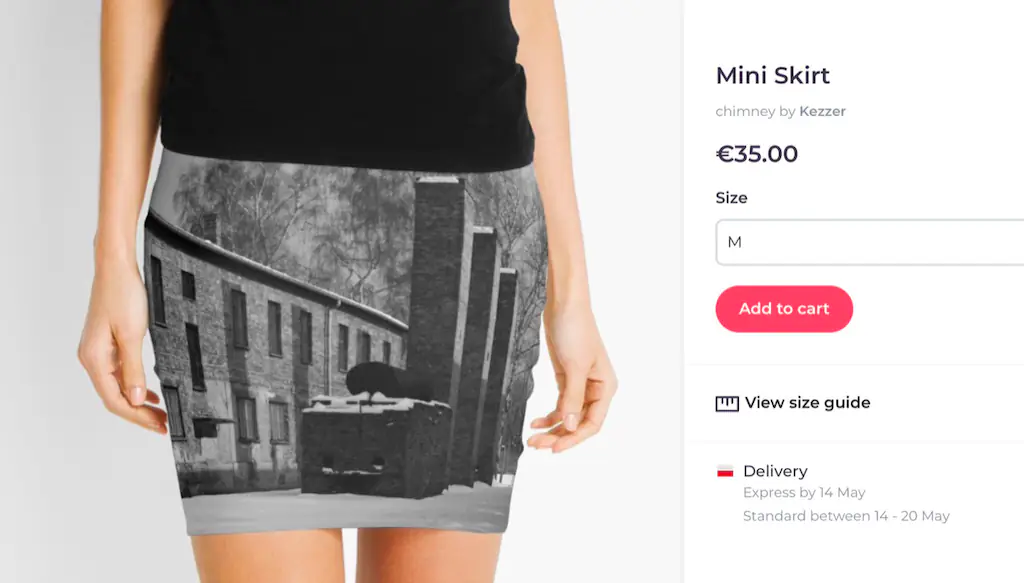
This week, it emerged that Redbubble.com, an e-commerce site often used by independent designers and artists to sell their work, had been selling pillows, mini skirts and tote bags with images of the death camp printed on them.
Auschwitz, which is now a memorial site, reached out to Redbubble on Twitter to challenge them on the matter.
"Do you really think that selling such products as pillows, mini skirts or tote bags with the images of Auschwitz — a place of enormous human tragedy where over 1.1 million people were murdered - is acceptable?" they asked. "This is rather disturbing and disrespectful."
[[twitterwidget||https://twitter.com/AuschwitzMuseum/status/1125814359391920129]]
Redbubble responded to apologise for the offensive items, and assured the memorial that they would be removing them from their site.
"Thank you for bringing this to our attention," they said. "The nature of this content is not acceptable and is not in line with our Community Guidelines. We are taking immediate action to remove these and similar works available on these product types."
However, this prompted the Auschwitz memorial to point out more antisemitic and insensitive items on the popular clothing store.
[[twitterwidget||https://twitter.com/AuschwitzMuseum/status/1126005341278429184]]
Once again, Redbubble said they were very sorry that this sort of material made it onto their site, and claimed that they were still working on removing it.
"Thanks again for reaching out to us, it is greatly appreciated, this work has now been removed," Redbubble stated. "We are currently still in the process of reviewing works of this nature but are working towards removal of all unacceptable works as soon as possible."
This is not the first time that the Auschwitz memorial has involved itself in issues online, either. In March of this year, they took to social media in order to highlight the problems with tourists posing for photos on the train tracks that brought millions of people into the camp and, ultimately, to their death.
[[twitterwidget||https://twitter.com/AuschwitzMuseum/status/1108337507660451841]]
"When you come to Auschwitz Museum, remember you are at the site where over 1 million people were killed. Respect their memory," they said. "There are better places to learn how to walk on a balance beam than the site which symbolizes deportation of hundreds of thousands to their deaths."
As the recent Redbubble incident shows, however, their pleas for respect fell on deaf ears. Perhaps now, after a more direct callout, Redbubble and other similar sites will be more vigilant in policing the sort of work that is hosted on their platforms.
uncategorised7 min(s) read
How did denial of the Holocaust start?
Rebuttal of the Holocaust finds its roots in the Nazi Party. Hitler, entrenched in the knowledge that his operation would warrant an unfavourable reaction, is said to have covered up the killings, ordering that the extermination not be spoken of in German documentation or public statements. Instead, heavily euphemistic language was used when speaking of the hushed operation, as well the careful cremation of victims’ bodies. For those who wonder why people choose to deny the Holocaust, it’s hard to say whether they're adamant Nazi supporters, brainwashed, or if they can honestly look themselves in the eye in the morning and assert that it never happened. Most historians determine that post-war Holocaust denial goes back to Paul Rassinier, a European writer who came to the defence of the Nazi regime after the war, asserting that the gas chambers were nothing but an invention of a "Zionist establishment." Astonishingly, Rassinier himself had been a victim of the Hitler’s regime, arrested by the Gestapo in 1943 for smuggling Jewish refugees over the Franco-Swiss border. Having never seen the gas chambers, he used his credibility as a survivor to disparage reports of the chambers, describing concentration camp literature as “a collection of contradictory pieces of ill natured gossip”. After the first specks of Holocaust denial became visible, it was inevitable that more would follow. The following years saw the uprising of widespread Holocaust denial with people like Heinz Roth, David Irving and Ahmad Hussein arguing against the mass murder of roughly six million people. But the question we have to ask is, how? How can anyone possibly deny the unshakeable evidence that narrates the worst homicide in history?Different groups of deniers
There are countless forms of Holocaust denial, but most variations tend to be based on four principles; that the number killed by the Nazis amounts to a few hundred thousand rather than six million, that the gas chambers were not used to kill and that Hitler merely intended to deport Jews to Eastern Europe and that the event was a myth invented by Allied propaganda during the war and has been sustained since by Jews who use it for political and financial gain. The most important thing to remember about these people is that, true to their name, they are in denial. Although they prefer to call themselves "revisionists", it's crucial to distinguish them from historians who challenge the past with a methodologist approach. Rather than looking at the facts in front of them and connecting them to reality, Holocaust deniers ask questions like “is there a written order from Hitler telling his people to exterminate?” and “why didn’t the Jews fight back?” They demand autopsy reports concluding that Jewish prisoners died from gassing and sneer at the many thousands of testimonies from prisoners, guards and allied soldiers, not to mention the secret wiretaps made of German prisoners of war where they freely discussed the extermination policy. Over the years it became clear that they could be categorised into three camps. The first group strongly believe that the “Final Solution” was faked by both the Allies and the Jews in order to gain sympathy; calling death camp witnesses “insane” or “liars,” they claim that the Nuremberg testimonies were extracted under torture and are therefore unreliable. The second sub-category group simply claims that the Holocaust was not genocide, but merely a forced labour program with the ultimate aim of excluding all Jews from Germany. Finally, the third group of Holocaust denial asserts that any evidence found is weak and death counts are “over-exaggerated”. A novice sceptic may be deceived by the attention to detail in any of the groups’ claims, but look closely and you’ll see that they simply aren’t true. Holocaust deniers often base their theories on so-called “scientific evidence”. In an effort to disprove the use of gas chambers, they cite the lack of Prussian Blue on the gas chamber walls and insist the chambers were used for nothing but delousing. They ignore the solid scientific fact that it takes a much lower concentration of HCN to kill a warm-blooded creature over a cold-blooded insect. The object that Zyklon B couldn’t have been used for killing in the gas chambers because it is explosive and was near to furnaces. They turn a blind eye to the fact that the concentration of HCN necessary to cause death is nearly 200 times lower than necessary to cause an explosion. They affirm that the Nazis couldn’t have possibly gotten rid of the ashes of the dead, estimated at one shoebox per person. They pay no attention to testimonies from concentration camp staff stating that remnants of human bodies were used as fertiliser and thrown into nearby rivers and swaps, as well as the belongings that have undergone forensic examination. They use the killing of six million people as a weapon against Israel, stating the Jews used the “hoax” to bring about the country. They forget the fact that Israel was not a direct result of the Holocaust and most of the institutions of a Jewish state were in place when Hitler rose to power. They ask why the eyewitnesses to the gas chambers not killed. They disregard the fact that there are few of these survivors and that they are merely lucky, having escaped through the rebellion of October 1944 or at the very end when the camps were liberated. They question the reliability of Anne Frank’s annex diary, among other war texts, claiming that the text written by the 13-year-old year is simply a forgery, forcing the Anne Frank Museum to investigate the authenticity. They turn a blind eye to the forensic document analysis and handwriting comparison that took place, bringing researchers to the conclusion that the young girl did in fact write the diary.Why is Holocaust denial relevant today?
So, if Holocaust denial is nothing but false claims, made by a deluded group of individuals, why are we still giving them the time of day? The awful truth is that Holocaust denial is alive and well right at this very moment. As hard as it is to believe, as we speak there is a whole new generation of Holocaust sceptics being inspired. Recently, David Irving, who has dismissed Auschwitz as “Disneyland”, stated that he regularly gets messages from people as young as 14 who have watched his Youtube videos. His claims highlight the fact that the rise of the internet has allowed these claims to resurface and thrive. The dangers of the online world were called to public attention again in 2016 when it was revealed that the top ranking Google search site for “did the Holocaust happen?” was Stormfront, a white supremacist Neo-Nazi site. In addition, many have speculated over the Trump administration’s flirtations with Holocaust denial, with deputy assistant secretary Teresa Manning praising an ally of the group. Not to mention, amid the recent Charlottesville rallies, it came to light that nearly 10 per cent of Americans believe it’s fine to be a Neo-Nazi. The truth is that, more than 70 years later, Holocaust denial is damningly relevant to our society and it is something that is not going away anytime soon. But by allowing people to even entertain the notion, we disparage the innocent people who suffered; Holocaust denial is an insult to all sufferers and their surviving relatives, and by letting it continue, we risk the resurgence of Nazi ideology. The Nazis are the very people who wanted us to believe the mass murder never happened and by accepting those who do so, we lose our compass that directs us to a better future. No matter what warped way they deny the events of the 1940s, the fact of the matter is that the Holocaust happened. However, those who cannot learn from history are doomed to repeat it and we're overdue in reasserting the truth in a world full of lies. Featured illustration by Egarcigunews2 min(s) read
While it seems like a pretty ridiculous thing to say, there's something about color photos that create a more vivid picture of reality than their black and white counterparts.
It should come as no surprise, then, that the colored portrait of a 14-year-old girl murdered in Auschwitz has gone viral. The images were uploaded to Twitter and lay bare the heartbreaking reality of the Holocaust.
[[twitterwidget||https://twitter.com/AuschwitzMuseum/status/973123153940635648]]
The photos were re-touched by artist Marina Amaral, who has managed to breathe life into a black and white image from one of the most disturbing and inhumane periods of modern history.
It took Amaral months of work on photoshop as well as extensive research, but the finished result manages to bring life and personality to the innocent young victim of the Nazi regime.
Czestawa Kowka was deported by the Nazis from Poland as part of their plan to create a "living space" in the east. She arrived at Auschwitz alongside her mother on December 13, 1942, on a train with 318 other innocent women. She was given the number 26947 and died in the camp just 67 days later on February 18, 1943. Czestawa was murdered with a phenol injection to the heart - a common method of execution for Polish children who were not deemed racially suitable to be "Germanised."
[[twitterwidget||https://twitter.com/AuschwitzMuseum/status/973123156822065154]]
The girl seems to have suffered multiple wounds to her face, especially on her lip; and according to Wilhelm Brasse, a survivor of the holocaust and the man behind the registration picture, the girl was beaten by one of the guards.She was one of approximately 230,000 children and 1,300,000 people who were deported to Auschwitz between 1940 and 1945.
According to Marina, as she began to transform Czestawa's photo into color, she realized that she was wearing a red triangle with a black "P" in the center. This means that the young girl had been taken in as a political prisoner.
"When we see the photos in black and white, we get the feeling that those events happened only in the history books," she said.
"According to the photographer’s account, Czeslawa had just been beaten by a guard before the photo was taken.
"By restoring the colors on her face, I was able to show the colors of the blood and the bruises, which made everything even more real."
Marina says that the color makes it easier for people to relate to those in the photos.
"These people were human beings who had dreams, ambitions, fears, friends, family, and had all this taken from them," she added.
"Unfortunately, Czeslawa was just one among millions of others, but the expression on her face – so much fear, and at the same time so much courage, will stay with me forever."
The images of Czeslawa are horrifying both in color and in black and white. But, as Marina says, the addition of color simply makes everything more real.