ADVERT
Health3 min(s) read
Published 16:22 27 May 2025 GMT
A terrifying simulation has given viewers a front-seat experience of what it would be like to ride the infamous euthanasia rollercoaster that "kills everyone".
First introduced in 2010 by Lithuanian designer and artist Julijonas Urbonas, the rollercoaster has been described as a "hypothetic death machine in the form of a roller coaster, engineered to humanely, with elegance and euphoria, take the life of a human being".
While it has never been built, a TikTok simulation now offers a terrifyingly realistic look at how such a ride, which reportedly holds 24 passengers, might play out.
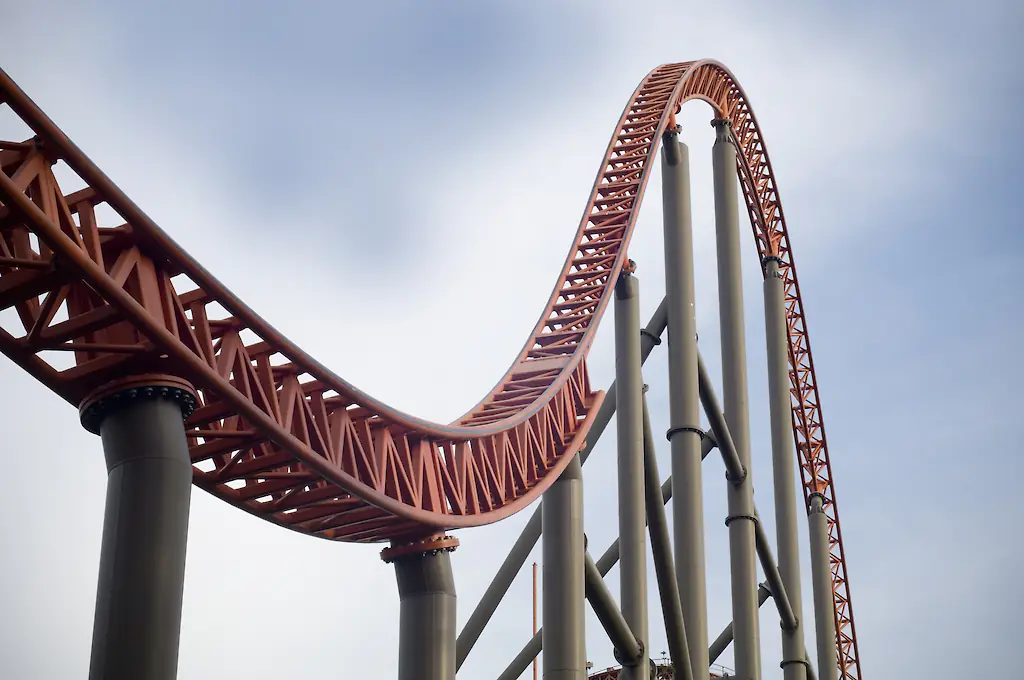
A simulation shows what it would be like to ride the euthanasia rollercoaster. Credit: Claudiad / Getty
Shared by user @ridesnslides, the video simulates the ride’s mechanics and visual experience.
The video begins with a slow ascent to a towering 510 feet, just shy of the tallest building in America.
Once at the peak, riders are given a final choice: descend safely or continue. If they choose the latter, each must manually press a button to initiate the ride.
Watch the simulation below:
The inversions are engineered with progressively smaller diameters to maintain a constant force of 10Gs - far beyond what most human bodies can withstand.
For comparison, Formula 1 drivers experience just over 6Gs during sharp turns, and Apollo 16 astronauts encountered 7.19Gs during re-entry.
“You would gradually begin experiencing worsening cases of cerebral hypoxia, meaning your blood would rush to the lower parts of your body, and so your brain wouldn’t be getting enough oxygen to survive,” the user said, cited by Vice.
“The first thing that you would notice is your vision greying out, which would then gradually turn to tunnel vision. From there, you would begin experiencing a blackout, and ultimately, you would eventually lose consciousness and die," they added.
Originally designed as a theoretical project while Urbonas was a PhD candidate at the Royal College of Art in London, a scale model of the rollercoaster was unveiled in 2011 at Dublin’s Science Gallery as part of the HUMAN+ exhibit.
The project went on to win the Public Prize of New Technological Art at Update 2013 and has since become a “unique media phenomenon".
The idea of using engineered devices to aid in euthanasia has gained wider attention in recent years. Another controversial concept is the “Sarco machine,” developed by Dr. Philip Nitschke, founder of the euthanasia advocacy group Exit International.
In an interview with SWI swissinfo.ch given in 2021, Nitschke explained: “It’s a 3-D printed capsule, activated from the inside by the person intending to die," cited by Right to Life.
“The machine can be towed anywhere for the death. The person will get into the capsule and lie down… They will be asked a number of questions, and when they have answered, they may press the button inside the capsule, activating the mechanism in their own time," he said.
“The person will get into the capsule and lie down… They will be asked a number of questions, and when they have answered, they may press the button inside the capsule, activating the mechanism in their own time," he continued.
Describing the actual manner of death, Nitschke said: “The capsule is sitting on a piece of equipment that will flood the interior with nitrogen, rapidly reducing the oxygen level to 1 per cent from 21 per cent in about 30 seconds.
"The person will feel a little disoriented and may feel slightly euphoric before they lose consciousness. Death takes place through hypoxia and hypocapnia, oxygen and carbon dioxide deprivation, respectively”.
relationships2 min(s) read
health2 min(s) read
Published 13:53 15 Oct 2024 GMT
travel2 min(s) read
us3 min(s) read
world4 min(s) read
Published 20:09 24 Nov 2024 GMT
A bone-chilling simulation illustrates what it's like to ride the euthanasia rollercoaster.
The controversial concept of the "euthanasia rollercoaster" was first proposed in 2010 by Lithuanian artist Julijonas Urbonas.
According to The Mirror, Urbonas created a scale model of the frightening idea as a PhD candidate at the Royal College of Art in London.
It was unveiled in 2011 as part of the HUMAN+ display in Dublin where it became the flagship exhibition at the Science Gallery.
TikToker Luke Davidson explained that the ride holds 24 passengers. "Once they're all on board there's a slow ascent to the top, which is 510ft in the air - that's just a little bit smaller than the tallest building in America," he continued.
"Once they're at the top it gives everyone the decision to stop and go back down safely. After that, everyone has to manually press a button to start the ride," he added.
While the "euthanasia rollercoaster" doesn't exist in reality, a terrifying simulation of this ride has been shared online, allowing viewers to experience it virtually.
The clip, shared by user @ridesnslides on TikTok, shows what a long-hypothesized and literal death contraption would look like.
Watch the clip below:
The ride begins with a 1,640-foot drop, reaching speeds exceeding 220 mph. This is followed by seven increasingly smaller inversion loops, designed to maintain a constant 10G force, ultimately leading to the rider's demise.
“You would gradually begin experiencing worsening cases of cerebral hypoxia, meaning your blood would rush to the lower parts of your body, and so your brain wouldn’t be getting enough oxygen to survive,” the user said, cited by Vice.
“The first thing that you would notice is your vision greying out which would then gradually turn to tunnel vision. From there, you would begin experiencing a blackout and ultimately you would eventually lose consciousness and die," they added.
Many users have shared their reactions to the scary simulation. One person remarked that they would've "died before falling" due to how frightening it is to reach the top of the rollercoaster.
Another questioned: "What if you didn’t [die] do you get a second go around ?" and the third said: "Screw that".
The designer's official website describes the coaster as "a hypothetic death machine in the form of a roller coaster, engineered to humanely - with elegance and euphoria - take the life of a human being".
Published 17:18 02 Mar 2026 GMT
Cruises have become an increasingly popular vacation choice for many travelers. With the promise of luxurious amenities, exotic destinations, and endless entertainment, cruise ships have become a floating paradise for vacationers.
However, as with any large-scale form of transportation, cruising carries certain risks that passengers often overlook. One of the most unsettling scenarios is falling overboard.
A chilling simulation posted on Instagram demonstrates the terrifying reality of what happens if someone falls from a cruise ship and no one sees it.
The simulation vividly portrays the harrowing experience of falling into the open ocean. In the video, the narrator explains in detail what would occur in such a situation.
"What happens if you fall from a cruise ship and no one sees you? First, you hit the water at 30 miles per hour. It feels like concrete."
The moment the body crashes into the water, the force is immense, and the shock of impact can leave a person momentarily disoriented.
The video continues, "You gasp, breaking the surface, but the panic hits immediately. You have no life jacket."
Once in the water, the danger escalates. "You scream, but the deafening roar of the propellers drowns you out. Within 10 minutes, the glowing ship is just a speck of light on the horizon. Then, it's gone."
The person is left alone, with no chance of immediate rescue. "You are alone in the pitch black." It becomes clear how quickly one can be separated from any hope of immediate safety.
The chilling reality becomes even more daunting. The simulation illustrates the extreme physical dangers of being stranded in the cold ocean waters.
"The freezing water instantly saps your body heat. By hour one, exhaustion and terror take over."
The fear of the unknown becomes as much of a threat as the physical cold itself.
The narrator explains, "You realize the water beneath you is two miles deep, and then you feel something brush against your leg."
This terrifying scenario brings to light the perilous conditions that many passengers may not consider when embarking on a cruise.
The video also highlights the harsh truth that this is not a rare occurrence. "In fact, over 30 people go overboard on cruise ships every single year, and most are never found."
This stark reminder reveals the risks of falling off a cruise ship and the challenges of survival when no one is around to help.
Published 09:51 01 Apr 2026 GMT
Newly released bodycam footage has revealed the heartbreaking moments after the tragic death of a 32-year-old wheelchair-bound man who died while riding the Stardust Racers at Universal Studios Florida’s Epic Universe.
On September 17, 2025, Kevin Rodriguez Zavala was enjoying the roller coaster ride with his girlfriend, Javiliz Cruz-Robles, when he suddenly lost consciousness.
"We went on the ride," Cruz-Robles told emergency responders in the footage.
"He was too low, he doesn’t have any support on his leg."
Even though he was strapped into his seat, Rodriguez was unable to remain secure during the ride’s first drop and was violently thrown around, repeatedly slamming his head against the restraints.
Zavala's distraught girlfriend, who fought desperately to keep him safe, tearfully recounted to police: "I tried - I saw him on the first drop. I saw him hit his head. I tried to hold him; I couldn’t hold him."
“Another one, he hit his head... He just went up and hit... It looked like [the restraint] was tight, but it wasn’t because he didn’t have support on his neck,” she added.
Witnesses at the scene described the aftermath as shocking. One person told police: "One of those ride carts – it’s just like, blood," per The New York Post.
Rodriguez had a spinal injury and used a wheelchair due to Spinal Cord Atrophy. He was rushed to a local hospital, where he was later pronounced dead from multiple blunt impact injuries.
The newly released footage includes testimony from Rodriguez's family and staff members.
Cruz-Robles explained that she tried to get help during the ride, but her calls went unheard as they were in the midst of the experience.
In addition, a doctor who was waiting to board the ride later shared that she had seen Rodriguez's bloodied, lifeless body slumped over, his arm dangling over the side of the cart.
Despite the tragic circumstances, the death was ruled accidental by the Orange County Sheriff’s Office (OCSO), which concluded that the ride operators had adhered to all safety procedures, and no negligence was found on their part.
The incident sparked an independent investigation by Rodriguez’s family, with renowned attorney Ben Crump involved.
In December, the lawyer revealed that the family "reached an amicable resolution" with Universal and "the terms are confidential," per a statement shared with the USA Today NETWORK Florida.
Published 16:19 23 Apr 2018 GMT
Should we have the right to die? It's a divisive question and one that regularly sparks furious debate among friends, family and strangers. In 2017, Gallup's annual Values and Beliefs poll asserted that 73 per cent of Americans supported euthanasia, the highest levels seen since 2005. Regardless, it appears that euthanasia is ultimately an issue that the country as a whole will never agree on.
With this in mind, the arrival of a controversial "suicide machine" is sure to spark debate about the rights and wrongs of assisted suicide. The machine in question is officially named as a "Sacrophagus" (or Sarco for short) and went on display at the Amsterdam funeral show in late April, drawing large crowds and causing concern among detractors of assisted suicide.
The inventor responsible is 70-year-old euthanasia activist Doctor Philip Nitschke, who has been dubbed "Doctor Death" for creating the 3D-printed device that fills with gas in order to end a person's life. Officially announced by Nitschke's Exit International foundation in February, the machine comes in two parts: a reusable machine base and a capsule that can be detached and used as a coffin.
The portable machine works by filling a capsule with nitrogen, which induces hypoxic death to the occupant, with its creator claiming that it provides people with a quick and painless death, saying: “The person who wants to die presses the button and the capsule is filled with nitrogen. He or she will feel a bit dizzy but will then rapidly lose consciousness and die... A Sarco death is painless. There’s no suffocation, choking sensation or air hunger as the user breathes easily in a low-oxygen environment. The sensation is one of well-being and intoxication."
Before being able to put it into service, the prospective user will reportedly be asked to pass an online test to show that they are in a sane state of mind and desire to die of their own volition. After this, they will allegedly receive a capsule access code that's valid for 24 hours. People who tested it at the Amsterdam funeral show were able to use VR glasses choose a view of the Alps or the sea as the last thing they see, before pressing the suicide button, which will turn everything black.
However, to make the device even more revolutionary for those wishing to end their life, the Sarco will also be able to be operated by the blink of an eye. When asked if his creation would cater for those who had conditions that made them unable to speak or move, such as British man Tony Nicklinson who suffered from locked-in syndrome, Nitschke stated: “While he may have needed some help to get into the machine, the actual action that initiated the flow of gas could be controlled by Tony."
[[heroimage||http://cdn.junglecreations.com/wp/junglecms/2018/04/philip-compressor.jpg||image]]
Predictably though, not everyone is thrilled at the arrival of the Sarco. The machine has been heavily criticised by euthanasia opponents who have likened it to the gas chambers used in the Holocaust, with Twitter user Devin Sena writing: "73 years after the Holocaust, people are now inviting others to *volunteer* to be gassed to death in the name of ‘freedom.’ We can’t let euthanasia touch America." In addition, user Mylo Hebron wrote: "There is something terribly wrong with us.. We are willing to spend so much money on a suicide machine rather than putting our money in the right places so we give people a reason to live.. Naahh, this is just wrong."
Dr Nitschke, who co-designed the device with Dutch designer Alexander Bannink, accepts that there is still opposition to his methods, saying: “Gas may never be an acceptable method for assisted suicide in Europe due to the negative connotations of the Holocaust. Some have even said that it’s just a glorified gas chamber.”
Asked further about the controversy surrounding euthanasia and legal hurdles, Nitschke said: "In many countries suicide is not against the law, only assisting a person to commit suicide is. This is a situation where one person chooses to press a button… rather than for instance standing in front of a train. I believe it’s a fundamental human right (to choose when to die). It’s not just some medical privilege for the very sick. If you’ve got the precious gift of life, you should be able to give that gift away at the time of your choosing."
Recognised for his dedicated work to legalise euthanasia, Nitschke was the first doctor in the world to administer a legal, voluntary, lethal injection. After a successful campaign to have a legal euthanasia law passed in Australia's Northern Territory, he successfully assisted four people in ending their lives before the law was overturned by the Government of Australia. In addition, he has developed machines in the past that could be used by individuals to inject themselves with lethal doses of barbiturates.
Despite the controversy, the arrival of the "suicide machine" still won't make a bit of difference when it comes to euthanasia laws across the world. Reportedly, the first fully-functional Sarco device is set to be built later this year in the Netherlands, before being shipped to Switzerland, one of the few countries where assisted suicide is legal. Meanwhile, the battle to legalise assisted suicide rages on.