ADVERT
Health4 min(s) read
A person who lives with dissociative identity disorder (DID) has opened up about being told they were "possessed" before getting their diagnosis.
Bo, who shares details of their experiences on social media, has been open about living with DID - a mental health condition where a person has multiple separate personalities that control their behavior at different times, per the Cleveland Clinic.
The identities are usually caused by living through trauma, meaning people "dissociate" and may experience several different personalities, known as "alters".
Bo opened up to the Tea At Four podcast about how they finally got their diagnosis and the effect it had on their life.
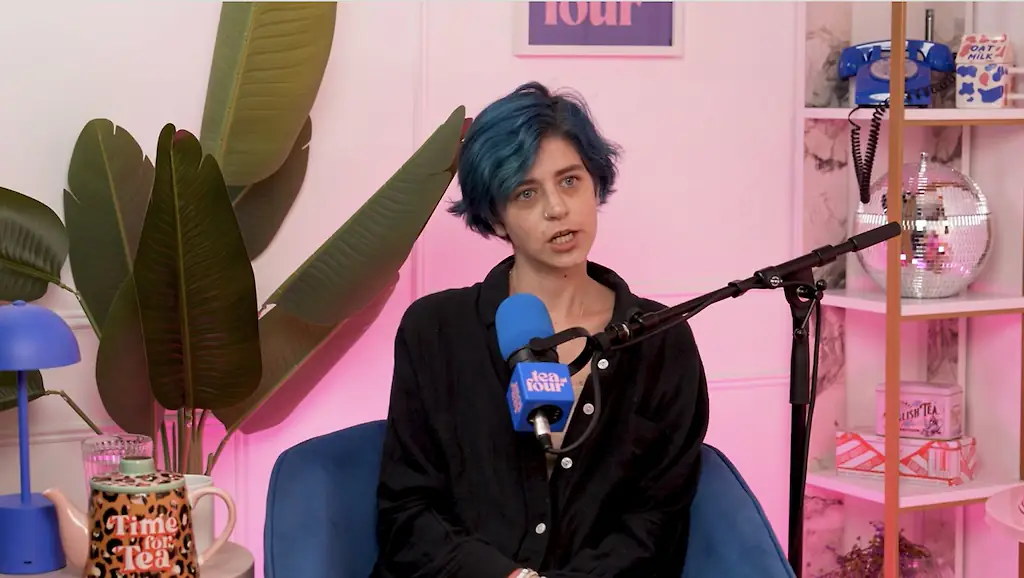
When asked if the diagnosis made it easier or harder, they admitted: "It was a bit of both. In terms of myself, it was a lot easier because it was like ‘I’m not crazy, I’m not possessed.’
"That was one of my biggest fears as well, because a lot of people tell me I’m possessed and that it’s demons."
They explained: "Everyone thinks it’s demons, everyone thinks I’m possessed, and they would tell me that when I was younger.
"These people would come out and they’d hurt them, and my friends would say it was a demon.
"Having a doctor come along and say ‘it’s not demons, you’re not possessed, you’re not crazy and you’re not making it up.’ Then, having this answer and this title, I was able to do research, I was able to find people that were like me. Seeing it in other people and seeing what happens during the blackouts made a lot more sense, it was a lot less confusing for me. Filming myself as well, that helped make it a lot less confusing."
While it was helpful for them to come to terms with their condition, Bo admitted that it wasn't so easy for their family to accept it, as they had to face up to their role in creating the trauma that led to their DID.
They revealed: "Then on the other end, my family now know, my friends know, I’ve been on TV, so people know that about me.
"My family are not very happy with it, because it’s one of those things - very rarely does a mental condition slap you in the face and say ‘your family is abusive’.
"If you’ve got OCD your brain a little bit rewired wrong. If you’ve got autism, your brain is rewired wrong. If you’ve got DID, your family were abusive - that’s it.
"Either they were the abusers, or they neglected you, because it can not happen without that."
Bo revealed that their mother asked them directly whether it was related to a certain incident in their childhood but found it difficult to accept the answer.
Their first alter arrived when they were just four years old in the form of a woman from the 1920s, though they were not aware what the condition was at the time.
Bo now has between 10 and 12 main alters, though there are "up to 30" other lesser personalities that have cropped up for short periods depending what is happening in their life.
When they experience a "switch" into one of the other personalities, Bo likens it to blacking out or being asleep as they have little to no memory of what happens during the time they are dissociated.
The alters can also have different skills or conditions to the main host, with Bo revealing that one of theirs is ambidextrous and is able to color with both hands, something they themself unable to do.
As DID stems from trauma, the condition can sometimes be managed or even cured by extensive therapy to work through the root cause and the memories which trigger the switch.
Catch the full episode with Bo on Tea At Four on Spotify and YouTube now.
health3 min(s) read
world1 min(s) read
film & tv2 min(s) read
health2 min(s) read
A woman who horrified people around her when she spoke out about her fears that she was a pedophile discovered that her intrusive thoughts were a form of OCD.
Dana Da Silva first had what she described as a “sticky thought” when she was bathing a friend’s young child. Although she had no intention to harm the child, she began to question whether she was capable of pedophilic acts, as well as murder or incest.
It was only after researching what her intrusive thoughts could mean that Da Silva discovered she could have Obsessive Compulsive Disorder (OCD). Then, while deep diving into what her unwanted thoughts could mean, she found out about Pedophilia-Themed Obsessive-Compulsive Disorder (POCD), which makes people have unwanted thoughts about harming or being attracted to children.
In a recent interview with The Sun, Da Silva described her symptoms, saying, “They appeared from nowhere. I never harmed anyone, but was terrified I would. I also feared being a murderer and incestuous. I ruminated on those possibilities, searching for answers. I wanted some confirmation whether the thoughts were real or not.”
Despite believing that her thoughts were a serious mental health condition, the Australian woman did not seek a diagnosis and remained silent for years for fear of being judged.
The 38-year-old found comfort in a podcast in which the host was talking about OCD, and it encouraged her to seek an official diagnosis.
Da Silva said, “I understood OCD to be repetitive physical rituals related to hygiene or organisation. But that’s a stereotype. Mental health misconceptions, resulting from a lack of awareness and education, are the reason I went so long without diagnosis and treatment.”
The mom-of-two revealed all the goriest details about her condition in a memoir that left her loved ones “shocked”.
Explaining why she wrote the detailed memoir, Da Silva said, “Everyone has intrusive thoughts. People standing on train station platforms sometimes think ‘oh I could push that person next to me’ but for most people those thoughts don’t linger.
“But for people with OCD they can and do. That’s why I call them sticky thoughts.
According to the National Institute of Mental Health, 1.2 percent of the US population is living with OCD.
Da Silva also explained, “I learned that everyone in the world has intrusive thoughts to some degree, but someone with OCD gives power to those thoughts. OCD types fixate on them, worry about their significance, become ashamed of them. OCD mostly involves irrational anxieties. For example, ‘what if this violent thought means I’ll kill someone?’
“We focused on my compulsions, which were mostly mental – arguing with the thoughts, seeking reassurance, searching for answers.
“Of course, therein lies one of the most dangerous misconceptions regarding OCD, that compulsions are always physical, external behaviours, when in actuality they can be mental, internal and hidden from the world.”
A woman who developed 2,500 personalities to cope with the abuse she suffered at the hands of her father has watched him get locked away.
Jennifer Haynes was raped and molested by her father from the age of four to 11 between 1974 and 1981. The Australian was then forced to testify against him when he refused to admit to his crimes and insisted on being tried at court after she reported him at the age of 39.
In the video below, Haynes recounts testifying against her father:
[[jwplayerwidget||https://content.jwplatform.com/videos/wrAN9fzJ-Q0L14jDU.mp4||wrAN9fzJ]]
According to 7 News, she developed dissociative identity disorder as a coping mechanism. It is an illness characterized by the development of multiple personalities, of which Haynes has 2,500, and other symptoms like detachment from reality and memory loss.
But today, Haynes' father Richard was finally brought to justice at Downing Centre District Court in Sydney. Judge Sarah Huggett sentenced him to 45 years behind bars with a non-parole period of 33 years after he finally admitted to 25 offences including rape.
Richard refused to make eye contact with his daughter as he was led to the cells, reporter Kelly Fedor tweeted.
Haynes, grinning from ear to ear, told reporters outside that she was now free to live her life.
She said: "It's my life now, isn't it - it's mine. I can have my life and do all the things I've always wanted to do."
"I can live with him in a jail. I don't have to think about it ever again.
I cannot speak highly enough of the judge because she has recognized in her sentence that I need this to end, I need my life to be about me."
Now, Haynes is hoping that her decision to speak out about the abuse she suffered will encourage others to do the same.
A reporter asked her: "Tell us how you're going?"
She replied: "Forty-five years, holy s***".
"I was hoping for 25, so I just got a massive bonus.
I'm ecstatic, I could not be happier. I think that the judge was brilliant - she recognized the enormity of what he did and the enormity of the impact, because it's not just me, people who abuse children, the impact they put on that child, goes forever.
What worried me was that he would get a short non-parole period and I would have to go back to court and do it all over again."
Ellen DeGeneres spoke candidly about receiving a triple diagnosis after stepping back from the glitz and glamor of showbiz following controversy around a toxic workplace culture on her hit talk show.
In her 2024 Netflix special For Your Approval, the 68-year-old used humor to describe how she’s been feeling physically, saying: “I don’t even know how I’m standing up right now. I’m like a human sandcastle. I could disintegrate in the shower.”
She revealed she had been diagnosed with Osteoporosis, a condition that weakens bones and makes them more fragile. DeGeneres recalled suffering “excruciating pain” and initially fearing a ligament injury, though early scans suggested arthritis before the final diagnosis.
Reflecting on ageing, she admitted: “It’s hard to be honest about aging and seem cool.”
Alongside her physical health, DeGeneres discussed mental health challenges that led her to therapy after the allegations about various workplace scandals surfaced. During those sessions, she was diagnosed with Obsessive-Compulsive Disorder (OCD).
She said: “I may have OCD because a therapist said so and I said, ‘Yes I am very organized,’ because I thought that was the O. I didn’t know what OCD was.”
She explained that conversations about mental health were absent in her upbringing, adding: “I was raised in a religion, Christian Science, that doesn’t acknowledge diseases or disorders. So when I was growing up, nobody talked about anything.”
Looking back, she believes her father showed similar behaviours, noting: “He would check the doorknob 15 times… unplug all the appliances… They say it could be hereditary.”
DeGeneres also shared that she has Attention Deficit Hyperactivity Disorder (ADHD), which affects focus and impulse control. Summing up her experience, she joked: “So, I have ADD, I have OCD, I’m losing my memory.” She added with humour: “I think I’m well-adjusted because I obsess on things, but I don’t have the attention span to stick with it… and I quickly forget what I was obsessing about.”
The comedian also briefly reflected on the backlash that led to the end of The Ellen DeGeneres Show four years ago after 19 seasons. Speaking about public criticism, she said: “When you’re a public figure, you’re open to everyone’s interpretation… But you know the truth and that’s all that matters.”
Her “triple diagnosis” refers to osteoporosis, OCD, and ADHD - conditions affecting both her physical and mental health, which she addressed candidly through humour and personal reflection.
A young woman who was struck with a life-threatening case of encephalitis has described the vivid religious delusions she experienced in the hospital.
Evie Moore was 20 years old when she was struck by encephalitis, a rare auto-immune illness which causes severe inflammation of the brain and can lead to psychological issues such as sudden mood swings, paranoia, changes in personality, hallucinations and, in Evie's case, a genuine Messiah complex.
The trouble began for the council worker, who is now 23, back in September 2015, when she began feeling sudden feelings of extreme jealousy and suspicion towards her then-boyfriend.
She was living with her partner at the time, and would become extremely suspicious of him interacting with other women - behaviour which was quite out-of-character for her.
Despite being acutely aware of how much her paranoia was affecting her love life, Evie was unable to stop herself. This culminated in her becoming bedbound for over a week with what she thought was the flu. But a visit from her concerned dad convinced her to check herself into the hospital to see if her illness was something more serious.
Not long after that, Evie suffered from a seizure. Doctors placed her into an induced coma to reduce the possibility of permanent brain damage. When her family came to visit her she couldn't recognise them and was barely able to form sentences. After another week of consciousness, Evie began to slowly regain her memory and faculties thanks to medical steroids.
She was released from hospital but became delusional while resting at home, at one point becoming convinced of a number of falsehoods: that her mother had died, that she was in the middle of a war zone she saw on television and that she could fly, even trying to leap from a window ledge in an attempt to take off. Her psychosis also led her to believe that she was the Messiah and a messenger of God.
Commenting on her ordeal in a recent interview, Evie stated: "It’s very upsetting because I feel like I am better and I am back to normal, but I know that something has changed and my mum and dad sometimes comment on things that I might say that before I wouldn’t have done, and after the breakdown of my last relationship, I stopped looking for love because I was worried that my illness would mean we just broke up again."
She added: "The three months before encephalitis hit me, I was becoming paranoid and was getting worked up about things that wouldn’t normally bother me. For no reason at all, I was getting really worried about my boyfriend at the time speaking to other girls, which never used to bother me before ...
"The illness had really altered who I was, and I think for a young relationship that was too much of a strain. He came to visit me and started crying and we both decided it wasn’t right any more. He left and I closed my curtains and just started sobbing my eyes out.
"For a long time, I had to rely on my mum to help me get dressed in the morning and put my make-up on. I felt so tired all the time, but my parents were amazing in getting me up and doing things so that I didn’t just sit around and wallow. And that really helped me get off my feet both emotionally and physically."
Evie has since recovered from her encephalitis and met a new man: George. The couple soon started dating after meeting each other on Snapchat and Evie has told him all about her prior illness, with George being completely accepting. With his love and support, Evie now feels far more confident about her future.
February 22 is officially World Encephalitis Day; if you'd like to help those struggling with this illness, then don't hesitate to visit the Encephalitis Society to make a charitable donation.