ADVERT
Travel4 min(s) read
Published 15:38 05 Jul 2026 GMT
A terrifying video has shown how tourists get dropped off to stay at the "most dangerous hotel in the world", where even medical help is far away.
For most people, a vacation involves rest and relaxation in some lavish accommodation, where your every need is catered for.
However, some people decide to do the exact opposite of that, and choose to stay in possibly the most stressful circumstances they can find - and pay handsomely for the dubious privilege.
Thrill-seeking holidaymakers are spending thousands of dollars to stay in a remote hotel in a decommissioned US Coast Guard light station located 34 miles off the coast of North Carolina.
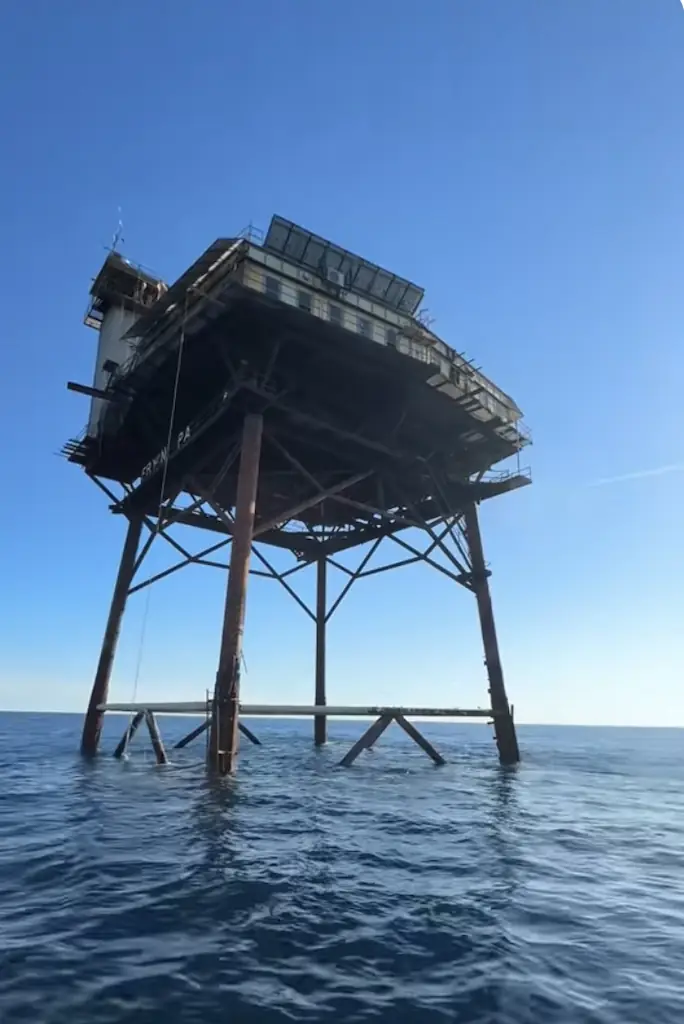
The light station, named Frying Pan Tower, was constructed in 1964 to warn ships of dangerously shallow waters in the "Graveyard of the Atlantic". However, advancements in GPS technology rendered it obsolete by the 2000s, and it was decommissioned in 2004.
The structure was bought in 2010 by an independent buyer, Richard Neal, who was joined by a team of volunteers in turning it into a nonprofit, as well as providing the opportunity for people to partake in a truly unique getaway in the middle of the ocean.
Charter boat captain Austin Aycock took to TikTok to share a glimpse at how people get dropped off to the steel tower, which stands 80 feet above the shark infested waters.
Those with a fear of water obviously need not apply, as the first stage of the journey requires being taken out on a small boat to the tower, before beginning the ascent to the platform.
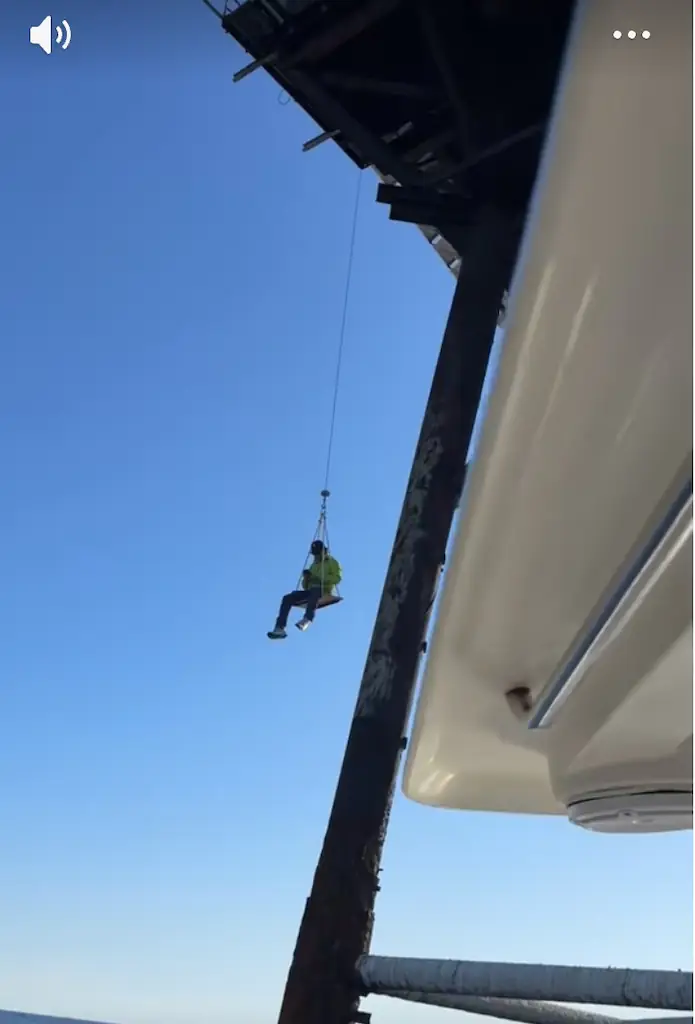
A fear of heights is also not ideal, as guests are then winched up on ropes on a high-speed lift that hauls them 80 feet into the air in under a minute to the platform - which looks hair-raising enough.
That's without mentioning that the waters below are full of sharks, and that the tower sits in the middle of hurricane alley and is regularly battered by tropical storms with wind speeds over 100MPH.
Guests are then left in the middle of the ocean until they are picked up "in a couple of days", returning back to the boat in a similar fashion.
Now, if the thought of being stranded on a potentially rusting steel tower in the middle of the ocean isn't anxiety-inducing enough, there's also the question of what would happen in an emergency, as help would be pretty far away and difficult to get to.
Viewers took to the comments to write: "My anxiety would never allow this, if a medical emergency, do they have to call the coast guard?"
Others added: "What’s the opposite of a bucket list?", and: "I don’t trust people enough for this."
One joked: "'See you in a couple days!' is literally like a line out of a horror movie!", as another wrote: "we'll see a scary movie with this plot 2 years from now lmao."
A horrified viewer added: "The fact that you can’t see land is sending me. Absolutely freaking not."
If all of that hasn't put you off, stays on Frying Pan Tower start from around $200 per person per night, with a three-night minimum stay, meaning it's going to cost at least $600 a head for a long weekend in the middle of nowhere.
For some, the peace and solitude is very alluring, as Aycock confirmed that one group stayed an impressive amount of time, writing: "The longest I’ve had a group stay out there was two weeks!"
As for what happens in an emergency, help is either a helicopter ride away, or a 35-mile trip on a boat back to shore.
The tower has eight bedrooms and can house up to 12 guests, and includes all the amenities you'd need for your stay, including a fully-equipped kitchen, as well as a washer and dryer, hot showers, and even high-speed internet powered by solar energy.
Guests also have fresh water by way of a reverse osmosis filtration system and for groups that don't want to cook, a private chef can be hired for the stay, too.
Despite being miles from land, there's little chance of boredom as there are activities ranging from fishing and snorkeling over a protected reef below the structure, as well as golf with biodegradable balls made of fish food, and skeet shooting with biodegradable clay targets.
Guests have been able to stay on the tower since 2012 and the property is maintained by a volunteer community dedicated to preserving the historic station.
It's definitely not for everyone, but that's one vacation you'd truly never forget.
weird2 min(s) read
Published 15:58 23 Jun 2025 GMT
travel2 min(s) read
Published 17:18 02 Mar 2026 GMT
Cruises have become an increasingly popular vacation choice for many travelers. With the promise of luxurious amenities, exotic destinations, and endless entertainment, cruise ships have become a floating paradise for vacationers.
However, as with any large-scale form of transportation, cruising carries certain risks that passengers often overlook. One of the most unsettling scenarios is falling overboard.
A chilling simulation posted on Instagram demonstrates the terrifying reality of what happens if someone falls from a cruise ship and no one sees it.
The simulation vividly portrays the harrowing experience of falling into the open ocean. In the video, the narrator explains in detail what would occur in such a situation.
"What happens if you fall from a cruise ship and no one sees you? First, you hit the water at 30 miles per hour. It feels like concrete."
The moment the body crashes into the water, the force is immense, and the shock of impact can leave a person momentarily disoriented.
The video continues, "You gasp, breaking the surface, but the panic hits immediately. You have no life jacket."
Once in the water, the danger escalates. "You scream, but the deafening roar of the propellers drowns you out. Within 10 minutes, the glowing ship is just a speck of light on the horizon. Then, it's gone."
The person is left alone, with no chance of immediate rescue. "You are alone in the pitch black." It becomes clear how quickly one can be separated from any hope of immediate safety.
The chilling reality becomes even more daunting. The simulation illustrates the extreme physical dangers of being stranded in the cold ocean waters.
"The freezing water instantly saps your body heat. By hour one, exhaustion and terror take over."
The fear of the unknown becomes as much of a threat as the physical cold itself.
The narrator explains, "You realize the water beneath you is two miles deep, and then you feel something brush against your leg."
This terrifying scenario brings to light the perilous conditions that many passengers may not consider when embarking on a cruise.
The video also highlights the harsh truth that this is not a rare occurrence. "In fact, over 30 people go overboard on cruise ships every single year, and most are never found."
This stark reminder reveals the risks of falling off a cruise ship and the challenges of survival when no one is around to help.
entertainment news3 min(s) read
Published 07:11 01 Jun 2025 GMT
People are vowing to never go on a cruise after a passenger recently showed them what they look like at night.
When you think of your perfect vacation, what comes to mind? For a lot of people, they picture kicking back and relaxing on a massive ship while it sails across the vast oceans.
However, for others, they couldn't imagine anything worse.
One passenger has ignited that fear amongst a handful of people on the internet after they recently showed what a cruise ship looks like in the dark - and let's just say we won't be in a rush to book one any time soon.
Taking to TikTok, user @chasingthedream.hj posted a viral video that showed what the ocean looks like after the sun has set.
The clip, which has been viewed almost 10 million times, shows a boujee cruise ship with all the lights on on board the ship, allowing passengers to see what's going on around them.
However, when you move away from the main part of the ship and towards the railings overlooking the sea, that's when the real nightmare begins.
Have a look at the full video below:
This has left a lot of people with a newfound fear of cruises.
"The ocean is the most terrifying place on earth but the ocean at night is just a different beast," wrote one user, while another added: "The darkness, the depth, the power, the total helplessness... It terrifies me. I'm a marine biologist."
A third commented: "Not only dark but whats in the dark ocean following the cruise ship..."
Another person described it as a "deep black void of nothing," adding: "The way I would grip the handrails looking at the ocean at night. It actually was terrifying..."
And one user even recalled one of their own memories, writing: "l used to work on cruise ship, that sight of absolute darkness scared me so much, I run inside in panic, never go outside and look at the ocean at night time."
Another TikToker who also shared her experience was @victorias.way, who posted a video of her on her cabin balcony in the middle of the night - with nothing but a confronting curtain of darkness in front of her.
"After what I saw, I couldn't sleep all night," she wrote. "This is the most terrifying thing I've ever laid eyes on," she added on the video's overlay text.
However, others seemingly disagreed, offering up a new perspective about it all.
"I don’t know why people see this as a shock. You’re literally in the middle of the ocean. You put your trust in the staff and captains. I love cruises and all of the excursions," this person wrote.
And this user also stated: "I work at sea... I find the darkness at night while at sea to be refreshing. When you come from somewhere saturated with light pollution, actually seeing the Milky Way is a great thing to behold."
What do you think?
travel3 min(s) read
Published 13:32 26 Jun 2024 GMT
Viewers have been left terrified after the man who sailed to the Pacific Ocean on his own revealed how he sleeps.
As previously reported, Luke, who goes by "sailing songbird" on TikTok, uses the social media platform to document his travels.
The content creator used to teach music at Washington Middle School in Seattle before giving up his career to follow his dreams.
In one of his recent videos, Luke showed people how he sleeps when he's taking a break from sailing in the Pacific.
Watch Luke's video below:
The traveler said that it was "night 18" of sailing across the deep ocean alone, and then demonstrated his sleeping style when there are high seas.
He swayed from one side to the other back and forth, slamming into the wall of his cabin and the side of his bed constantly.
Luke noted that "wedging" yourself before dozing off is important as it can reduce you from "flying around everywhere".
He then told his followers to be grateful for a flatbed, quipping: “I would pay a pretty penny for a flatbed right now, goodbye, wish me luck."
Many people flooded the comment sections with their shocked reactions as one user said: "That's why I personally chose not to sail across the ocean. That and I've never sailed before."
Another wrote that they "would be so sick and my anxiety of sinking while asleep would torture me," while a third added: "The constant thought of the boat being so close to tipping over legit everytime it turns to the side makes me not wanna do this."
One user who sailed alone offered some advice, suggesting that a hammock and bungee lines might reduce all the tossing and turning.
"Seems that a bunch more cushiony pillows would fix the problem," someone else said, while another added: "You should build a harness bolted directly into the bed frame so you can hook into it and remain stationary when sleeping."
Luke surpassed a full month out in the Pacific. On day 31, he decided to do paddle-boarding for some "exercise," and noticed that he was stuck "in the doldrums," where there is "no wind".
He showed a screen recording of his location on Google Maps, where he was "about as far away from land as you can be on this planet".
Despite Mexico appearing to be one of the closest destinations, albeit a long distance away, he found that there was "absolutely nothing on the horizon".
"I am well over 1,000 miles away from any piece of land and it's so quiet," he said. "This definitely feels like one of the more incredible things I'm privileged enough to experience."
travel3 min(s) read
Published 10:31 29 Nov 2024 GMT