


US4 min(s) read
Aviation expert responds to wild conspiracy theories about Florida Learjet crash after almost no wreckage remains

An aviation expert has addressed a swathe of online conspiracy theories and speculation related to the Learjet plane crash that killed nine people in Florida, and answered the question of why there was no wreckage.
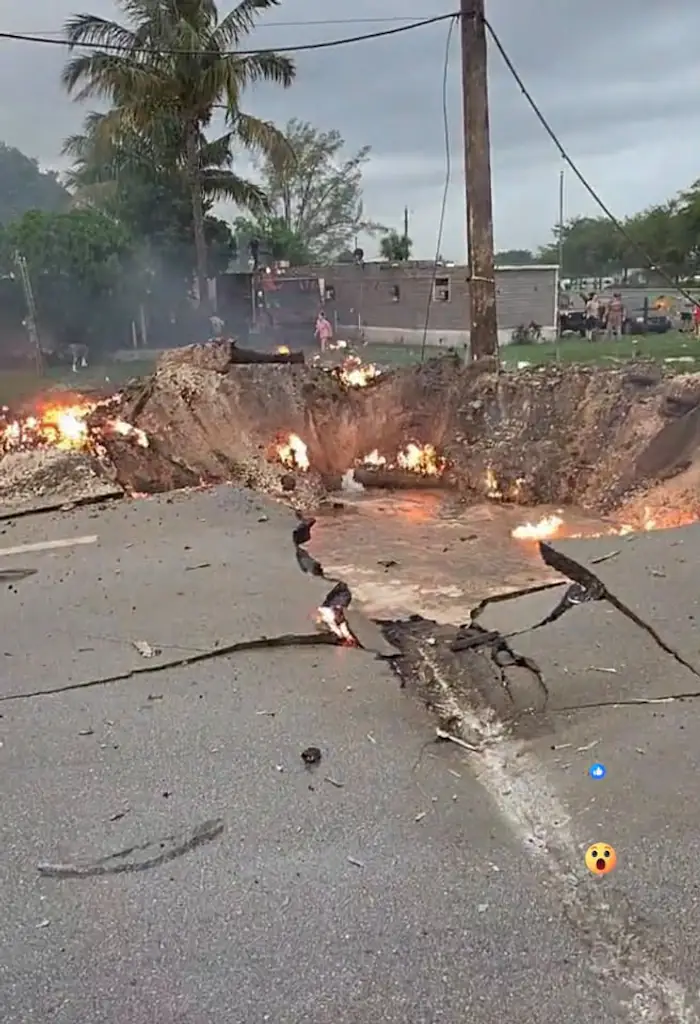
Everyone onboard the aircraft died when the private jet plunged from around 35,000ft and crashed beside a road in Palm Beach County on Sunday, November 1.
The aircraft was traveling from Austin-Bergstrom International Airport in Texas to North Eleuthera Airport in the Bahamas when it came down near Military Trail, close to Greenacres and Trump’s Mar-a-Lago estate,
Aviation expert explains crash
In a video shared on the Taking Off YouTube channel, aviation expert and pilot Dan Millican discussed the latest information about the disaster, responding to questions from viewers and addressing claims circulating online.
He said the amount of misinformation surrounding the crash had been particularly troubling, stressing that theories should not be presented as established facts.
"The aviation community is small and when we see our peers, our friends have something like this happen to them. We hear something like this happen, it hits us really hard," he explained.
Millican said he had initially stepped away from the news because of how upsetting the tragedy was, but was shocked by some of the claims he encountered when he returned.
"There's just a lot that's wrong. And there's also a lot of speculation, which is okay. Just don't pass it off as anything but a guess. Speculation isn't fact," he added.
One of the biggest questions surrounding the disaster is whether ice played a role in bringing down the aircraft, with Millican explaining that the pilots had reported encountering light clear ice at approximately 35,000ft, alongside moderate turbulence and precipitation.
A separate pilot weather report, filed at around 12:45PM, also recorded light clear icing at minus 46°C involving a Learjet 60 in the area.
However, he cautioned that the report did not include the aircraft's registration number, meaning investigators cannot yet confirm whether it related to the crashed jet.
"Could be. Did the ice cause this? We don't know yet. Reporting ice is one thing. Ice bringing down a jet is another," he said.
The aircraft's anti-icing equipment is likely to be an important part of the investigation, particularly the system designed to protect its tail.
Millican said he had spoken to a Learjet specialist who suggested that the aircraft's radar was not particularly effective and that its tail anti-icing heater had a reputation for being unreliable.
According to the pilot's theory, ice accumulating on the tail could have contributed to a stall when the crew attempted to climb, potentially leading to an overspeed condition and the tail breaking away.
The horizontal stabiliser, which is the smaller wing-like structure at the back of the aircraft, helps keep the plane's nose level. If ice builds up on it, the stabiliser can stall and cause the nose to pitch sharply downwards, which is known as a tailplane stall.
There is also historical evidence that Learjet tail anti-icing systems have previously attracted safety concerns. In 1999, the FAA ordered a one-off inspection of anti-icing wiring on several Learjet models, including some Learjet 60 aircraft, following a malfunction on a Learjet 55 that caused severe buffeting.
Footage from a vehicle's dashcam has prompted further speculation, with some viewers claiming the aircraft appeared to be missing its wings or horizontal stabiliser as it descended.
Millican said the images were difficult to interpret because the aircraft's wings were similar in colour to the clouds behind it, pointing to one frame in which two wings appeared to be visible, while cautioning that unclear footage of a rapidly moving aircraft cannot establish exactly what happened.
The NTSB provided a further update during its press conference on Monday, November 2, revealing that investigators had found evidence suggesting the aircraft may have begun breaking apart before impact.
They were still working to confirm this, and the investigator in charge said teams were documenting debris discovered away from the main crash site, and when asked specifically about the tail, officials said they had not yet identified particular components.
Millican explained that investigators would use the position of individual pieces of wreckage to establish whether anything separated from the aircraft while it was still airborne.
Expert addresses conspiracies around wreckage

With many social media users quick to point out the fact that there appeared to be little in the way of visible wreckage, Millican responded comprehensively and consequently dismissed any conspiratorial claims.
“Where's the wreckage? There's no airplane, no wing. No. A plane coming down that hard and that fast basically vaporizes. There's not going to be much left, not of any size that looks like an airplane,” Millican revealed.
According to Learjet-rated captain Dwight Ingram, who told CBS News: “A high-speed impact can shatter an aircraft into small fragments. Heavier parts like engine pieces, landing gear may still be there, but they'll be digging for days. What's left is in pieces, very small pieces, and investigators will collect every single one of them they can find."